
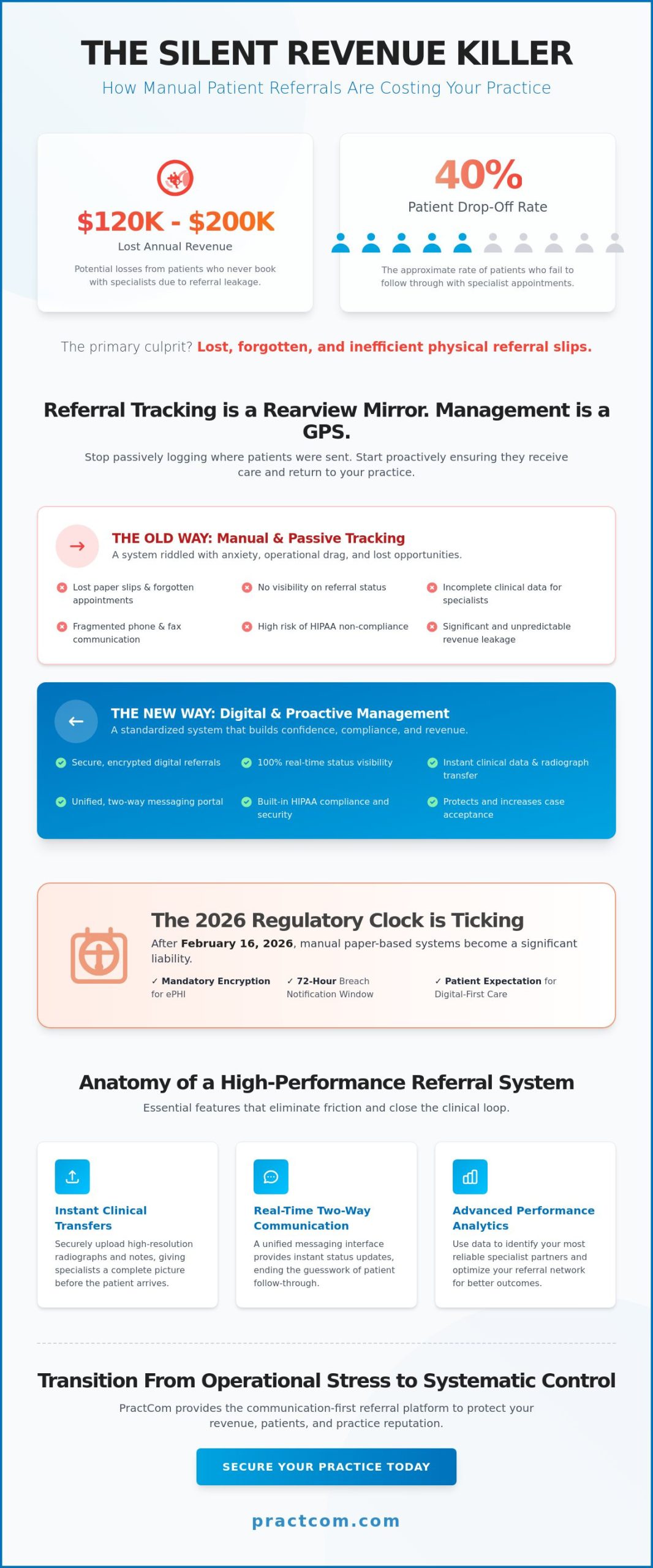
Did you know that 40% of manual dental referrals never result in a completed appointment? This leakage represents a massive clinical and financial gap that most practices simply accept as an unavoidable reality. You likely feel the daily friction of tracking paper slips or worrying about the medico-legal risks of sending patient images through unsecured email. It’s exhausting for your team and dangerous for your compliance standing, especially since the February 16, 2026, HIPAA deadline for updated privacy notices has passed. Adopting a modern dental referral management software is now a clinical necessity to protect your practice and your patients.
We agree that your front desk shouldn’t waste hours on manual follow-up calls that rarely move the needle. In this article, you’ll learn how to eliminate referral leakage, secure patient data transfers, and boost case acceptance using automated systems. We’ll preview the essential features that turn a chaotic handoff into a frictionless clinical loop, ensuring your patients actually receive the care they need without adding friction to your day.
Key Takeaways
- Identify why paper referral slips are the primary point of failure in 2026 and how to recapture the 30% of patients lost to manual systems.
- Discover the essential features of modern dental referral management software, focusing on HIPAA-compliant image exchange and real-time status tracking to maintain your standard of care.
- Learn to distinguish between internal tracking and external patient engagement to effectively solve the “no-show” problem before it impacts your schedule.
- Standardize the handoff between GPs and specialists using structured feedback loops and post-treatment summaries for better medico-legal documentation.
- Streamline your clinical communication with automated templates in 15 languages to boost case acceptance without adding friction to your day.
Why Referral Leakage is the “Silent Killer” of Dental Practice Growth
Referral leakage is the specific percentage of patients who fail to complete their transition from a general practitioner to a specialist. In a modern clinical environment, this isn’t just an administrative oversight; it’s a fundamental breakdown in the medical referral process. Verified data from late 2025 shows that 30% to 40% of manual referrals are never completed. This means nearly four out of every ten patients you diagnose with a critical need, such as an RCT or advanced periodontal surgery, simply vanish from the care cycle. Relying on outdated paper slips in 2026 is the primary point of failure. These physical cards are easily lost, provide zero tracking, and offer no medico-legal protection for your practice.
Closing the loop is now a recognized Standard of Care. If a patient experiences a clinical complication because a referral was “lost” in an unmonitored email chain or a misplaced folder, the referring dentist faces significant liability. Why it’s critical: A documented, automated trail proves you fulfilled your duty of care by ensuring the patient had the information and access they needed. Implementing dental referral management software transforms this high-risk “honor system” into a secure, verifiable clinical loop that protects both the patient’s health and your professional reputation.
The Anatomy of a Failed Referral
Referrals often fail due to a combination of patient anxiety and administrative friction. When a patient leaves your office with nothing but a business card, they often experience the “Black Hole” effect. They don’t understand the urgency of the specialist visit, and your team has no way of knowing if they ever called the other office. This lack of visibility creates a disconnect where the GP assumes the specialist has the case, and the specialist doesn’t even know the patient exists. Without a dental referral management software to bridge this gap, the patient’s treatment plan stalls, and their oral health inevitably declines.
The Financial Impact of Poor Referral Management
The financial drain of uncompleted referrals is staggering. When 40% of your referred cases don’t move forward, you aren’t just losing the production value of those specific procedures; you’re eroding the lifetime value of the patient. Beyond the direct revenue loss, your front desk team likely spends hours every week playing “phone tag” with specialist offices to confirm appointments or request reports. This manual labor is expensive and contributes to the high burnout rates seen in 2026. By standardizing the handoff, you reclaim that lost production and reduce the administrative friction that prevents your practice from scaling efficiently.
Essential Features of Modern Dental Referral Management Software
Modern dental referral management software isn’t just a digital logbook; it’s a high-performance clinical engine designed to protect your practice’s reputation. As of April 2026, the baseline for these systems has shifted from simple tracking to comprehensive data security and patient engagement. Why it’s critical: With the February 16, 2026, deadline for updated HIPAA Notice of Privacy Practices now passed, your referral system must explicitly handle substance use disorder (SUD) record confidentiality. Using standard email to share X-rays or clinical notes is no longer just “risky” behavior. It’s a compliance violation that exposes you to significant audits and potential fines.
A robust system provides an encrypted portal for all specialist communication. This ensures a clean audit trail, which is a mandatory technical safeguard under the 2026 HIPAA Security Rule. Research by the Agency for Healthcare Research and Quality highlights the importance of improving care with integrated EHRs to minimize clinical errors and ensure patient safety. By moving away from fragmented communication, you create a standardized environment where every detail, from RCT specifics to perio measurements, is captured and transmitted securely. This level of patient-centric design is what separates a basic tool from a professional dental referral management software.
One often overlooked feature is multi-language support. In a diverse clinical setting, providing post-referral instructions only in English is a recipe for non-compliance and patient confusion. PractCom bridges this gap by offering a library of 80+ templates in 15 different languages. This ensures that every patient, regardless of their primary language, understands why they’re seeing a specialist and what their next steps are. You can start a free trial to see how these automated, multi-lingual notifications keep your patients engaged without adding friction to your day.
HIPAA Compliance and Data Security
Security in 2026 requires more than just a password. Multi-Factor Authentication (MFA) is now mandatory for all interactive access to systems containing electronic Protected Health Information (ePHI). Your software must facilitate this while maintaining a frictionless user experience. An encrypted portal doesn’t just protect data; it builds trust with your specialist network. When you send a referral, you’re providing a vetted, medico-legal package that aligns with the current Standard of Care, ensuring the specialist has everything they need before the patient even walks through their door.
Automation Without the Clinical Coldness
Efficiency shouldn’t come at the cost of the personal touch. Modern systems utilize “Five-Click” workflows that allow your team to send a comprehensive referral in seconds. This speed doesn’t mean the communication is generic. Automated SMS and email reminders keep the patient informed throughout their journey, reducing the 10-15% no-show rate common in manual systems. By standardizing your clinical notes and integrating automated follow-ups within your dental referral management software, you maintain control over the patient experience without burdening your front desk with manual calls.
Evaluating Tracking vs. Patient Engagement: A Selection Framework
Many practitioners confuse a digital logbook with a complete communication system. Internal tracking is for your office; it tells you where the referral stands in your workflow. External engagement is for the patient; it ensures they actually show up for their appointment. While tracking is necessary for your records, it doesn’t solve the 15% missed appointment rate common in 2026. Why it’s critical: You need a system that actively bridges the gap between diagnosis and treatment. High-quality dental referral management software should include a secure patient portal that provides 24/7 access to referral details, specialist locations, and clinical visual aids like Smile Design. These visual tools transform a complex clinical procedure into a tangible goal, significantly boosting case acceptance for your specialist partners.
The National Academy of Medicine emphasizes the need for robust communication and referral networks to ensure patient safety and continuity of care. This goes beyond just “sending a file.” It involves creating a navigable path for the patient that reduces anxiety and confusion. When a patient can log in at 9:00 PM to review their specialist’s instructions or view a pre-treatment visualization, they feel supported rather than abandoned. This proactive engagement is what prevents the “Black Hole” effect mentioned earlier, turning a passive referral into an active treatment journey.
Does Your Software Educate the Patient?
Anxiety is the primary driver of referral leakage. Patients often leave the GP chair asking why they even need to see an endodontist for an RCT. If your software doesn’t answer that question immediately, you’ve already lost them. Providing plain-language explanations of procedures and post-treatment instructions *before* the specialist visit builds immense trust. It’s also vital to deliver this information in the patient’s native language. Using vetted, multi-lingual templates ensures clarity and reduces the friction of language barriers, which is a core component of the modern Standard of Care in 2026. Understanding how communication shapes the overall dental patient experience is essential to reducing leakage and building lasting trust with every referral you send.
Integration vs. Specialization
You don’t need to replace your entire Practice Management System (PMS) to fix your referral loop. Many office managers believe that if their current software doesn’t have a built-in referral module, they’re stuck with paper pads. This is a myth. A “Clinical Ally” approach involves using specialized dental referral management software that sits alongside your existing workflow. These systems are designed for “One-Click” ease of use, allowing your clinical team to send a secure referral without adding friction to their day. By choosing a specialized tool, you gain deep functionality, such as encrypted image portals and 80+ clinical templates, that general practice software often lacks.
Best Practices for Strengthening Your Specialist-GP Network
Strengthening your referral network requires more than just a holiday gift basket for the specialist’s office. It demands a standardized, high-utility handoff that respects the time of both clinical teams and ensures the patient feels a continuous circle of care. Moving to a 100% digital workflow is the first step toward this professional standard. By eliminating paper referral pads, you remove the risk of lost instructions and illegible handwriting that often lead to clinical errors. Why it’s critical: A digital system ensures that the specialist receives a complete clinical package before the patient even schedules their consultation, allowing them to prepare effectively for the case. If you’re ready to transform your process, our step-by-step guide to implementing dental referral management walks you through each phase of building a frictionless, compliant workflow.
Data auditing is a powerful, often underutilized benefit of modern dental referral management software. In 2026, you shouldn’t have to guess which specialist is taking the best care of your patients. Use your software’s dashboard to track completion rates and time-to-treatment metrics. If you notice a high no-show rate with a specific office, it may indicate a friction point in their intake process. Having this data allows you to have objective conversations with your partners to improve the patient experience. You can standardize your referral network today by implementing a system that tracks every handoff with precision.
The Specialist’s Perspective: What They Wish You Sent
Specialists frequently cite poor communication as their biggest operational hurdle. They don’t want a grainy printout of an X-ray; they need high-resolution digital imaging that allows for accurate diagnostic assessment. Be clear about the clinical goals of the referral. Are you requesting a limited consultation for an RCT, or are you handing over the full management of a complex perio case? Including premedication requirements and a vetted medical history is also essential. Why it’s critical: Providing this data upfront prevents last-minute procedure cancellations and ensures the specialist can maintain their own Standard of Care without chasing your office for missing details.
Closing the Loop: The GP’s Requirement
For the general practitioner, the referral doesn’t end when the patient leaves the office. You need a “Post-Treatment Summary” to update the patient’s permanent record and plan for restorative follow-ups. A high-performance dental referral management software provides automated alerts the moment a specialist completes a treatment phase. This frictionless exchange of notes and images ensures you’re never “in the dark” about a patient’s progress. By closing the loop digitally, you create a professional, protective environment that minimizes medico-legal risks and maximizes the clinical outcomes for every patient you refer. To dive deeper into building a systematic approach, explore our comprehensive resource on dental specialist referral tracking that shows you how to reduce leakage to as low as 10%.
Closing the Loop with PractCom: Your Clinical Communication Ally
PractCom serves as the stabilizing force your practice needs in an increasingly complex regulatory and clinical environment. It acts as the essential bridge between the general practitioner, the specialist, and the patient, ensuring that no part of the communication loop is left to chance. By utilizing a library of 80+ vetted post-treatment templates translated into 15 languages, you provide a level of clarity that paper slips can’t match. This isn’t just about convenience. It’s about achieving a professional Standard of Care that protects your patients and your reputation.
The integrated Patient Portal is designed to dismantle the anxiety that leads to referral leakage. By offering 24/7 access to clinical instructions and specialist details, you empower your patients to take the next step in their treatment journey. This transparency reduces the volume of emergency phone calls to your front desk and ensures that patients arrive at the specialist’s office well-informed and ready for care. Using specialized dental referral management software like PractCom transforms a fragmented process into a cohesive clinical experience.
Standardize, Automate, and Protect
PractCom provides the medico-legal reassurance that modern practitioners demand. Every referral sent through the system generates a tracked delivery log, providing a verifiable audit trail that generic PMS modules often lack. Why it’s critical: In the event of a clinical complication or a compliance audit, having documented proof of the referral handoff is your best defense. The system also reduces the administrative burden on your team by using automated follow-ups. These reminders keep the patient engaged without adding friction to your day, allowing your staff to focus on in-office care rather than chasing uncompleted referrals.
Implementation: Getting Started Without the Chaos
We understand that adding new technology can feel overwhelming for a stretched team. That’s why we built our “Five-Click” promise. You can create, secure, and send a comprehensive referral package in seconds, fitting seamlessly into your existing clinical workflow. Once implemented, you can use the performance dashboard to identify growth opportunities and audit your specialist network’s efficiency. It’s time to move from the chaos of manual tracking to the confidence of a standardized system. Schedule a demo to see how PractCom streamlines your referrals.
Secure Your Practice’s Future and Patient Outcomes
Moving beyond the chaos of paper referral pads is no longer optional in 2026; it’s a clinical necessity. You’ve seen how referral leakage can drain 40% of your potential production while exposing you to significant medico-legal risks. By implementing a dedicated dental referral management software, you replace administrative friction with a standardized, high-utility communication loop. This transition ensures every patient receives the care they need without burdening your team with manual follow-up calls. It’s about moving from a state of constant administrative catch-up to a proactive, protective system of care.
You deserve the peace of mind that comes from a vetted, secure system. PractCom provides this through 80+ clinical templates and support for 15 languages, all protected by HIPAA-compliant secure messaging. It’s time to protect your practice’s reputation and elevate your professional standard of care. Streamline your practice with PractCom’s Referral Management System and take control of your patient’s journey today. Your team, your specialists, and your patients will thank you for the clarity and consistency.
Frequently Asked Questions
Does referral management software replace my existing Practice Management Software?
Referral software doesn’t replace your Practice Management Software (PMS); it acts as a specialized clinical bridge that handles the complex communication loops your general system often ignores. While your PMS manages in-office scheduling and billing, a dedicated referral tool ensures that the 40% of patients who typically drop out of the referral cycle actually make it to the specialist. It supplements your workflow without adding friction to your day.
How does digital referral software improve HIPAA compliance?
Digital systems improve HIPAA compliance by replacing unsecure email with encrypted, MFA-protected portals. As of February 16, 2026, all practices must use systems that specifically track the confidentiality of substance use disorder records under the updated Notice of Privacy Practices. Modern dental referral management software provides the mandatory audit trails and delivery logs required to meet these updated standards, ensuring your documentation is medico-legal and vetted.
Can I send clinical images and X-rays through the referral portal?
Yes, you can securely send high-resolution digital imaging, clinical notes, and periodontal charts directly through the portal. This eliminates the need for grainy printouts or unsecured attachments that violate the HIPAA Security Rule. Specialists receive these files in a centralized, encrypted environment, allowing them to review the case before the patient arrives. This is critical for maintaining a high Standard of Care and reducing diagnostic delays.
What happens if a patient doesn’t speak English as their first language?
Patients who don’t speak English can access instructions and consent forms through a library of 80+ templates available in 15 different languages. This feature is a signature of PractCom’s commitment to patient engagement. Why it’s critical: Clear communication in a patient’s native language reduces anxiety and significantly increases the likelihood that they will follow through with complex specialty procedures like RCT or perio treatment.
How does automated follow-up reduce no-show rates for specialists?
Automated follow-ups reduce no-show rates by sending timely SMS and email reminders that keep the patient engaged throughout the handoff. Data from 2026 shows that practices using automated systems can lower referral leakage from 40% down to 15% or less. By keeping the specialist visit top of mind for the patient, you ensure the treatment plan moves forward without your front desk having to make manual calls.
Is it possible to track which specialists are providing the best feedback?
Yes, the performance dashboard allows you to audit your specialist network to see which partners are closing the loop and providing the best clinical feedback. You can track completion rates and time-to-treatment metrics for every office in your network. Having this objective data lets you strengthen your GP-specialist relationships based on actual patient outcomes rather than anecdotal evidence.
How much time does it take for a dental assistant to send a digital referral?
A dental assistant can send a comprehensive digital referral in less than 60 seconds using a “Five-Click” system. This speed is a core promise of modern dental referral management software, designed to fit into the physical demands of a busy office. It standardizes the handoff process so that your team spends less time on administrative paperwork and more time on direct patient care.
Do patients actually use a patient portal for their referrals?
Patients utilize portals at a high rate when they offer 24/7 access to their referral details and plain-language explanations of their treatment. In a modern clinical environment, patients expect instant digital access to their health information. By providing a secure portal, you satisfy this expectation while reducing the volume of emergency phone calls regarding specialist locations or pre-appointment instructions.

Article by
Cary Ganz DDS
Dr. Cary H. Ganz is a dentist, prosthodontist, entrepreneur, lecturer, and author with more than 50 years of experience in clinical dentistry and dental technology. Throughout his career, he has combined hands-on patient care with a deep understanding of how technology can improve dental practice operations, communication, documentation, and patient outcomes.
In addition to his clinical background, Dr. Ganz has held significant leadership roles in the dental technology industry, including Past Owner and Vice President of Clinical Affairs at DEXIS Digital Radiography and Past Vice President of Clinical Affairs at Denticon Practice Management Software. His business experience includes product development, clinical strategy, dental software innovation, practice management solutions, and educating dental professionals on the effective use of technology in modern dentistry.
Today, Dr. Ganz continues to focus on creating practical technology solutions for dental practices, including PractCom, a comprehensive dental practice communication platform designed to improve patient communication, documentation, compliance support, referrals, and overall practice efficiency. His work reflects a career-long commitment to helping dentists deliver better care while making their practices more organized, efficient, and protected.
10 Responses
[…] doctor knows exactly what wisdom teeth removal post-op instructions were provided. A modern dental referral management software should capture the post-op record automatically, creating a seamless experience from the first […]
[…] Efficient collaboration requires more than just a phone call. You need to standardize the data sent to specialists, including high-resolution X-rays, clinical notes, and informed consent documentation. This reduces the exhausting back-and-forth between offices and eliminates the “phone tag” that drains staff energy. Utilizing a secure, digital referral portal ensures that all necessary information is transferred instantly and accurately. This creates a professional ecosystem where no part of the communication process is left to chance. To see how to implement these systems effectively, you can read our guide on Mastering Dental Referral Management Software in 2026. […]
[…] administrative friction and increasing the risk of inconsistent documentation. Understanding how Mastering Dental Referral Management Software in 2026 prevents these breakdowns is essential for modern practices. Standardized digital documentation […]
[…] the exact same vetted protocol. Maintaining this level of documentation is just as critical as Mastering Dental Referral Management Software in 2026 to keep your practice running […]
[…] a powerful driver for word-of-mouth referrals. If you’re coordinating care with specialists, mastering dental referral management software ensures that these cultural considerations follow the patient throughout their entire treatment […]
[…] that often leads to abandoned care. For a deeper dive into these protocols, your team can use Mastering Dental Referral Management Software in 2026 as a primary training resource. If you are ready to eliminate the anxiety of “lost” […]
[…] data they need before the patient arrives. For more on optimizing these transitions, refer to our Mastering Dental Referral Management Software guide. If you’re ready to see how a secure portal can protect your practice, explore our […]
[…] notifications can save a single coordinator several hours of labor every month. Beyond the clock, Mastering Dental Referral Management Software in 2026 allows you to build stronger, more professional relationships with your specialist partners. They […]
[…] the loss of production and ensures the continuity of care. For more on this, see our guide on mastering dental referral management software. High-performing practices use these insights to refine their specialist partnerships and ensure […]
[…] 3, you move beyond paper slips and insecure emails. Modern practices are transitioning to dedicated dental referral management software to facilitate a secure, instant handoff. This system automatically notifies the specialist office […]