
A patient questions a treatment recommendation, grows frustrated about a boundary, or says they don’t understand the options. In that moment, even a routine discussion can feel tense, and a rushed explanation may make things worse. Handling difficult patient conversations in dentistry starts with a simple shift: lower the pressure, listen for the concern, and give the patient clear choices about what happens next.
You don’t have to agree with every request to respond with empathy. Acknowledge the patient’s perspective, explain clinical options in plain language, and set respectful boundaries without dismissing their concerns. A consistent approach also helps your team avoid mixed messages when conversations become challenging.
This guide offers practical steps and language for de-escalating tense discussions, clarifying expectations, and agreeing on a constructive next step. You’ll learn how to listen before responding, explain recommendations and alternatives clearly, and follow through. Written resources and follow-ups can reinforce what you’ve discussed, while supporting, not replacing, the clinician’s live explanation.
Key Takeaways
- Recognize when emotion, uncertainty, or disagreement is getting in the way of understanding, and respond to the concern beneath the tension.
- Use a flexible five-step approach to handling difficult patient conversations in dentistry: pause, listen, reflect, clarify, and agree on a next step.
- Choose an opening that fits the concern, whether the patient is questioning a recommendation, feeling anxious, or unsure about instructions.
- Set respectful boundaries when needed, and use a calm pause to reset a conversation that can’t move forward productively.
- Align your team on roles and next steps, then reinforce spoken explanations with clear written instructions and follow-ups.
Why patient conversations become difficult in dentistry, and what the tension may signal
Tense conversations can happen even when you and your team are trying to help. A patient may question a recommendation, go quiet during an explanation, or sound frustrated while discussing treatment. A difficult conversation is one where emotion, uncertainty, or disagreement gets in the way of understanding. The term difficult conversations describes interactions where the way people interpret a situation can shape how they respond. In a dental setting, a visible reaction is a cue to learn more, not proof of a patient’s motives.
That distinction matters. A patient who declines treatment might be worried about pain, unclear about alternatives, concerned about cost, or working through a past experience. They might also need more time to consider the information. Assuming they are being difficult or don’t care can close down the conversation before you understand what’s actually blocking it.
What can sit underneath a patient’s frustration?
Fear, anticipated pain, a previous negative dental experience, uncertainty about the outcome, and feeling unheard can all contribute to frustration. Cost or treatment concerns may be part of the discussion, too, but don’t assume you know a patient’s financial circumstances or priorities. One reaction can have several possible causes.
Use an open question to learn more: “What’s your main concern about this recommendation?” or “What would help you feel clearer about your options?” Then give the patient time to answer. If they mention cost, ask which part they want to discuss, such as the proposed care, alternatives, or timing. Asking before explaining again helps you address the actual concern instead of repeating information that hasn’t landed.
How to notice your own contribution to the interaction
Communication is shaped by both what you say and how the patient hears it. The ADA’s listener-perspective guidance is a useful reminder to consider how your explanation may have landed, especially if the patient seems confused or reacts differently than you expected. Check your tone, pace, and assumptions. Did you introduce unfamiliar terms without defining them? Did you move to the next point before the patient had time to respond?
Notice what happens when you’re interrupted, too. Speaking faster, raising your voice, or defending your recommendation immediately can add pressure, even when your intention is to clarify. Pause and try: “I may not have explained that clearly. What part should we go over?” Define unfamiliar terms and leave space for the patient to ask questions.
Acknowledging emotion doesn’t mean agreeing with every claim or promising a requested outcome. You can say, “I can see why that feels concerning,” then calmly explain what you know, what options are available, and what needs further discussion. This separates respect for the patient’s feelings from clinical judgment. For handling difficult patient conversations in dentistry, that distinction helps you stay empathetic without losing clarity about the care being discussed.
A five-step approach to handling difficult patient conversations
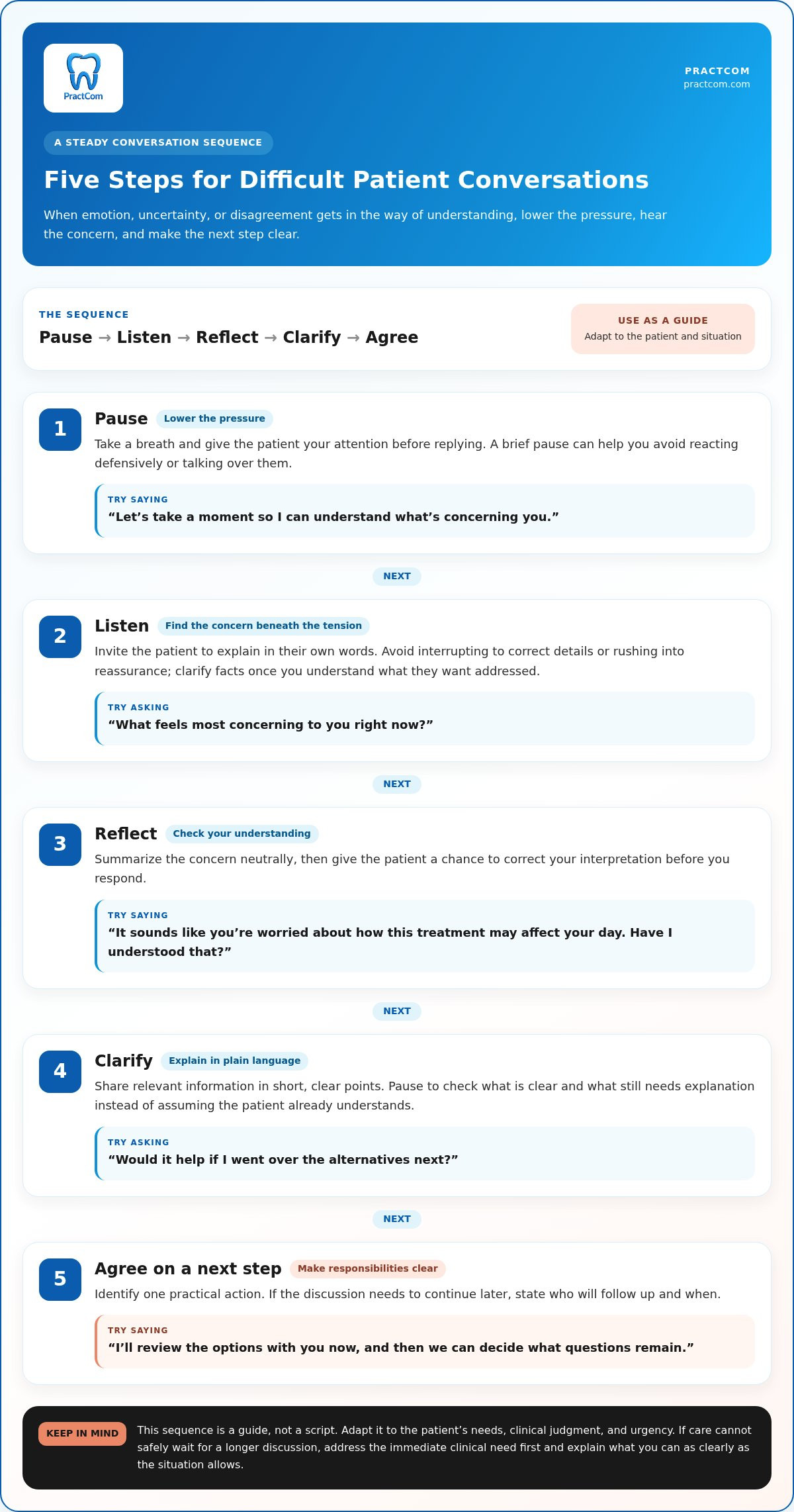
A repeatable sequence gives you a steady place to start when a discussion gets tense. Use these five steps as a guide, not a script: adapt them to the patient’s needs, your clinical judgment, and any urgency that requires prompt action. If care cannot safely wait for a longer discussion, address the immediate clinical need first and explain what you can as clearly as the situation allows.
- Pause. Take a breath and give the patient your attention before replying. Try: “Let’s take a moment so I can understand what’s concerning you.” A brief pause can help you avoid reacting defensively or talking over the patient.
- Listen. Invite the patient to explain in their own words. Ask: “What feels most concerning to you right now?” Avoid interrupting to correct details or rushing into reassurance. Clarify facts once you understand what the patient wants you to address.
- Reflect. Summarize the concern neutrally, then check your understanding: “It sounds like you’re worried about how this treatment may affect your day. Have I understood that?” This gives the patient a chance to correct your interpretation before you respond.
- Clarify. Explain the relevant information in short, plain-language points. Pause to check what’s clear and what still needs explanation: “Would it help if I went over the alternatives next?” Check your understanding before responding instead of assuming you already know what the patient means.
- Agree on a next step. Identify one practical action and make responsibilities clear. Say: “I’ll review the options with you now, and then we can decide what questions remain.” If the discussion needs to continue later, state who will follow up and when.
Listen and reflect before explaining
The sequence works best when listening comes before persuasion. If a patient challenges a recommendation, resist the urge to defend it before you know what’s behind the objection. Reflecting doesn’t require you to endorse every statement; it shows you’re taking the concern seriously. If your summary misses the point, invite correction and listen again. That check can prevent a long explanation from addressing the wrong question.
Clarify options and agree on one next step
Once you understand the concern, break your explanation into manageable points and pause between them. Ask the patient to describe what they understand or what they’d like clarified, rather than relying only on “Does that make sense?” Offer choices when they’re clinically appropriate, while being clear that not every option suits every patient. Close by naming the next action, who is responsible, and when you’ll revisit unanswered questions.
Written materials can reinforce the clinician’s explanation and give the patient a reference for the next step. For example, post-treatment instructions or a follow-up message can restate agreed expectations without replacing the discussion itself. PractCom’s patient communication tools include a library of post-treatment instructions and automated follow-ups to support this kind of follow-through. Explore PractCom’s communication tools. In handling difficult patient conversations in dentistry, a clear follow-through helps turn a tense exchange into a more manageable plan.
How to handle difficult dental office conversations
Ready-to-use language can help your team respond consistently without sounding scripted. Start with the concern the patient raises, then ask a question that helps identify what they need clarified. The examples below are starting points, not promises about treatment, cost, or outcomes. Adapt them to the patient and the clinical situation.
| Patient concern | Helpful opening | Possible next step |
|---|---|---|
| Disagreement about a recommendation | “What did you understand about why I’m recommending this, and what still feels uncertain?” | Explain the clinical rationale in plain language, discuss suitable alternatives, and invite questions. |
| Anxiety about treatment | “What part of the treatment feels most worrying to you?” | Address that specific concern, explain what the patient can expect, and agree on whether to continue the discussion now. |
| Confusion about instructions | “Which part of the instructions would you like me to go over again?” | Restate the key actions clearly and check what the patient plans to do next. |
| Billing or cost concern | “Which part of the cost or estimate would you like to understand better?” | Clarify the information available, identify unanswered questions, and agree on who will follow up. |
When a patient questions a recommendation or expected outcome
Invite the patient to explain their understanding before repeating the recommendation. For example: “What have you heard so far about the reason for this treatment?” Then separate what you know from what can’t be predicted with certainty. Use direct language, pause for questions, and avoid implying a guaranteed result. Record relevant discussion according to your practice’s established clinical process, including the questions raised and the information reviewed.
When fear, frustration, or confusion takes over
Acknowledge the emotion without labeling the patient or minimizing the concern: “I can hear that this feels overwhelming.” Then ask, “What would help you feel informed enough to continue talking this through?” If an explanation hasn’t landed, try a simpler version. Instead of “Keep the area clean and monitor for complications,” say, “Follow these cleaning steps, and call the practice if you notice the warning signs we discussed.” Clear post-treatment instructions can reinforce a live explanation and give patients a reference afterward.
Cost questions deserve the same curiosity as clinical questions. Don’t assume why a patient is concerned or promise options that may not apply. Ask what they want clarified, explain the information you can, and identify any details that need follow-up. To handle difficult patient conversations in dentistry more effectively, respond to the concern in front of you, then agree on a clear next action.
De-escalation, respectful boundaries, and when to pause a conversation
A patient can disagree with a recommendation, decline care, or express frustration without making the conversation unsafe or unproductive. The distinction is the behavior, not whether the patient agrees with you. A disagreement can usually be explored with questions and explanation. Repeated interruptions, personal insults, threats, or behavior that prevents staff from communicating may call for a boundary, a pause, or support from another team member.
A pause should reset the interaction, not punish or silence the patient. Explain why you’re pausing and what happens next: “I want to make sure we can discuss this clearly. Let’s take a short break, then we can continue with [team member] present.” If the patient or team member may be at immediate risk, follow the practice’s established safety procedures rather than trying to continue the conversation.
Set a clear boundary without escalating the exchange
Keep your voice steady, describe the immediate behavior without judging the patient’s character, and state what’s needed to continue. For example: “I want to address your concern. I can do that if we speak without personal insults.” Avoid threats, sarcasm, blame, or labels such as “difficult.” Consistent boundaries give the team a reliable standard, while staff can adapt their wording and support to the patient and situation.
- Name the concern: “We’re having trouble hearing each other over the interruptions.”
- State the condition: “I can continue if we take turns speaking.”
- Offer a next step: “Would you like to continue now, or take a pause and return to this with another team member?”
Recognize when to pause, hand off, or follow up
Repeated misunderstanding, rising distress, or an inability to discuss options constructively are signs to slow down. A team member should pause and seek appropriate support when safety is at risk or the conversation can’t proceed productively. A handoff can be framed as support, not rejection: “I’d like to bring in the clinician who can answer this part more fully.” Confirm who will reconnect and when, so the patient isn’t left uncertain.
Consent discussions deserve particular care. If emotion or confusion is making it hard to discuss the proposed care, its risks, benefits, or alternatives, pause to restore understanding before moving forward. Digital informed consent forms can support the process, but they don’t replace a clear conversation or clinical judgment.
After a difficult exchange, make a brief, factual record according to your practice’s established process, including the concern raised, the boundary or pause, and the agreed follow-up. For handling difficult patient conversations in dentistry, the goal isn’t to win the exchange. It’s to protect a respectful path toward a clear next step. Explore patient communication tools that can help reinforce clear expectations after the conversation.
Make difficult conversations a consistent part of the dental team’s communication process
A calm, clear response shouldn’t depend on which team member happens to be in the room. A shared process helps staff coordinate who leads the discussion, which terms to use, and what needs to happen next. That doesn’t mean everyone must use identical words. Patients have different questions, communication preferences, and levels of understanding, so team members should adapt their language while keeping the explanation and follow-through aligned.
Before a sensitive conversation, take a brief moment to agree on the essentials: who will answer clinical questions, who will clarify practical details, and what next step the patient should leave with. Use plain language for recurring topics, and avoid introducing several different terms for the same procedure or instruction. Make sure each team member knows where to direct questions they aren’t responsible for answering.
Create shared communication habits across the team
Consistent handling of difficult patient conversations in dentistry comes from shared habits, not memorized scripts. Agree on a few plain-language explanations for common questions, while leaving room for clinicians to tailor details to the patient and situation. Identify who leads sensitive clinical discussions and how other staff can support without interrupting or giving conflicting information.
After a challenging interaction, use a short debrief to close communication gaps. Keep it practical and focused on next steps:
- What helped? Identify a question, explanation, or pause that moved the conversation forward.
- What remains unclear? Note any unresolved patient question or point the team should explain differently.
- Who will follow up? Confirm the responsible team member and the agreed next action.
Document relevant communication within the practice’s existing workflow and applicable policies. Keep the record factual and focused on the patient’s concern, information discussed, decisions or questions, and follow-up plan. A clear record supports continuity when another team member needs to pick up the conversation.
Reinforce the conversation with clear written follow-through
Patients may not remember every detail discussed during an appointment, especially if they feel anxious or overwhelmed. Relevant written instructions give them something to revisit afterward and can reinforce the clinician’s explanation. PractCom’s library includes more than 80 post-treatment instruction templates, and documents can be sent by email or text, or provided in print, in 15 languages. Choose material that fits the care discussed, then clarify any patient-specific details directly.
Written resources and follow-ups support communication and documentation; they don’t replace a clinician’s judgment, a live explanation, or the patient’s opportunity to ask questions. PractCom supports patient communication and documentation workflows, rather than replacing a full practice management system. Keep the human conversation at the center, with written materials reinforcing what the team has explained and agreed.
Build a repeatable process around preparation, clear roles, appropriate documentation, and thoughtful follow-through. Explore a more consistent patient communication process to support your team’s communication workflow.
Make your next patient conversation easier to approach
The next tense exchange doesn’t have to catch your team off guard. Choose one communication habit to practice at your next team huddle, such as asking an open question before explaining or agreeing on who will follow up. A small, shared preparation step can help each person respond with greater confidence while still adapting to the patient in front of them.
Handling difficult patient conversations in dentistry is an ongoing team skill, built through thoughtful practice and clear follow-through. The right communication tools can help your team reinforce explanations and make next steps easier to manage.
Explore PractCom’s patient communication tools to support clearer conversations and more consistent follow-through. Your team can keep building trust, one interaction at a time.
Frequently Asked Questions
How do you calm an angry dental patient?
Help lower the pressure by giving the patient your full attention and addressing the specific issue they’ve raised. If you’re at the front desk, offer to continue the discussion somewhere more private, when appropriate. Try, “I can see this has been frustrating. What would you like us to address first?” Handling difficult patient conversations in dentistry is easier when staff focus on the concern rather than matching the patient’s intensity.
What should you say to a patient who refuses recommended dental treatment?
Ask what’s influencing the patient’s decision before giving more information: “What’s the main reason you’d prefer not to proceed?” Then respond to that concern and explain the clinical considerations without pressuring them or promising an outcome. Check what they’ve decided and whether they want to discuss the recommendation again later. A refusal is a reason to clarify and document the discussion according to the practice’s process, not to assume the patient has changed their mind.
How can dental teams communicate with anxious patients?
Make the interaction more predictable by explaining what will happen before moving to the next part of the visit. Ask whether a particular step or sensation is worrying the patient, and agree on a way they can signal that they need a pause if it’s clinically workable. Avoid promising that treatment won’t hurt or that everything will go perfectly. Specific, honest expectations help patients prepare and make it easier to raise concerns.
How do you set boundaries with a difficult patient?
Describe the behavior that needs to change, then state what will help the conversation continue. For example: “I’m ready to discuss your concern, but I need us to speak without insults.” Keep the focus on conduct, not character, and apply the practice’s agreed approach consistently across the team. If a boundary isn’t respected, explain the next appropriate step calmly, such as pausing the discussion or involving the clinician leading care.
What should you do if a patient misunderstands treatment information?
Ask the patient to describe the information in their own words, without making it feel like a test: “Just so I can see what I should explain more clearly, how would you describe the next step?” Listen for the specific point that’s unclear, then restate only that part using familiar words or a simple comparison. Invite another question before moving on. This helps reveal confusion that a quick “Do you understand?” may not uncover.
When should a dental professional pause a difficult conversation?
Pause when rising distress, repeated miscommunication, or disruptive behavior makes it hard to exchange information safely and constructively. Explain the reason and what will happen next: “We’re not making progress right now, so let’s stop and continue with the lead clinician.” If an urgent clinical issue is present, follow the practice’s clinical procedures rather than delaying necessary assessment. Afterward, record the agreed follow-up through the practice’s usual workflow.
Can written instructions help after a difficult dental conversation?
Yes. A relevant written instruction can help a patient revisit details after leaving the appointment, especially if the discussion was stressful or included several steps. Point out the section that relates to the care discussed, and explain any patient-specific directions verbally so general material isn’t mistaken for a complete explanation. Written information should support, not replace, the clinician’s conversation. Invite the patient to raise questions if the instructions don’t match what they understood.

Article by
Cary Ganz DDS
Dr. Cary H. Ganz is a dentist, prosthodontist, entrepreneur, lecturer, and author with more than 50 years of experience in clinical dentistry and dental technology. Throughout his career, he has combined hands-on patient care with a deep understanding of how technology can improve dental practice operations, communication, documentation, and patient outcomes.
In addition to his clinical background, Dr. Ganz has held significant leadership roles in the dental technology industry, including Past Owner and Vice President of Clinical Affairs at DEXIS Digital Radiography and Past Vice President of Clinical Affairs at Denticon Practice Management Software. His business experience includes product development, clinical strategy, dental software innovation, practice management solutions, and educating dental professionals on the effective use of technology in modern dentistry.
Today, Dr. Ganz continues to focus on creating practical technology solutions for dental practices, including PractCom, a comprehensive dental practice communication platform designed to improve patient communication, documentation, compliance support, referrals, and overall practice efficiency. His work reflects a career-long commitment to helping dentists deliver better care while making their practices more organized, efficient, and protected.
No responses yet