
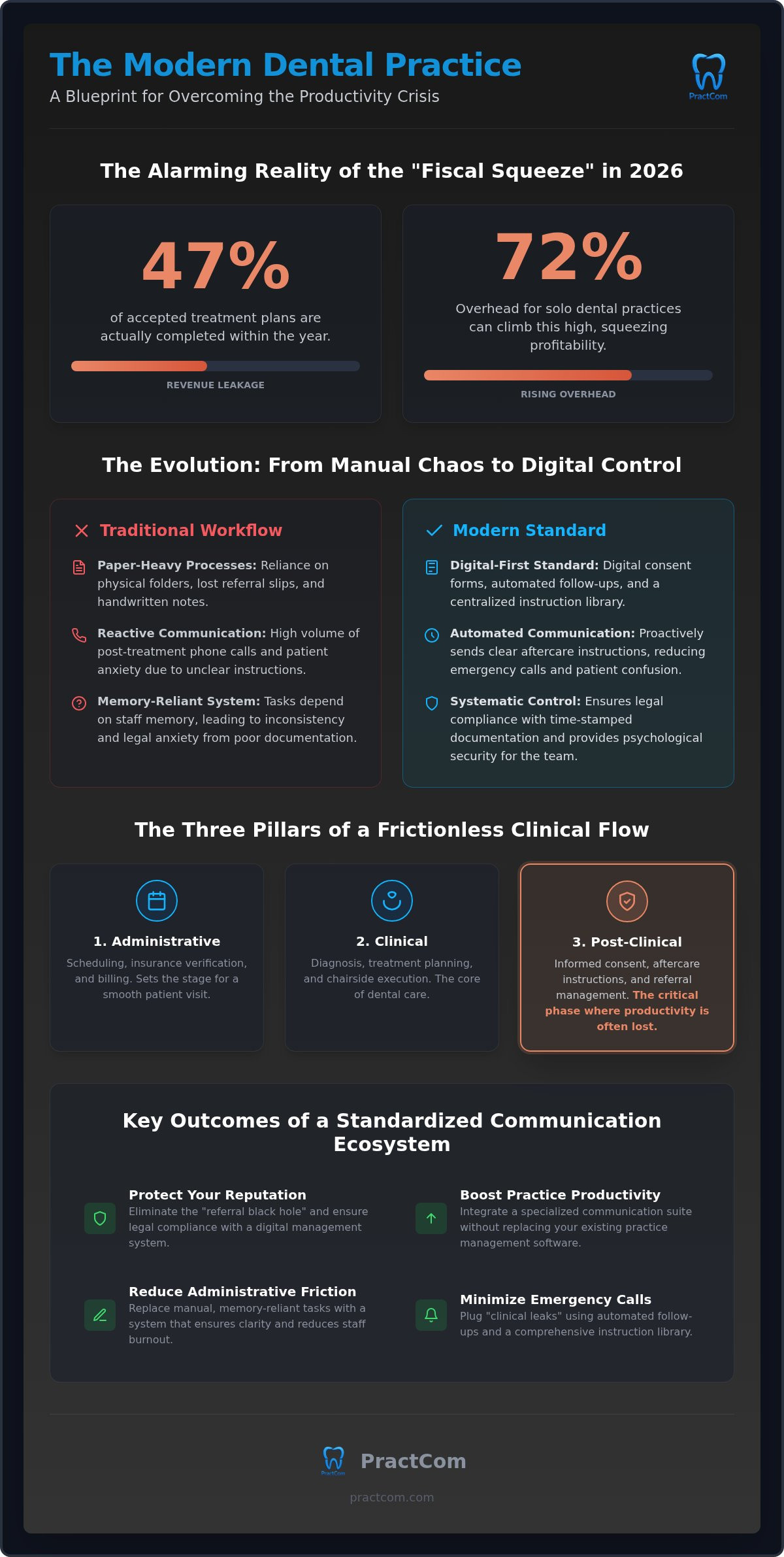
Did you know that in 2026, only 47% of accepted treatment plans are actually completed within the year? This massive revenue leak often stems from a breakdown in the clinical workflow rather than a lack of patient interest. You’re likely feeling the “fiscal squeeze” as overhead for solo practices climbs as high as 72% and staff recruitment remains extremely challenging. It’s frustrating to watch potential growth vanish into a void of post-treatment phone calls and referral leakage where patients never actually see the specialist. We agree that the current pressure to maintain dental practice productivity while managing rising supply costs is exhausting for any practitioner.
This guide promises to show you how to eliminate administrative friction by mastering a standardized, communication-first workflow. You’ll learn to replace manual, memory-reliant tasks with a system that ensures legal compliance and patient clarity. We’ll explore how digital informed consent and automated follow-ups can stabilize your daily operations and protect your reputation. By the end of this article, you’ll have a blueprint for a repeatable clinical environment that reduces emergency calls and secures your professional standing.
Key Takeaways
- Shift your focus from paper-heavy administrative tasks to a digital-first standard that defines productivity through high-quality care and minimal friction.
- Identify and plug “clinical leaks” by using automated follow-ups and a comprehensive instruction library to reduce the volume of post-treatment phone calls.
- Eliminate the “referral black hole” by replacing paper slips with a digital management system that protects your reputation and ensures patients see specialists.
- Boost your dental practice productivity by integrating a specialized communication suite that manages front-end clinical success without needing to replace your existing practice management software.
- Implement a standardized communication ecosystem that uses multi-language support and consistent documentation to provide psychological security for your team and patients alike.
Defining Modern Dental Practice Productivity in 2026
In 2026, dental practice productivity is no longer measured solely by the number of patients in the chair. It’s defined by your ability to deliver high-quality clinical care while maintaining a workflow that has minimal administrative friction. While the traditional model relied on paper-heavy processes and manual memory, the modern standard is digital-first. This shift isn’t just about technology; it’s about reputation management. If your office feels disorganized or your follow-up is inconsistent, patients notice. This creates “communication friction,” which is the primary enemy of your clinical output.
Consider the stark differences between legacy systems and modern expectations:
- Traditional Workflow: Physical folders, handwritten notes, and paper referral slips that often get lost in a patient’s car or handbag.
- Modern Standard: Digital consent forms, automated follow-ups, and centralized referral management that ensures no patient falls through the cracks.
Integrating digital dentistry workflows into your daily routine ensures that your team isn’t bogged down by manual data entry or lost paperwork. Systematic control provides the psychological security needed to move from a state of constant operational resistance to one of confident, standardized execution. We understand the pressure of maintaining clinical excellence while managing the logistical weight of a busy office.
The Three Pillars of Clinical Flow
To optimize your clinic, you must address the three distinct stages of the patient journey. First is the administrative pillar, which covers the logistics of scheduling, insurance verification, and billing. This sets the stage for a smooth day. Next is the clinical pillar, focusing on the precision of diagnosis, treatment planning, and chairside execution. Finally, the post-clinical pillar is where many practices fail. This involves securing informed consent, delivering clear aftercare instructions, and closing referral loops. Productivity thrives when all three pillars operate without bottlenecks. If even one area lags, the entire system feels the strain.
Why 2026 Demands Systematic Control
Patients now expect instant communication through SMS and email. They don’t want to wait for a phone call that might never come. Additionally, the rise of multi-location practices means that standardized protocols are no longer optional. They’re a peer-level necessity for staff training and quality control. By implementing these systems, you reduce the mental load on your providers. This prevents burnout and ensures that your team can focus on dentistry rather than chasing down missing files. Systematic control acts as a stabilizing force, turning dental practice productivity from a source of stress into a predictable business outcome. It’s about protecting your time and your professional reputation through order and speed.
Identifying and Plugging “Clinical Leaks” in Your Workflow
True dental practice productivity is often sabotaged by what we call “clinical leaks.” These are the silent drains on your time and revenue that occur when communication fails after the patient leaves the operatory. While many practitioners focus on speeding up the procedure itself, the real loss happens during the post-treatment phase. High volumes of aftercare phone calls and patient anxiety aren’t just inconveniences. They are symptoms of a fragmented system that forces your front desk to act as a triage unit instead of a growth engine. When a patient calls back because they don’t remember their post-op instructions, it’s a failure of the workflow, not the patient.
The “Informed Consent Gap” represents another significant leak. When documentation is inconsistent or buried in paper folders, you expose the practice to unnecessary legal anxiety. Standardizing this process isn’t just about risk management; it’s about establishing a protective barrier around your professional reputation. Moving to a digital-first documentation model provides the regulatory reassurance that every step of the patient journey is time-stamped and verified. This systematic control allows you to focus on care, knowing your compliance is handled. If you’re ready to stop the drain on your clinic’s time, you can explore how to bridge these communication gaps today.
Automating Post-Treatment Instructions
Verbal instructions are notoriously unreliable. Research indicates that patients forget up to 80% of what they are told before they even reach the parking lot. This memory gap leads to improper home care, increased pain, and preventable emergency visits. By using a digital library of multi-language instructions sent via text or email, you ensure compliance regardless of the patient’s primary language. It’s a pre-emptive strike against administrative failure. For a deeper look at these strategies, see the Automated Dental Post-Op Instructions: The 2026 Guide to Frictionless Aftercare.
Standardizing Informed Consent
Transitioning from physical folders to secure digital consent forms saves hours of staff time each week. Digital signatures and automatic time-stamping create a robust audit trail that paper simply cannot match. This shift eliminates the resistance of manual tasks and replaces it with the confidence of a standardized system. It provides a level of psychological security that manual filing systems simply cannot offer. You can explore legal best practices in our Digital Dental Informed Consent Forms: The 2026 Guide to Clinical Compliance to ensure your practice remains protected and efficient.
Referral Management: The Often Overlooked Efficiency Driver
Referral management is frequently the weakest link in clinical workflows, yet it holds significant potential for optimizing your dental practice productivity. We often see patients leave the operatory with a physical paper slip, only to have that referral disappear into what we call the “Referral Black Hole.” When a patient loses that slip or simply forgets to book, the care cycle breaks. This leakage doesn’t just stall the patient’s treatment; it actively damages your professional reputation. Patients who don’t receive the specialized care they need often associate that failure with the referring office, leading to lower trust and lost future revenue.
By treating referral tracking as a Key Performance Indicator (KPI), you gain a clear view of your practice’s growth trajectory. A closed-loop system ensures that you know exactly when a patient has booked with a specialist and when the treatment is completed. This level of systematic oversight eliminates the ambiguity that typically surrounds external care. It allows you to function as a guardian of the patient’s health, ensuring no one is left behind due to a simple administrative oversight. Moving from a manual referral process to a digital standard provides the psychological security that your patients are receiving the care you recommended.
GP-Specialist Communication Protocols
Efficient collaboration requires more than just a phone call. You need to standardize the data sent to specialists, including high-resolution X-rays, clinical notes, and informed consent documentation. This reduces the exhausting back-and-forth between offices and eliminates the “phone tag” that drains staff energy. Utilizing a secure, digital referral portal ensures that all necessary information is transferred instantly and accurately. This creates a professional ecosystem where no part of the communication process is left to chance. To see how to implement these systems effectively, you can read our guide on Mastering Dental Referral Management Software in 2026.
Improving Patient Referral Compliance
A patient’s journey to a specialist is often fraught with anxiety. You can alleviate this stress by providing a patient portal where they can access their referral details at any time. Automated follow-ups are a powerful tool here; they remind the patient to book their appointment without requiring a manual call from your front desk. This proactive approach increases compliance and ensures that the transition to the specialist is seamless. When patients feel supported through clear, digital communication, they are far more likely to complete their treatment plan. This directly contributes to a more efficient and profitable clinical environment while protecting your standing as a reliable professional ally.
Digital Transformation: Beyond Basic PMS Capabilities
Many practitioners believe their Practice Management Software (PMS) is the final word in technology. It isn’t. While a PMS excels at back-end logistics like billing and insurance verification, it often lacks the specialized tools required for front-end clinical success. Investing in a dedicated communication layer is essential for maximizing dental practice productivity. This specialized suite acts as the steering wheel for your patient experience, while the PMS serves as the engine under the hood. For modern practices, the choice between “Best-of-Breed” and “All-in-One” software often comes down to clinical precision versus administrative convenience.
A significant ROI exists within automated follow-ups and performance dashboards. These tools reclaim hundreds of staff hours by handling routine check-ins without human intervention. Additionally, serving a diverse demographic in 2026 requires support for 15 or more languages. Providing digital documents in a patient’s native tongue isn’t just a courtesy; it’s a stabilizer that ensures regulatory compliance and reduces the risk of misunderstood aftercare. This systematic oversight turns a disorganized office into a high-utility clinical environment. If you want to see where your current system might be falling short, you can review the PractCom Comparison Page to evaluate specific feature gaps.
The Role of a Specialized Communication Suite
General PMS templates are frequently too generic for complex procedures. They are often difficult to customize, leaving your team to manually edit documents for every patient. A library of over 80 specific clinical templates allows high-volume practices to maintain speed without sacrificing technical accuracy. This reduces operational resistance and ensures that every piece of communication reflects your professional standards. By moving away from manual data entry, you provide your staff with numerical shortcuts to task completion, which is a necessity in high-pressure settings. You can start optimizing your front-end workflow to experience these efficiency gains firsthand.
Visual Communication and Smile Design
Visual aids bridge the gap between complex professional procedures and general patient understanding. Using before-and-after visualizations, such as Smile Design, dramatically improves treatment acceptance rates. When patients can see the potential cosmetic changes, their psychological resistance to the procedure decreases. Integrating these visual documentations into your daily clinical workflow makes case presentations more persuasive and faster. It transforms a technical explanation into a shared vision of the outcome. This clarity not only boosts productivity but also functions as a guardian of your reputation by setting realistic, visual expectations from the start.
Implementing a Standardized Communication Ecosystem
Adopting a communication-first approach serves as a stabilizing force in any modern clinic. It moves your team from a state of reactive chaos to one of proactive, systematic control. By standardizing every patient touchpoint, you eliminate the mental load that leads to burnout and administrative failure. This ecosystem ensures that your professional reputation is protected through consistent, high-quality documentation. It’s about creating a predictable environment where dental practice productivity isn’t a variable, but a constant result of your workflow design. We understand that your time is the practice’s most valuable asset, and a standardized system is the best way to guard it.
Implementation is designed to be high-utility and low-resistance. We use numerical shortcuts to task completion, allowing busy staff to send complex instructions or secure consent in just a few clicks. This speed is critical in a high-pressure clinical setting where every second counts. While the world is moving toward digital-first standards, we recognize the logistical reality of diverse patient demographics. Physical document printing remains an essential feature for patients who are less tech-savvy. Providing a tangible copy of aftercare instructions ensures that no one is excluded from your high standard of care, regardless of their digital literacy or access to email.
Why Specialized Tools are the Ally for Modern Dentists
General tools often fail to account for the specific nuances of a dental surgery. You need peer-designed solutions that anticipate administrative failures and bridge clinical gaps before they occur. Intelligent automation offers the promise of reducing operational resistance by handling the repetitive tasks that human memory often fails to manage. This allows you to function as a clinician rather than a data entry clerk. For a deeper breakdown of how this platform philosophy supports your growth, you can explore Why PractCom? to see the stabilizing impact of our specialized suite.
Next Steps for Practice Growth
The first step toward optimization is an honest audit of your current clinical workflow friction. Start by tracking your post-treatment call volume for one week. These calls are often the most visible symptom of communication friction and “clinical leaks.” Simultaneously, you should standardize your referral tracking today to prevent patient loss and protect your revenue cycle. Turning these insights into action is straightforward. You can visit starthere.practcom.com to begin your workflow transformation and experience the psychological security of a truly standardized clinical environment.
Securing Your Practice’s Future Through Systematic Control
Mastering dental practice productivity requires moving past the friction of manual tasks to embrace a standardized communication ecosystem. By plugging clinical leaks and eliminating the referral black hole, you protect both your professional reputation and your revenue cycle. Specialized tools provide the regulatory reassurance that a standard PMS often lacks, ensuring no patient is left behind due to administrative gaps.
You don’t have to navigate these operational stresses alone. Our peer-designed platform offers a library of 80+ post-treatment templates and digital informed consent in 15 languages to keep your patients compliant and your practice protected. This systematic oversight turns operational resistance into a predictable clinical environment.
It’s time to move toward a more organized and protective clinic. Streamline your clinical workflow at starthere.practcom.com to begin your practice transformation today. Your team and your patients deserve the confidence that comes with a world-class system.
Frequently Asked Questions
How does a standardized workflow improve dental patient safety?
A standardized workflow improves patient safety by eliminating reliance on human memory during high-pressure clinical moments. It ensures that every patient receives identical, high-quality instructions and that all informed consent protocols are strictly followed. By removing operational resistance, you provide a stabilizing force that reduces the risk of post-operative complications. This systematic oversight creates a protective barrier for both the patient’s health and your professional reputation.
Can I integrate a communication suite if I already have a Practice Management Software?
You can absolutely integrate a specialized communication suite alongside your current Practice Management Software. While your PMS handles back-end logistics like billing and scheduling, a communication suite focuses on front-end clinical success. This “best-of-breed” approach allows you to optimize your clinical workflow without the disruption of replacing your entire management system. It acts as a stabilizing layer that plugs the communication gaps your primary software might overlook.
What are the most common bottlenecks in a dental practice workflow?
The most common bottlenecks include manual informed consent processes, verbal aftercare instructions that patients quickly forget, and disorganized referral tracking. These issues create significant “communication friction” that drains staff energy and stalls your daily schedule. Identifying these clinical leaks is the first step toward improving dental practice productivity. By replacing manual tasks with automated, digital protocols, you eliminate the administrative resistance that typically slows down a busy dental office.
How do automated post-op instructions reduce emergency phone calls?
Automated post-op instructions reduce emergency calls by providing patients with a clear, digital reference they can access via text or email. When patients receive instructions in their native language with specific recovery details, their anxiety levels drop significantly. This proactive approach answers common questions before they become phone calls to your front desk. It transforms the post-treatment phase from a source of administrative stress into a predictable, standardized part of your care.
What features should I look for in dental referral management software?
Look for a system that offers secure data transfer for clinical notes and X-rays to eliminate the back-and-forth with specialists. It should also include automated patient follow-ups and a closed-loop tracking dashboard to prevent the “referral black hole.” These features ensure that you remain a guardian of the patient’s care throughout their entire journey. A high-utility system will also provide numerical shortcuts to make task completion effortless for your busy clinical team.
Is multi-language support necessary for dental consent forms in 2026?
Multi-language support is an ethical and professional necessity in 2026 to ensure true informed consent across diverse demographics. If a patient doesn’t fully understand the risks and instructions in their primary language, your documentation may be legally vulnerable. Providing digital consent forms in 15 or more languages offers the regulatory reassurance you need to protect your practice. It bridges the gap between complex professional procedures and general patient understanding.
How does a digital workflow help with dental HIPAA compliance?
Digital workflows enhance HIPAA compliance by replacing vulnerable paper folders with secure, encrypted data storage and automated audit trails. Every digital signature and form submission is time-stamped, providing a level of psychological security that manual filing simply cannot match. This systematic control makes responding to audits faster and more accurate. It ensures that your patient communication is not just efficient, but also functions as a reliable guardian of sensitive clinical data.
What is the ROI of implementing a specialized clinical communication tool?
The ROI of a specialized clinical communication tool is found in reclaimed staff hours and increased case completion rates. By reducing the volume of post-treatment phone calls and stopping referral leakage, you directly boost your dental practice productivity. Fewer administrative failures mean your team can focus on high-value chairside care instead of chasing down missing paperwork. This investment provides a stabilizing force that turns operational efficiency into a predictable business outcome.

Article by
Cary Ganz DDS
Dr. Cary H. Ganz is a dentist, prosthodontist, entrepreneur, lecturer, and author with more than 50 years of experience in clinical dentistry and dental technology. Throughout his career, he has combined hands-on patient care with a deep understanding of how technology can improve dental practice operations, communication, documentation, and patient outcomes.
In addition to his clinical background, Dr. Ganz has held significant leadership roles in the dental technology industry, including Past Owner and Vice President of Clinical Affairs at DEXIS Digital Radiography and Past Vice President of Clinical Affairs at Denticon Practice Management Software. His business experience includes product development, clinical strategy, dental software innovation, practice management solutions, and educating dental professionals on the effective use of technology in modern dentistry.
Today, Dr. Ganz continues to focus on creating practical technology solutions for dental practices, including PractCom, a comprehensive dental practice communication platform designed to improve patient communication, documentation, compliance support, referrals, and overall practice efficiency. His work reflects a career-long commitment to helping dentists deliver better care while making their practices more organized, efficient, and protected.
No responses yet