
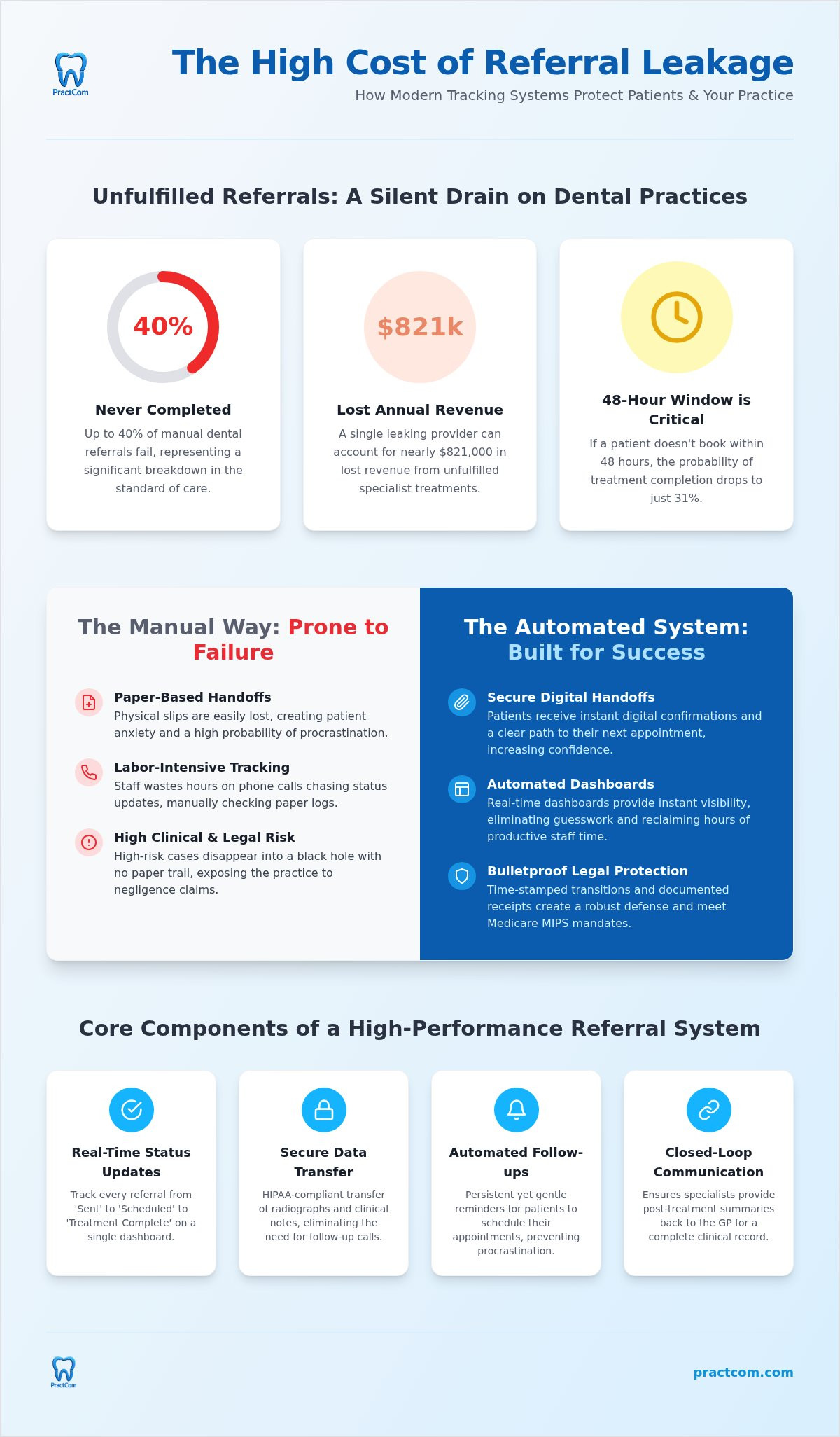
Did you know that 30% to 40% of manual dental referrals are never completed? It’s a staggering statistic that represents both lost revenue and a significant breakdown in the standard of care. When a patient leaves your office with only a physical slip, the probability of treatment completion drops to just 31% if they don’t book an appointment within 48 hours. Establishing a robust system for dental referral tracking is no longer just an administrative preference; it’s a stabilizing force for your practice’s clinical and financial health in 2026.
You likely feel the daily friction of staff wasting hours on the phone chasing status updates or the legal anxiety of high-risk cases disappearing into a black hole. We understand these operational stresses and the need for regulatory reassurance. This guide will show you how to eliminate referral leakage, strengthen specialist bonds, and meet the latest Medicare MIPS closed-loop mandates. We’ll explore a systematic approach to digital handoffs that replaces manual resistance with the confidence of a standardized, protective ecosystem.
Key Takeaways
- Quantify the financial and clinical impact of unfulfilled specialist treatments to build a robust business case for improved oversight.
- Adopt a systematic approach to dental referral tracking to eliminate “lost” high-risk cases and ensure patient safety throughout the entire care cycle.
- Standardize data transfer protocols to ensure specialists receive essential radiographs and clinical notes without the need for time-consuming follow-up calls.
- Analyze the labor efficiency of manual logs against automated dashboards to identify specific areas where your staff can reclaim hours of productive time.
- Leverage integrated tools like post-treatment instruction libraries and digital consent forms to bridge the communication gap between GPs and specialists.
The High Cost of Referral Leakage in Modern Dental Practices
Referral leakage is the silent drain on your practice’s productivity. It’s defined as the specific gap between your clinical recommendation and the actual completion of specialized treatment. When you hand a patient a physical slip and they never book the appointment, you aren’t just losing a procedure; you’re losing the continuity of care. This represents a massive financial hit. Industry data suggests a single leaking provider can account for nearly $821,000 in lost annual revenue. This makes precise dental referral tracking a fiscal necessity rather than an administrative luxury.
Beyond the balance sheet, the clinical stakes are high. In fields like endodontics or oral surgery, a delayed or lost referral can lead to systemic infections or permanent nerve damage. Manual tracking systems, which rely on the limitations of human memory and physical paper logs, frequently buckle under high patient volumes. They fail to provide the “closed-loop” visibility required by modern standards. This leaves your practice vulnerable to claims of negligence when a high-risk patient falls through the cracks because a slip was misplaced or a follow-up call was never made.
Clinical Liability and the Paper Trail
Missing documentation is a primary driver of dental malpractice claims. If you can’t prove a specialist received the referral or that you followed up on a missed appointment, you’re legally exposed. Modern regulatory environments, including the 2026 Medicare MIPS mandates, now require documented acknowledgement of receipt. Large-scale models like the Veterans Health Information Systems and Technology Architecture (VistA) have long utilized integrated tracking modules to mitigate these risks. For a private practice, time-stamping every transition is the only way to build a bulletproof defense. It transforms a “lost” referral from a legal threat into a documented administrative success.
The Patient Experience Gap
Patients often feel abandoned during the specialist hand-off. A physical paper slip often feels like a dismissal rather than a continuation of care. This psychological gap leads to procrastination, which is the primary cause of referral failure. When a patient receives a digital confirmation and a clear path to their next appointment, their anxiety drops. High-performing practices link referral success directly to overall patient satisfaction scores. By using automated follow-ups, you provide the administrative warmth that keeps patients engaged. It’s about moving from operational resistance to a system that protects the patient’s peace of mind and ensures they don’t feel like a burden passed between offices. Using a dedicated dental referral tracking system stabilizes this transition and reinforces your reputation as a protective provider.
Core Components of a High-Performance Referral Tracking System
A high-performance system replaces the uncertainty of “sending and praying” with granular, actionable visibility. Effective dental referral tracking relies on four foundational pillars that ensure no patient or procedure is overlooked. First, real-time status updates provide a clear timeline from the moment a referral is ‘Sent’ to when the patient is ‘Scheduled’ and finally ‘Treatment Complete.’ This transparency ensures that neither the GP nor the specialist is left guessing about the patient’s progress. Second, secure clinical data transfer is critical. Radiographs, periodontal charts, and medical histories must arrive intact and HIPAA-compliant, eliminating the need for specialists to duplicate diagnostics and reducing patient frustration. Third, automated follow-ups act as a persistent yet gentle reminder for the patient to schedule. Finally, the system must offer multi-language support to reflect diverse patient demographics and ensure non-English speaking patients fully understand their care requirements.
Closing the Communication Loop
The ultimate goal of any tracking framework is to achieve closed-loop referral systems. This means the specialist provides a post-treatment summary back to the referring GP, ensuring the clinical record is complete and future maintenance is coordinated. Automated alerts serve as the engine for this loop, replacing manual “status check” phone calls that drain staff resources and lead to human error. To maximize legal protection and clinical clarity, it’s vital to integrate these workflows with Digital Dental Informed Consent Forms. This ensures the patient hasn’t just been referred but has also acknowledged the risks of non-compliance in a documented, time-stamped format that protects the practice’s reputation.
Language and Accessibility in Referrals
Accessibility is a cornerstone of modern patient care and a primary driver of referral compliance. In 2026, a robust system must support at least 15 languages to ensure every patient feels seen and understood. When a patient receives referral instructions via SMS or email in their primary language, their confidence in the process increases and their anxiety levels drop. This reduces operational resistance and prevents the “abandonment” feeling that often leads to treatment procrastination. By using varied delivery options, you cater to different generational preferences and ensure instructions are fully grasped before the patient even reaches the specialist’s office. You can explore how automation bridges these communication gaps to improve compliance and patient outcomes across your entire community.
Manual vs. Automated Referral Tracking: A Comparative Analysis
Manual logbooks and paper slips represent a significant risk to modern clinical efficiency. When a practice relies on physical tracking, staff must dedicate hours each week to administrative “detective work,” cross-referencing paper files with specialist call-backs. This labor-intensive process is fundamentally reactive. In contrast, digital dental referral tracking centralizes this data into a high-utility dashboard. This shift eliminates the human error inherent in manual entry, such as illegible notes or misplaced contact information, ensuring that every patient transition is documented with technical precision.
Accuracy is the first casualty of a manual system. Research indicates that manual methods suffer from a 30% to 40% leakage rate, meaning nearly four out of ten patients never receive the specialized care they need. Automated systems reduce this leakage to between 10% and 15% by providing real-time visibility into the patient’s status. Beyond the numbers, reducing administrative friction has a profound impact on staff morale. When your team isn’t trapped in a cycle of endless “phone tag” to verify appointment statuses, they can focus on delivering high-quality, in-office patient care. They move from being reactive chasers to proactive care coordinators.
The ROI of Automation
The financial impact of this transition is measurable and immediate. If a patient fails to book with a specialist within 48 hours, the completion rate plummets from 91% to just 31%. Automation captures these at-risk patients by triggering immediate follow-ups, effectively “saving” referrals that would otherwise be lost. By eliminating redundant phone calls and automating the delivery of clinical data, you significantly reduce overhead. This allows your practice to recapture the value of every recommended procedure, turning a disorganized administrative burden into a predictable revenue stream.
Scalability for DSOs and Multi-Location Practices
Growth requires a system that doesn’t buckle under the pressure of high patient volume. Manual tracking inevitably breaks down when managing dozens of specialists across multiple locations. Without a unified digital standard, clinical data becomes siloed and tracking becomes impossible to audit. Standardizing the referral process through PractCom for DSOs ensures that every office follows the same high-compliance path. This creates a stabilizing force for group practices, allowing for centralized oversight and a consistent patient experience regardless of which location initiates the hand-off. It transforms a complex logistical challenge into a streamlined, scalable asset for the entire organization.
Implementation Strategies for Frictionless Specialist Communication
Implementing a robust system for dental referral tracking requires a transition from passive hope to active oversight. You can’t fix what you haven’t measured. Start by auditing your referral volume over the last quarter to pinpoint exactly where leakage occurs. Is it at the initial hand-off, or during the scheduling phase? Once identified, standardize the clinical data package required for every referral. This ensures radiographs and medical histories are transmitted immediately, preventing the specialist from flying blind. Select a platform that bridges the gap between clinical care and patient education. Train your team on “Closing the Loop” protocols to meet 2026 regulatory standards. Finally, use a Practice Performance Dashboard to monitor these trends in real-time, allowing you to make data-driven adjustments to your workflow.
Building the Specialist Network
Your specialists are your clinical partners. When you present a digital tracking system to them, emphasize the reduction in their administrative burden. They receive cleaner data, better-prepared patients, and a clear clinical narrative. This collaborative “Circle of Care” prioritizes the patient’s outcome over fragmented paperwork. It transforms a loose collection of providers into a stabilizing professional alliance. By providing specialists with predictable, high-quality data, you become their most valued referring partner. This leads to faster turnaround times for your patients and clearer post-treatment summaries for your records.
Training for Consistency
Consistency is the enemy of human error. Develop a “Never Say” list for your front-desk staff to eliminate vague instructions that lead to patient procrastination. Phrases like “just give them a call when you have a chance” should be replaced with “you will receive a digital link to schedule your appointment now.” Every patient must receive digital instructions alongside their referral to ensure they understand the necessity of the treatment. This reduces the psychological resistance that often leads to abandoned care. For a deeper dive into these protocols, your team can use Mastering Dental Referral Management Software in 2026 as a primary training resource. If you are ready to eliminate the anxiety of “lost” referrals, you can start your 15-day free trial today to see these systems in action.
The PractCom Advantage: Beyond Basic Referral Tracking
PractCom isn’t just another software tool; it’s a guardian of your practice’s reputation and legal standing. It functions as the essential “middle layer” that bridges the gap between your internal clinical care and the external specialist’s office. While basic dental referral tracking might tell you a file was sent, our system ensures the patient is actually prepared for what comes next. By integrating our library of 80+ post-treatment templates directly into the referral workflow, you provide patients with the specific clinical guidance they need during the vulnerable transition period. This eliminates the “abandonment” feeling and replaces it with a sense of continuous, professional oversight.
National dental organizations and DSOs face the unique challenge of managing diverse patient populations across multiple states. Our 15-language support ensures that every referral, instruction, and follow-up is understood, regardless of the patient’s primary language. This isn’t just about convenience; it’s a clinical necessity for informed consent and regulatory compliance. When you combine our Digital Informed Consent Forms with automated dental referral tracking, you create a comprehensive digital paper trail. This synergy minimizes legal risk by documenting that the patient received the referral, understood the instructions, and acknowledged the risks of the procedure in a language they speak fluently.
Systematic Control for Busy Practices
PractCom moves your office from the stress of operational resistance to the peace of systematic confidence. Our Practice Performance Dashboard does more than track files; it identifies your most and least profitable referral paths, allowing you to optimize your specialist network based on actual completion data. You can customize follow-up cadences to match the specific urgency of each procedure. A high-risk endodontic case requires a different communication rhythm than a routine consult, and our system allows you to automate those distinctions with a few clicks. This level of oversight provides the psychological security that comes from knowing no patient is left behind.
Getting Started with Professional Documentation
Transitioning from a manual or paper-based system doesn’t have to be a high-pressure event that disrupts your workflow. PractCom was designed as a peer-founded solution specifically to address the clinical communication gaps that lead to referral leakage and administrative burnout. We’ve grounded the platform in the physical and logistical realities of daily practice life to ensure it’s modern, tech-savvy, and easy to use. It’s a pragmatic tool that values your time and protects your professional standing. If you’re ready to close the loop on your patient hand-offs and eliminate the anxiety of lost documentation, you can start your free trial today and experience the stabilizing force of a truly standardized system.
Securing Your Clinical Legacy Through Systematic Oversight
Transitioning to a digital framework for dental referral tracking is more than a technical upgrade; it’s a commitment to clinical excellence and practice security. By eliminating the staggering leakage rates common in manual systems, you protect your revenue and ensure your patients receive the specialized care they require. Closing the loop with specialists is no longer just an administrative task. It’s a regulatory necessity that builds a bulletproof record of your standard of care and professional integrity.
As a peer-founded platform, PractCom understands the specific operational stresses you face daily. We provide the tools to stabilize your communication ecosystem, including support for 15 languages and a library of 80+ standardized post-treatment templates. This ensures every patient feels understood and every hand-off is documented with technical precision. You don’t have to manage these transitions alone.
Ready to move from operational resistance to systematic confidence? Streamline your practice workflow with PractCom’s Referral Management System. You’ve worked hard to build your reputation. Now, let’s put the systems in place to protect it and your patients’ outcomes.
Frequently Asked Questions
What is dental referral tracking and why is it necessary?
Dental referral tracking is the systematic process of monitoring a patient’s transition from a general practitioner to a specialist. It’s necessary because it prevents referral leakage, which occurs when patients fail to schedule or complete their treatments. Without this oversight, your practice loses revenue and patients risk worsening clinical conditions. A digital system ensures that every recommendation is followed by a documented outcome, providing the stabilizing force needed in a high-pressure setting.
How does digital referral tracking reduce practice liability?
Digital systems reduce liability by creating a bulletproof documentation trail of every hand-off. If a patient experiences a complication after failing to visit a specialist, your practice must prove that the referral was sent and that follow-ups occurred. Using dental referral tracking provides time-stamped evidence of communication and informed consent. This regulatory reassurance protects your reputation and legal standing by demonstrating that you fulfilled your professional duty to coordinate care effectively.
Can referral tracking software integrate with my current PMS?
Specialized communication tools like PractCom are designed to function as a high-utility “middle layer” alongside your current Practice Management Software (PMS). While we don’t sell a full PMS, our system addresses the specific communication gaps those larger platforms often overlook. By focusing on referral management and automated follow-ups, we provide a streamlined workflow that enhances your existing technology stack without the complexity or high cost of a full software replacement.
What are the benefits of multi-language referral instructions?
Multi-language instructions significantly improve patient compliance and reduce the psychological resistance to seeking specialized care. PractCom supports 15 languages, ensuring that all referral documents and post-treatment instructions are understood by diverse patient populations. When patients receive instructions in their primary language via text or email, their anxiety levels drop and their confidence in the treatment plan increases. This accessibility is an ethical and professional necessity in a modern, inclusive practice environment.
How do I know if my patients are following through with their referrals?
You can monitor patient progress through real-time status updates and a dedicated performance dashboard. Instead of waiting for a phone call, you can see exactly when a referral is sent, when the patient schedules their appointment, and when the treatment is completed. This level of visibility allows your team to intervene proactively if a patient stalls. It replaces the uncertainty of manual tracking with the confidence of a standardized, data-driven oversight system.
Does a specialist need to have the same software to track a referral?
Specialists don’t need to purchase the same software to participate in the tracking process. The system is designed to facilitate frictionless communication by sending secure, digital packages that specialists can acknowledge and update through a simplified interface. This ensures that the “Circle of Care” remains intact without imposing technical or financial burdens on your specialist network. It prioritizes the clinical outcome by making it easy for all parties to share vital data.
How much time can my staff save by automating referral follow-ups?
Automating follow-ups can reclaim several hours of productive time each week for your front-desk staff. By eliminating the need for repetitive “status check” phone calls and manual logbook entries, your team can focus on in-office patient engagement and higher-value tasks. Automation handles the persistent reminders that prevent referral leakage, moving your staff from the stress of administrative “detective work” to the efficiency of a high-performance, automated communication ecosystem.
What is ‘closing the loop’ in a dental referral context?
“Closing the loop” refers to the verified completion of the referral cycle. In a dental context, this means the referral is only considered finished once the specialist acknowledges receipt, the patient completes the encounter, and the specialist sends a post-treatment summary back to the referring GP. This process is a key requirement for 2026 Medicare MIPS compliance. It ensures that the patient’s clinical record is complete and that the GP remains fully informed.

Article by
Cary Ganz DDS
Dr. Cary H. Ganz is a dentist, prosthodontist, entrepreneur, lecturer, and author with more than 50 years of experience in clinical dentistry and dental technology. Throughout his career, he has combined hands-on patient care with a deep understanding of how technology can improve dental practice operations, communication, documentation, and patient outcomes.
In addition to his clinical background, Dr. Ganz has held significant leadership roles in the dental technology industry, including Past Owner and Vice President of Clinical Affairs at DEXIS Digital Radiography and Past Vice President of Clinical Affairs at Denticon Practice Management Software. His business experience includes product development, clinical strategy, dental software innovation, practice management solutions, and educating dental professionals on the effective use of technology in modern dentistry.
Today, Dr. Ganz continues to focus on creating practical technology solutions for dental practices, including PractCom, a comprehensive dental practice communication platform designed to improve patient communication, documentation, compliance support, referrals, and overall practice efficiency. His work reflects a career-long commitment to helping dentists deliver better care while making their practices more organized, efficient, and protected.
No responses yet