
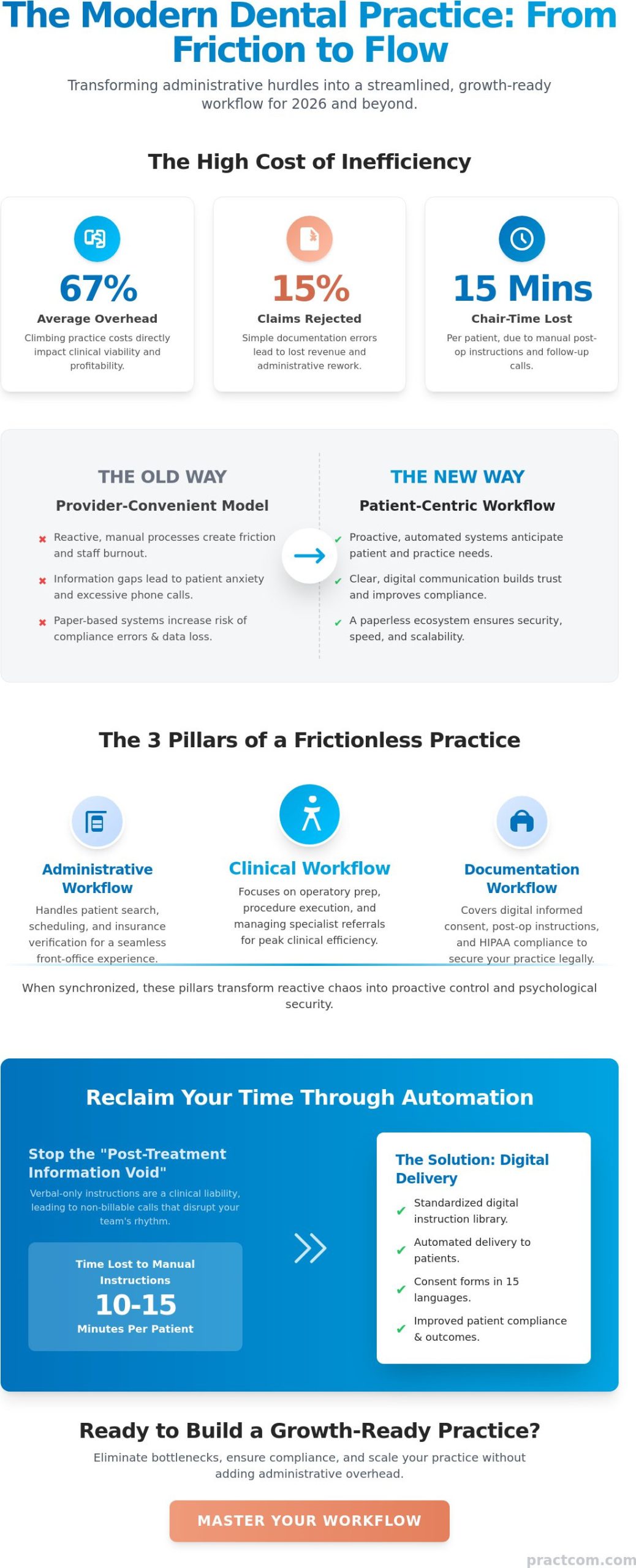
With average dental practice overhead climbing as high as 67% in 2026, every minute lost to manual documentation or a misunderstood post-op instruction is a direct hit to your clinical viability. You’re likely feeling the weight of the latest CDT 2026 updates and the February 16 mandate for updated HIPAA Notice of Privacy Practices. It’s exhausting to bridge the communication gap between your front office and the clinical chair while managing patient anxiety that leads to excessive phone calls. If your current dental practice workflow feels like a series of administrative hurdles rather than a streamlined path to care, you aren’t alone. Many practitioners find that 15% of their claims are rejected due to simple documentation errors that a more systematic approach could prevent.
You deserve a clinical environment where technical precision meets administrative warmth. This guide promises to help you master the frameworks and digital tools needed to eliminate bottlenecks and create a growth-ready practice. We’ll explore how to achieve a seamless, paperless system that reduces chair-time per procedure and improves patient compliance with post-op care. From automated follow-ups to digital informed consent in 15 languages, you’ll learn to replace operational resistance with the confidence of a standardized, tech-forward system.
Key Takeaways
- Transition from provider-convenience to a patient-centric dental practice workflow to eliminate operational resistance and improve clinical speed.
- Reclaim up to 15 minutes of chair-time per patient by automating post-treatment instruction delivery through a standardized digital library.
- Synchronize your clinical schedule with digital informed consent forms to ensure regulatory compliance and seamless, paperless transitions.
- Utilize a practice performance dashboard to audit bottlenecks and transform administrative failures into a predictable, growth-ready system.
- Scale your practice without adding administrative overhead by integrating automated patient follow-ups and high-impact visual tools like smile design.
Modernizing the Dental Practice Workflow: Beyond Basic Scheduling
Modernizing the dental practice workflow requires moving past the outdated idea that efficiency is just a full calendar. In 2026, workflow is defined as the integrated path of patient data and clinical actions. It’s the silent machinery that ensures a patient’s medical history, informed consent, and post-treatment needs move as fast as the clinical procedure itself. Many offices still operate on a “provider-convenient” model, where systems are designed around the doctor’s preferences rather than the patient’s experience. This misalignment creates operational friction. When staff members spend hours chasing missing signatures or clarifying post-op care over the phone, burnout follows. Patients notice this disorganization. It often manifests as poor online reviews or a lack of trust in the clinical outcome.
Establishing a high “Communication ROI” is the remedy for this friction. This concept measures the tangible value of every automated touchpoint. If an automated patient follow-up prevents a five-minute, non-billable phone call, your practice gains back valuable clinical minutes. High ROI comes from systems that anticipate patient needs before they become administrative burdens. It moves your team from a defensive posture of “catching up” to an offensive posture of growth.
The Three Pillars of a Frictionless Practice
A truly optimized dental practice workflow relies on three distinct but interconnected pillars. The administrative workflow handles the patient search, scheduling, and insurance verification. The clinical workflow focuses on operatory preparation, procedure execution, and managing specialist referrals. Finally, the documentation workflow covers the essential legal and educational requirements, including digital informed consent and post-op instruction delivery. When these pillars are synchronized, the practice moves from reactive chaos to proactive control. You don’t just work faster; you work with a sense of psychological security.
Why 2026 Demands a Paperless Ecosystem
The transition to digital dentistry workflows is no longer optional. Regulatory pressure is mounting, specifically with the 2026 HIPAA Security Rule updates that mandate encryption for all electronic protected health information at rest and in transit. Moving from physical filing to cloud-based patient portals reduces “search time” for patient records, allowing your team to focus on care rather than paperwork. Digital informed consent forms and secure messaging ensure your practice remains compliant while meeting the modern patient’s expectation for a seamless, mobile-first experience. By eliminating paper, you don’t just save space. You secure your reputation and your legal standing in an increasingly regulated environment.
The Communication Bottleneck: Where Most Clinical Workflows Fail
Most clinical efficiencies aren’t lost while the handpiece is running. Instead, they vanish in the silence that follows a procedure, often referred to as the “Post-Treatment Information Void.” This gap in the dental practice workflow occurs when a patient leaves the chair without a clear, accessible record of their aftercare requirements. Relying on verbal-only instructions is a significant clinical liability. Patients under the influence of local anesthesia or procedural anxiety rarely retain complex medical directions. When the information doesn’t stick, the result is a surge in non-emergency phone calls that clog your front-office lines and disrupt the clinical team’s rhythm.
Analyzing the time-motion of a typical day reveals that manual post-op instruction delivery drains between 10 and 15 minutes per patient. Over a full schedule, this translates to hours of lost production time. Modern evidence-based healthcare management models emphasize that standardized, automated delivery systems are essential to mitigate these losses. By shifting from manual repetition to a digital library of instructions, you protect your staff’s time and your patient’s health. You can audit your communication bottlenecks to see exactly how much time your team could reclaim through automation.
The Cost of Manual Patient Education
The “burden of repetition” is a primary catalyst for clinical staff burnout. Clinicians find themselves reciting the same phrases dozens of times a day, which leads to mental fatigue and a higher probability of omitting critical details. This lack of consistency directly impacts patient compliance. If a patient is unsure about managing discomfort or when to resume normal activities, their first instinct is to call the office. These avoidable interruptions create a reactive environment where the team is constantly putting out fires rather than focusing on the next procedure.
Referral Friction and Specialist Coordination
The “Referral Black Hole” is another major disruptor where patients often lose momentum when moving between a general practitioner and a specialist. Traditional paper referral slips are easily lost and fail to provide the specialist with the necessary clinical context. This breakdown in data synchronization leads to lower case acceptance and frustrated patients. To solve this, you must integrate a more robust system as detailed in our guide on Mastering Dental Referral Management Software in 2026. Ensuring that patient data and clinical intent move seamlessly between offices is a requirement for a growth-ready dental practice workflow in 2026.
Transitioning to a Paperless Ecosystem: Clinical vs. Administrative Synchronization
A robust dental practice workflow requires a clear distinction between your administrative engine and your patient communication suite. While your Practice Management Software (PMS) is essential for billing and ledger management, it often lacks the specialized tools needed for high-velocity clinical communication. Relying solely on a PMS for patient education or consent often leads to fragmented data and manual workarounds. A dedicated communication platform acts as the bridge, ensuring that the information your clinical team generates is instantly accessible to the patient. This synchronization prevents the “data silos” that often occur when the front office and the operatory aren’t using the same digital language.
Security is the foundation of this digital transition. With the 2026 HIPAA Security Rule updates now requiring mandatory encryption for all ePHI at rest and in transit, your digital signatures and legal forms must meet the highest technical standards. It’s no longer enough to have a scanned copy of a signature. You need a secure, encrypted audit trail that proves the patient received, read, and understood the document. Utilizing American Dental Association resources can help you stay aligned with these evolving standards. By moving these requirements into a cloud-based ecosystem, you eliminate the physical “search time” that drains productivity in traditional offices.
Digital Informed Consent: Risk Management as Workflow
Informed consent shouldn’t happen while the patient is already in the chair. Moving this process to a patient portal or sending it via email allows the patient to review the risks and benefits in a low-pressure environment. This shift not only saves five to ten minutes of chair-time but also creates a more robust legal defense. For a deeper look at navigating these requirements, see our guide on Digital Dental Informed Consent Forms: The 2026 Guide to Clinical Compliance. When your consent forms are synchronized with your schedule, your team can see at a glance if a patient is ready for treatment before they even enter the building.
Automating the Post-Op Loop
True efficiency is found in the “Post-Op Loop,” where SMS and email deliver standardized instructions the moment a procedure is completed. This ensures the patient has a permanent, searchable record of their aftercare on their mobile device. In diverse communities, providing these documents in 15 or more languages is a clinical necessity for ensuring comprehension and safety. Compliance automation is a 2026 industry standard that removes the burden of manual follow-ups from your staff. By using automated systems to monitor recovery, you can identify potential complications early without picking up the phone for every routine case. This proactive oversight builds patient trust and secures your reputation as a modern, tech-savvy provider.
A 5-Step Framework for Workflow Optimization in 2026
Optimizing your dental practice workflow shouldn’t feel like earning an MBA. While some hospital-grade frameworks rely on complex Lean Six Sigma mapping, a high-growth dental practice needs a practical, five-step approach that targets the specific friction points of 2026 dentistry. This framework moves your team from a state of operational resistance to a standardized system where clinical precision and administrative speed coexist. By identifying where data stalls, you can protect your practice from the 15% claim rejection rate that currently plagues the industry due to documentation gaps.
Step 1: Auditing with Clinical Intelligence
You can’t fix what you don’t measure. The first step involves using custom dashboards to track real-time procedure durations and identify “lag time.” This is the non-productive window between patient check-in and the start of treatment. A dashboard also highlights “referral leakage,” where patients fall out of the system before visiting a specialist. By visualizing these bottlenecks, you transform vague frustrations into actionable data points. You’ll likely find that the same two or three administrative hurdles are responsible for 80% of your daily delays.
Step 2: Standardize Clinical Documentation. Once you’ve identified the gaps, you must standardize your instruction libraries and consent forms. This ensures every patient receives the same high level of care information, regardless of which staff member is assisting. It removes the mental load from your clinicians, allowing them to focus entirely on the procedure at hand.
Step 3: Optimizing Patient Access
Reducing front-desk friction is essential for maintaining a healthy dental practice workflow. Implementing fast patient search by name allows your team to access records in seconds, preventing the bottleneck that occurs when a patient calls or arrives at the desk. Digital intake portals further streamline this by collecting data before the patient ever steps into the office. In 2026, this step must include 10DLC registration for your SMS services. This regulatory requirement ensures your secure dental messages are delivered reliably and aren’t flagged as spam by carriers, which is critical when 10% to 15% of appointments result in no-shows without proper reminders.
Step 4: Automate Follow-ups and Referral Tracking. Automation should handle the repetitive tasks that drain your team’s energy. Automated patient follow-ups ensure that every patient is monitored during recovery, while referral management systems keep you informed of the patient’s progress with specialists. Finally, Step 5: Review Analytics involves a monthly deep dive into your performance data to identify any remaining operational resistance. This continuous improvement loop ensures your practice remains growth-ready and resilient. Optimize your clinical workflow today by implementing these standardized frameworks.
Scaling Efficiency with Integrated Patient Communication Systems
Scaling a dental practice often feels like a choice between hiring more administrative staff or sacrificing the quality of patient care. For Dental Support Organizations (DSOs) and growing solo practices, the goal is to expand clinical capacity without inflating overhead costs. This is where an optimized dental practice workflow becomes a primary competitive advantage. Instead of relying on expensive consultants to fix operational gaps, you need a communication layer that bridges the distance between your clinical team and your patients. PractCom serves as this essential layer, sitting on top of your existing Practice Management Software (PMS) to handle the high-volume patient interactions that a ledger-focused system isn’t designed to manage.
Efficiency in 2026 isn’t just about clinical speed; it’s about case conversion. Integrated “Smile Design” tools allow you to show patients before and after cosmetic changes during the consultation. This visual evidence increases case acceptance for high-value procedures by making the clinical outcome tangible and immediate. It transforms the treatment planning phase into a persuasive, high-ROI part of your workflow. By automating these visual and communicative touchpoints, you allow your practice to scale predictably while maintaining a high standard of professional care.
Standardization as a Growth Strategy
Clinical consistency is the bedrock of a scalable practice. When you utilize a library of over 80 post-treatment templates, you ensure that every patient receives the same authoritative guidance, regardless of which office they visit or which assistant they see. This standardization provides several key benefits:
- Reduced Training Time: New clinical assistants become productive faster because they don’t need to memorize complex verbal instructions or aftercare protocols.
- Automated Follow-ups: You can implement “set it and forget it” systems to monitor patient recovery, which justifies the shift away from non-billable manual phone calls.
- Liability Protection: Providing standardized, multi-language documentation in 15 languages ensures comprehension across diverse demographics and creates a secure audit trail.
Next Steps for Your Practice
Moving from reactive management to proactive clinical oversight requires the right digital tools to eliminate operational resistance. You can test these workflow improvements immediately to see exactly how much time your team reclaims during a typical week. Start a free trial today to experience the confidence of a standardized, communication-focused system. By automating the clinical-patient loop, you protect your professional reputation and secure your practice’s growth for the long term. It’s time to stop chasing documentation and start focusing on the chair-side excellence that defines your practice.
Transforming Your Clinical Operations for 2026 and Beyond
Mastering a modern dental practice workflow is no longer just about internal speed; it’s about creating a secure, patient-centric ecosystem that thrives under regulatory pressure. You’ve seen how identifying the post-treatment information void and standardizing your documentation can reclaim hours of lost chair-time. By moving toward a paperless synchronization of clinical and administrative tasks, you protect your team from burnout and your practice from the risks of non-compliance. These frameworks provide the stability needed to scale without the unsustainable cost of manual labor.
You can begin this transformation today by integrating tools designed for technical precision and administrative warmth. With access to 80+ post-treatment templates, HIPAA-compliant digital consent, and support for 15 languages, you can ensure every patient interaction is professional and protected. It’s time to move from the resistance of manual tasks to the confidence of a standardized system. Start your free trial of PractCom and automate your clinical workflow today. Your growth-ready practice is waiting, and the tools to build it are within reach.
Frequently Asked Questions
What is the difference between dental workflow and practice management?
Practice management refers to the administrative and financial framework of your business, such as billing and scheduling. In contrast, dental practice workflow represents the integrated path of patient data and clinical actions. While your PMS acts as a ledger, your workflow is the specific series of steps that move a patient from check-in to recovery. Optimizing this process ensures that your clinical team spends less time on paperwork and more time on care.
How does digital patient communication improve clinical workflow?
Digital communication streamlines the clinical-patient loop by automating the delivery of essential information. Instead of staff spending 10 to 15 minutes manually explaining aftercare, systems deliver standardized instructions via SMS or email instantly. This eliminates the “burden of repetition” for your team. It also provides patients with a permanent, searchable record, which significantly increases compliance and reduces the likelihood of avoidable follow-up questions.
Can I optimize my workflow without changing my Practice Management Software?
You don’t need to replace your entire Practice Management Software to achieve a high-velocity dental practice workflow. Many practitioners choose to implement a specialized communication layer that sits on top of their existing PMS. This allows you to add advanced features like digital informed consent and automated follow-ups without the disruption of a software migration. It’s a cost-effective way to modernize your operations while keeping your current financial database intact.
How do automated post-op instructions reduce phone calls to the office?
Automated instructions provide immediate clarity at the moment of highest patient anxiety. When patients receive post-treatment guidance on their mobile devices, they no longer rely on fading memories or verbal directions. This clear documentation answers common questions regarding discomfort or activity levels before the patient feels the need to call. By providing a reliable digital reference, you protect your front-office staff from a high volume of non-emergency phone calls.
What are the most common bottlenecks in a dental practice workflow?
The most frequent disruptions occur during manual documentation and the delivery of verbal instructions. Other significant bottlenecks include “lag time” between a patient’s arrival and the start of their procedure, as well as “referral leakage” where specialists lose track of patients. These gaps in the clinical process create operational resistance. Identifying these specific friction points through a performance dashboard is the first step toward reclaiming your production time.
Is digital informed consent as legally binding as paper signatures?
Digital signatures are legally binding and often provide a more robust audit trail than traditional paper forms. Secure systems use encryption to verify the patient’s identity and record the exact time the document was signed. This creates a permanent, tamper-proof record that is easily accessible during audits. Moving to digital informed consent protects your reputation and legal standing by ensuring that no signature is ever lost or illegible.
How does a patient portal contribute to office efficiency?
A patient portal serves as a secure, centralized hub for all patient-facing documentation. It allows patients to complete intake forms and review treatment plans before they step into the operatory. This proactive approach reduces “search time” for staff and eliminates the bottleneck of physical paperwork at the front desk. By empowering patients to manage their own data access, you create a more fluid, paperless ecosystem that values everyone’s time.
What role does multi-language support play in practice workflow?
Multi-language support is a clinical necessity in diverse communities to ensure patient safety and compliance. Providing post-op instructions and consent forms in 15 or more languages removes the barrier of misunderstanding that often leads to treatment failure. It ensures that every patient, regardless of their native tongue, receives the same high standard of care. This inclusive approach reduces clinical errors and protects your practice from the liabilities of poor communication.

Article by
Cary Ganz DDS
Dr. Cary H. Ganz is a dentist, prosthodontist, entrepreneur, lecturer, and author with more than 50 years of experience in clinical dentistry and dental technology. Throughout his career, he has combined hands-on patient care with a deep understanding of how technology can improve dental practice operations, communication, documentation, and patient outcomes.
In addition to his clinical background, Dr. Ganz has held significant leadership roles in the dental technology industry, including Past Owner and Vice President of Clinical Affairs at DEXIS Digital Radiography and Past Vice President of Clinical Affairs at Denticon Practice Management Software. His business experience includes product development, clinical strategy, dental software innovation, practice management solutions, and educating dental professionals on the effective use of technology in modern dentistry.
Today, Dr. Ganz continues to focus on creating practical technology solutions for dental practices, including PractCom, a comprehensive dental practice communication platform designed to improve patient communication, documentation, compliance support, referrals, and overall practice efficiency. His work reflects a career-long commitment to helping dentists deliver better care while making their practices more organized, efficient, and protected.
10 Responses
[…] a legal environment; if it wasn’t documented, it didn’t happen. Moving toward a modern dental practice workflow requires a shift to timestamped digital delivery. This “Proof of Delivery” acts as a […]
[…] experience. To see how these tools fit into your broader operations, you can explore our guide on optimizing dental practice workflow for maximum […]
[…] and high staff turnover rates. You can find strategies to mitigate these issues in our guide on Optimizing Dental Practice Workflow: The 2026 Guide to Clinical Efficiency. Investing in automation is a pre-emptive strike against the exhaustion and errors that drive […]
[…] copies ensures maximum reach across all age groups. This synchronized approach is a key part of optimizing dental practice workflow, allowing your clinical staff to focus on chairside care rather than administrative […]
[…] of documentation follows the patient throughout their entire treatment journey. Modernizing your dental practice workflow involves more than just going paperless; it requires a strategic alignment of your communication […]
[…] documents before the patient even enters the operatory. This integration is a critical component of optimizing dental practice workflow, as it significantly reduces front-desk friction. By adhering to the legal and ethical requirements […]
[…] A significant barrier to portal engagement is the language gap. If a patient can’t read the instructions, they won’t use the tool. Supporting 15 languages isn’t just about inclusion; it’s about ensuring true informed consent and psychological security. PractCom’s multi-language library removes the “I don’t understand” barrier, which is a critical step in how to increase dental patient portal adoption for diverse communities. Providing information in a patient’s native tongue builds immediate trust and establishes you as a protective, forward-thinking ally. For more on this, explore our resource on Optimizing Dental Practice Workflow. […]
[…] to systematic control. For a deeper look at streamlining these processes, see our guide on optimizing dental practice workflow. This oversight ensures that your communication tools are functioning as a professional necessity […]
[…] achieve maximum efficiency, you must embed these protocols directly into your Dental Practice Workflow. Setting up automated triggers based on procedure codes ensures that the moment a treatment is […]
[…] the full dental practice workflow, from the first patient interaction through clinical care and follow-up. A recurring workaround may […]