
Your paper referral slips aren’t just administrative clutter; they’re a significant medico-legal liability waiting to happen. In an era where California SB 351 and Minnesota HF 2779 now enforce strict clinical autonomy and documentation standards as of January 1, 2026, relying on a patient to remember their specialist appointment is no longer a viable strategy. Effective dental referral management is now a fundamental requirement for the modern Standard of Care. We understand the daily frustration of chasing specialists for treatment updates or the anxiety of knowing a high-risk RCT case has fallen through the cracks because a paper slip was lost.
You deserve the peace of mind that comes from a standardized, frictionless system. This clinical guide will show you how to transform your referral process from a manual burden into a high-conversion workflow that protects your practice and your patients. We will explore how to achieve 100% visibility on all outgoing cases and implement standardized documentation that satisfies the latest 2026 Medicare quality improvement activities. Why it’s critical is simple: closing the loop ensures patient compliance and clinical safety without adding friction to your team’s busy day.
Key Takeaways
- Stop losing 50% of your outgoing cases to the “Referral Black Hole” by implementing a systematic digital tracking process.
- Transition to a secure, digital-first portal to streamline your case transfers and provide a frictionless experience for both specialists and patients.
- Establish a comprehensive digital paper trail to satisfy medico-legal requirements and ensure every patient returns to your office for restorative care.
- Use real-time specialist updates to gain 100% visibility on scheduling and treatment completion without adding friction to your day.
- Discover why a dedicated dental referral management platform is essential for maintaining the clinical Standard of Care across diverse patient bases.
The Hidden Cost of Manual Dental Referral Management
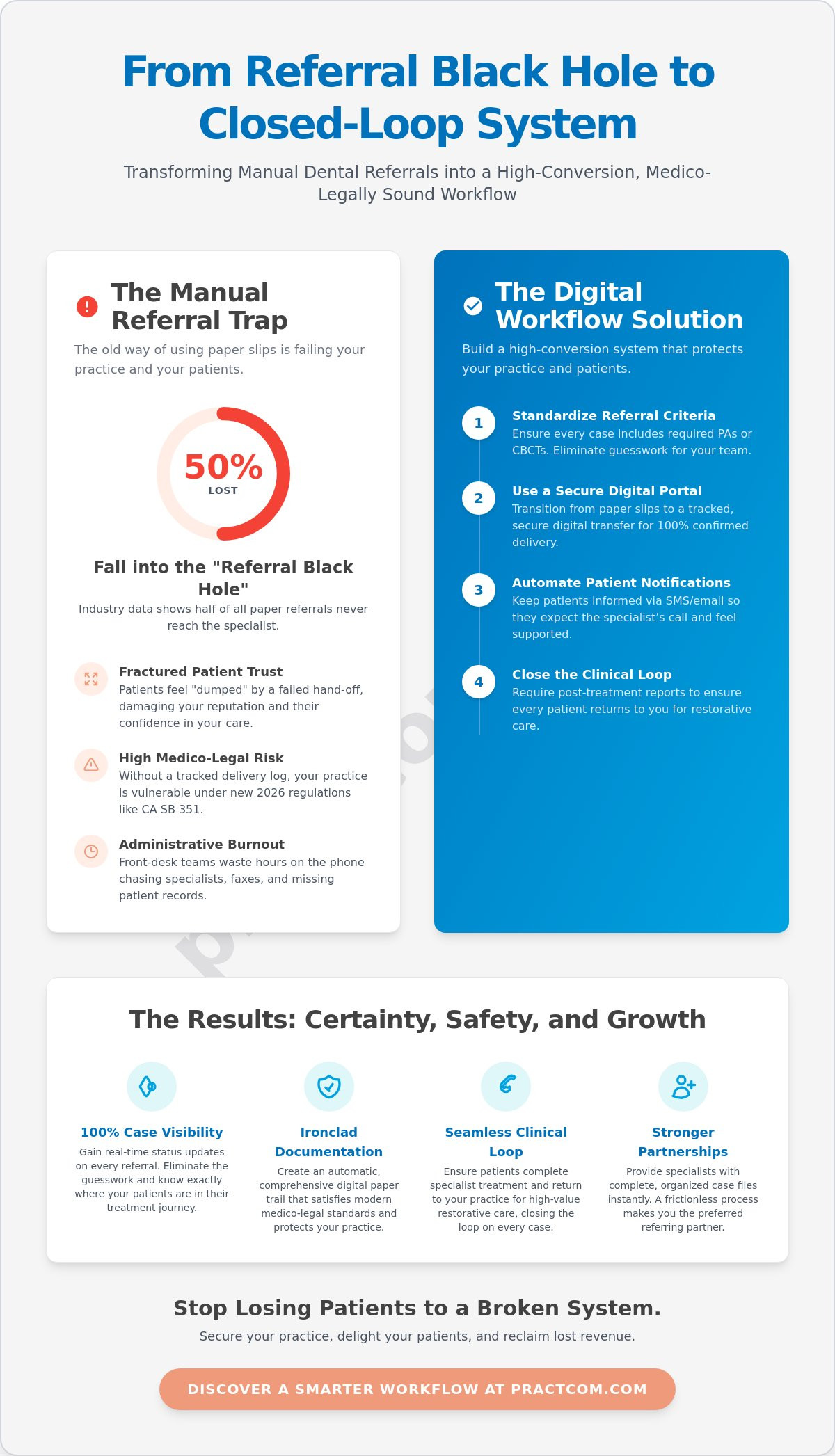
Dental referral management is the systematic tracking of patient care as it moves between a general practitioner and a specialist. It’s the bridge between a diagnosis and a completed treatment. Unfortunately, for most practices, this bridge is built on paper slips that frequently vanish. Industry data consistently shows a “Referral Black Hole” where 50% of paper referral slips never actually reach the specialist’s office. This creates a dangerous fracture in the patient referral process, leaving patients in a state of clinical limbo and your practice at risk.
Why it’s critical: Manual systems create significant medico-legal gaps in the patient’s clinical record. If a patient fails to follow through on a referral for a suspicious lesion or a failing RCT, and your practice lacks a tracked delivery log, you’re professionally vulnerable. Documentation isn’t just about billing; it’s about clinical protection. Without a standardized system, you can’t prove that you fulfilled your duty to ensure the patient understood the necessity of the specialist’s care.
Your front-desk team feels this friction every day. They spend hours on the phone chasing missing X-rays or waiting for specialists to fax back treatment notes that never arrive. This administrative chaos drains energy that should be focused on patient care. It’s a cycle of inefficiency that leads to burnout and increases the likelihood of errors in the dental referral management workflow. Research shows that between 30% and 40% of patients referred through manual processes never complete their treatment, making a structured approach to dental specialist referral tracking essential for preventing patient leakage and protecting your practice.
Why Paper Referral Slips Fail in 2026
Physical slips are relics of a slower era. By 2026, patients expect digital convenience, not a piece of paper that gets lost in a car door pocket or a kitchen drawer. When a slip is lost, the specialist has no way to proactively follow up because they don’t even know the patient exists. This creates data silos where critical clinical information is trapped in a scanning queue rather than being accessible in your practice management software. Relying on physical media adds unnecessary friction to every transfer.
The Impact on Patient Experience and Trust
A patient’s trust is fragile. When they arrive at a specialist’s office only to find there’s no record of their consultation, they feel “dumped” by your practice. Inconsistent instructions regarding pre-op requirements or costs lead to immediate anxiety and confusion. In modern dentistry, the Standard of Care is defined as a seamless, documented hand-off that ensures the patient feels supported and informed throughout their entire treatment journey. Without this level of control, your clinical reputation is at the mercy of a patient’s memory and a piece of paper.
To see how a digital approach eliminates these risks, you can explore why a standardized system is essential for your practice’s growth and safety.
How to Build a High-Conversion Referral Workflow
Moving from the chaos of manual tracking to a high-conversion system requires a structured blueprint. It’s not enough to simply send a patient to a specialist; you must engineer a path that ensures they arrive, receive care, and return to your chair. Modern dental referral management is a multi-step clinical process that prioritizes visibility and patient compliance. By following a standardized workflow, you eliminate the friction that causes patients to delay essential treatments like RCT or complex perio surgery.
The first step is to standardize your referral criteria. Why it’s critical: consistency ensures that every team member knows exactly what documentation, such as specific PAs or CBCT scans, must accompany a case. Next, transition from physical slips to a secure, digital-first portal. This move replaces “hope-based” referrals with tracked delivery logs. Once the referral is sent, automate patient notifications via SMS or email so they expect the specialist’s call. Finally, establish a “Closing the Loop” protocol where post-treatment reports are required before a case is marked as complete in your system. To see how these steps look in action, you can explore a streamlined clinical workflow designed for modern teams.
Centralizing Your Referral Dashboard
A single source of truth is essential, especially for multi-location practices where data often lives in isolated silos. By centralizing your dashboard, you can implement referral tracking that monitors “Referral Aging.” This metric allows you to identify patients who have stalled in the process before they become a clinical liability. Integrating this tracking with your documentation suite ensures that every provider has 24/7 access to the case status, moving your practice toward a more protective and organized environment.
Automating the Patient Hand-off
The hand-off is where most referrals fail. Sending digital referral cards via SMS provides patients with instant access to specialist details and map locations. Including pre-appointment instructions directly in these notifications reduces specialist chair-time friction and ensures patients arrive prepared. Data indicates that you can reduce the “no-show” rate by 30% through these automated follow-up reminders. This proactive approach aligns with the ADA Guidelines for Referring Dental Patients, which emphasize clear communication and patient management as the foundation of professional hand-offs. In 2026, providing this level of digital support is a core component of the Standard of Care.
Reviewing performance metrics via a centralized dashboard allows you to see which specialists are closing the loop the fastest. This control transforms your referral network from a burden into a high-utility asset for your practice.
Closing the Clinical Loop: Documentation and Liability
Closing the loop isn’t just an administrative goal; it’s a clinical safeguard. Incomplete referrals are a leading cause of dental malpractice claims, often because a patient claims they didn’t understand the urgency of the specialist’s care or the instructions provided. In modern dental referral management, you must maintain a documented paper trail that tracks the patient’s journey from the initial hand-off to the final restorative phase back in your chair. This ensures that no clinical detail is left to chance.
Why it’s critical: Without a recorded log of sent instructions and specialist updates, you’re professionally vulnerable if a patient ignores a necessary referral, such as a biopsy or a complex RCT. This documentation is the only objective proof that you fulfilled your duty of care. By integrating informed consent directly into the referral process, you ensure the patient acknowledges the specialist’s role and the clinical risks of non-compliance. This step moves the process from a casual suggestion to a formal, documented clinical event.
Standardized post-treatment instructions are equally vital. They serve as the roadmap that brings the patient back to your office for the final restorative work. When a specialist provides the same high-quality instructions that you do, it reinforces the patient’s trust in the entire clinical network. This level of coordination is what separates a chaotic practice from one that operates with true medico-legal peace of mind.
Multi-Language Support: Bridging the Compliance Gap
Providing referral instructions in 15 languages is a clinical necessity, not a luxury. Instructions that aren’t understood are instructions that won’t be followed. PractCom supports diverse patient bases by translating complex clinical directions into plain language that patients can actually use. This proactive approach significantly reduces post-op emergency calls by providing clear, native-language aftercare via the patient portal. It’s about ensuring every patient has the same access to safety, regardless of their primary language.
Standardizing Post-Op and Referral Instructions
Consistency is the enemy of clinical chaos. By using a library of 80+ vetted templates, you ensure that every provider in your office delivers the same high-quality messaging every time. This standardization prevents the confusion that occurs when different clinicians give conflicting advice to the same patient. The role of automated patient follow-ups is to act as a persistent clinical ally, confirming treatment completion and prompting the patient to return for follow-up care. Standardized clinical documentation protects your practice’s reputation by ensuring no patient feels forgotten or mismanaged during their transition between offices.
Optimizing GP-Specialist Relationships for Growth
A high-conversion referral network is built on more than just professional courtesy; it requires a data-driven partnership. Modern dental referral management moves away from the “send and forget” model toward a structured “Preferred Provider” network. By using a performance dashboard, you can identify which specialists are your most reliable partners based on actual outcomes rather than anecdotal evidence. You deserve to know which offices are closing the loop quickly and which ones are letting your patients stall in the consultation phase. You can build your vetted specialist network today to start closing these communication gaps and securing your practice’s growth.
The value of real-time specialist updates cannot be overstated. Knowing exactly when a patient schedules their appointment and when they complete care gives your team the control they need to manage the restorative timeline. Why it’s critical: Real-time visibility prevents the “Referral Black Hole” where patients disappear for months, only to return with complications that could have been avoided. Specialists can “earn” more referrals from your practice by providing this frictionless communication, proving they are committed to the same Standard of Care that you provide your patients.
The Specialist’s Perspective: What They Need from You
To provide elite care, specialists need more than just a name and a tooth number. They require complete clinical data, including current X-rays, relevant medical history, and specific treatment goals. Providing clear diagnostic reasoning in your referral prevents redundant consultations and saves the patient time and money. Digital hand-offs are the solution here; they allow the specialist to access all necessary files with a One-Click action, ensuring they don’t have to navigate multiple clunky systems to find your notes. This level of organization makes your practice their favorite source of referrals.
Ensuring the Patient Returns to Your Practice
Successful referral management is rooted in a “Mutual Patient” mindset. The specialist’s role is to complete a specific clinical task, but the patient remains yours for long-term health. For multi-location practices, using PractCom for DSOs allows you to manage these internal referrals with 100% visibility across every site. You can even use a Smile Design tool to visualize the final restorative phase with the patient before they ever leave for the specialist. This visual commitment ensures the patient understands that the specialist visit is just one step in a larger plan that always leads back to your chair.
Selecting the Right Referral Management Solution
Choosing the right platform for your practice is a decision that impacts your clinical safety as much as your bottom line. When evaluating a dental referral management solution, you must look beyond basic data entry. A truly effective system must offer HIPAA compliance, multi-language support, and automated follow-ups as core features. These aren’t just “nice-to-haves” in 2026; they’re the pillars of a protective workflow. You need a system that acts as a Reliable Clinical Ally, anticipating failures before they happen and ensuring your team stays organized under pressure.
A dedicated standalone referral tool is often superior to a limited PMS module. While your practice management software is designed for scheduling and billing, it rarely provides the clinical depth needed for complex hand-offs. A specialized system allows for a One-Click transfer of high-resolution X-rays and comprehensive treatment notes without the clunky interface of a general-purpose module. This ensures that both the front desk and the clinical team can operate at peak efficiency without adding friction to their day.
The ROI of a frictionless system is measured in time saved and cases captured. Every hour your team spends chasing a missing report is an hour lost to patient care. By automating the follow-up process, you ensure a higher conversion rate for specialists, which naturally leads to more completed restorative cases returning to your office. Why it’s critical: investing in a specialized system transforms an administrative burden into a predictable clinical asset that pays for itself through improved patient compliance.
PractCom vs. Traditional Referral Methods
Manual tracking and basic email are no longer sufficient to meet the modern Standard of Care. Manual logs are prone to human error, and basic email lacks the tracking and security required for sensitive clinical data. PractCom provides a centralized suite that offers tracked delivery logs and 24/7 access to case statuses. The unique advantage of PractCom is our “Why it’s critical” clinical call-out system, which transforms simple feature descriptions into essential business requirements for your team. If you’re ready to see the difference, you can start a free trial to test this workflow in your office today.
The Future of Dental Communication in 2026
By 2026, “Paperless” has become the baseline expectation for every professional dental practice. Patients expect digital convenience, and specialists demand complete, organized data. The role of automated post-op instructions is central to this total patient journey, ensuring that aftercare is never left to chance. This level of coordination reduces emergency calls and strengthens your clinical reputation. If you’re ready to streamline your entire communication ecosystem, learn more about the PractCom clinical ally and how we protect the integrity of your practice.
Secure Your Clinical Future with Standardized Referrals
Transitioning from a manual, paper-based system to a digital workflow isn’t just about efficiency; it’s about protecting your practice’s reputation and clinical integrity. By implementing a robust system for dental referral management, you eliminate the data silos that lead to treatment delays and medico-legal gaps. You’ve seen how closing the loop requires standardized documentation and a “Mutual Patient” mindset with your specialist network. Why it’s critical: a frictionless hand-off ensures that your patients receive the care they need and, most importantly, return to your office for their final restorative phase.
PractCom was designed by dental professionals who understand the realities of a busy clinical environment. With 80+ clinical post-op templates and full support for 15 languages, our platform acts as your reliable clinical ally. You don’t have to manage the chaos of missing X-rays or unconfirmed appointments alone. Take the first step toward a more organized, protective, and high-conversion practice today. Start your free trial of PractCom and close the referral loop today. Your team, your specialists, and your patients will appreciate the clarity and peace of mind that a standardized system provides.
Frequently Asked Questions
How does digital referral management improve patient compliance?
Digital systems improve compliance by keeping the referral top-of-mind through automated SMS and email notifications sent directly to the patient. Why it’s critical: patients often lose physical slips within 24 hours of leaving your office. By providing instant, digital access to specialist details and map locations, you remove the friction that leads to treatment delays. This proactive approach ensures patients understand the urgency of their care, which is a core component of the modern Standard of Care.
Is dental referral software HIPAA compliant?
Yes, professional dental referral management platforms are built with end-to-end encryption and secure data storage to meet all HIPAA requirements. Unlike unsecure email or physical mail, these systems provide tracked delivery logs and secure patient portals. This protects your practice from the medico-legal risks associated with mishandling Protected Health Information (PHI) during the transfer of clinical records or high-resolution X-rays between providers.
Can I send referral instructions in different languages?
Yes, you can provide clear, plain-language instructions in 15 different languages to support a diverse patient base. Instructions that aren’t understood are instructions that won’t be followed. By offering native-language aftercare and pre-op directions, you reduce clinical confusion and emergency phone calls. This level of communication ensures every patient has equitable access to safe, high-quality care without adding friction to your team’s day.
How do I track if a patient actually visited the specialist?
You track patient progress through a centralized dashboard that provides real-time updates on scheduling and treatment completion. Why it’s critical: this visibility allows you to identify “Referral Aging” cases where patients have stalled in the process. Instead of waiting for a fax that might never arrive, your team has 24/7 access to the status of every outgoing case, ensuring no patient falls into the “Referral Black Hole.”
What happens if the specialist doesn’t use the same software as me?
Specialists do not need to purchase or install the software to receive your referrals. They receive a secure, web-based link that allows them to view clinical notes and images with a One-Click action. This frictionless experience ensures that your preferred providers can collaborate with you immediately. It maintains the clinical loop without requiring the specialist to manage multiple logins or complex software integrations.
Does referral management software integrate with my current PMS?
Professional dental referral management tools are designed to work alongside your current Practice Management System (PMS) to eliminate data silos. While your PMS handles billing and basic scheduling, the referral platform manages the clinical hand-off and automated follow-ups. This integration ensures that your clinical documentation remains centralized and accessible, allowing your team to focus on patient care rather than manual data entry.
How much time does it take to set up a digital referral workflow?
Most practices can transition to a standardized digital workflow in less than 24 hours. The setup involves selecting your library of 80+ clinical templates and inviting your preferred specialist network. Why it’s critical: because the system is designed for clinical reality, the learning curve is minimal for both the front desk and the clinical team. This quick implementation provides immediate peace of mind and starts protecting your practice from day one.
Can I include X-rays and clinical notes in a digital referral?
Yes, you can securely attach high-resolution PAs, bitewings, CBCT scans, and detailed clinical notes to every referral. This ensures the specialist has all the diagnostic data they need before the patient arrives for their consultation. Providing complete clinical data reduces redundant imaging and saves the patient time. It also reinforces your reputation as a highly organized practitioner within your local dental community.

Article by
Cary Ganz DDS
Dr. Cary H. Ganz is a dentist, prosthodontist, entrepreneur, lecturer, and author with more than 50 years of experience in clinical dentistry and dental technology. Throughout his career, he has combined hands-on patient care with a deep understanding of how technology can improve dental practice operations, communication, documentation, and patient outcomes.
In addition to his clinical background, Dr. Ganz has held significant leadership roles in the dental technology industry, including Past Owner and Vice President of Clinical Affairs at DEXIS Digital Radiography and Past Vice President of Clinical Affairs at Denticon Practice Management Software. His business experience includes product development, clinical strategy, dental software innovation, practice management solutions, and educating dental professionals on the effective use of technology in modern dentistry.
Today, Dr. Ganz continues to focus on creating practical technology solutions for dental practices, including PractCom, a comprehensive dental practice communication platform designed to improve patient communication, documentation, compliance support, referrals, and overall practice efficiency. His work reflects a career-long commitment to helping dentists deliver better care while making their practices more organized, efficient, and protected.
No responses yet