
Imagine it’s 5:01 PM on a Friday when your front desk phone rings with the fourth patient inquiry about post-extraction bleeding, even though your assistant handed them a printed guide. This friction is a daily reality for teams stretched thin, but it’s also a major risk to your practice’s clinical outcomes. Transitioning to automated dental post-op instructions is no longer just a luxury; it’s a vital component of a modern, “Five-Click” workflow. With the global dental software market projected to hit $1.97 billion in 2026, the shift toward digital, trackable aftercare is the new baseline for professional excellence.
You’ve likely felt the anxiety of wondering if a patient actually read their RCT aftercare or if they’ve already lost the paper slip in their car. This guide will show you how to eliminate that administrative burden, slash emergency call volume, and establish a bulletproof medico-legal standard of care. We’ll examine the latest cloud-based automation tools and how they help practices recapture the $20,000 to $70,000 lost annually to compliance gaps, ensuring your team remains focused on clinical excellence without adding friction to your day.
Key Takeaways
- Learn how to map ADA procedure codes to vetted templates so every patient receives precise aftercare the moment treatment ends.
- Bridge the gap between clinical care and patient memory by replacing forgotten verbal advice with permanent, digital access to instructions.
- Strengthen your medico-legal defense using automated dental post-op instructions that provide a verifiable delivery log for every procedure.
- Identify and eliminate “administrative chaos” by auditing high-friction procedures that trigger repetitive, time-consuming phone calls.
- Elevate your practice’s “Standard of Care” with professional templates available in 15 languages without adding friction to your team’s daily workflow.
The Clinical and Operational Cost of Manual Post-Op Instructions
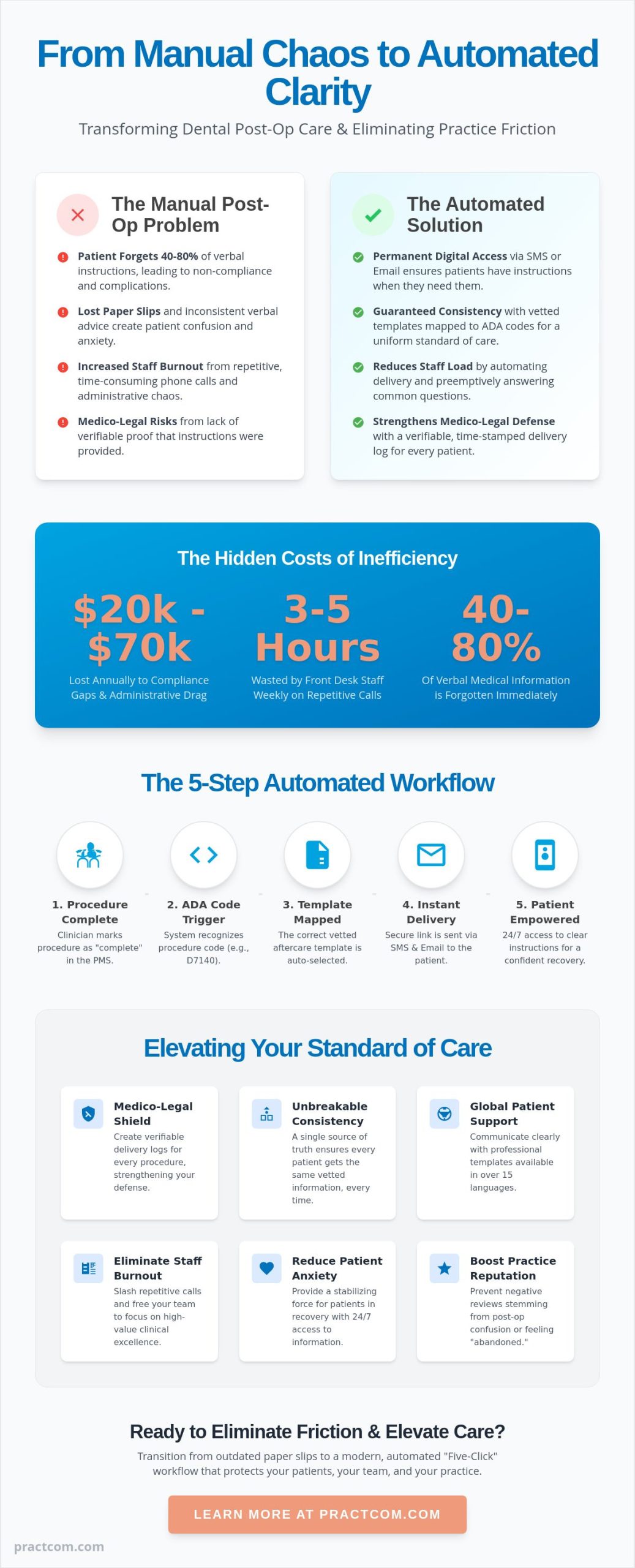
Manual aftercare is a legacy process that creates unnecessary friction in an otherwise modern practice. We define automated dental post-op instructions as a digital communication protocol that triggers the delivery of specific, vetted guidance based on ADA procedure codes. When a clinician marks a procedure as “complete” in the practice management system, the software automatically sends a secure link to the patient via SMS or email. This eliminates the “Verbal Instruction Fallacy,” where clinical studies show patients forget 40% to 80% of medical information the moment they leave the chair. Relying on a patient’s memory or a crumpled piece of paper is a clinical risk that your practice doesn’t need to take.
By integrating a Dental Procedure Education System, you ensure that every patient has a permanent, digital record of their care requirements. This isn’t just about convenience; it’s about protecting your team from the “Phone Tag Drain.” A single front desk coordinator can lose 3 to 5 hours per week answering repetitive questions like “Can I drink through a straw?” or “Is this swelling normal?” This administrative weight leads to staff burnout and increases the likelihood of negative online reviews. Patient dissatisfaction often stems from feeling “abandoned” after they leave the clinic. When a patient can’t find their instructions at 9:00 PM, their anxiety frequently turns into a one-star review that stays on your profile forever.
The Anxiety Gap in Patient Recovery
Patients in recovery are often in a state of physiological stress. Post-anesthesia fog and rising cortisol levels make it nearly impossible to process complex care steps or remember medication schedules. A digital reference provides a stabilizing force, moving the patient from a state of friction to one of confidence. Why it’s critical: clear, accessible instructions are proven to reduce patient cortisol levels and lower their perceived pain. Providing 24/7 access to aftercare info bridges the gap between the chair and a successful recovery at home.
Staff Burnout and the Consistency Problem
Inconsistency is the enemy of the “Standard of Care.” When different assistants give varying versions of RCT aftercare, patients get confused and lose trust. Manual systems rely on forgotten paper slips or “shorthand” notes that lack critical details. Implementing automated dental post-op instructions establishes a single source of truth for the entire clinical team. It ensures that every clinician provides the exact same vetted information every single time. This consistency protects the practice’s reputation and legal standing while significantly reducing the mental load on your staff.
How Automated Dental Post-Op Systems Work: From Code to Inbox
The journey from a clinical procedure to a successful recovery at home relies on a seamless transfer of information. Modern automated dental post-op instructions function as a bridge between your practice management system and the patient’s mobile device. This process starts the moment a clinician enters an ADA procedure code; such as D7140 for an extraction or D3330 for a molar RCT; into the patient’s chart. By mapping these specific codes to pre-vetted instruction templates, the system removes the need for manual selection, ensuring the right information reaches the right patient every time.
Once the procedure is marked “complete,” the software triggers a “TouchPoint” through SMS or email. This immediate delivery is a vital part of the “Standard of Care,” as it places instructions in the patient’s hands before the local anesthetic even begins to wear off. With the global dental software market projected to reach USD 1.97 billion in 2026, practices are increasingly moving toward these “Five-Click” workflows to maintain a competitive edge. Standardizing your protocols with a comprehensive communication suite ensures no patient is left in the dark during their most vulnerable recovery hours.
Mapping Procedures to Vetted Templates
Success begins with a robust library of content. A reliable system should offer 80+ pre-vetted templates covering everything from routine hygiene to complex oral surgery. Why it’s critical: having a “Reliable Clinical Ally” in your software means you don’t have to write these instructions from scratch. You can simply customize existing clinical protocols to align with your specific practice preferences. This mapping ensures that your “Standard of Care” remains consistent across all providers, regardless of which assistant or associate performed the treatment.
The Multi-Channel Delivery Advantage
To truly Improve Patient Communication, you must meet patients where they are. SMS delivery is the gold standard for aftercare, boasting a 98% open rate compared to the much lower engagement seen with traditional email. However, a “Hybrid Approach” remains necessary. While most patients prefer digital access, your system should still allow for one-click printing to accommodate demographics who rely on physical documents. This flexibility ensures that health literacy remains high across your entire patient population. Additionally, ensuring your messaging platform has 10DLC registration compliance is essential for secure, uninterrupted delivery of these critical medical updates.
The final step in a frictionless system is the automated patient follow-ups sequence. For invasive procedures like implants, a single message isn’t enough. The system can be configured to send a “Day 3” check-in or a “Day 7” reminder for suture removal. This proactive approach identifies potential complications early, often preventing the need for an emergency visit. It also addresses a common SERP gap: supporting non-English speaking patients. By offering instructions in 15 different languages, you ensure that language barriers don’t compromise clinical outcomes or patient safety.
Standardizing the Standard of Care: Medico-Legal Benefits
Clinical excellence is only half the battle; the other half is proving it through meticulous documentation. In a high-pressure environment, manual aftercare often leaves gaps that expose you to risk. Automated dental post-op instructions transform this vulnerability into a strength by ensuring the “Standard of Care” remains consistent across your entire practice. Unlike paper handouts that a patient might lose or verbal advice that is 40% to 80% forgotten, digital systems create a permanent, timestamped record. Informed consent is a continuous process that must extend into the home recovery phase to be legally sound.
Medico-legal liability frequently centers on the concept of “failure to warn.” If a patient experiences a post-surgical infection because they didn’t understand the rinsing protocol, your practice is on the hook unless you can prove instructions were delivered. Using “Plain Language” is a legal requirement to ensure patients of all education levels can follow your guidance. By standardizing these vetted templates across your entire clinical team, you eliminate the chaos of conflicting advice. This protects your practice’s reputation and ensures your documentation is always board-ready without adding friction to your day.
The Audit Trail: Proving Instructions Were Received
A robust communication system acts as a “Guardian of the Practice” by maintaining a tracked delivery log. This log shows exactly when a patient received and opened their automated dental post-op instructions. This data is a “Reliable Clinical Ally” during an audit or a board inquiry. By integrating these instructions with your digital informed consent process, you create a complete medico-legal loop. It proves you did your due diligence from the moment of diagnosis through the final stages of recovery, leaving no room for “failure to warn” claims.
Bridging the Language Barrier
Providing instructions only in English poses a significant legal risk in a multi-lingual community. If a patient cannot understand the care steps, they cannot comply with them, which directly impacts clinical outcomes. Why it’s critical: supporting 15+ languages is both a professional and ethical necessity. It reduces “lost in translation” errors that lead to surgical complications or medication mishaps. Moving to a standardized, multi-lingual system provides the “peace of mind” that every patient, regardless of their native tongue, has the tools for a safe recovery. This approach ensures you meet the highest standards of health literacy and professional responsibility.
Best Practices for Implementing Post-Treatment Automation
Moving from a manual system to a digital workflow requires a strategic audit of your current “chaos.” To start, identify the top five procedures that generate the highest volume of repetitive phone calls to your front desk. For most practices, these are extractions, RCTs, and periodontal surgeries. By pinpointing these friction points, you can prioritize which automated dental post-op instructions to deploy first. This targeted approach allows your team to see immediate results, often reducing aftercare inquiry calls by 30% or more within the first month of implementation.
Your clinical library should serve as a “Reliable Clinical Ally” for your staff. Instead of writing instructions from scratch, use professionally vetted templates as your baseline. These should be customized to reflect your specific clinical preferences, such as your preferred brand of chlorhexidine rinse or specific pain management protocols. Training your team is equally vital. Ensure every assistant and hygienist understands that the automation system isn’t a replacement for their expertise; it’s a tool that guarantees their hard work in the chair isn’t undone by a patient’s poor memory at home.
Optimizing Timing and Frequency
Timing is the difference between a compliant patient and a panicked emergency call. We recommend an “Immediate Trigger” protocol where instructions are sent via SMS while the patient is still in the chair or checking out. This ensures the information is at the top of their inbox before the local anesthetic wears off. Why it’s critical: sending a proactive follow-up message the next morning allows you to catch minor complications, like slight swelling or manageable discomfort, before they escalate into perceived emergencies. This cadence maintains a continuous loop of care that paper handouts simply cannot match. To see how real dental teams are using this approach to reclaim administrative time, review this 2026 case study on automated patient follow-ups in dental practice efficiency.
Content Quality: Plain Language vs. Clinical Jargon
Effective communication requires translating complex clinical terms into actionable steps. Instead of “avoiding strenuous activity to prevent alveolar osteitis,” use plain language like “rest for 24 hours to help the extraction site heal.” Digital portals also allow for the inclusion of visual aids, such as tooth loss charts or step-by-step cleaning videos, which bridge the gap for visual learners. In modern practice, the “Standard of Care” is defined as the ethical obligation to provide clear, accessible, and trackable health information that empowers the patient toward a successful recovery. To see how these best practices look in action, explore our automated communication suite and start reducing your practice friction today.
PractCom: Streamlining Patient Communication Without Adding Friction
PractCom is built for the reality of the modern dental office. It serves as a dedicated communication suite rather than a bloated, all-in-one Practice Management System (PMS). We understand that your team doesn’t have time to learn a complex new platform. Instead, PractCom acts as a “Reliable Clinical Ally” that enhances your current setup. By focusing specifically on the high-friction areas of aftercare and consent, we provide a stabilizing force in a busy clinical environment. Our 80+ pre-vetted templates cover everything from routine cleanings to complex RCT and perio surgeries, ensuring your “Standard of Care” remains unshakeable.
A major differentiator is our support for 15 different languages. This addresses a critical gap in many practices where non-English speaking patients often struggle with recovery instructions. Why it’s critical: health literacy is a professional and ethical necessity. When patients understand their care steps in their native tongue, compliance rates rise and complications fall. Additionally, our platform integrates “Smile Design” visualizations with automated dental post-op instructions. This allows patients to see the value of their cosmetic investment while receiving the precise steps needed to protect it. For patients interested in maintaining their results with professional-grade kits like GLI GLI, these recommendations can be easily automated. You can track the success of these interactions through the Practice Performance Dashboard, which provides clear data on time saved and improved patient outcomes.
The Frictionless Integration Model
Our “One-Click” philosophy ensures that clinical documentation never slows down your production. PractCom works alongside your existing workflow by pulling ADA codes directly from your PMS. This reduces the friction of manual follow-ups by centralizing all communication in a secure patient portal. Patients can access their instructions 24/7, which eliminates the chaos of lost paper handouts and late-night phone calls. This system provides the “peace of mind” that your team is covered and your patients are cared for, even after they leave the building.
Beyond Instructions: The Total Communication Ecosystem
We believe that aftercare is just one piece of the puzzle. PractCom creates a total communication ecosystem by linking your instructions to dental referral management software and digital informed consent. This creates a seamless loop that protects the practice’s reputation and legal standing. By moving from manual chaos to a standardized system, you reclaim hours of administrative time every week. It’s time to move your practice into the future of frictionless aftercare. Standardize your practice aftercare with PractCom and experience the confidence of a truly streamlined office.
Establish a New Standard for Your Practice Aftercare
Moving from manual chaos to a standardized system is the most effective way to protect your practice and your patients. By implementing automated dental post-op instructions, you bridge the 40% to 80% memory gap that often leads to avoidable complications and repetitive phone calls. This shift ensures every patient receives vetted, multi-lingual guidance. Your team gains the peace of mind that comes with an unshakeable medico-legal audit trail.
PractCom provides the tools you need to establish this new “Standard of Care” without adding friction to your day. Our library of 80+ vetted templates and support for 15 languages ensures no patient is left behind. With integrated medico-legal documentation, you can focus on clinical excellence knowing your documentation is always board-ready. You’ve worked hard to build your reputation; let’s ensure your aftercare protocols reflect that same level of excellence.
Book a Demo to See the PractCom Instruction Library in Action
Frequently Asked Questions
How do automated dental post-op instructions actually save my staff time?
Automation removes the need for manual follow-up calls and the “Phone Tag Drain” that exhausts front desk teams. By triggering delivery based on ADA codes, your staff avoids answering the same aftercare questions 15 to 20 times every week. This “One-Click” efficiency allows clinical assistants to focus on production rather than administrative tasks. It provides a standardized system that ensures accuracy without adding friction to your team’s busy schedule.
Are digital post-op instructions HIPAA compliant?
Yes, our system utilizes encrypted delivery methods and secure patient portals to maintain full HIPAA compliance. Unlike standard text messages, we provide secure links that protect electronic protected health information (ePHI) at all times. Every interaction is logged with a Business Associate Agreement (BAA) in place. This level of security is a vital component of the modern “Standard of Care,” ensuring your practice remains protected against documentation gaps and legal liabilities.
Can I customize the templates to fit my specific clinical protocols?
You have complete control over every instruction sent to your patients. While we provide 80+ pre-vetted templates, you can easily edit them to reflect your specific clinical preferences or pain management protocols. Why it’s critical: every practice has unique workflows for procedures like RCT or implants. Customizing these templates ensures that your automated dental post-op instructions act as a direct extension of your clinical voice and professional standards.
What happens if a patient doesn’t have a smartphone or email?
Our system supports a “Hybrid Approach” for patients who prefer physical documents. While 98% of patients have access to SMS, your team can still print any instruction with a single click during checkout. This ensures that 100% of your patient population receives the necessary aftercare information. Providing both digital and physical options bridges the gap in health literacy and ensures that no patient is left without a clear recovery plan.
Does the system support multiple languages for diverse patient bases?
The platform currently supports 15 different languages to accommodate diverse patient demographics. This feature is essential for reducing “lost in translation” errors that often lead to post-surgical complications. By providing instructions in a patient’s native tongue, you significantly increase compliance and improve clinical outcomes. This capability transforms the software into a “Reliable Clinical Ally” for practices serving multi-lingual communities that require clear, accessible medical guidance.
How does this integrate with my existing dental practice management software?
The system integrates seamlessly with most leading dental practice management platforms. It functions by pulling ADA procedure codes directly from your existing schedule to trigger the appropriate instruction. This “Five-Click” integration model means your team doesn’t have to enter data twice. It creates a streamlined workflow that connects your clinical chairside actions to your patient’s inbox without requiring a full software overhaul or complex staff retraining.
Will automating instructions reduce the number of emergency phone calls?
Automation identifies and answers common questions before they escalate into perceived emergencies. By providing clear guidance on “what to expect” and when to call the office, you eliminate the anxiety that often triggers a Friday evening phone call. Proactive follow-up messages catch minor issues early, which can reduce unnecessary emergency visits by an average of 22.95% according to recent industry data. This proactive care model stabilizes your office environment. For a deeper look at how to build a complete outreach strategy, explore our guide on mastering dental patient communication for modern practices.
Can I track if a patient has actually opened and read the instructions?
Every message sent creates a timestamped delivery log that shows exactly when a patient opened their automated dental post-op instructions. This “Guardian of the Practice” feature provides a robust audit trail in the event of a board inquiry or liability claim. You can verify engagement in real time through the Practice Performance Dashboard. Having this verifiable proof of delivery is a cornerstone of professional medico-legal documentation in a modern dental office.

Article by
Cary Ganz DDS
Dr. Cary H. Ganz is a dentist, prosthodontist, entrepreneur, lecturer, and author with more than 50 years of experience in clinical dentistry and dental technology. Throughout his career, he has combined hands-on patient care with a deep understanding of how technology can improve dental practice operations, communication, documentation, and patient outcomes.
In addition to his clinical background, Dr. Ganz has held significant leadership roles in the dental technology industry, including Past Owner and Vice President of Clinical Affairs at DEXIS Digital Radiography and Past Vice President of Clinical Affairs at Denticon Practice Management Software. His business experience includes product development, clinical strategy, dental software innovation, practice management solutions, and educating dental professionals on the effective use of technology in modern dentistry.
Today, Dr. Ganz continues to focus on creating practical technology solutions for dental practices, including PractCom, a comprehensive dental practice communication platform designed to improve patient communication, documentation, compliance support, referrals, and overall practice efficiency. His work reflects a career-long commitment to helping dentists deliver better care while making their practices more organized, efficient, and protected.
12 Responses
[…] Digital delivery acts as a guardian for your practice’s reputation and legal standing. Patients are significantly less likely to lose a text or email than a physical piece of paper that often ends up in the trash before they even leave the parking lot. From a risk management perspective, digital logs provide timestamped proof of instruction delivery, which is an essential business requirement in a modern clinical environment. You can explore more about this transition in our guide to automated dental post-op instructions. […]
[…] that your practice is a stabilizing force in their healing process. Integrating these guides with automated dental post-op instructions allows for timed delivery, ensuring the right information reaches the patient at the exact moment […]
[…] Verbal instructions are notoriously unreliable. Research indicates that patients forget up to 80% of what they are told before they even reach the parking lot. This memory gap leads to improper home care, increased pain, and preventable emergency visits. By using a digital library of multi-language instructions sent via text or email, you ensure compliance regardless of the patient’s primary language. It’s a pre-emptive strike against administrative failure. For a deeper look at these strategies, see the Automated Dental Post-Op Instructions: The 2026 Guide to Frictionless Aftercare. […]
[…] in 15 languages, you eliminate the confusion that leads to frantic phone calls. Learn more about automated dental post-op instructions to see how this system stabilizes your clinical […]
[…] Effective follow-up isn’t about generic reminders; it’s about a strategic cadence that mirrors the patient’s psychological journey. We recommend a 24-hour, 72-hour, and 1-week protocol for high-value cases. The initial 24-hour message should focus on clarity and answering immediate questions. The 72-hour touchpoint provides reassurance regarding the clinical outcome, and the 1-week follow-up acts as a gentle nudge toward scheduling. Personalizing these automated messages ensures the patient feels their specific health concerns are being prioritized. For more on the relationship between communication and operational ease, see our sibling article on Why Clear Aftercare Reduces Post-Treatment Phone Calls. […]
[…] to ensure accuracy for every case, from simple fillings to complex implants. By leveraging Automated Dental Post-Op Instructions: The 2026 Guide to Frictionless Aftercare, you ensure the right information reaches the patient via SMS or email exactly when they need it. […]
[…] sensations and genuine red flags is the most effective way to protect your investment. Following Standardized Post-Op Instructions provides the clinical framework you need to evaluate your progress objectively. One critical […]
[…] 2: Select a centralized library. Deploy a comprehensive library of post-treatment instructions. Having these ready in 15 languages eliminates the need for manual […]
[…] same high-quality information regardless of which assistant is in the operatory. You can leverage automated dental post-op instructions to maintain consistency across your entire office. This level of oversight removes the operational […]
[…] non-compliance is often a failure of communication rather than intent. By utilizing a Post-Treatment Instruction Library, you ensure that every patient leaves with clear, accessible protocols. These digital instructions […]
[…] implants, and endodontic treatments to maintain accuracy across your entire practice. Implementing Automated Dental Post-Op Instructions ensures every patient receives the same high standard of guidance regardless of which doctor they […]
[…] Confusion is the primary enemy of clinical success. In a DSO or group practice environment, different providers might give slightly different verbal advice, which leads to patient uncertainty. Standardizing these instructions ensures a unified professional voice across all locations. Clear, simplified language and visual aids improve patient adherence significantly. You can explore more about this in our Automated Dental Post-Op Instructions: The 2026 Guide. […]