
Handing a patient a paper referral slip and hoping they book an appointment isn’t a clinical strategy; it’s an open invitation for care leakage. When you send a case out your front door, you risk losing that patient entirely if communication stalls between offices. You shouldn’t have to chase down post-treatment notes or worry whether a specialist will redirect your restorative production elsewhere. Sustainable partnerships don’t thrive on casual professional favors. Truly building a dental specialist referral network requires standardized clinical communication protocols that protect patient outcomes and secure bi-directional care.
You already know that friction in the handoff process drains practice momentum and compromises compliance. In this guide, you will learn how to build, scale, and manage a reliable specialist network that eliminates patient drop-off and keeps restorative cases returning to your chair. We’ll explore modern closed-loop tracking protocols, seamless sharing of diagnostic records and digital consent forms, and the foundational systems needed to foster predictable, mutual clinical growth.
Key Takeaways
- Pinpoint why unstandardized handoffs cause clinical care leakage, and discover how building a dental specialist referral network around structured workflows stops patient loss.
- Establish clinical compatibility criteria and verify technology standards, including digital scans and CBCT data sharing, before finalizing specialist partnerships.
- Implement bi-directional service-level agreements and standardize minimum diagnostic record packages to ensure complete case visibility across offices.
- Transition from manual tracking methods to centralized referral workflows and real-time status dashboards that track patients through their restorative return.
- Conduct structured quarterly audits to evaluate referral cycle velocity, strengthen clinical collaboration, and protect mutual production long term.
Why Traditional Dental Referral Networks Fail Modern Clinical Practices
Clinical referral leakage occurs when a patient diagnosed with an advanced condition drops out of the care continuum during an inter-office transition. Corporate networks often argue that only centralized dental groups can solve this operational fracture, while traditional consultants claim manual front-desk follow-up calls are sufficient. Both approaches miss the root issue. Reliable inter-office stability demands systematic coordination. Successfully building a dental specialist referral network requires moving beyond casual professional recommendations and paper slips that leave restorative continuity to chance.
The Anatomy of Referral Leakage in General Practice
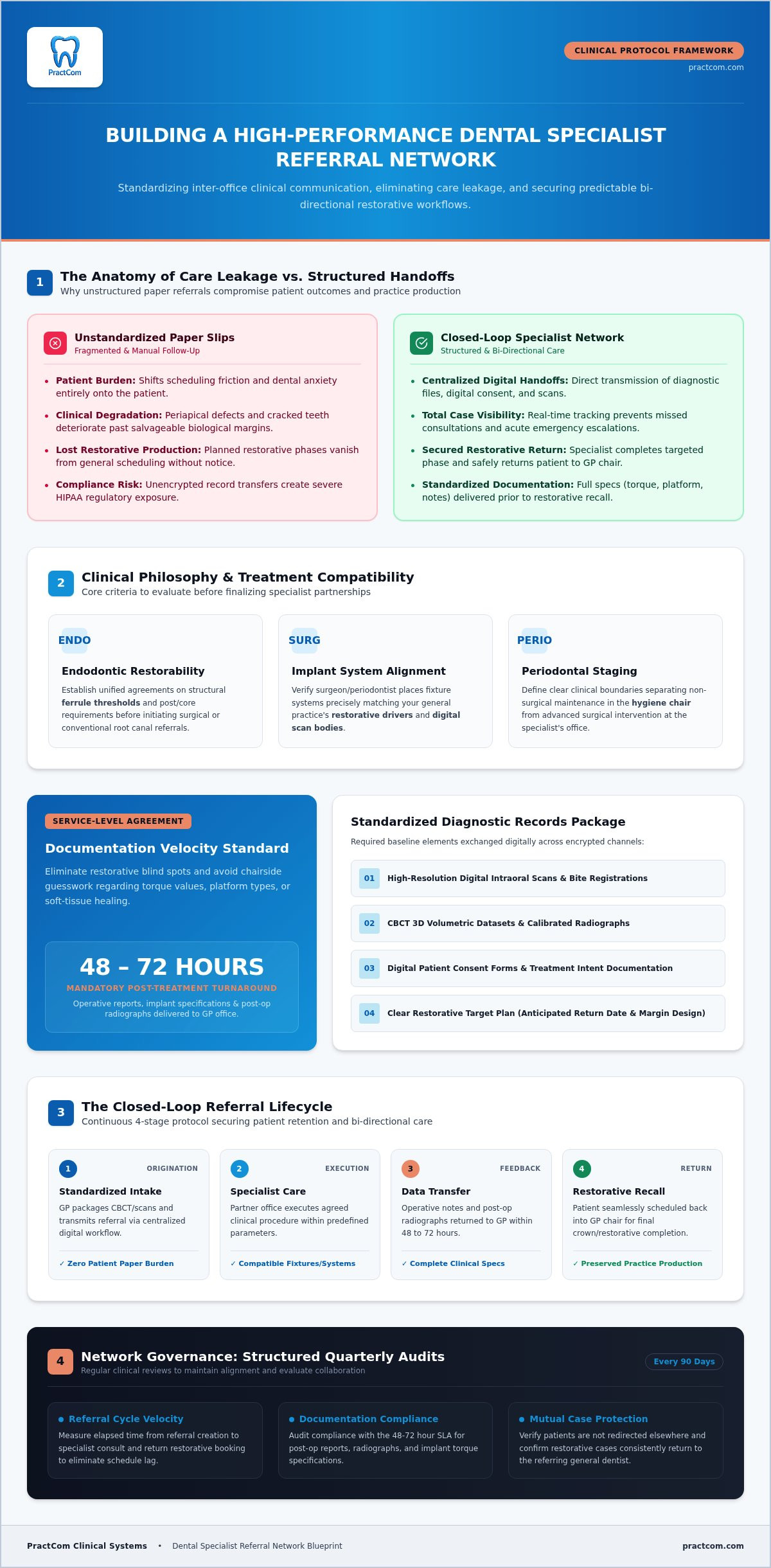
When patients leave an operatory holding a paper referral slip, the entire burden of care coordination shifts onto them. Dental anxiety, scheduling friction, and unclear expectations cause many patients to delay or avoid booking consultations altogether. This breakdown carries steep clinical and operational costs:
- Chronic periapical lesions and periodontal defects progress into emergency visits or structural tooth loss.
- Cracked teeth deteriorate past salvageable biological margins while awaiting specialty evaluation.
- Planned restorative phases vanish from the general practitioner’s schedule, stranding anticipated production.
Without closed-loop visibility, your clinical team remains completely unaware of missed appointments until the patient resurfaces months later with an acute failure.
The Breakdown in Cross-Practice Clinical Documentation
Administrative bottlenecks between independent practices create significant clinical liability. Diagnostic records, intraoral scans, and referral notes sent across unstructured email chains or physical mail frequently go missing. When patients consult external dental specialists without standardized communication channels, post-operative reports rarely arrive before the patient returns to the general dentist’s chair.
Restorative clinicians lose productive chair time guessing at implant platform dimensions, torque specifications, or soft tissue healing timelines. Additionally, transmitting unencrypted patient records and radiographs between offices creates severe HIPAA regulatory exposure. Building a dental specialist referral network around standardized digital protocols eliminates these documentation blind spots, protecting your practice against compliance liabilities while securing seamless restorative handoffs.
How to Vet and Select Partners for Your Dental Specialist Network
Corporate groups often claim networking requires shared corporate ownership, while basic directories suggest partnering with any credentialed provider down the street. In private practice, clinical compatibility dictates success. Building a dental specialist referral network that protects your restorative outcomes starts with rigorous clinical and operational vetting.
Clinical Philosophy and Treatment Compatibility
Shared clinical standards prevent patient confusion and compromised restorative outcomes. Before sending your first case, evaluate whether the specialist’s approach complements your treatment planning:
- Endodontic restorability: Agree on structural ferrule thresholds and core requirements before referring for root canal therapy or surgical endodontics.
- Implant system alignment: Verify the oral surgeon or periodontist places fixture systems that match your existing restorative drivers and digital scan bodies.
- Periodontal staging: Establish clear boundaries between non-surgical maintenance in your hygiene chair and surgical intervention at the specialist’s office.
The American Dental Association stresses the value of standardized referral protocols to ensure patient needs remain central throughout every handoff.
Operational and Administrative Alignment
Clinical alignment means little if administrative delays stall patient care. Set explicit expectations around turnaround times and record exchanges before formalizing any working arrangement:
- Documentation velocity: Operative notes, implant specifications, and post-op radiographs must return to your office within 48 to 72 hours of treatment completion.
- Diagnostic file exchange: Confirm the specialist’s practice can export open DICOM files and STL scans from CBCT units, preventing unnecessary repeat radiation for the patient.
- Emergency availability: Clarify same-day triage protocols so acute surgical or endodontic patients receive immediate relief.
When building a dental specialist referral network, managing these handoffs shouldn’t rely on staff memory. Implementing a dedicated Referral Management System provides real-time visibility across partner offices, ensuring patients stay scheduled and records flow without friction.
A Step-by-Step Playbook for Establishing Bi-Directional Referral Protocols
Casual doctor lunches and holiday gift baskets don’t create sustainable referral pipelines. Relying on goodwill without structural workflows leaves your schedule vulnerable to miscommunication. A predictable clinical partnership demands an operational service-level agreement (SLA) between offices. When building a dental specialist referral network, establishing clear, documented handoff rules ensures complete clinical continuity and protects restorative returns.
Creating Standardized Clinical Diagnostic Packages
Diagnostic packages must eliminate guesswork before the specialist evaluates the patient. Incomplete records force redundant imaging, delay treatment, and create patient frustration. Aligning your diagnostic requirements with established ADA guidelines on specialty referrals ensures every case handoff contains the clinical depth needed for immediate consultation:
- Targeted imaging: Current high-resolution periapical radiographs, bitewings, and open-format CBCT volumes.
- Clinical objectives: Clearly documented tooth numbers, relevant periodontal probing depths, and specific treatment requests (e.g., surgical crown lengthening versus apicoectomy).
- Restorative framework: Clear notes indicating planned future prosthetics, such as monolithic zirconia crowns or multi-unit fixed bridges, so the specialist plans biologic width accordingly.
Standardizing this intake package eliminates duplicate diagnostics, lowers patient out-of-pocket costs, and accelerates chairside decisions.
Formalizing the Restorative Return Loop
Patient leakage often happens after specialist treatment concludes. Without an explicit return protocol, patients assume care is finished once surgical or endodontic symptoms subside. Successful bi-directional collaboration requires proactive coordination between clinical teams:
- Explicit case stewardship: Every referral form must clearly state that all final restorative and hygiene care remains with the referring general dentist.
- Granular operative specifications: Specialists must return post-operative documentation within 72 hours, noting implant fixture brands, platform diameters, final insertion torque values, and healing abutment dimensions.
- Coordinated chairside scheduling: The specialist’s administrative team schedules the patient’s restorative follow-up with your office before releasing them from their chair.
Building a dental specialist referral network around these mutual agreements closes the clinical loop. Patients experience seamless transitions, and your restorative chair time remains completely protected.
Modernizing Referral Tracking and Inter-Office Communication
Manual spreadsheets and paper cards fail because they can’t actively update your front desk. When staff must call offices or parse fragmented email threads, patients slip through the cracks unnoticed. Modernizing these handoffs replaces administrative friction with systematic oversight. While building a dental specialist referral network, deploying dedicated digital coordination tools bridges the communication divide between practices without requiring an overhaul of your core practice management software.
Closed-Loop Tracking vs. Paper Referral Cards
Traditional referral logs act as passive graveyards for outbound cases. Centralized digital tracking replaces guesswork with active, real-time oversight from consultation to final restoration:
- Status dashboards flag unbooked consultations immediately, prompting proactive outreach before treatment lapses.
- Automated text notifications prompt patients to schedule their specialist evaluations, eliminating hours of front-desk phone tag.
- Automated coordinator alerts highlight stalled cases so clinical teams can intervene before symptoms escalate.
Reviewing operational resources like Mastering Dental Referral Management Software in 2026 illustrates how replacing manual spreadsheets with automated status triggers protects restorative schedules and keeps patients accountable.
Synchronized Patient Education and Digital Consent
Coordinated patient communication reduces clinical anxiety and increases case acceptance. When partner practices align their messaging, patients feel supported across every phase of care:
- Deliver procedure-specific overviews before the consultation so patients understand why specialty intervention is necessary.
- Implement digital dental informed consent forms prior to visits to clarify risks, treatment alternatives, and financial expectations without rushed chairside paperwork.
- Share standardized post-treatment homecare guidance via text and email in 15 languages, ensuring consistent recovery protocols across both facilities.
This systematic alignment turns disjointed referrals into a cohesive clinical journey. When building a dental specialist referral network, relying on standardized digital workflows protects patient compliance and clinical outcomes. Explore how PractCom’s Referral Management System streamlines inter-office tracking to keep your clinical handoffs organized, compliant, and predictable.
Scaling Your Network: Long-Term Governance and Relationship Cultivation
Enterprise organizations often claim network expansion requires corporate consolidation, while outdated practice management advice suggests holiday gift baskets keep colleagues engaged. Neither approach establishes clinical accountability. Sustainable governance relies on structured performance reviews and mutual operational transparency. Successfully building a dental specialist referral network over the long term requires auditing real clinical throughput, tracking referral velocity, and maintaining direct doctor-to-doctor communication.
Conducting Data-Driven Clinical Referral Audits
Subjective impressions can’t reveal where patients drop out of care. Establishing quarterly case audits allows partner practices to evaluate workflow bottlenecks using objective data points:
- Referral cycle velocity: Track the calendar days elapsed between the initial specialty handoff, completed specialty treatment, and the patient’s return to your chair for final restorative care.
- Case completion rates: Measure the exact percentage of referred patients who completed active treatment versus those who abandoned therapy after the initial exam.
- Documentation turnaround: Verify whether post-operative notes, implant torque values, and diagnostic imaging arrived within agreed clinical service windows.
- Patient sentiment: Review cross-practice feedback to identify administrative delays or billing confusion before patient trust erodes.
When clinical discrepancies or restorative conflicts arise, review the case records together promptly. Open, data-backed dialogue resolves misunderstandings quickly and protects professional partnerships.
Collaborative Continuing Education and Study Clubs
Inter-office relationships flourish when clinical teams share knowledge outside active treatment operatories. Hosting regular interdisciplinary study sessions unifies treatment philosophies across practices:
- Review complex full-arch rehabilitations collaboratively, aligning on bone grafting protocols, ridge preservation techniques, and ideal fixture positioning.
- Train front-desk and clinical assisting teams on standardized handoff protocols to eliminate cross-office administrative friction.
- Scale clinical handoff standards across expanding multi-location groups. Dental organizations can examine how specialized platforms like PractCom for DSOs scale communication protocols across regional practices without requiring a single practice management software.
Building a dental specialist referral network isn’t a one-time project; it’s an evolving clinical partnership. Structured audits and shared continuing education ensure your network consistently delivers predictable patient outcomes and protected restorative production.
Securing Your Restorative Pipeline Through Standardized Clinical Workflows
Clinical continuity shouldn’t dissolve the moment a patient walks out your operatory door. Successfully building a dental specialist referral network requires replacing informal favors with structured, transparent handoff protocols. By establishing explicit service-level agreements, standardizing diagnostic packages, and auditing referral velocity, you safeguard patient health while ensuring planned restorative production returns reliably to your chair.
PractCom gives your clinical team the systematic control needed to maintain seamless case transitions. Equipped with a dedicated Referral Management System and a centralized performance dashboard delivering real-time patient handoff visibility, your front desk stays ahead of stalled appointments. Supported by a standardized library of over 80 digital post-treatment templates in 15 languages, you bridge the gap between specialty care and restorative completion. Discover how PractCom eliminates care leakage; start your free trial today to build enduring, high-trust specialist partnerships.
Frequently Asked Questions
How do general dentists choose which dental specialists to include in their referral network?
General practitioners evaluate potential partners based on clinical alignment, diagnostic technology, and administrative reliability. Compatibility involves matching implant systems and agreeing on structural tooth restorability thresholds. Practitioners should confirm the specialist accepts digital scans and returns operative notes within 72 hours. Prioritizing clear communication and patient comfort ensures seamless transitions when building a dental specialist referral network.
What is referral leakage in dentistry and how can practices prevent it?
Referral leakage occurs when a patient diagnosed with advanced clinical needs fails to schedule or complete treatment at a specialist’s office. Practices prevent leakage by replacing passive paper slips with closed-loop tracking workflows. Deploying automated patient follow-ups and inter-office status alerts bridges the handoff gap, keeping coordinators informed until the patient attends the specialist visit.
Why are paper dental referral slips ineffective for modern patient handoffs?
Paper slips place the administrative burden entirely on an anxious patient, leading to high cancellation and no-show rates. Physical cards offer zero tracking visibility for referring doctors and cannot alert coordinators when appointments go unbooked. They also fail to securely transmit critical diagnostic imaging, increasing the likelihood of costly repeat radiographs and fragmented restorative records.
How can general dentists ensure specialists send patients back for restorative treatment?
Clinicians secure restorative returns by establishing bi-directional service-level agreements before transferring cases. Every referral package should explicitly define that final prosthetics and maintenance remain with the referring doctor. Coordinated offices schedule the patient’s restorative appointment before they leave the specialist’s operatory, pairing that booking with prompt delivery of post-operative torque and platform data.
What clinical information should be included in a dental specialist referral package?
A comprehensive intake package must contain targeted periapical or open-format CBCT radiographs, precise tooth numbers, and detailed diagnostic charting. Clinicians should explicitly document the clinical objective, pertinent medical histories, and anticipated restorative designs. Supplying complete clinical data eliminates redundant exams, reduces out-of-pocket costs, and accelerates specialist treatment planning.
How does dedicated referral tracking software differ from practice management software?
Practice management software (PMS) handles internal scheduling, billing, and native clinical charting within a single facility. Dedicated referral tracking software bridges separate, incompatible systems across independent offices. A specialized platform provides real-time status dashboards, multi-practice file sharing, and automated patient reminders without attempting to function as a full PMS.
Can digital post-op instructions and consent forms improve specialist referral compliance?
Delivering digital consent forms and post-treatment templates directly to a patient’s mobile device significantly improves procedural comprehension and reduces anxiety. When building a dental specialist referral network, using standardized educational libraries in 15 languages ensures clear expectations across every visit. Consistent digital guidance helps patients navigate recovery smoothly, ensuring they return confident for their final restorations.

Article by
Cary Ganz DDS
Dr. Cary H. Ganz is a dentist, prosthodontist, entrepreneur, lecturer, and author with more than 50 years of experience in clinical dentistry and dental technology. Throughout his career, he has combined hands-on patient care with a deep understanding of how technology can improve dental practice operations, communication, documentation, and patient outcomes.
In addition to his clinical background, Dr. Ganz has held significant leadership roles in the dental technology industry, including Past Owner and Vice President of Clinical Affairs at DEXIS Digital Radiography and Past Vice President of Clinical Affairs at Denticon Practice Management Software. His business experience includes product development, clinical strategy, dental software innovation, practice management solutions, and educating dental professionals on the effective use of technology in modern dentistry.
Today, Dr. Ganz continues to focus on creating practical technology solutions for dental practices, including PractCom, a comprehensive dental practice communication platform designed to improve patient communication, documentation, compliance support, referrals, and overall practice efficiency. His work reflects a career-long commitment to helping dentists deliver better care while making their practices more organized, efficient, and protected.
No responses yet