
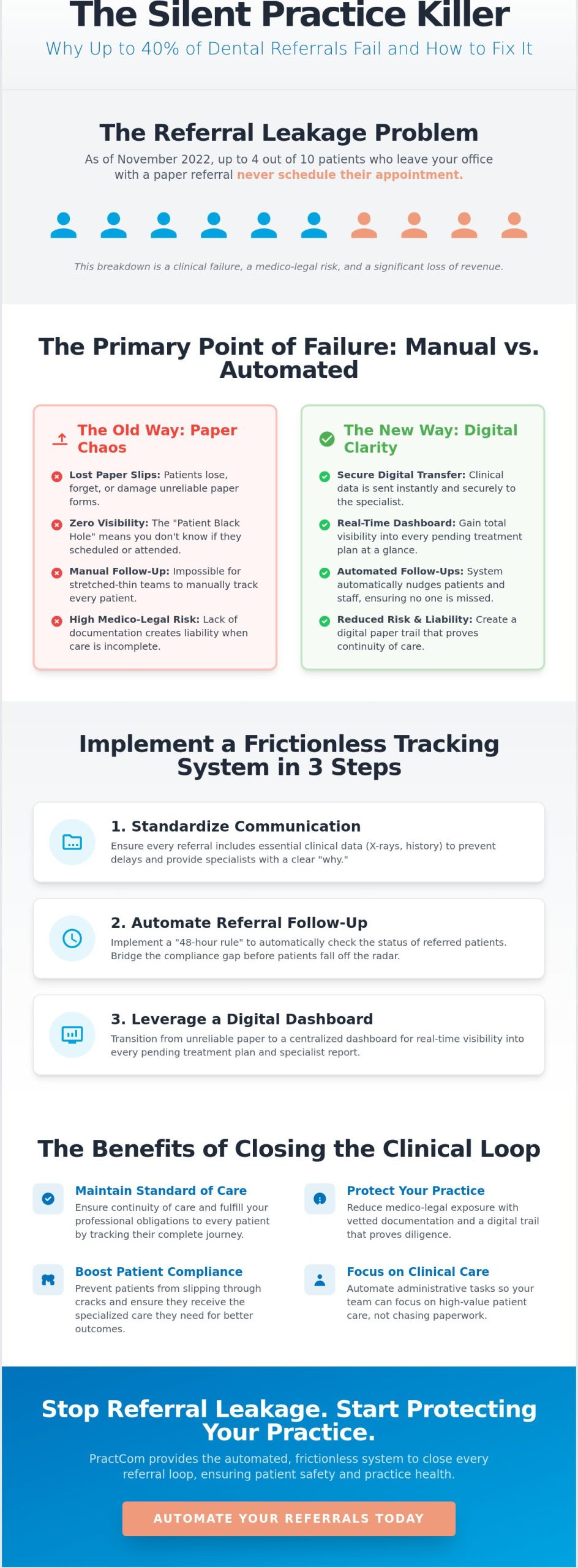
Did you know that as of November 2022, up to 40% of patients who walk out of your office with a paper referral form never actually schedule that appointment? It’s a frustrating reality that every clinical team faces. You’ve diagnosed the need for an RCT or specialized perio care, only to have the treatment plan stall because a patient lost a slip of paper. This breakdown in referral follow-up isn’t just an administrative headache. It’s a clinical failure that creates significant medico-legal risk when the standard of care isn’t documented as complete.
You likely agree that your team is already stretched thin, making manual tracking nearly impossible. However, you can eliminate this “referral leakage” and protect your practice by moving from manual chaos to a standardized, automated system. Why it’s critical: a predictable loop ensures patients stay compliant and specialist reports return to your office on time. This guide explores how to implement a frictionless tracking system that provides total visibility into every patient’s journey without adding extra work to your day.
Key Takeaways
- Recognize why closing the clinical loop is essential for maintaining the standard of care and protecting your practice from medico-legal exposure.
- Establish a standardized communication protocol to ensure specialists receive necessary clinical data like X-rays and history without adding friction to your day.
- Implement an automated referral follow-up system to bridge the compliance gap and prevent patients from slipping through the cracks after they leave your chair.
- Transition from unreliable paper slips to a centralized digital dashboard that provides real-time visibility into every pending treatment plan.
- Learn why it’s critical to leverage technology that automates administrative tasks, ensuring your team remains focused on high-value clinical care.
The Silent Revenue Killer: Why Dental Referral Follow-Up Fails
The referral loop is the clinical lifecycle of a patient’s journey outside your four walls. It begins the moment you diagnose a need for specialized care, such as an RCT or complex perio surgery, and only concludes when the final specialist report is filed in your patient record. When this loop remains open, it creates a vacuum where both clinical outcomes and practice revenue disappear. This isn’t just a minor administrative oversight; it’s a systemic drain on your practice’s health.
Leakage occurs when that loop is broken. Statistics from November 2022 show that between 30% and 40% of patients who receive a paper referral form never actually schedule the appointment. For the specialist, this means an empty chair and a fragmented schedule. For you, the general dentist, it means the restorative work dependent on that specialist’s intervention never happens. It’s a lose-lose scenario born from a lack of consistent referral follow-up. Relying on a patient to act as the primary courier of clinical information is a recipe for chaos.
Paper referral slips are the primary point of failure in modern dentistry. They’re easily lost, forgotten in car glove boxes, or buried under household mail. Why it’s critical: manual systems lack the secure, tracked delivery logs found in modern Electronic Health Records, leaving you with zero visibility into whether the patient even reached the specialist’s front desk. Without a digital trail, you’re practicing in the dark. Adopting a purpose-built dental referral management software is the most effective way to replace this uncertainty with a fully auditable, automated workflow.
The Standard of Care and Medico-Legal Liability
An unclosed referral loop is often viewed by regulatory bodies as a failure in the continuity of care. If a patient’s condition worsens because they didn’t follow through on a referral you didn’t track, the liability often rests on your shoulders. Referral tracking is a vital risk management strategy for the 2026 dental practice that prioritizes patient safety. Vetted documentation acts as your shield during audits, proving that you met the standard of care by attempting to close the loop and protect the patient’s health.
Identifying the Points of Failure in Your Current System
The “Patient Black Hole” occurs the second a patient leaves your office. Without an automated nudge, the urgency of the clinical need is replaced by the distractions of daily life. Then there is “Specialist Silence.” You might know the patient attended the appointment, but without the final report, you can’t proceed with the next phase of treatment. This communication chaos doesn’t just hurt the bottom line; it erodes patient trust. When a patient feels lost in the system, their anxiety spikes, and they begin to question the organization and professionalism of your entire practice. Consistent referral follow-up is the only way to bridge these gaps and maintain the high level of care your patients expect.
Standardizing the Specialist-GP Communication Loop
Effective communication is the backbone of clinical success, yet it’s often the first thing to break down when a practice gets busy. Standardizing the way you transfer information to a specialist isn’t just a courtesy; it’s a clinical necessity. When a specialist receives a “naked” referral-one lacking recent X-rays or a clear history-it adds immediate friction to their day and delays patient care. By establishing a rigid protocol for what accompanies every patient, you transform from a chaotic source of leads into a Reliable Clinical Ally.
Timing is everything. Implementing a “48-hour rule” ensures your team checks the status of every referred patient within two business days. This proactive referral follow-up allows you to catch non-compliant patients before they fall off the radar entirely. It shows the patient that you are invested in their total health, not just the procedure performed in your chair. This level of organization builds a reputation for excellence that specialists will notice and reciprocate.
The Essential Referral Data Set
To ensure a seamless transition, every referral must include a standardized package of digital radiographs and specific clinical notes. Why it’s critical: Providing the specialist with the exact “why” behind the referral prevents redundant imaging and reduces patient radiation exposure. Use plain-language summaries so the patient understands the necessity of the visit. You can easily manage these data sets and track their delivery by Mastering Dental Referral Management Software, which keeps all parties on the same page without adding friction to your day.
Formalizing the ‘Report Back’ Process
The loop only closes when the specialist’s report is back in your hands. You must set clear expectations with your specialist partners regarding post-treatment documentation. For example, a general dentist cannot accurately plan a final restoration after an implant or RCT without knowing the specific materials or tooth conditions encountered during surgery. Standardized reports ensure you have the data needed to provide the highest Standard of Care. This formal process eliminates “hidden referral card” syndrome, where critical patient information sits on a desk instead of being scanned into the digital record. Consistent communication ensures that no part of the treatment plan is left to chance, providing you with true peace of mind. If you’re ready to streamline these interactions, consider a system that allows for frictionless clinical updates between offices.
Solving the Patient Compliance Gap: Why Referrals Go Unfilled
Understanding why a patient ignores a referral is the first step toward fixing your practice’s leakage. While academic studies often cite cost as a primary barrier, clinical reality shows that fear of the unknown and simple forgetfulness are equally powerful. A patient diagnosed with a complex perio issue or a failing root canal is often in a state of “clinical overwhelm.” They hear your recommendation, but by the time they reach the parking lot, the details are fuzzy and the paper slip is already buried in a handbag. This is exactly Why Patients Ignore Dental Referral Slips and why a manual approach to referral follow-up consistently fails.
Automation bridges the gap between your clinical recommendation and the specialist’s front desk. Instead of hoping the patient remembers to call, you can implement a system that stays in front of them with professional, empathetic touchpoints. Why it’s critical: digital persistence replaces the friction of a lost paper slip with the convenience of 24/7 access to specialist information. When you provide a secure Patient Portal, you empower the patient to review instructions and contact details on their own terms, significantly improving the likelihood of treatment follow-through.
Automated Patient Follow-Up Cadences
A structured cadence removes the burden from your front office team while keeping the patient engaged. The “Day 1” text is essential; it confirms the referral immediately and provides the specialist’s digital business card directly to the patient’s phone. If the specialist hasn’t confirmed an appointment by “Day 7,” a gentle, automated nudge reminds the patient that their health is the priority. Since April 2026, PractCom has supported automated messaging in 15 languages, ensuring that language barriers never become a reason for a patient to slip through the cracks. This multilingual support is a vital component of a modern referral follow-up strategy that respects the diversity of your patient base.
Reducing Friction with Digital Instructions
Paper slips are a relic of a slower era and are the leading cause of non-compliance. By replacing them with a secure link to digital instructions, you ensure the patient always has the “vetted” information they need. Using “Five-Click” systems allows patients to find the specialist’s office, view map directions, and call the desk in seconds. Digital portals reduce patient anxiety during the transition to a specialist by providing a clear, predictable roadmap for their care. This frictionless transition protects the patient’s health and secures the restorative revenue waiting for you once the specialist’s work is complete. It’s about moving from the chaos of “I forgot” to the control of a standardized clinical loop.
Implementing a Frictionless Referral Tracking System
Transitioning your practice from the chaos of physical slips to a streamlined digital system is the only way to ensure no patient is left behind. While generic business advisors often suggest using spreadsheets to track leads, this approach creates clinical chaos and fails to meet HIPAA requirements. A centralized digital referral dashboard provides the real-time visibility you need to manage your referral follow-up without the risk of data silos or manual entry errors. It’s about moving from a reactive “hope they called” mindset to a proactive, standardized protocol. Practices that have made this transition by implementing dedicated dental referral management software report measurable reductions in leakage and significant time savings for their front office teams.
Establishing this system involves four critical steps to protect your practice and your patients:
- Step 1: Move from physical slips to a centralized digital referral dashboard that tracks every outbound request in real time.
- Step 2: Assign a dedicated “Referral Coordinator” or, more efficiently, automate the role using specialized software to handle repetitive nudges.
- Step 3: Establish clear “Completion” criteria, such as requiring the specialist’s report to be received and scanned into your PMS before a case is marked as closed.
- Step 4: Audit the referral pipeline monthly using a performance dashboard to identify bottlenecks or non-compliant specialist partners.
Why it’s critical: Without these standardized steps, your team spends hours on “detective work” trying to find out which patients actually completed their treatment. You can streamline your referral tracking today to gain the peace of mind that comes with a closed-loop system. For a deeper look at building this process from the ground up, our clinical guide to implementing dental referral management walks you through every step required to achieve 100% visibility on your outbound cases.
The Role of the Practice Performance Dashboard
Data is the best tool for identifying which specialists are your most responsive “Clinical Allies.” By auditing your pipeline, you can track the ROI of referred-out procedures compared to your in-house production. This high-level view allows you to see exactly where patients are dropping out of the treatment loop. If a specific specialist has a 40% non-compliance rate with your patients, it may be time to re-evaluate that professional relationship to protect your restorative revenue.
Streamlining the Front Office Workflow
Front office teams are often stretched thin, making manual phone calls a low-priority task. Implementing “One-Click” actions allows your admin team to send secure clinical data and follow-up reminders in seconds rather than minutes. This frictionless approach also impresses referring GPs when you are on the receiving end of a referral. Most importantly, every action is automatically logged. This creates a permanent, vetted record of your referral follow-up efforts, providing essential medico-legal protection in the event of a board audit or patient dispute.
Beyond the Referral Slip: How PractCom Automates the Loop
PractCom acts as the stabilizing force your practice needs to move from clinical chaos to administrative control. It isn’t just a communication tool; it acts as a Reliable Clinical Ally that guards your reputation and ensures no patient is left behind. By transforming the fragmented process of referral follow-up into a streamlined, frictionless workflow, you can focus on dentistry while the system handles the administrative heavy lifting. Why it’s critical: An automated system provides the medico-legal reassurance that every recommendation is tracked, vetted, and closed, maintaining the highest Standard of Care without adding friction to your day.
The platform replaces the uncertainty of manual tracking with the precision of the Practice Performance Dashboard. You gain 24/7 access to tracked delivery logs, showing exactly when a referral was sent, opened, and acted upon. This level of control eliminates the anxiety of “incomplete” treatment plans. Instead of reacting to failures, you’re empowered with a system that anticipates them, offering a pre-emptive strike against patient non-compliance.
The Power of Integrated Patient Communication
A referral doesn’t exist in a vacuum. To provide a truly seamless patient experience, your communication must be consistent across all touchpoints. In April 2026, PractCom announced a new feature: automated, multilingual informed consent. This allows you to send consents and post-op instructions in 15 languages via email and text, which patients sign digitally. When these tools work alongside your referral follow-up cadences, you create a comprehensive ecosystem where instructions are never lost and details are never forgotten. This integrated approach provides the “peace of mind” that every clinical loop is securely closed.
Getting Started with Standardized Follow-Ups
Many practitioners rely on generic PMS referral modules, but these often lack the sophisticated automation required for modern practice. These basic modules are frequently just digital checkboxes that still require manual phone calls and “detective work” from your team. A dedicated communication suite is superior because it proactively manages the relationship between the GP, the specialist, and the patient.
Implementation doesn’t have to be a burden. With a “Five-Click” setup, you can establish your referral network and begin tracking outbound cases in minutes. This rapid deployment means your team starts saving hours of manual labor immediately. You can See how PractCom streamlines your referral management and move your practice toward a more predictable, protected, and profitable future. By choosing a system designed for the realities of clinical practice, you ensure that your documentation is always audit-ready and your patients always receive the care they need.
Securing the Standard of Care through Automated Clinical Loops
Standardizing your referral follow-up is the most effective way to eliminate the 40% non-compliance rate historically associated with traditional paper slips. You’ve learned that closing this loop is not just about administrative efficiency; it’s a clinical necessity that protects your restorative revenue and your patient’s health. Moving from manual chaos to a digital dashboard provides the visibility you need to manage specialist relationships and ensure every treatment plan reaches completion.
PractCom serves as your Reliable Clinical Ally by replacing friction with a standardized, automated system. With a library of 80+ vetted templates and tracking capabilities in 15 languages, you can provide clear instructions to every patient regardless of their primary language. Why it’s critical: the system automatically generates the medico-legal documentation required to prove you’ve met the professional Standard of Care. This isn’t just software; it’s a shield for your practice’s reputation and legal standing.
Take the first step toward a more organized and protected office. Streamline your referral follow-up with PractCom today and enjoy the confidence of knowing no patient will ever slip through the cracks again. Your practice is ready for the control and peace of mind that automation provides.
Frequently Asked Questions
What is the best timeline for a dental referral follow-up?
The 48-hour rule is the industry standard for the initial referral follow-up. You should check if the patient has scheduled within two business days. If they haven’t, a second nudge should occur at the 7-day mark. This timeline catches non-compliant patients before the clinical urgency fades from their memory. Why it’s critical: consistent timing prevents patients from slipping into a “black hole” where treatment plans stall and conditions worsen.
How do I track referrals without adding more work for my front desk?
You can track referrals by moving from manual logs to a centralized digital dashboard. Automation handles the repetitive task of nudging patients and specialists, which saves your admin team hours of phone calls. Why it’s critical: digital systems provide real-time visibility into the pipeline without adding friction to your day. This allows your team to focus on high-value clinical tasks while the software ensures no patient is forgotten.
Is it the GP’s or the Specialist’s responsibility to follow up with the patient?
While both parties share communication duties, the general dentist holds the primary medico-legal responsibility for the patient’s continuity of care. If a patient fails to see a specialist and their condition deteriorates, the GP must prove they attempted to close the loop. Maintaining a vetted log of every referral follow-up attempt is essential for protecting your practice’s reputation and meeting the professional Standard of Care during audits.
What should be included in a professional referral follow-up email?
A professional follow-up should include the specialist’s name, contact information, and a secure link to map directions. You should also provide a plain-language summary of why the treatment is necessary to reduce patient anxiety. Why it’s critical: providing a digital business card directly to the patient’s phone removes the barrier of a lost paper slip. This ensures the patient has all the tools needed to schedule the appointment in seconds.
How can I improve patient compliance for specialist referrals?
Improving compliance requires reducing the friction between your recommendation and the specialist’s chair. You can achieve this by providing digital instructions and 24/7 access to specialist details through a patient portal. Since April 2026, offering these instructions in 15 languages has become a key strategy for removing cultural barriers. When patients feel understood and have easy access to information, their likelihood of following through increases significantly.
What are the legal risks of not following up on a dental referral?
The legal risks include being held liable for a failure in the continuity of care or a delay in diagnosis. If a patient’s tooth requires extraction because they didn’t follow through on an endodontic referral you didn’t track, your practice faces significant exposure. Why it’s critical: documented follow-up attempts serve as your primary defense in board audits. It proves you fulfilled your ethical obligation to guide the patient toward necessary treatment.
Can automated SMS messages be used for referral follow-ups under HIPAA?
Yes, automated SMS messages are permitted for referral follow-up cadences, provided you use a HIPAA-compliant secure texting platform. According to CMS guidance issued in February 2024, texting patient information is allowed if the platform meets strict security standards. PractCom’s system ensures that every message is secure and automatically saved to the patient’s record. This provides a frictionless way to communicate without compromising patient privacy.
How do I know if my referral management system is actually working?
You’ll know your system is working when your Practice Performance Dashboard shows a measurable decrease in referral leakage and an increase in restorative revenue. Track metrics such as specialist response times and patient dropout rates to identify bottlenecks. A successful system moves your office from a state of chaos to one of control. It ensures that every referral is a documented, predictable part of your practice’s clinical workflow.

Article by
Cary Ganz DDS
Dr. Cary H. Ganz is a dentist, prosthodontist, entrepreneur, lecturer, and author with more than 50 years of experience in clinical dentistry and dental technology. Throughout his career, he has combined hands-on patient care with a deep understanding of how technology can improve dental practice operations, communication, documentation, and patient outcomes.
In addition to his clinical background, Dr. Ganz has held significant leadership roles in the dental technology industry, including Past Owner and Vice President of Clinical Affairs at DEXIS Digital Radiography and Past Vice President of Clinical Affairs at Denticon Practice Management Software. His business experience includes product development, clinical strategy, dental software innovation, practice management solutions, and educating dental professionals on the effective use of technology in modern dentistry.
Today, Dr. Ganz continues to focus on creating practical technology solutions for dental practices, including PractCom, a comprehensive dental practice communication platform designed to improve patient communication, documentation, compliance support, referrals, and overall practice efficiency. His work reflects a career-long commitment to helping dentists deliver better care while making their practices more organized, efficient, and protected.
No responses yet