
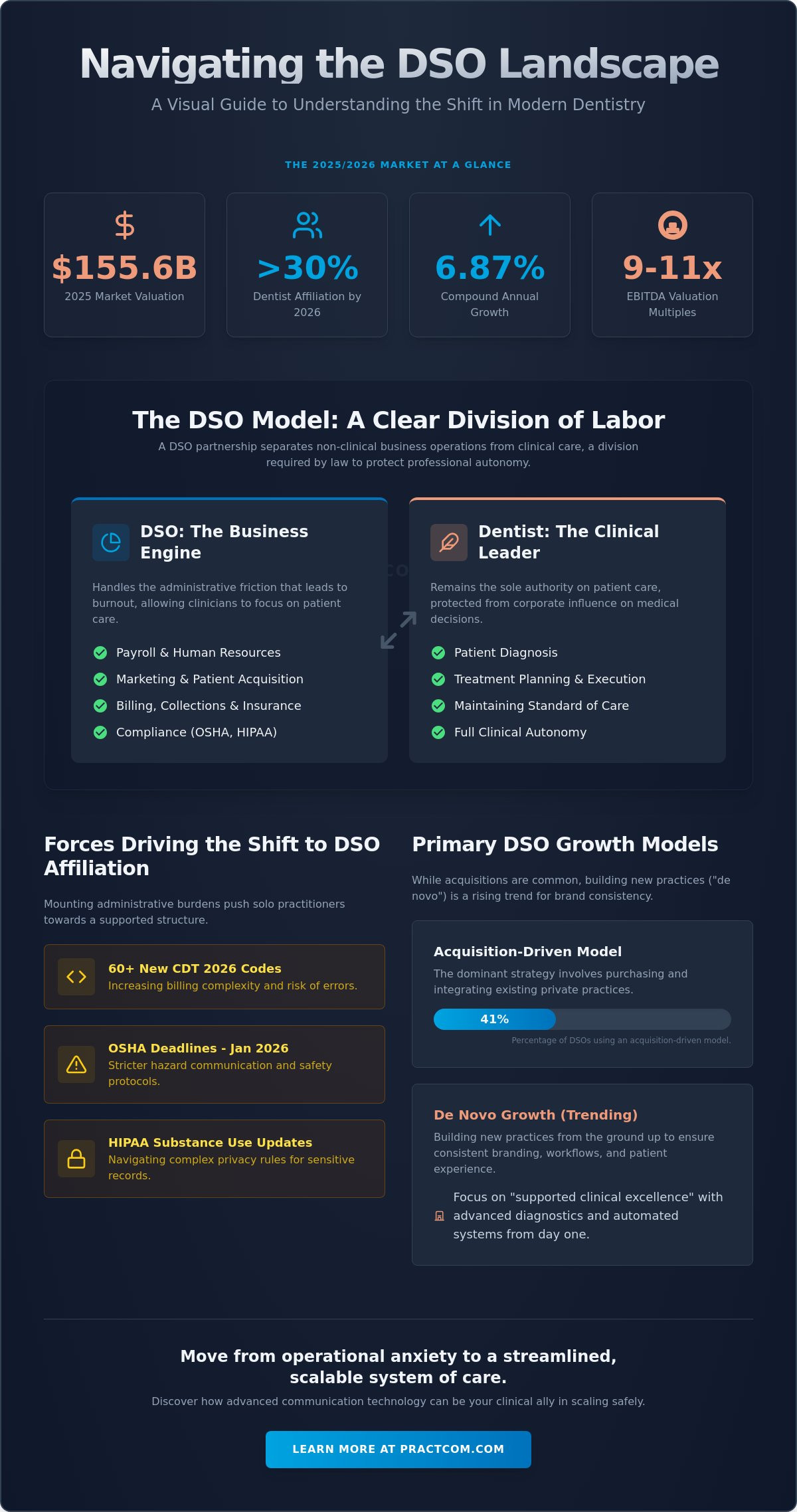
The U.S. market for dental support organizations, or dsos, reached a staggering $155.65 billion valuation in 2025, signaling a permanent shift in how modern dentistry functions. You’ve likely felt the mounting pressure of this transition, especially as you balance the 60 new CDT 2026 code changes against the daily operational chaos of a solo practice. It’s exhausting to maintain a high standard of care when you’re also worried about the January 2026 OSHA Hazard Communication deadlines or the latest HIPAA updates regarding substance use records. You deserve to focus on clinical excellence rather than administrative friction.
This guide provides the clarity you need to navigate the DSO landscape with confidence. You’ll discover how these organizations are reshaping the industry and learn practical strategies to maintain your clinical autonomy within a corporate structure. We will examine the impact of the Improving Dental Administration Act of 2026, analyze current valuation multiples of 9 to 11x EBITDA for large practices, and outline a framework for standardized, medico-legal documentation that protects your reputation. Why it’s critical: understanding these structures is the only way to move from operational anxiety to a streamlined, scalable system of care.
Key Takeaways
- Define the critical boundary between non-clinical management and clinical autonomy to protect your practice’s legal standing and professional reputation.
- Evaluate various dsos structures, from brand-neutral affiliations to fully integrated models, to determine which best fits your vision for scalability.
- Implement standardized informed consent and clinical protocols that ensure a consistent Standard of Care across every location in your organization.
- Identify the specific KPIs that balance administrative efficiency with clinical quality to create a frictionless practice environment for your team.
- Discover why advanced communication tech acts as a “clinical ally” to help you scale safely without adding friction to your day.
What is a DSO? Defining the Dental Support Organization Model
A Dental Support Organization is a professional entity that contracts with dental practices to manage their non-clinical, administrative operations. This partnership creates a clear division of labor. The dentist remains the clinical leader, while the organization handles the operational friction that often leads to burnout. By centralizing tasks like payroll, human resources, and facility management, these entities allow clinicians to focus entirely on patient outcomes and the Standard of Care. It’s a model designed to replace the chaos of manual office management with a streamlined, scalable system.
The distinction between administrative and clinical roles isn’t just a business preference; it’s a legal necessity. As of April 2026, most states maintain strict “corporate practice of dentistry” laws that require clinical decisions to remain in the hands of licensed practitioners. A DSO manages the business side, but they don’t diagnose patients or dictate treatment plans for procedures like an RCT or complex perio cases. This legal boundary protects your professional autonomy while providing the back-office power needed to stay competitive. Why it’s critical: Failing to maintain a clear separation between business management and clinical judgment can lead to severe medico-legal complications and regulatory scrutiny.
The current market landscape shows that dsos are no longer a niche alternative. By the end of 2026, over 30% of U.S. dentists are expected to be affiliated with a support organization. This shift is driven by the increasing complexity of practice ownership, including the January 2026 OSHA hazard communication updates and the 60 new CDT 2026 code changes. Many practitioners are finding that the “Reliable Clinical Ally” provided by a support structure offers the peace of mind they can’t achieve as solo owners.
The Evolution of the DSO in 2026
The industry has moved far beyond small regional clusters. Today, international giants dominate the space, fueled by a 6.87% compound annual growth rate. While 41% of dsos still utilize an acquisition-driven model, we’re seeing a significant shift toward “de novo” growth. This means organizations are building new practices from the ground up to ensure brand consistency. The focus has evolved from simple cost-cutting to “supported clinical excellence,” where the organization provides advanced AI diagnostics and automated workflows to enhance the patient experience.
DSO vs. Private Practice: The Fundamental Differences
The most striking difference lies in ownership and operational focus. In a traditional private practice, you own the real estate, the equipment, and the patient records. In a DSO model, the management entity often holds these assets while you focus on the clinical side. Centralized billing and marketing replace the “hidden referral cards” and forgotten follow-up calls common in solo offices. However, this centralization requires a robust framework for informed consent and documentation. You must ensure that the organization’s systems support your clinical decisions rather than creating “standardization chaos” that ignores patient-specific needs.
The Main Types of DSO Structures and Affiliations
Choosing a partnership model is a strategic pivot that defines your clinical legacy. You aren’t just selecting a buyer; you’re selecting a management philosophy. The Association of Dental Support Organizations provides an essential framework for Defining the Dental Support Organization Model, emphasizing that the right fit depends on your desired level of clinical involvement and your long-term financial goals.
Affiliation models are ideal if you’ve spent decades building a trusted local reputation. You keep your practice name and local identity while the organization handles the “invisible” tasks like payroll, vendor negotiations, and IT support. In contrast, fully branded dsos create a uniform patient experience across hundreds of locations. This model is highly efficient for the de novo growth we’re seeing in 2026 because it uses a vetted, repeatable playbook for everything from office floor plans to patient intake workflows. For specialists, the rise of endodontic and orthodontic-specific dsos offers a way to scale complex procedures like an RCT or clear aligner therapy without the administrative burden of a general practice. Joint venture models further bridge the gap by allowing clinical founders to retain a significant stake in the local entity, sharing both the operational risks and the financial rewards.
Integrating a streamlined communication platform allows these diverse models to maintain a high Standard of Care without adding friction to your day.
Branded vs. Non-Branded Support
Maintaining a local brand helps preserve patient loyalty, but it can complicate centralized marketing efforts. Fully branded models often see a 15% to 20% reduction in patient acquisition costs due to national brand recognition and unified digital strategies. Standardizing the patient experience across diverse local brands requires a meticulous approach to documentation. You must ensure that every office, regardless of the name on the door, follows the same medico-legal protocols for informed consent and post-op instructions to prevent “standardization chaos.”
Equity and Buy-In Opportunities
The 2026 market favors deal structures that include rolling equity. In a typical arrangement, a practitioner might receive 70% to 80% of the practice value in cash at closing, with the remaining balance “rolled” into equity in the larger organization. This aligns the interests of the dentist and the DSO. For younger associates, many organizations now offer clear paths to partnership, allowing them to earn equity through clinical performance and tenure rather than just capital investment. Why it’s critical: Your equity structure is the primary driver of long-term wealth. Understanding the difference between local-level equity and parent-company shares is essential for protecting your financial future and ensuring your exit strategy remains secure.
Navigating the Medico-Legal Realities of the DSO Model
Scaling a dental group brings undeniable economic advantages, but it also introduces the risk of “Standardization Chaos.” This phenomenon occurs when centralized business systems focus so heavily on administrative speed that they fail to account for clinical nuances. While 41% of dsos currently utilize an acquisition-driven growth model, the rapid integration of new offices often creates gaps in documentation. These gaps are where legal liabilities hide. Your medico-legal documentation is the practice’s primary defense against malpractice claims. It must remain ironclad across every location, regardless of how fast the organization grows. Bridging the gap between administrative efficiency and clinical thoroughness is the only way to protect both the practitioner’s license and the organization’s reputation.
Compliance requirements are evolving rapidly in 2026. As of February 16, 2026, HIPAA-covered practices must update their Notice of Privacy Practices to include specific disclosures regarding substance use disorder records. Additionally, the new California law that took effect on January 1, 2026, prohibits private equity groups from imposing patient quotas or interfering in clinical referral decisions. Why it’s critical: Staying ahead of these regulatory shifts provides the peace of mind necessary to focus on patient care. You need a system that acts as a guardian of your reputation, ensuring that every chart note and consent form meets the highest professional standards.
Standardizing Informed Consent
Paper-based consent forms are a significant liability in a high-volume clinical environment. Physical files are easily lost. Patients forget details. In 2026, digital, multilingual consent forms are a DSO requirement. These systems allow your team to create, send, and track consents without adding friction to the day. By using vetted, plain-language templates for procedures like an RCT or complex perio treatment, you ensure the patient truly understands the risks and benefits. This level of clarity is essential for maintaining the Standard of Care across a multi-location organization.
Post-Treatment Compliance as a Risk Management Tool
Post-op instructions are frequently the first point of failure in patient communication. When teams are stretched thin, verbal instructions are often glossed over, and paper handouts are discarded before the patient even reaches their car. Automated post-treatment workflows solve this by delivering clear guidance directly to the patient’s mobile device. This reduces emergency phone calls and alleviates patient anxiety. Crucially, it creates a tracked digital paper trail that proves the instruction was delivered and accessed. For a detailed framework, read our guide on Automated Dental Post-Op Instructions: The 2026 Guide to Frictionless Aftercare. This proactive approach acts as a pre-emptive strike against common office failures, ensuring clinical safety while maintaining administrative speed.
Measuring DSO Success: Efficiency vs. Clinical Quality
Success for modern dsos isn’t just a matter of increasing collections. It’s about balancing administrative speed with the ethical demands of clinical quality. In 2026, the ideal overhead for a dental practice sits between 58% and 65%, yet many DSO-managed offices see ratios climb to 62% or 70% due to management fees. To justify this higher cost, the organization must deliver extreme efficiency through automated clinical workflows. This “Frictionless Practice” model replaces manual administrative tasks with standardized systems, ensuring that your team isn’t stretched thin by redundant data entry or paperwork chaos.
Why it’s critical: Efficiency should never come at the cost of the patient experience. If a patient feels like “just a number” because the front desk is overwhelmed, the Standard of Care suffers. You need a system that acts as a clinical ally, protecting your reputation while streamlining the business. By moving from manual tasks to a “One-Click” philosophy, you create an environment where clinicians can focus on the physical demands of the chair rather than the friction of the back office. Leveraging AI in dental patient communication is one of the most effective ways to close the gap between administrative efficiency and the personalized care patients expect.
The Role of Referral Tracking in Large Groups
Traditional paper referral slips are a primary source of “referral leakage.” Patients frequently lose these slips, leading to lost revenue and fragmented care. In a multi-specialty DSO, a digital referral management system is essential for maintaining the GP-to-specialist pipeline. By tracking every referral in real-time, you ensure patients receive the follow-up care they need, whether it’s for an RCT or specialized perio treatment. This centralized tracking provides a clear ROI by keeping production within the organization’s ecosystem and ensuring no patient falls through the cracks.
Patient Portals and the Modern DSO Experience
Modern patients expect 24/7 access to their clinical documentation and treatment plans. Providing this through a secure portal significantly reduces front-desk burnout by eliminating the need for staff to manually send records or answer basic scheduling questions. Automated follow-ups and integrated smile design tools further enhance this experience, making treatment options clear and visual for the layperson. This level of transparency increases case acceptance across the entire organization without adding friction to your day. To achieve this level of operational control, you need a total practice communication system that bridges the gap between your PMS and the patient.
Scaling Standard of Care: Why Communication Tech is the Secret Weapon
While many dsos focus on centralizing billing and payroll, the most successful organizations realize that clinical communication is the hardest element to scale. Most Practice Management Software (PMS) platforms are designed for financial transactions and scheduling, not for the nuanced reality of patient education or post-operative care. This creates a dangerous gap. If your communication isn’t standardized, your liability increases with every new location you acquire. You need a “clinical ally” layer that ensures every patient receives the same high-quality information, whether they’re visiting a de novo practice in Georgia or an affiliated office in California. Understanding how to deploy AI-driven dental patient communication tools to build trust and automate follow-up is now a core competency for any DSO looking to scale responsibly in 2026.
We built the “Five-Click” system to ensure that compliance is always easier than cutting corners. In a high-pressure environment where teams are stretched, any system that adds friction will be ignored. By providing 80+ vetted post-treatment templates in 15 languages, you allow your team to deliver elite care in seconds. Why it’s critical: Standardized communication protects your practitioners from the anxiety of forgotten instructions or lost medico-legal documentation. It transforms the “chaos” of manual handouts into a controlled, tracked, and professional ecosystem that supports your clinical staff instead of burdening them.
Standardizing the Un-Standardizable
Patients don’t just judge your organization by the clinical outcome of an RCT or a perio surgery. They judge it by the quality and clarity of the interaction. Automated messaging bridges the gap between clinical coldness and administrative warmth. It ensures a consistent voice across one hundred locations, making every patient feel seen and supported. This isn’t just about efficiency; it’s about maintaining the Standard of Care at scale. When a patient receives a clear, plain-language text immediately after their procedure, their anxiety drops and their trust in your brand increases.
Implementing a Total Practice Communication System
A centralized documentation library reduces the medico-legal anxiety of the DSO executive team. You no longer have to wonder if a specific office is providing the correct informed consent for the 31 new CDT 2026 codes. The system handles the updates and delivery logs, so you don’t have to. This level of control is essential for managing the 6.87% growth rate expected in the industry through 2035. It moves your organization from a reactive state to a proactive one, where every referral and post-op instruction is tracked and vetted. Discover how PractCom helps DSOs standardize clinical communication without adding friction.
Mastering the Modern Dental Support Model
The dental landscape is undergoing a permanent transformation. By 2026, the influence of dsos has made it clear that clinical excellence alone isn’t enough to sustain a practice; you also need absolute operational control. You’ve learned that the secret to scaling safely lies in the clear division between business management and clinical judgment. Why it’s critical: Without a standardized system for informed consent and post-op instructions, your reputation is at the mercy of administrative friction. You deserve a system that acts as a guardian of your legal standing while your team focuses on the physical demands of care.
Implementing a robust communication layer allows you to maintain a high Standard of Care without adding friction to your day. It’s about moving from the chaos of manual tasks to the peace of mind that comes with a vetted, automated system. Standardize your clinical communication with PractCom to access our library of 80+ vetted post-treatment templates and multilingual support in 15 languages. Our platform provides the medico-legal documentation tracking you need for total peace of mind. Take control of your practice’s future and focus on providing exceptional care to your patients with confidence.
Frequently Asked Questions
Do DSOs own the dental practice?
DSOs do not own the clinical dental practice in states where the corporate practice of dentistry is prohibited. Instead, the organization owns the business assets and provides management services through a professional service agreement. Why it’s critical: This structure ensures a licensed dentist remains legally responsible for patient care while the DSO handles the operational friction. It’s a legal safeguard that protects your professional license and autonomy.
How do DSOs impact clinical autonomy for dentists?
Legally, your clinical judgment remains independent from the management entity. New regulations, such as the California law that took effect on January 1, 2026, explicitly prohibit management groups from imposing patient quotas or interfering in your referral decisions. Modern dsos aim to be a clinical ally by providing advanced AI diagnostics and digital workflows without dictating how you treat an RCT or perio case.
What is the difference between a DSO and a group practice?
A group practice is typically a clinical partnership owned and managed by dentists who share clinical and administrative duties. In contrast, dsos are separate management entities that provide non-clinical support services to multiple locations. This allows a group practice to scale by offloading the chaos of payroll, marketing, and HR to a specialized team that focuses entirely on business efficiency.
Can a DSO help with HIPAA compliance?
Yes, they provide the standardized infrastructure needed for rigorous medico-legal documentation and privacy safeguards. As of February 16, 2026, all HIPAA-covered practices must update their Notice of Privacy Practices regarding substance use records. A support organization ensures these updates are implemented across all locations without adding friction to your day. This proactive approach acts as a guardian of your practice’s reputation and legal standing.
Why are private equity firms so interested in DSOs?
Private equity firms value the predictable, recession-resistant cash flow of dental offices. With the U.S. market valued at $155.65 billion in 2025, firms see a massive opportunity for consolidation and growth. They often use high valuation multiples, typically 9 to 11x EBITDA for established groups, to attract practitioners looking for a secure exit strategy. This investment drives the 6.87% compound annual growth rate expected through 2035.
What happens to my staff if I sell my practice to a DSO?
Most organizations retain existing clinical staff to maintain the local Standard of Care and patient trust. However, your team’s employment contracts and benefits packages will transition to the DSO’s centralized HR system. This shift often provides staff with better health insurance and 401(k) options that solo practices can’t afford. It’s a transition that replaces administrative chaos with a more structured, professional employment environment.
How does a DSO handle patient referrals?
Support organizations use centralized digital tracking to manage the GP-to-specialist pipeline and prevent “referral leakage.” This ensures patients receive the follow-up care they need within the organization’s ecosystem. By using a streamlined referral system, you ensure that complex treatments remain with trusted specialists. This level of control protects your production and ensures that no patient falls through the cracks due to a lost paper referral card.
Does the term DSO mean anything other than Dental Support Organization?
While “Dental Support Organization” is the industry standard, you may also see the term “Dental Service Organization.” Both terms refer to the same management model where a business entity handles non-clinical operations. Regardless of the label, the goal is to provide a stabilizing force in a chaotic environment. This allows dentists to focus on the realities of clinical practice rather than the physical demands of office management.

Article by
Cary Ganz DDS
Dr. Cary H. Ganz is a dentist, prosthodontist, entrepreneur, lecturer, and author with more than 50 years of experience in clinical dentistry and dental technology. Throughout his career, he has combined hands-on patient care with a deep understanding of how technology can improve dental practice operations, communication, documentation, and patient outcomes.
In addition to his clinical background, Dr. Ganz has held significant leadership roles in the dental technology industry, including Past Owner and Vice President of Clinical Affairs at DEXIS Digital Radiography and Past Vice President of Clinical Affairs at Denticon Practice Management Software. His business experience includes product development, clinical strategy, dental software innovation, practice management solutions, and educating dental professionals on the effective use of technology in modern dentistry.
Today, Dr. Ganz continues to focus on creating practical technology solutions for dental practices, including PractCom, a comprehensive dental practice communication platform designed to improve patient communication, documentation, compliance support, referrals, and overall practice efficiency. His work reflects a career-long commitment to helping dentists deliver better care while making their practices more organized, efficient, and protected.
No responses yet