
How much clinical time and personal peace of mind are you losing to “nuisance” emergency calls that could have been prevented by a better handout? You’ve likely felt the frustration of a patient calling after hours because they’ve misplaced their paper instructions or can’t remember the dosage for their post-extraction pain management. It’s a common operational stress that drains your team’s energy and leaves your practice vulnerable to liability concerns. Implementing a standardized dental post-op instructions template isn’t just about administrative speed; it’s a strategic move to act as a guardian of your reputation and legal standing.
In this guide, you’ll discover how to build and implement standardized post-treatment templates that reduce emergency interruptions, improve patient compliance, and ensure regulatory reassurance. We’ll examine the shift toward digital, multi-language solutions that bridge the gap between complex clinical procedures and patient understanding. You’ll learn how to leverage a library of over 80 templates to create a systematic follow-up process that aligns with the latest 2026 clinical guidelines. This approach transforms your aftercare from a manual burden into a standardized, automated asset that protects your practice while delivering the psychological security your patients need for a faster recovery.
Key Takeaways
- Reframe aftercare documentation as a vital risk management asset that protects your practice from liability while ensuring patient safety.
- Identify the non-negotiable “Red Flag” symptoms every template must include to prevent unnecessary emergency calls and improve recovery outcomes.
- Discover why a digital dental post-op instructions template delivered via SMS or email outperforms paper handouts by providing accessible, trackable guidance.
- Implement a systematic 5-step workflow to standardize post-treatment protocols across your clinical team for maximum efficiency and staff buy-in.
- Access a library of 80+ pre-built templates and automated follow-up systems to scale patient communication without increasing your administrative workload.
The Role of a Dental Post-Op Instructions Template in 2026
A dental post-op instructions template is a standardized clinical document designed to guide patients through the critical recovery phase following a procedure. While it might look like a simple list of rules, it’s actually a sophisticated risk management tool. In 2026, the dental industry has moved away from viewing these handouts as optional extras. Instead, they’re now considered essential documentation that protects your practice from liability and ensures clinical consistency. We speak as colleagues who’ve managed the same midnight phone calls and the same frustrated patients. Standardizing this process isn’t just a business move; it’s an ethical necessity for the modern practitioner.
The shift toward structured templates is driven by a need for psychological security. When a patient leaves your chair, they’re often in a state of high cognitive load. They’re processing the physical trauma of the procedure, the effects of local anesthesia, and the logistical stress of getting home. Expecting them to remember verbal instructions is unrealistic. By providing a clear, written roadmap, you’re acting as a guardian of their recovery. This proactive approach reduces the resistance of manual tasks and replaces it with the confidence of a standardized system, creating an immediate bond of shared professional experience between you and your patient.
Standardization vs. Clinical Variance
Every procedure requires a core template to ensure no detail is missed. Whether you’re providing post-operative care after tooth extraction or finishing a simple composite filling, consistency is your best defense against confusion. When your entire team uses the same dental post-op instructions template, you eliminate the risk of conflicting advice. This uniformity builds deep trust because patients feel secure when the assistant, the hygienist, and the doctor all speak with one voice. It creates a sense of order that reflects the high standards of your clinical work and reduces operational friction.
The Psychological Impact of Clear Aftercare
Post-treatment anxiety is a significant barrier to compliance. If a patient doesn’t know what to expect, every minor ache feels like a major complication. This leads to the “anxiety-compliance link,” where high stress causes patients to either over-react or ignore protocols entirely. The anxiety-compliance link dictates that a patient’s ability to follow recovery protocols is inversely proportional to their level of post-operative stress. By proactively defining “normal” symptoms, like minor swelling or slight oozing, you prevent unnecessary emergency room visits. Clear communication provides the administrative warmth that balances technical precision, ensuring no part of the communication process is left to chance.
Critical Components of a High-Compliance Post-Op Template
A high-compliance dental post-op instructions template acts as a bridge between your clinical expertise and your patient’s at-home reality. It’s not enough to list medical facts; you must translate complex surgical requirements into actionable, layman-friendly steps. Modern templates in 2026 use a blend of technical precision for the medical record and simplified language for the patient. This dual-purpose design ensures legal protection for you and psychological security for them. By using a systematic approach, you replace operational disorganization with a reliable, repeatable protocol that protects your reputation and your staff’s time.
Incorporating visual aids or diagrams is a professional necessity in a digital environment. Patients often struggle to visualize concepts like “slight oozing” or “proper gauze placement” when they’re still recovering from anesthesia. A template that includes clear illustrations or links to short instructional videos can significantly reduce the volume of “Is this normal?” inquiries. These visual anchors transform a static document into a dynamic recovery tool, ensuring that your advice remains accessible and understandable long after the patient has left your office.
The Clinical Essentials: Pain, Bleeding, and Hygiene
Your template must provide a clear medication schedule that justifies the rationale for each dose. Following the updated 2026 ADA guidelines for acute pain management, emphasize the combination of NSAIDs and acetaminophen for maximum efficacy. Dietary instructions should be specific. Move beyond “soft foods” and list concrete examples like yogurt, lukewarm soup, or mashed potatoes. Hygiene protocols are equally vital. You must explain exactly how to rinse without using a straw or creating suction, as these small errors often lead to painful complications like dry socket. This technical precision, delivered with administrative warmth, ensures the patient feels guided rather than just instructed.
Emergency Protocols and Contact Information
The “Red Flag” section is the most critical part of your aftercare document. Providing a dental post-op instructions template that clearly defines what constitutes a true emergency, such as a fever over 101°F, uncontrollable bleeding, or difficulty breathing, is vital for patient safety. Identifying these specific symptoms helps patients distinguish between normal healing and a genuine crisis. Provide your after-hours contact details clearly, but set expectations by explaining response times for non-urgent questions. This protects your team’s personal time while ensuring patients feel supported during a genuine crisis. To simplify this process for your staff, you can access our library of 80+ pre-built templates and start delivering professional, standardized advice today.
Static Paper Templates vs. Automated Digital Solutions
Relying on a traditional dental post-op instructions template printed on paper introduces unnecessary risks into your clinical workflow. Physical handouts are easily lost, damaged by moisture, or forgotten in the patient’s car, leaving them without guidance during the most critical hours of recovery. From a risk management perspective, paper offers no way to verify that a patient actually received or reviewed the information. Transitioning to a digital approach is a core component of Optimizing Dental Practice Workflow; it replaces manual printing with automated oversight and provides a timestamped digital paper trail that acts as a guardian for your practice’s reputation.
Digital delivery via SMS or email ensures that recovery protocols are always in the patient’s pocket. This shift moves your practice from a state of operational disorganization to a model of systematic control. When you send a digital dental post-op instructions template, you’re not just providing information; you’re creating a reliable, accessible ecosystem for aftercare. This method significantly increases engagement rates because patients are far more likely to consult a text message than a crumpled piece of paper when they have a question at 9:00 PM. It’s a modern solution that respects the logistical realities of both the patient and the provider.
Accessibility and Multi-Language Support
Clinical compliance often fails when there is a language barrier between the provider and the patient. Providing instructions in a language the patient doesn’t fully master is a significant clinical risk that can lead to improper medication use or missed “red flag” symptoms. A digital system allows you to switch between 15 different languages with a single click, ensuring equity in patient care. This capability transforms a standard instruction sheet into an inclusive professional tool, allowing your staff to provide precise guidance to a diverse patient base without the administrative resistance of manual translation.
Mobile-First Design for the Modern Patient
Modern patients expect their healthcare information to be as mobile-responsive as their banking apps. Digital templates must be designed for the smartphone screen to avoid the frustrating “pinch and zoom” required by static PDFs. By integrating these instructions into a dedicated patient portal, you provide 24/7 access to recovery protocols. This mobile-first approach reduces post-treatment anxiety by making the information easy to read and navigate. It ensures that your technical precision isn’t lost due to poor formatting, allowing the patient to focus entirely on their recovery rather than struggling with a difficult document.
How to Standardize Your Post-Treatment Documentation Workflow
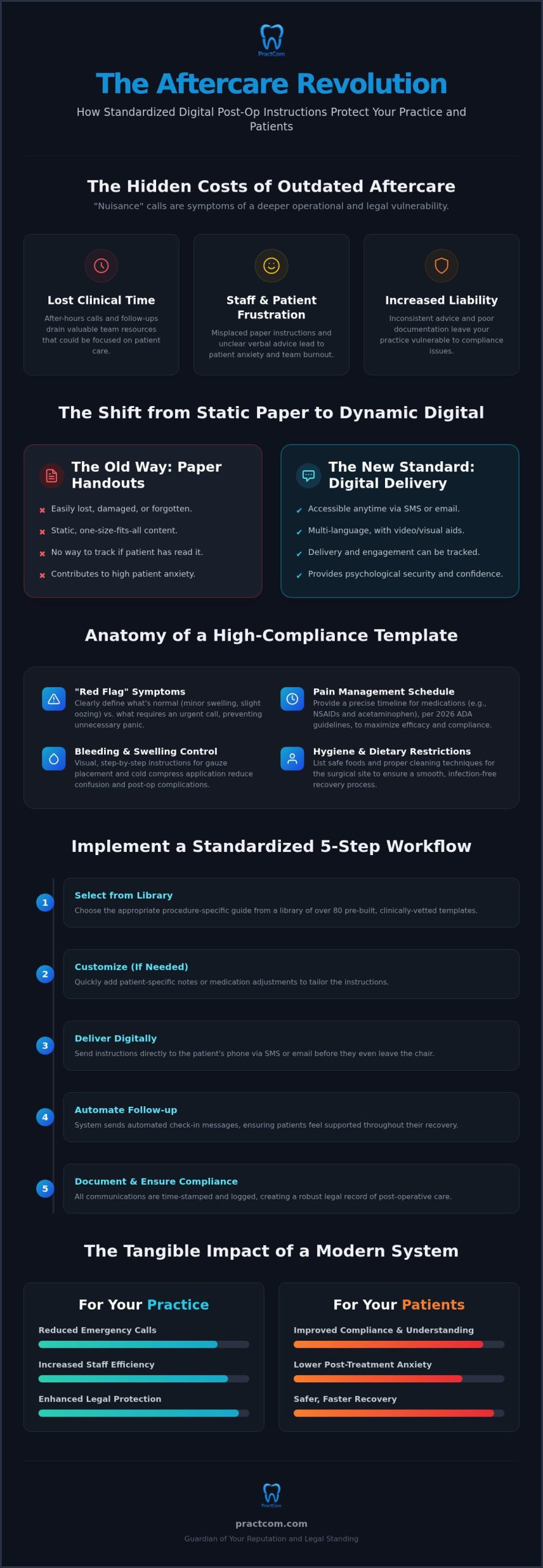
Standardizing your workflow transforms a dental post-op instructions template from a static file into a living clinical asset. Simply having the documents isn’t enough; your team needs a structured protocol to ensure every patient receives the right information at the right time. This transition requires moving from the resistance of manual tasks to the confidence of a standardized system. By following a 5-step process, you can eliminate operational friction and ensure that your clinical advice remains consistent across all providers and locations.
Procedure-specific customization is the key to preventing “nuisance” calls. Generic forms often lead to patient confusion because they include irrelevant information or omit critical steps for specialized treatments. When your documentation is tailored to the specific surgery, it reflects the technical precision of your work and provides the administrative warmth patients need during a stressful recovery. This systematic oversight acts as a guardian of your reputation and ensures no part of the communication process is left to chance.
Step 1: Auditing Your Current Instruction Library
Start by identifying gaps in your existing procedure list. Many practices discover they’re missing detailed guidance for crown and bridge work or specific cosmetic enhancements. Consolidating conflicting versions of instructions that may have accumulated over the years is essential for maintaining clinical standards. Establishing a single source of truth for clinical advice ensures that every patient receives the same high standard of care regardless of which staff member is on duty.
Step 2: Training the Team for Consistent Delivery
Training your team is the bridge between technology and patient compliance. You must introduce digital templates during the chairside handoff, explaining that a text or email is being sent immediately to the patient’s smartphone. This verbal summary should highlight the most critical “Red Flags” discussed in previous sections. To complete the standardization of your workflow, follow these remaining steps:
- Step 3: Customize for Complexity: Adjust templates for high-risk patients or complex surgical cases.
- Step 4: Coordinate with Specialists: Use Dental Referral Management Software to ensure seamless aftercare communication between offices.
- Step 5: Monitor Engagement: Use a performance dashboard to track delivery rates and ensure no patient leaves without their recovery roadmap.
This comprehensive approach ensures that your technical precision isn’t lost during the handoff. To see how these systems work together to protect your practice and reclaim staff time, explore our comprehensive template library and start your 15-day free trial today.
Scaling Patient Communication with the PractCom Instruction Library
Managing a high-volume practice requires more than just clinical skill; it demands a systematic approach to patient messaging. Our peer-founded platform provides a library of over 80 pre-built templates, ensuring you have a high-compliance dental post-op instructions template ready for every clinical scenario, from simple restorations to complex implant surgeries. This extensive resource allows your team to move from the resistance of manual document creation to the confidence of a standardized system, acting as a guardian for your practice’s reputation and clinical standards.
Automated follow-ups are the engine that “closes the loop” on the patient recovery journey. By scheduling automated check-ins via SMS or email, you provide the administrative warmth that patients crave during the vulnerable hours following a procedure. This proactive communication identifies potential complications before they become after-hours emergencies, significantly reducing the volume of nuisance calls. It’s a protective measure that ensures no patient feels abandoned, reinforcing the trust built during the chairside visit while reclaiming valuable staff time.
The PractCom performance dashboard provides the technical precision needed to oversee your entire communication ecosystem. It allows you to monitor delivery rates and patient engagement across multiple providers or locations, ensuring that your recovery protocols are followed every time. You can Start your free trial today to access our full library and experience how a standardized system eliminates operational friction. This transition provides the psychological security that both you and your patients need for a successful post-treatment experience.
Beyond Post-Ops: Integrated Consent and Referrals
Software fatigue is a genuine threat to administrative efficiency in a high-pressure clinical environment. By connecting your aftercare protocols with Digital Dental Informed Consent Forms, you create a seamless workflow that protects your legal standing from start to finish. Using a unified Communication Suite instead of disconnected tools ensures that your staff spends less time toggling between apps and more time focusing on patient care. This integration provides the regulatory reassurance that modern practitioners require to thrive in an increasingly complex legal landscape.
Future-Proofing Your Practice Communication
Staying ahead of Dental Technology Trends means preparing your practice for the rapid growth projected in the 2026 market. Standardized templates are not just a tool for today; they’re a foundation for scaling into multiple locations or DSOs where consistency is the primary driver of success. We invite you to see the difference for yourself by reviewing our PractCom vs. Modento comparison. Investing in a future-proof system ensures your practice remains grounded in the logistical realities of the profession while embracing the efficiency of modern, cloud-based technology.
Secure Your Clinical Reputation with Standardized Aftercare
We’ve explored how transitioning from fragmented paper handouts to a systematic digital approach transforms your recovery protocols into a vital risk management asset. By prioritizing high-compliance components like “Red Flag” warnings and multi-language accessibility, you bridge the gap between technical precision and patient understanding. Standardizing your workflow doesn’t just reduce after-hours interruptions; it provides the regulatory reassurance and psychological security that define a modern, patient-centered practice. It’s about moving from the resistance of manual tasks to the confidence of a system that works for your team and your patients.
Implementing a professional dental post-op instructions template is an ethical and professional necessity for the modern dental office. With our library of 80+ procedure-specific templates, support for 15 languages, and an automated follow-up system, you can eliminate operational resistance and focus entirely on clinical excellence. Streamline your aftercare with 80+ professional templates—Start your PractCom free trial today. You have the power to turn every recovery into a predictable, protected success story that enhances your practice’s reputation.
Frequently Asked Questions
What are the most common procedures that require a post-op template?
Every surgical or restorative procedure that alters oral tissue requires a specific dental post-op instructions template to ensure safe healing. Common examples include simple and surgical extractions, dental implant placement, root canal therapy, and periodontal surgeries. Providing procedure-specific guidance ensures the patient knows exactly how to manage site-specific care, such as avoiding suction after an extraction or maintaining hygiene around a new temporary crown.
How many languages should my dental post-op instructions be available in?
You should aim to provide instructions in the primary languages spoken within your local community, which often requires support for at least 15 different languages. Providing care in a patient’s native tongue isn’t just about inclusivity; it’s a clinical necessity that significantly improves compliance. When a patient fully understands the rationale behind their recovery protocol, the risk of mismanaged medications or post-operative complications drops.
Can digital post-op templates help reduce my practice’s legal liability?
Digital templates reduce legal liability by creating a timestamped record of exactly what information was delivered and when. Unlike paper handouts that can be lost or forgotten, a digital system provides a “reputation guardian” for your practice. In the event of a dispute, you have verifiable documentation that the patient received comprehensive aftercare advice, which is an essential part of your risk management strategy.
How do I ensure my patients actually read the instructions I send via SMS?
Ensuring engagement starts with a strong chairside handoff where the clinical team explains that a text message is being sent immediately to their smartphone. You can further improve read rates by using a system that tracks link clicks and triggers automated follow-ups. These automated check-ins act as a nudge, reminding the patient to review their recovery steps and providing a sense of administrative warmth that encourages compliance.
What is the difference between a post-op instruction and an informed consent form?
An informed consent form is a legal document signed before treatment to authorize the procedure after discussing risks, while a post-op template is a recovery roadmap provided after treatment. While consent protects you by documenting the patient’s agreement to the surgery, post-op instructions protect you by guiding the patient through a safe recovery. Both are essential components of a unified professional communication suite that ensures clinical and legal safety.
Is it better to print post-op instructions or send them digitally?
Sending instructions digitally is significantly more effective than printing because it ensures the information is always accessible on the patient’s smartphone. Digital delivery eliminates the risk of lost or damaged paper and allows for easier translation into multiple languages. While some patients may still request a physical copy, the primary delivery should be digital to ensure you have a trackable record of communication and better patient engagement.
How often should I update my dental post-treatment instruction templates?
You should review and update your templates at least once a year or whenever major clinical guidelines are revised. For instance, the 2026 updates to ADA pain management guidelines required immediate changes to post-treatment protocols regarding NSAID use. Keeping your dental post-op instructions template current ensures you’re providing evidence-based advice that reflects the latest standards in clinical safety and regulatory compliance.

Article by
Cary Ganz DDS
Dr. Cary H. Ganz is a dentist, prosthodontist, entrepreneur, lecturer, and author with more than 50 years of experience in clinical dentistry and dental technology. Throughout his career, he has combined hands-on patient care with a deep understanding of how technology can improve dental practice operations, communication, documentation, and patient outcomes.
In addition to his clinical background, Dr. Ganz has held significant leadership roles in the dental technology industry, including Past Owner and Vice President of Clinical Affairs at DEXIS Digital Radiography and Past Vice President of Clinical Affairs at Denticon Practice Management Software. His business experience includes product development, clinical strategy, dental software innovation, practice management solutions, and educating dental professionals on the effective use of technology in modern dentistry.
Today, Dr. Ganz continues to focus on creating practical technology solutions for dental practices, including PractCom, a comprehensive dental practice communication platform designed to improve patient communication, documentation, compliance support, referrals, and overall practice efficiency. His work reflects a career-long commitment to helping dentists deliver better care while making their practices more organized, efficient, and protected.
No responses yet