
With dry socket incidence rates reaching as high as 30% for mandibular third molar extractions, your clinical success often depends more on what happens at the patient’s home than what happens in your chair. You know the operational strain of the late-afternoon emergency call caused by a patient who misplaced their post-op instructions or simply ignored verbal advice. It’s a significant drain on your administrative team and creates unnecessary anxiety for everyone involved. We agree that a practitioner’s reputation shouldn’t be at the mercy of a patient’s memory. This article will equip you with a standardized how to prevent dry socket patient handout strategy that eliminates communication gaps and reinforces your clinical authority.
You’ll learn how to integrate 2026 clinical benchmarks, such as 0.12% chlorhexidine protocols and antiseptic irrigation, into a system that patients actually follow. We’ll preview a modern recovery plan designed to reduce post-operative complications and move your practice toward a zero-incident environment. By shifting from manual reminders to a systematic digital approach, you can protect your chair time and build lasting patient trust. This guide provides the technical precision and administrative warmth needed to stabilize your post-surgical workflow.
Key Takeaways
- Establish a clear clinical foundation for patients by explaining the physiological necessity of clot preservation to prevent alveolar osteitis.
- Enforce strict immediate-recovery protocols, including firm gauze compression and the total avoidance of suction, to stabilize the initial blood clot.
- Mandate a minimum 72-hour abstinence from all tobacco products to eliminate the risk of chemical interference and mechanical clot failure.
- Standardize your post-operative workflow with a digital how to prevent dry socket patient handout to ensure instructions are accessible, multi-lingual, and mobile-friendly.
- Equip your administrative team to distinguish between normal post-operative oozing and critical warning signs to significantly reduce the volume of emergency phone calls.
What is Dry Socket and Why is Prevention Critical?
Dry socket, or alveolar osteitis, is more than just a painful setback; it’s a clinical complication that disrupts your practice’s workflow and compromises patient satisfaction. Understanding What is Dry Socket (Alveolar Osteitis) starts with the biological role of the post-extraction blood clot. After you remove a tooth, this clot serves as a natural bandage. It shields the underlying bone and sensitive nerve endings from the bacteria and debris found in the oral cavity. If this clot is dislodged or dissolves before the wound has a chance to heal, the socket is left “dry” and exposed. This typically occurs in a critical window between 3 to 5 days post-extraction. While you can manage the condition with palliative care, prevention is significantly more efficient than treating the intense, radiating pain that follows. Integrating a clear how to prevent dry socket patient handout into your discharge process is the most effective way to safeguard your patients and your schedule.
The Consequences of Non-Compliance
When a patient fails to follow post-operative protocols, the clinical outcomes are predictable and taxing for your team. The hallmark of dry socket is a severe, throbbing pain that often radiates toward the ear or eye. OTC analgesics rarely manage this level of discomfort effectively. This condition doesn’t just hurt the patient; it delays the overall tissue regeneration process. From a practice management perspective, every dry socket case necessitates unscheduled office visits for socket irrigation and the placement of medicated dressings. These emergency calls increase your administrative burden and consume chair time that could be dedicated to productive procedures. Providing a high-quality how to prevent dry socket patient handout ensures that patients understand the high stakes of their recovery journey.
Who is at Higher Risk?
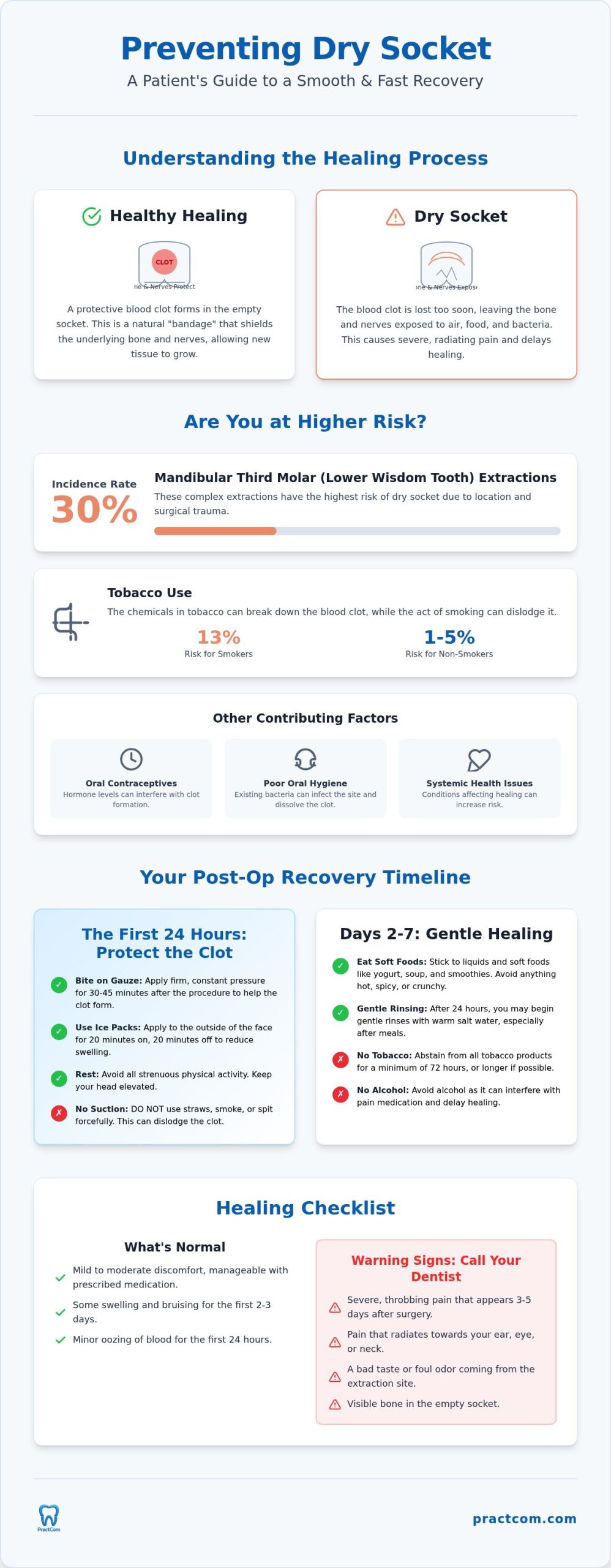
Identifying high-risk patients allows you to provide targeted education and more robust follow-up. According to a 2022 review, smokers face a 13% risk of developing dry socket. This is a staggering increase compared to the 1% to 5% incidence seen in routine, non-surgical extractions. Patients using oral contraceptives are also at an elevated risk because high estrogen levels can interfere with the fibrinolytic system. Location is another major factor. While routine extractions have a low complication rate, mandibular third molar surgeries can see dry socket incidence as high as 30%. Poor oral hygiene and systemic health issues further compromise clot stability. You can mitigate these risks by using standardized templates that address these specific variables, ensuring every patient receives the precise level of guidance they need for a successful recovery.
Immediate Post-Op Care: The First 24 Hours
The first 24 hours following an extraction are the most critical for establishing a stable foundation for healing. During this window, the body works to form the initial fibrin clot that fills the socket. To facilitate this, patients must bite firmly on the provided gauze packs for at least 30 to 45 minutes. This constant pressure is necessary to achieve hemostasis and secure the clot in place. We recommend applying ice packs to the outside of the face in 20-minute intervals, alternating 20 minutes on and 20 minutes off. This practice effectively constricts local blood vessels to minimize swelling and post-operative discomfort. Physical activity should be kept to an absolute minimum during this period. Spikes in blood pressure from exercise or heavy lifting can cause the socket to bleed or even dislodge the delicate clot before it has fully matured. A well-structured how to prevent dry socket patient handout should clearly prioritize these immediate actions to ensure patient compliance from the moment they leave your chair.
Managing the Extraction Site
Patients often feel the urge to clear their mouths of blood or saliva, but aggressive spitting is one of the primary causes of mechanical clot failure. Instead, they should be instructed to swallow saliva gently or let it flow out of the mouth passively if necessary. When it’s time to change the gauze, they should dampen the new pad with water so it doesn’t stick to the forming tissue. Treat the extraction site as a “clot protection zone” where any mechanical disruption, including aggressive tongue exploration or finger contact, is strictly prohibited for the first 24 hours. This level of behavioral detail is essential for Preventing Dry Socket and ensuring the wound remains undisturbed during its most vulnerable phase.
Dietary Adjustments for Day One
Nutrition plays a significant role in early recovery, but the consistency and temperature of food are vital factors. Patients should stick to cold or room-temperature soft foods like yogurt, pudding, or smoothies. It’s imperative to avoid hot liquids like coffee or soup, as heat can prematurely dissolve the fibrin matrix of the clot. All beverages must be consumed from a glass rather than a straw. The negative pressure created by suction is a leading risk factor for alveolar osteitis. By providing these instructions through a standardized how to prevent dry socket patient handout, you reduce the likelihood of accidental non-compliance. If you’re looking to modernize your delivery of these vital recovery steps, you can explore our digital library of post-op templates to ensure every patient has these rules at their fingertips.
Behavioral Guidelines: What to Avoid During Recovery
Prohibiting tobacco for at least 72 hours post-surgery is a non-negotiable standard in a modern clinical setting. While some legacy instructions suggest a 24-hour window, current data shows that smokers have a 13% risk of dry socket according to a 2022 review. Smoking introduces chemical toxins that impair local blood flow and requires physical suction that can instantly dislodge a clot. A comprehensive how to prevent dry socket patient handout must explicitly warn against all tobacco and vaping products to prevent these avoidable failures. You’re effectively protecting the patient from their own habits during this high-risk period.
The Danger of Suction and Pressure
Straws create a localized vacuum in the oral cavity. This negative pressure is the leading cause of mechanical clot displacement. We also advise patients to sneeze with their mouths open to avoid internal pressure spikes that can impact the surgical site. If your patient plays a wind instrument, they should take a hiatus until the tissue has stabilized. Brushing is still necessary for overall hygiene, but they must avoid the socket entirely to prevent accidental trauma. You don’t want a simple hygiene habit to become the reason for a painful emergency visit.
Medication and Substance Restrictions
Alcohol consumption should be avoided for at least 48 hours because it acts as a vasodilator and thins the blood. This can lead to renewed bleeding or clot dissolution. For pain management, we prioritize Ibuprofen or Acetaminophen. Avoid Aspirin, as its anti-platelet properties can interfere with the very clot you’re trying to protect. If antibiotics are part of the treatment plan, patients must finish the full course to prevent secondary infections. Understanding Dry Socket Symptoms and Causes empowers patients to recognize when their behaviors might be causing issues. By providing this information in a clear how to prevent dry socket patient handout, you ensure that the patient has a reliable reference when they’re away from your office.
To ensure your patients don’t accidentally compromise their healing, advise them to avoid these specific “danger foods” and activities:
- Seeds and popcorn: These small particles can easily become trapped in the open socket.
- Nuts and chips: Sharp edges can lacerate the delicate, healing tissue.
- Vigorous rinsing: Patients should skip commercial, alcohol-based mouthwashes for the first week.
- Spicy or acidic foods: These can irritate the wound and cause unnecessary discomfort.
Monitoring Progress: Normal Healing vs. Warning Signs
Many patients experience significant post-operative anxiety because they cannot distinguish between a standard inflammatory response and a true clinical complication. Establishing clear visual and sensory benchmarks in your how to prevent dry socket patient handout is a proactive way to manage these expectations and reduce the volume of “is this normal?” phone calls. A healthy, stabilizing socket should contain a dark, gelatinous blood clot that sits level with or slightly below the gum line. This is the biological shield that protects the underlying structures. If a patient looks in the mirror and sees bare white bone or a hollow, empty looking site, it is a primary indicator that the clot has dislodged. Providing this visual contrast helps patients identify alveolar osteitis before the pain becomes unmanageable.
Normal Post-Extraction Symptoms
Recovery is rarely a linear path, but certain symptoms are expected milestones of the healing process. Mild to moderate pain typically peaks around 48 hours post-extraction before it begins to gradually subside. Patients may also notice minor facial bruising or jaw stiffness, a condition known as trismus, especially after surgical extractions of impacted teeth. A slight “bad taste” or mild odor is often just the result of initial tissue breakdown and early clot stabilization; it shouldn’t be confused with a severe infection. It is also helpful to clarify that a small amount of “oozing,” which looks like pink-tinged saliva, is normal for the first day. This is quite different from bright red, active bleeding that doesn’t stop with pressure.
Red Flags Requiring Clinical Intervention
Your team’s efficiency depends on patients knowing exactly when an emergency office visit is mandatory. If a patient describes severe, radiating pain that is not relieved by their prescribed medication, it’s a major red flag. This level of discomfort usually signals that the bone and nerves are fully exposed to the oral environment. Other critical signs include fever, chills, or the presence of persistent, foul-smelling discharge or pus. These symptoms suggest a secondary infection rather than a simple mechanical clot failure. By providing these specific criteria in your how to prevent dry socket patient handout, you empower patients to self-triage effectively. This protects your clinical schedule from non-urgent interruptions while ensuring that genuine emergencies receive immediate care. If you want to automate this triage process and deliver these instructions via SMS or email, you can standardize your post-op workflow with our template library to ensure no patient is left guessing about their recovery status.
Standardizing Your Practice’s Post-Op Instructions
The most common point of failure in oral surgery recovery isn’t the clinical procedure; it’s the delivery of post-operative information. Traditional paper handouts are often discarded or forgotten in the car before the patient even reaches their first dose of pain medication. Transitioning to a digital how to prevent dry socket patient handout ensures your instructions are always accessible on the one device your patient never loses: their smartphone. By leveraging PractCom’s Post-Treatment Instruction Library, you replace disorganized verbal advice with a standardized, clinically precise system that patients can reference at the exact moment they need it. This digital shift moves your practice from a reactive stance to a proactive model of patient care.
The Benefits of Digital Delivery
Digital delivery through SMS or email eliminates the “I lost my paper” excuse and places critical recovery rules directly in the patient’s hand. This method allows you to improve compliance by sending automated reminders during the critical 72-hour window when clot stability is most at risk. Providing a comprehensive digital FAQ section also reduces the volume of incoming “is this normal?” calls, as patients can quickly verify their symptoms against your professional benchmarks. This systematic oversight transforms a chaotic post-op afternoon into a controlled, predictable workflow for your administrative team. It’s about providing psychological security for the patient while protecting your team’s time.
Multi-language support is another essential component of a modern practice. PractCom offers templates in 15 languages, ensuring that demographic barriers never compromise clinical outcomes or patient understanding. Implementing automated SMS follow-ups to check on patient pain levels at day 3 provides a pre-emptive strike against potential complications. This is the period when dry socket most frequently occurs. A simple automated check-in can identify issues before they escalate into an emergency, saving you and your staff hours of stressful after-hours coordination.
Ensuring Regulatory and Clinical Compliance
Standardized documentation serves as a guardian of your practice’s reputation and legal standing. When you use a platform like PractCom, you create a verifiable trail of exactly which instructions were sent and when they were delivered. This level of regulatory reassurance is invaluable in the rare event of a patient complication or clinical dispute. Modernizing your aftercare isn’t just about convenience; it’s an ethical and professional necessity in a high-pressure clinical environment. You can start your free trial with PractCom today to begin standardizing your how to prevent dry socket patient handout and protecting your practice from operational resistance.
Modernize Your Post-Surgical Recovery Workflow
Preventing alveolar osteitis isn’t just about clinical technique; it’s about closing the communication gap between your office and the patient’s home. By enforcing strict 72-hour behavior protocols and providing clear visual benchmarks for healing, you can significantly reduce the risk of painful complications and emergency interruptions. Standardizing your how to prevent dry socket patient handout through a digital delivery system ensures that vital instructions are never lost or ignored. This transition protects your practice’s reputation and clinical schedule from the operational strain of avoidable post-op failures.
PractCom acts as your professional ally in this effort. Our platform provides access to over 80 clinically-vetted post-treatment templates with automated SMS and email delivery to ensure every patient stays on track. With support for 15 languages, you can build trust and improve compliance across your entire patient demographic. It’s time to replace manual reminders with a systematic approach that guarantees results. Streamline your post-op communication with PractCom’s template library and take control of your recovery outcomes today. Your team deserves the security of a standardized system.
Frequently Asked Questions
How long does it take for the risk of dry socket to go away?
The risk of dry socket significantly decreases after the first 7 to 10 days of healing. Most incidents occur during the critical window between days 3 and 5 post-extraction. Once the socket is covered by a layer of healthy granulation tissue, the underlying bone and nerves are no longer exposed. Following the protocols in your how to prevent dry socket patient handout during this first week is essential for a complication-free recovery.
Can I eat normally after 24 hours if I don’t have pain?
You should wait at least 3 to 5 days before reintroducing firmer foods to your diet. Even if you aren’t experiencing pain after 24 hours, the blood clot is still delicate and easily dislodged by mechanical force. Stick to soft options like scrambled eggs or mashed potatoes. Avoid chewing on the side of the extraction to ensure the “clot protection zone” remains undisturbed while the tissue stabilizes.
What should I do if I accidentally used a straw?
If you accidentally used a straw, stop immediately and monitor the site for any sudden increase in pain or renewed bleeding. One instance of suction doesn’t guarantee a dry socket, but it does increase the risk of mechanical displacement. Avoid all further suction and check that the dark clot is still visible in the socket. If severe, radiating pain develops over the next 24 hours, contact your dental office for an evaluation.
Is it normal to see white stuff in my extraction socket?
Seeing white or grayish material in the socket is often a normal sign of granulation tissue formation. This tissue is a critical part of the body’s healing process and serves as the framework for new bone growth. However, it can sometimes be confused with food debris. If the white area is accompanied by intense pain or a foul odor, it may indicate a complication that requires a clinical check-up.
How can I tell the difference between a normal clot and a dry socket?
A normal clot appears dark, deep red, or brownish and fills the majority of the extraction site. In contrast, a dry socket often looks empty or shows visible white bone because the clot has dissolved or dislodged. The most definitive difference is the level of discomfort. While a healthy socket feels tender, a dry socket produces severe, throbbing pain that usually radiates toward the ear and isn’t managed by OTC medication.
Does salt water rinsing help prevent dry socket?
Gentle salt water rinses are highly effective for maintaining hygiene, but only after the initial 24-hour window has passed. Rinsing too early can wash away the forming clot. After the first day, mixing half a teaspoon of salt in eight ounces of warm water helps kill bacteria and remove debris. This simple step is a core component of any how to prevent dry socket patient handout designed to minimize infection risks.
When is it safe to resume smoking after a tooth extraction?
You must wait a minimum of 72 hours before resuming smoking or using any tobacco products. The chemical toxins in tobacco smoke impair blood flow to the surgical site, while the physical act of inhaling creates suction that can pull the clot out of place. Data suggests that smokers are significantly more likely to develop alveolar osteitis. Extending this window as long as possible provides the best environment for tissue regeneration.
What will the dentist do if I actually have a dry socket?
If a dry socket is diagnosed, your dentist will focus on palliative care to manage your pain while the site heals. This typically involves gently irrigating the socket to remove debris and then placing a medicated dressing or paste. This dressing provides immediate relief by covering the exposed bone and nerves. You may need to return to the office every few days to have the dressing changed until the pain subsides naturally.

Article by
Cary Ganz DDS
Dr. Cary H. Ganz is a dentist, prosthodontist, entrepreneur, lecturer, and author with more than 50 years of experience in clinical dentistry and dental technology. Throughout his career, he has combined hands-on patient care with a deep understanding of how technology can improve dental practice operations, communication, documentation, and patient outcomes.
In addition to his clinical background, Dr. Ganz has held significant leadership roles in the dental technology industry, including Past Owner and Vice President of Clinical Affairs at DEXIS Digital Radiography and Past Vice President of Clinical Affairs at Denticon Practice Management Software. His business experience includes product development, clinical strategy, dental software innovation, practice management solutions, and educating dental professionals on the effective use of technology in modern dentistry.
Today, Dr. Ganz continues to focus on creating practical technology solutions for dental practices, including PractCom, a comprehensive dental practice communication platform designed to improve patient communication, documentation, compliance support, referrals, and overall practice efficiency. His work reflects a career-long commitment to helping dentists deliver better care while making their practices more organized, efficient, and protected.
No responses yet