
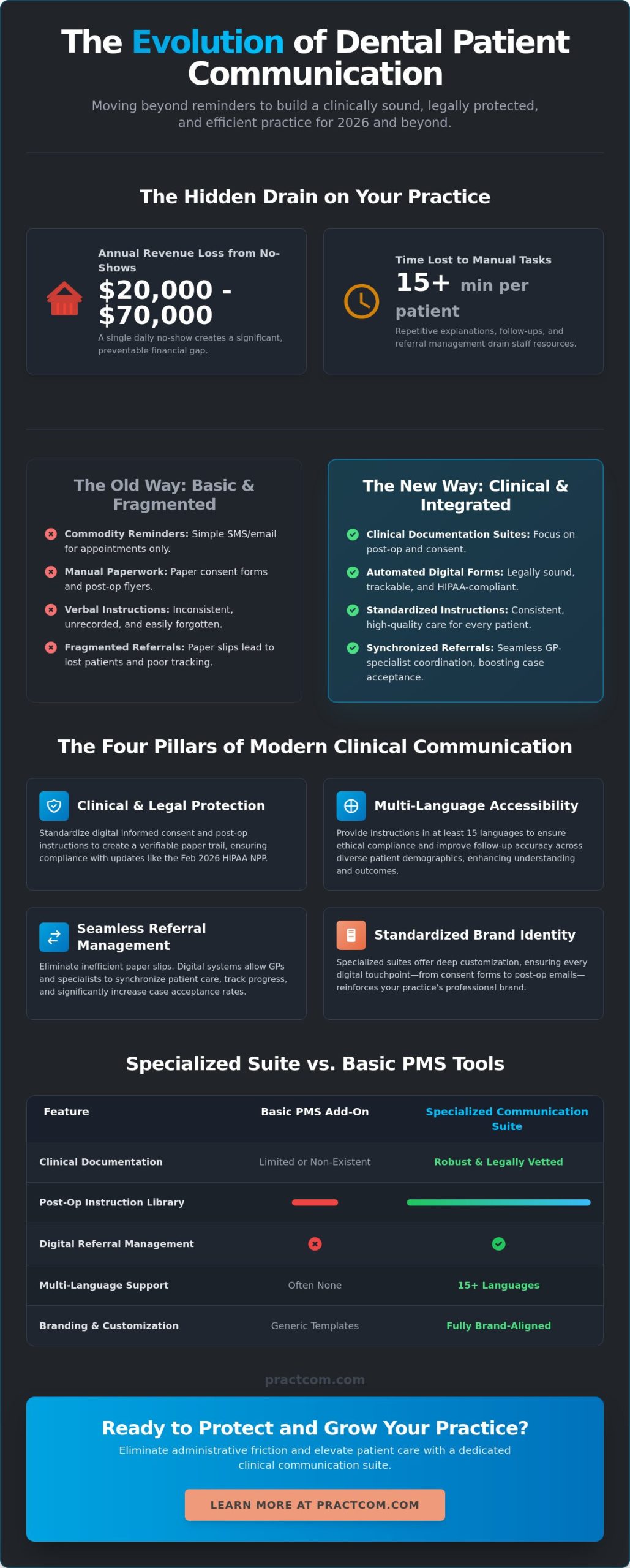
What if the fifteen minutes your front office spends explaining post-extraction care for the third time today could be reclaimed entirely by your dental patient communication technology? You’re likely already aware that a single daily no-show can cost your practice between $20,000 and $70,000 in annual revenue. However, the hidden drain on your resources often stems from the administrative friction of manual follow-ups and fragmented specialist referral chains that leave patients feeling disconnected.
We understand the persistent anxiety of ensuring every patient receives legally sound informed consent while staying compliant with the February 2026 HIPAA Notice of Privacy Practices updates. You’ll discover how modern systems are shifting from basic reminders to comprehensive clinical documentation suites that protect your practice and empower your patients. We will preview the move toward integrated platforms that automate your post-treatment instructions and standardize your brand image across every digital touchpoint.
Key Takeaways
- Modern dental patient communication technology is transitioning from simple appointment reminders to essential clinical documentation suites that reduce administrative burden.
- Standardizing your post-treatment instruction library and digital informed consent forms provides a protective layer of regulatory reassurance and legal documentation.
- Implementing a multi-language communication system in at least 15 languages ensures ethical compliance and improves patient follow-up accuracy across diverse demographics.
- Digital referral management systems eliminate the inefficiencies of paper slips, allowing GPs and specialists to synchronize care and increase case acceptance.
- Specialized communication suites offer deeper clinical functionality and standardized branding that basic Practice Management Software (PMS) built-in tools often lack.
The Landscape of Dental Patient Communication Technology in 2026
Modern dental patient communication technology is no longer just a digital megaphone for practice marketing. It has evolved into a specialized ecosystem of tools designed to manage the precise clinical and administrative exchange between your practice and your patients. In 2026, we see a definitive shift from marketing-first strategies to clinical-first communication. This transition prioritizes the accuracy of post-op instructions and the legal integrity of consent forms over simple promotional blasts. It moves your practice from a state of operational disorganization to one of systematic control.
This shift aligns with fundamental health communication principles, which emphasize that the quality of information exchange directly impacts clinical outcomes. When your communication is standardized, you reduce the psychological resistance patients feel toward complex treatments. 2026 is the year the paperless clinical workflow becomes a requirement for survival rather than a luxury. By automating follow-ups and documentation, you eliminate the manual errors that lead to patient confusion and administrative friction.
Automation now functions as a reliable professional ally. It handles the repetitive tasks that typically cause staff burnout, such as answering the same post-extraction questions ten times a day. This technology doesn’t just act as a service provider; it functions as a guardian of your reputation. You can explore how these systems stabilize high-pressure environments at why PractCom.
Beyond Appointment Reminders: The New Standard
Basic SMS reminders are now a commodity. Patients expect them, but they don’t build long-term practice value or clinical safety. To differentiate your brand, you must integrate digital informed consent as a prerequisite for clinical excellence. Transitioning from reactive phone calls to proactive digital education allows your team to focus on high-value clinical tasks. This proactive approach ensures that every patient receives the same high standard of care, regardless of how busy the front desk is on a Tuesday morning.
The Impact of Technology on Patient Trust and Retention
Standardized communication reduces patient anxiety and prevents buyer’s remorse after complex procedures. There’s a strong psychological link between professional documentation and perceived clinical quality. When patients receive high-quality digital instructions in their inbox, they feel safer. Using visual aids like smile design tools to show before and after cosmetic changes bridges the communication gap. It transforms a vague treatment plan into a concrete reality that builds immediate trust and encourages case acceptance.
Clinical Communication Pillars: Post-Op and Informed Consent
The core of your practice’s legal and clinical safety rests on two distinct pillars: what you tell the patient before a procedure and what they remember after it. While many generic platforms treat communication as a simple marketing tool, true dental patient communication technology must prioritize clinical documentation and risk mitigation. This involves standardizing your post-treatment instruction libraries to ensure every patient receives consistent, high-quality messaging. By automating the delivery of aftercare via SMS and email immediately following a procedure, you eliminate the risk of human error and the “forgotten instructions” problem that often plagues manual workflows.
Tracking the ‘read’ status of these documents is no longer optional; it’s a vital component of clinical and legal compliance in 2026. If a patient experiences a complication but hasn’t opened their post-op instructions, your digital paper trail provides the necessary documentation to protect your practice. This systematic oversight replaces the uncertainty of verbal instructions with a verifiable record. You can see how this works in practice by exploring the Automated Dental Post-Op Instructions guide.
Automated Post-Treatment Instruction Libraries
A robust library of 80+ templates allows your practice to cover the full spectrum of general and specialty dentistry without reinventing the wheel for every patient. These templates act as a stabilizing force in high-pressure clinical settings. Instead of relying on a busy assistant to hand out a paper flyer, the system sends a professional, standardized digital document the moment the treatment is logged. This ensures the information is available on the patient’s device exactly when they need it most. It’s about moving from the resistance of manual tasks to the confidence of a standardized system.
Digital Consent as a Risk Management Tool
The industry is rapidly shifting away from paper clipboards in favor of secure, cloud-based digital signatures. This transition isn’t just about going paperless; it’s a fundamental shift in patient safety and communication. Sending digital dental informed consent forms to a patient’s home before their appointment gives them the psychological security to review risks and benefits in a low-pressure environment. This proactive approach significantly improves the quality of informed consent. It ensures that when the patient arrives, they’re truly prepared for the procedure. To see how these tools fit your workflow, you might view our documentation features.
Solving the Multi-Language and Accessibility Challenge
Effective dental patient communication technology must solve the linguistic barriers that currently compromise patient safety. You understand that clinical excellence is impossible if a patient cannot comprehend their aftercare instructions. In 2026, providing instructions in a patient’s native language is no longer a courtesy; it’s an ethical and clinical requirement. Standardizing these materials ensures that every patient, regardless of their primary language, receives the same high-tier clinical oversight. This systematic approach alleviates the anxiety of practitioners who worry about miscommunication during the recovery phase.
Maintaining clinical accuracy across translations requires more than just generic web tools. You need a system that offers professionally vetted templates to ensure that complex dental terminology remains accurate in every translation. This level of precision protects your practice from the legal risks associated with misunderstood consent or aftercare. By moving away from the resistance of manual translation tasks, you gain the confidence of a standardized system that speaks clearly to every member of your community.
Diversity in Dental Care: 15-Language Support
Miscommunication in non-English speaking populations often leads to poor compliance and preventable complications. By offering your post-treatment instruction library and digital informed consent forms in 15 languages, you provide a stabilizing force for a diverse patient base. This level of accessibility reduces the operational stress of trying to find an ad-hoc translator for every follow-up call. It also positions your practice as a community leader that values patient understanding as much as clinical results. Standardized support in 15 languages ensures your professional brand remains consistent across all demographics.
Hybrid Communication: Digital Delivery vs. Physical Print
While the industry is moving toward a paperless clinical workflow, some patients still find psychological security in a physical document. You need a system that bridges the digital divide by supporting both digital and physical touchpoints. Modern suites allow for one-click physical document printing of the same digital templates sent via email or text. This hybrid approach ensures consistency across all channels. Whether a patient reads their instructions on a smartphone or a printed sheet at home, the clinical messaging remains identical. This prevents the confusion that occurs when verbal instructions conflict with written materials, ultimately reducing the volume of repetitive post-treatment phone calls.
Referral Management: The Overlooked Communication Frontier
The traditional paper referral slip represents a significant point of operational failure in the modern clinic. When a patient leaves your office with a physical piece of paper, you lose all visibility into their treatment journey. This breakdown in the communication chain often leads to a sharp decline in case acceptance. Modern dental patient communication technology solves this by creating a closed-loop system between the general practitioner and the specialist. By digitizing this exchange, you replace operational disorganization with systematic control.
Implementing a digital referral management system ensures that the specialist receives all necessary clinical data before the patient even calls to schedule. This proactive approach eliminates the friction of missing charts or duplicate digital informed consent forms. It allows you to function as a reliable professional ally to your referral partners. You can explore the technical requirements for these systems in our guide to Mastering Dental Referral Management Software.
Automation also plays a critical role in ensuring treatment completion. Your system can trigger automated patient follow-ups for referred procedures to remind the patient of the clinical necessity of the specialist visit. This reduces the burden on your administrative team to manually track every outgoing referral. It provides a stabilizing force that keeps your patients within a trusted network of care.
Streamlining the GP-Specialist Data Exchange
Lost referrals are a primary source of lost revenue and clinical risk. Secure, digital transmission of patient data ensures that specialists have immediate access to clinical notes and previous treatment history. This transparency improves the patient experience by eliminating the need for them to repeat their history at a new office. When you provide specialists with high-quality digital documentation, you enhance your practice’s reputation for professional excellence. It ensures that no part of the clinical process is left to chance during the hand-off.
Referral Tracking and Practice Performance
A practice performance dashboard allows you to identify exactly where your referral leak is occurring. You can track which patients have scheduled with a specialist and which have stalled in the process. This data-driven oversight helps you identify your most active referral partners and evaluate the efficiency of your professional network. By monitoring referral in-flow and out-flow, you gain a clear picture of your practice’s external growth. This level of systematic oversight is essential for maintaining a high-tier professional brand. To begin closing the gaps in your referral chain, start optimizing your referral workflow today.
Choosing the Right Suite: Specialized Tools vs. Basic PMS
Many practitioners believe their Practice Management Software (PMS) provides all the dental patient communication technology they need. It’s a common misconception that leads to significant clinical and administrative gaps. While your PMS is essential for scheduling and billing, its built-in communication features are often secondary additions rather than core clinical tools. These generic modules typically lack the depth required to manage complex post-operative instructions or multi-language consent forms effectively. Choosing a specialized suite isn’t about adding more software; it’s about implementing a stabilizing force that protects your practice’s legal standing.
High-growth practices often fall for the ‘all-in-one’ myth. They assume that using a single platform for everything is more efficient. However, the reality is that specialized tools provide a much higher ROI by solving specific administrative failures that generic tools ignore. When your communication system is a mere afterthought of your billing software, you risk operational disorganization. A dedicated clinical documentation suite functions as a guardian of your reputation, ensuring that no part of the patient journey is left to chance. You can evaluate how a specialized system compares to basic tools by reviewing Why PractCom?
Why Dedicated Suites Outperform Generic Tools
The difference lies in the depth of the resources provided. Standard PMS tools usually offer a handful of basic templates that require heavy manual editing. In contrast, a dedicated suite provides an extensive post-treatment instruction library designed for clinical precision. Another critical factor is technical reliability. Specialized platforms prioritize 10DLC registration for dental practices, which is essential for ensuring your SMS messages actually reach the patient’s device without being flagged as spam. This level of systematic oversight ensures that your clinical messaging is delivered every time, reducing the psychological resistance patients feel when they don’t receive clear guidance. If you’re evaluating unified communication platforms, understanding how weave for dental integrates with specialized clinical tools can help you make a more informed decision about your practice’s technology stack.
Implementing 2026 Technology Today
Moving from administrative resistance to systematic control requires a clear evaluation of your current gaps. You don’t need to overhaul your entire office overnight to see an improvement. Start by auditing your current post-op and consent workflows to see where the most repetitive phone calls originate. Most practices find that automating just a few key procedures immediately reduces the staff’s administrative burden. Training your team on a specialized platform is often faster than fighting with clunky PMS modules because the interface is built for this specific purpose. To see the impact on your clinical workflow, you can start a free trial and begin standardizing your patient touchpoints today.
Securing Your Practice’s Clinical Reputation
The transition to a paperless, clinically-focused workflow is the most effective way to protect your practice from the operational stresses of 2026. By moving away from fragmented systems, you gain the psychological security of knowing every patient receives accurate, multi-language aftercare instructions. You’ve seen how integrating specialized dental patient communication technology can transform your referral efficiency and reduce the volume of repetitive phone calls that drain your team’s energy.
Standardizing your clinical touchpoints ensures that your professional brand remains consistent across all 15 supported languages. With access to a library of 80+ clinical templates, you can provide the regulatory reassurance your patients expect while significantly mitigating legal risks. It’s time to replace manual administrative resistance with the confidence of a professional, automated system that acts as a guardian of your reputation.
Streamline your clinical communication with PractCom—Start your free trial today. You provide the clinical expertise; let us provide the tools to ensure your patients follow through on their care with total clarity.
Common Questions About Dental Patient Communication Technology
Does dental patient communication technology replace my Practice Management Software (PMS)?
No, this technology is designed to complement your Practice Management Software rather than replace it. While your PMS handles core administrative tasks like billing and scheduling, a dedicated communication suite provides the clinical depth needed for comprehensive documentation. It functions as a specialized layer of systematic control that bridges the gap between your office’s financial records and the patient’s clinical experience.
How do automated post-op instructions improve patient compliance?
Automated delivery ensures that patients receive clear, standardized instructions on their personal devices the moment a procedure is completed. By providing this information digitally, you eliminate the risk of lost paper flyers and the confusion of verbal instructions given while the patient is still recovering. This proactive approach leads to a reduction in repetitive post-treatment phone calls and improves the accuracy of at-home care.
Is digital informed consent legally binding for dental procedures in 2026?
Yes, digital dental informed consent forms are legally binding when they utilize secure, cloud-based digital signatures and comply with updated HIPAA encryption standards. These digital records provide a superior paper trail compared to traditional clipboards because they include time-stamped logs and verifiable delivery receipts. This level of documentation is an ethical and professional necessity for protecting your practice during board reviews or legal inquiries.
Can communication software handle multiple languages for diverse patient bases?
Modern dental patient communication technology must support a wide range of languages to ensure inclusive and safe care. Our platform provides full support for 15 languages, allowing you to send clinical documents in a patient’s native tongue. This capability ensures that complex dental terminology is accurately translated, which significantly improves compliance and reduces the risk of emergency complications among non-English speaking populations.
What is 10DLC registration and why does it matter for my dental practice?
10DLC registration is a regulatory requirement for businesses sending SMS messages to ensure high deliverability and prevent messages from being flagged as spam. For your practice, this registration is a technical necessity that ensures your appointment reminders and post-op instructions actually reach the patient. Without it, your communications risk being blocked by mobile carriers, creating a dangerous breakdown in your clinical workflow. You can learn the full vetting requirements and how to avoid costly fines in our 10DLC registration compliance guide for dental practices.
How does a referral management system help grow my practice’s revenue?
A referral management system grows revenue by closing the referral leak where patients fail to schedule appointments with specialists. By digitizing the exchange of patient data and clinical notes, you ensure a seamless hand-off that increases case acceptance. The system allows you to track every outgoing referral through a performance dashboard, helping you identify and optimize your most active and profitable professional partnerships.
Do I need to be tech-savvy to implement a communication suite in my office?
You don’t need advanced technical skills to implement these tools because they are designed for immediate ease of use in high-pressure clinical environments. The interface focuses on reducing operational resistance through intuitive templates and automated triggers. Most teams find that moving to a standardized system actually simplifies their daily tasks by eliminating the need for manual follow-up phone calls and repetitive data entry.
What happens if a patient prefers paper documents instead of digital ones?
The system remains grounded in the physical realities of the profession by offering physical document printing for all digital templates. If a patient prefers a physical copy, your staff can generate one with a single click, ensuring the messaging remains identical across all touchpoints. This hybrid approach allows you to maintain a professional, standardized brand image while accommodating individual patient preferences without extra administrative effort.

Article by
Cary Ganz DDS
Dr. Cary H. Ganz is a dentist, prosthodontist, entrepreneur, lecturer, and author with more than 50 years of experience in clinical dentistry and dental technology. Throughout his career, he has combined hands-on patient care with a deep understanding of how technology can improve dental practice operations, communication, documentation, and patient outcomes.
In addition to his clinical background, Dr. Ganz has held significant leadership roles in the dental technology industry, including Past Owner and Vice President of Clinical Affairs at DEXIS Digital Radiography and Past Vice President of Clinical Affairs at Denticon Practice Management Software. His business experience includes product development, clinical strategy, dental software innovation, practice management solutions, and educating dental professionals on the effective use of technology in modern dentistry.
Today, Dr. Ganz continues to focus on creating practical technology solutions for dental practices, including PractCom, a comprehensive dental practice communication platform designed to improve patient communication, documentation, compliance support, referrals, and overall practice efficiency. His work reflects a career-long commitment to helping dentists deliver better care while making their practices more organized, efficient, and protected.
One response
[…] their primary language. You can explore how these shifts are shaping the industry in our guide on The Future of Dental Patient Communication Technology: 2026 Trends. If you’re ready to modernize your compliance strategy and reach a more diverse patient base, […]