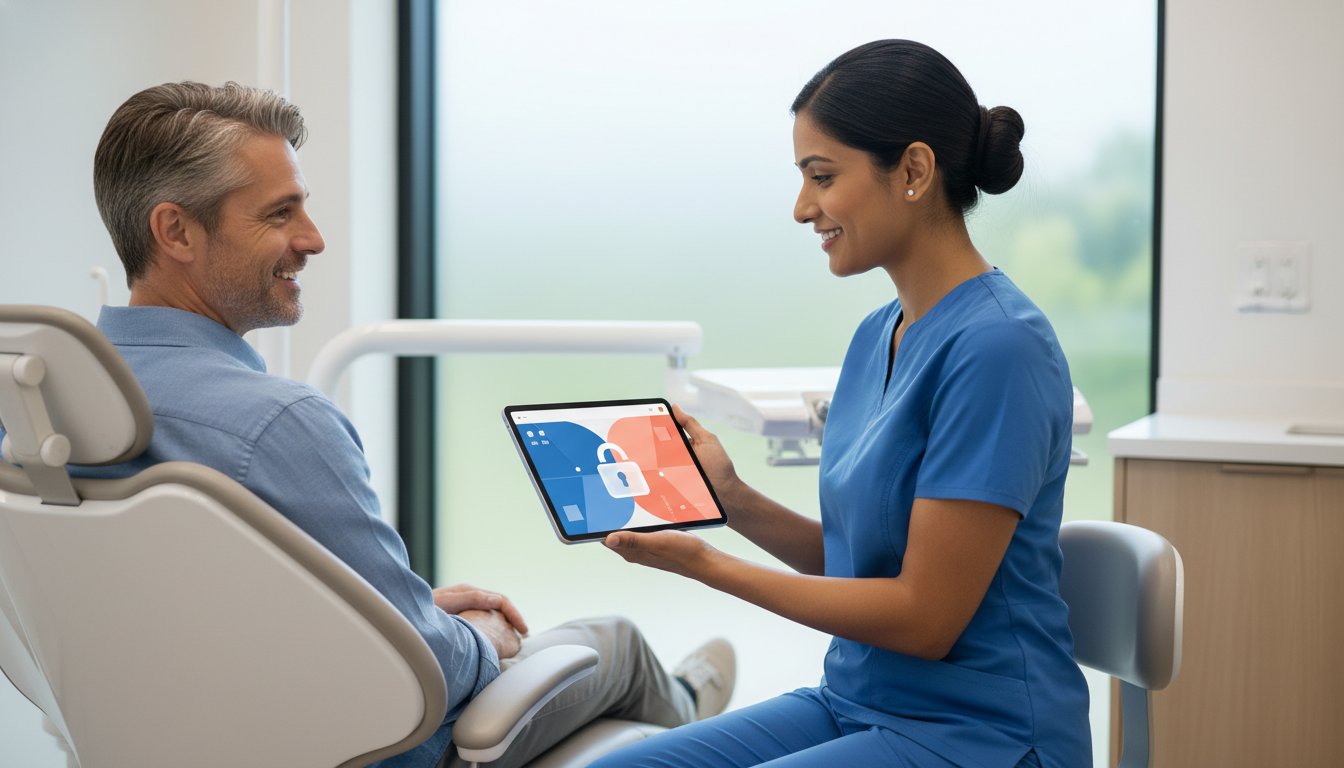
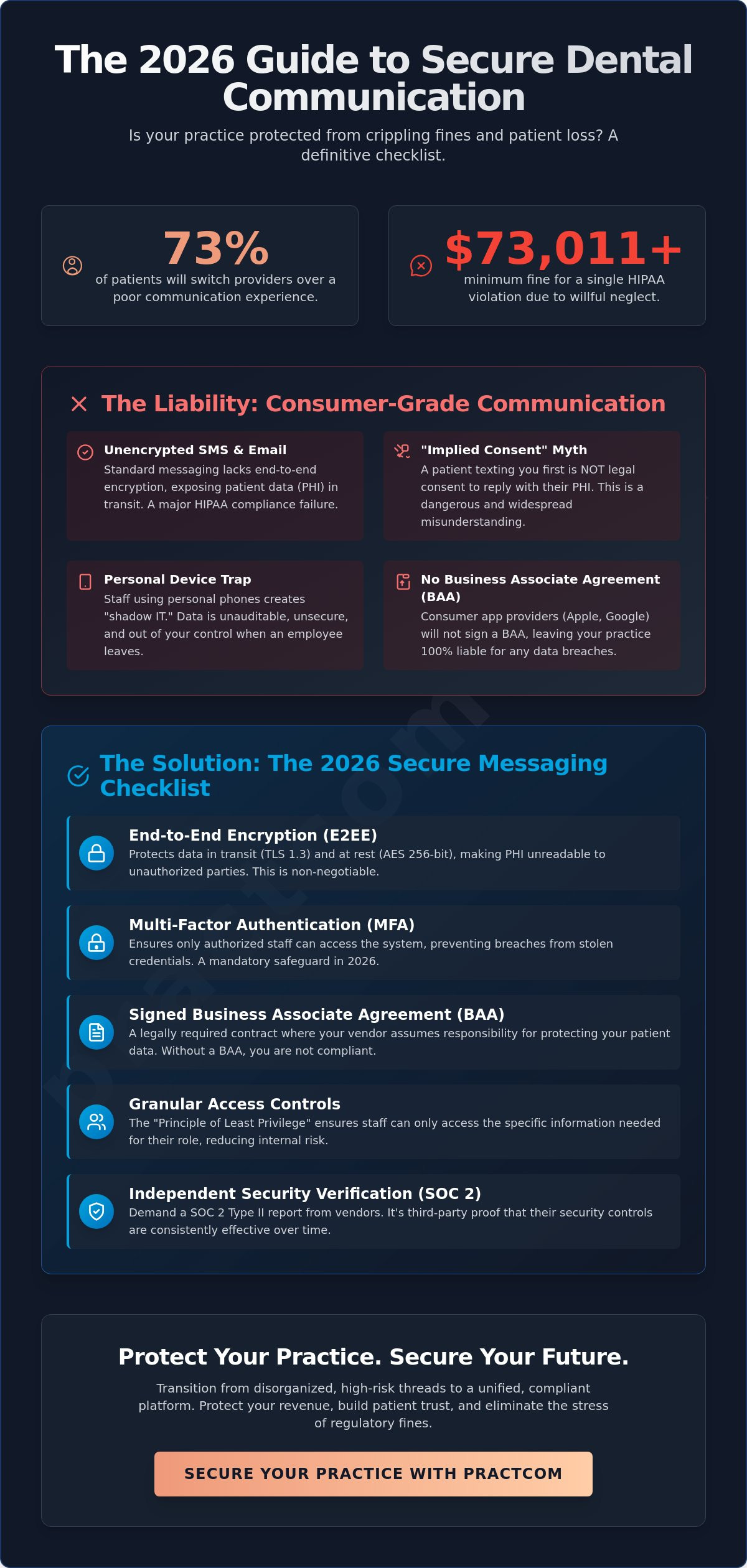
Did you know that 73% of patients aged 17-54 are willing to switch dental providers simply because of a poor communication experience? You likely feel the daily pressure of managing patient updates while staring down the threat of a $73,011 HIPAA fine for willful neglect under the 2026 penalty adjustments. It’s frustrating when staff resort to personal phones or unencrypted email threads just to keep the schedule moving, knowing every secure dental messaging gap is a potential liability. You need a system that protects your reputation and your revenue without adding to your team’s operational stress.
We’ve developed this guide to provide a definitive 2026 checklist that helps you audit your current software and eliminate manual risks. By following this framework, you’ll ensure your practice meets the latest mandatory encryption and multi-factor authentication requirements while reducing your liability. We will explore how to move from disorganized threads to a standardized system that improves patient compliance with post-op instructions and strengthens clinical security.
Key Takeaways
- Identify the hidden legal risks of using consumer-grade apps and the dangerous myth of “implied consent” in modern dentistry.
- Implement a checklist of mandatory technical safeguards for secure dental messaging, including end-to-end encryption and multi-factor authentication.
- Streamline your clinical workflow by automating the delivery of digital informed consent forms and multilingual post-treatment instructions.
- Use our 5-step vendor audit to verify Business Associate Agreements and ensure a high-security, low-friction experience for your patients.
- Transition from fragmented communication to a centralized documentation ecosystem that shields your practice from heavy regulatory penalties.
Why Standard SMS and Email Are Liabilities for Dental Practices
Many dental practices rely on standard SMS or email because these tools feel familiar and convenient. However, consumer-grade apps are built for social interaction, not clinical security. They lack the robust end-to-end encryption (E2EE) required to protect sensitive patient data at rest and in transit. Relying on “implied consent” for texting is a dangerous legal myth in 2026. Just because a patient initiates a text doesn’t mean you have the legal clearance to reply with unencrypted protected health information (PHI). Without a formal, documented opt-in and a secure platform, every message sent is a potential regulatory landmine.
The financial and reputational costs of a breach are devastating. Beyond the immediate fines, a leak of clinical notes or radiographs during specialty referrals can shatter patient trust. Patients expect their data to be handled with the same precision you use during a complex restorative procedure. When information is lost in unencrypted threads, you lose professional credibility and risk clinical errors due to fragmented data. Implementing secure dental messaging is no longer an optional upgrade; it is the regulatory backbone of a modern practice.
The “Personal Device” Trap in Dental Offices
It’s a common scenario: a busy assistant uses their personal smartphone to send a quick patient update. This creates a “shadow IT” environment where clinical data exists entirely outside your control. You can’t audit these messages, and you can’t wipe the data if that employee leaves your practice. This fragmented communication leads to operational disorganization and high stress. You can eliminate this risk by transitioning your team to a unified practice portal. This move replaces manual, high-risk tasks with a standardized system, ensuring that every clinical update is documented, searchable, and secure.
HIPAA Fines and Regulatory Realities in 2026
The Health Insurance Portability and Accountability Act (HIPAA) enforcement landscape has shifted dramatically. As of January 28, 2026, the Department of Health and Human Services adjusted civil monetary penalties for inflation. A single violation categorized as “willful neglect” that isn’t corrected now carries a minimum fine of $73,011, with an annual penalty cap reaching $2,190,294. These aren’t just theoretical numbers; they are active threats to your practice’s solvency.
To achieve true secure dental messaging, you must secure a signed Business Associate Agreement (BAA) from your vendor. This document is a legal necessity that confirms the provider assumes responsibility for safeguarding your data. In the eyes of the law, “secure” isn’t a vague technical claim. It is a legal status defined by specific safeguards, including the mandatory encryption and multi-factor authentication (MFA) standards expected to be finalized in May 2026. If your current messaging tool doesn’t offer a BAA and these technical controls, it is a liability you can’t afford to ignore.
The 2026 Secure Dental Messaging Checklist: Technical Requirements
As the May 2026 HIPAA Security Rule updates move technical safeguards from “addressable” to mandatory, your practice must transition to a more rigorous defensive posture. Secure dental messaging is no longer defined by simple password protection. It requires a specific stack of protocols designed to shield electronic protected health information (ePHI) from sophisticated cyber threats. Your software must act as a digital vault, ensuring that every interaction is encrypted, every user is verified, and every access event is recorded for future audits.
Encryption Standards You Must Verify
Encryption is your first line of defense. You must verify that your vendor utilizes AES 256-bit encryption for all data at rest, which includes any stored clinical images or patient documents. For data in transit, standard SSL is no longer sufficient. Your messaging platform should utilize TLS 1.3 to protect information as it moves between devices. To confirm these claims, ask your provider for their SOC 2 Type II compliance report. This document provides independent verification that the vendor’s security controls are consistently effective over time, rather than just at a single point in time.
Access Control and Staff Accountability
Modern clinical security relies on the “Principle of Least Privilege.” This means your system should offer granular user access controls based on specific clinical roles. By implementing unique identifiers for every team member, you eliminate the risks associated with shared logins and create a clear trail of accountability. If a staff member leaves your practice, your system must allow for immediate access revocation to prevent unauthorized data entry or extraction. This protective measure ensures that patient records remain accessible only to those currently involved in their care.
Beyond basic logins, mandatory Multi-Factor Authentication (MFA) is now a non-negotiable requirement for all systems that access ePHI. MFA adds a critical layer of psychological and technical security, moving your practice beyond the vulnerability of human memory or easily guessed passwords. You should also ensure your platform features automatic session timeouts. This prevents patient data from being exposed on unattended workstations in high-traffic areas like the front desk or operatory. For a deeper look at how these technical safeguards fit into your daily routine, you can evaluate your practice’s current security posture.
Finally, your platform must maintain immutable audit logs. These logs act as a permanent, unchangeable record of who viewed PHI and when they accessed it. In the event of a regulatory inquiry, these logs provide the evidence needed to prove your compliance and reduce your liability. When combined with remote wipe capabilities for lost or stolen devices, these technical requirements form a comprehensive ecosystem that protects both your patients and your professional reputation.
Integrating Secure Messaging into the Clinical Workflow
True clinical efficiency happens when your communication tools align with your documentation requirements. Secure dental messaging shouldn’t exist in a vacuum; it should serve as the primary delivery vehicle for critical patient data. By moving your interactions into a protected ecosystem, you can reduce appointment “no-shows” while maintaining the highest privacy standards. Research indicates that 76% of patients favor text reminders, and these messages boast a 98% open rate. When you use a HIPAA-compliant platform for these touchpoints, you’re not just sending a reminder; you’re building a secure bridge for future clinical updates. Understanding the full range of dental patient portal benefits for 2026 can help you see how a dedicated portal transforms these touchpoints into a complete clinical documentation and compliance ecosystem.
Protecting Consent and Aftercare Data
Delivering digital informed consent forms through a secure portal ensures that patients can review and sign documents on their own devices without compromising their privacy. These digital signatures are legally binding and provide a clear, timestamped audit trail that protects your practice from future disputes. Once the procedure is complete, you can automate the delivery of automated dental post-op instructions via encrypted SMS. This standardized approach ensures that every patient receives the exact guidance they need to recover safely, which significantly improves compliance and reduces the volume of post-treatment phone calls.
Compliance also requires clear communication across diverse patient populations. Providing all clinical documents in 15 or more languages isn’t just a courtesy; it’s a safety requirement that prevents misunderstandings during the recovery phase. By using a system that supports multilingual communication, you remove the operational resistance that often leads to patient confusion or non-compliance.
The Referral Security Loop
The transition of a patient to a specialist is often where clinical security breaks down. Sending radiographs and clinical notes through unencrypted email is a major liability that compromises patient privacy. You can eliminate this risk by utilizing integrated dental referral management software to close the communication loop. This system allows you to share high-resolution files securely while tracking the status of the referral in real-time.
This organized approach solves the “lost referral” problem that plagues many multi-disciplinary cases. Instead of wondering if a specialist received your notes, you’ll have an immutable record of the transfer. When evaluating your options, understanding the differences between a specialized networking tool and a complete clinical communication ecosystem — as explored in this PractCom vs. Refera comparison for dental referral and communication platforms — can help you determine which solution best protects your patients and your practice. This level of systematic control ensures that no part of the professional communication process is left to chance, protecting your reputation and ensuring the continuity of patient care.
How to Audit Your Current Messaging Vendor: A 5-Step Guide
Auditing your vendor is a preemptive strike against administrative failure. It’s not enough for a provider to claim they’re HIPAA compliant; you must verify that their technical reality matches their marketing promises. A rigorous audit ensures your secure dental messaging partner acts as a guardian of your reputation and legal standing. Follow these five steps to evaluate your current solution:
- Step 1: Request a signed BAA. You must have a signed Business Associate Agreement that specifically outlines liability coverage. If a vendor hesitates to provide this, they aren’t a clinical-grade partner.
- Step 2: Test the patient-side experience. Friction is the enemy of compliance. If your patients find the system difficult to use, they’ll revert to unencrypted channels.
- Step 3: Review audit log export functionality. Ensure your compliance officer can easily export immutable logs that show who accessed PHI and when.
- Step 4: Verify integration with your clinical library. Your messaging should pull directly from your post-op instructions and consent forms to ensure data consistency.
- Step 5: Assess uptime history and redundancy. Demand a 99.9% uptime record. Your communication ecosystem must remain stable even during high-traffic periods or regional outages.
Testing the Patient Portal Experience
Patient engagement drops when security measures feel like roadblocks. Does your portal require a complex, multi-step login for every simple appointment update? While security is paramount, PractCom’s patient portal balances technical precision with administrative warmth, ensuring patients can access their data without frustration. You should also evaluate mobile responsiveness. If secure message alerts don’t display correctly on a smartphone, your patient compliance will suffer. A high-utility portal should feel like a natural extension of your practice, not a technical hurdle. Reviewing the specific clinical and operational dental patient portal benefits available in 2026 can give you a clear benchmark for what a compliant, patient-friendly portal should deliver.
Verification of Clinical Integration
Your communication platform must align with your existing dental practice workflow to be truly effective. Check if your system allows for automated follow-up triggers based on specific treatment codes. For example, an extraction code should automatically trigger a secure post-op instruction sequence. You also need to confirm that any “printed” versions of secure messages maintain full data integrity and include all necessary audit markers. This level of systematic control reduces the limitations of human memory and ensures no part of the documentation process is left to chance. If you’re ready to move toward a more standardized system, you can audit your messaging vendor today.
Scaling Secure Communication with PractCom’s Integrated Suite
Scaling your practice in 2026 requires moving from manual oversight to a standardized, high-utility communication ecosystem. While many Practice Management Software (PMS) providers offer basic texting add-ons, these tools often lack the technical depth needed for a full documentation and consent lifecycle. PractCom centralizes your clinical interactions in a single, HIPAA-compliant environment, transforming secure dental messaging from a simple notification tool into a robust legal safeguard. By integrating your post-treatment library and digital consent forms into one platform, you eliminate the operational resistance that leads to fragmented patient records.
A dedicated communication suite provides a level of systematic control that generic add-ons cannot match. You’ll gain access to a Practice Performance Dashboard that monitors communication efficiency across your entire team. This transparency allows you to identify bottlenecks in patient follow-ups or delays in consent form completion. In a high-pressure clinical setting, having real-time data on your patient interactions provides the psychological security needed to focus on clinical care rather than administrative firefighting. It’s the difference between hoping your staff is compliant and knowing they are.
The PractCom Advantage for DSOs and Multi-Location Groups
For DSOs, the primary challenge is standardizing security protocols across multiple office locations. Fragmented systems create weak points that can lead to massive regulatory penalties if a single office fails to maintain encryption standards. You can learn more about PractCom for DSOs and how it enables centralized reporting for compliance audits and practice growth. This unified approach ensures that every location follows the same rigorous multi-factor authentication and data redundancy protocols, protecting your organization’s reputation at scale. It’s about moving from individual office habits to a corporate culture of clinical safety.
Getting Started with Secure Clinical Documentation
Bridging the gap between the dental patient experience and clinical safety is the key to long-term growth. Patients today expect modern, tech-savvy interactions; 80% prefer using their smartphones to engage with healthcare providers. PractCom meets this demand by offering specialized tools like Smile Design, which allows you to securely share cosmetic visualizations of before and after changes. This builds patient trust and increases case acceptance while keeping all visual data within a protected portal. You don’t have to choose between modern convenience and regulatory compliance. If you’re ready to secure your practice and streamline your documentation, start your free trial today.
Securing Your Practice’s Future in a New Regulatory Era
The 2026 regulatory landscape demands more than just basic encryption; it requires a systematic approach to clinical documentation and patient oversight. You’ve seen how standard SMS and unencrypted email act as liabilities that compromise your professional standing. By implementing a secure dental messaging framework, you replace operational resistance with the confidence of a standardized, auditable system. This transition shields your practice from heavy fines while building the psychological security your team needs to thrive in a high-pressure environment.
Moving toward a centralized portal doesn’t just reduce your liability. It actively enhances the care you provide. With access to over 80 post-treatment templates and support for 15 languages, your staff can ensure every patient understands their recovery steps without manual effort. A dedicated patient portal acts as a guardian of your reputation, ensuring that every radiograph, consent form, and clinical note remains within a protected loop.
It’s time to move from the anxiety of manual tasks to the security of a professional alliance. Secure your clinical communications: Start a PractCom Free Trial. You’ve built a practice based on clinical excellence; now it’s time to protect it with communication that matches your professional standards.
Frequently Asked Questions
Is standard SMS texting HIPAA compliant for dental offices?
Standard SMS is not HIPAA compliant because it lacks end-to-end encryption and robust access controls. Messages sent via traditional cellular networks can be intercepted or viewed by unauthorized parties on lock screens. To achieve clinical security, you must use secure dental messaging that protects data both at rest and in transit while maintaining a complete audit trail of every interaction.
Do I need a BAA (Business Associate Agreement) for my messaging software?
Yes, a signed BAA is a legal requirement for any vendor that handles protected health information (PHI) on your behalf. This agreement establishes a chain of trust and confirms that the software provider assumes responsibility for safeguarding your data. Without a BAA, your practice remains solely liable for any data breaches or security failures that occur within the messaging platform.
What happens if a dental practice sends a text that contains PHI without encryption?
Sending unencrypted PHI exposes your practice to significant civil monetary penalties, which can reach $73,011 per violation for willful neglect under 2026 inflation adjustments. Beyond the financial impact, you may be required to issue a formal breach notification to the affected patients and the Department of Health and Human Services. This process often causes irreversible damage to your professional reputation and patient trust.
Can patients “opt-in” to receive unsecure text messages?
Patients can technically request unencrypted communication, but you must first warn them of the security risks and document their informed consent. However, relying on this exception is dangerous for clinical documentation like post-op instructions or radiographs. It’s safer to provide a secure dental messaging portal where patients can access their information without compromising their privacy or your practice’s compliance standing.
How does secure messaging improve dental patient compliance?
Secure messaging improves compliance by delivering clear, actionable instructions directly to a patient’s smartphone where they are 98% likely to be read. When you automate the delivery of post-treatment guidance in the patient’s preferred language, you remove the operational resistance that often leads to recovery complications. This systematic approach ensures that patients have a permanent, searchable record of their care plan available at all times.
What features should I look for in a secure dental patient portal?
You should prioritize multi-factor authentication (MFA), automatic session timeouts, and granular user access controls based on staff roles. A high-utility portal should also offer SOC 2 Type II verification to prove its security protocols are consistently effective. Ensure the interface is mobile-responsive so patients can view digital informed consent forms and clinical visualizations without needing to navigate a complex login process.
How long should a dental practice keep records of secure patient messages?
HIPAA requires you to retain clinical documentation and related communications for at least six years from the date of creation or the date it was last in effect. However, many state dental boards require longer retention periods for clinical records. Your messaging platform should provide immutable audit logs that allow you to export and archive these interactions to meet both federal and state-specific legal requirements.
Does secure messaging integrate with my existing dental practice management software?
Most professional messaging suites are designed to work alongside your Practice Management Software (PMS) rather than replacing it. These systems often use treatment codes to trigger automated follow-ups or consent form requests. By bridging the gap between your clinical database and your communication tools, you create a seamless ecosystem where no part of the patient documentation lifecycle is left to chance.

Article by
Cary Ganz DDS
Dr. Cary H. Ganz is a dentist, prosthodontist, entrepreneur, lecturer, and author with more than 50 years of experience in clinical dentistry and dental technology. Throughout his career, he has combined hands-on patient care with a deep understanding of how technology can improve dental practice operations, communication, documentation, and patient outcomes.
In addition to his clinical background, Dr. Ganz has held significant leadership roles in the dental technology industry, including Past Owner and Vice President of Clinical Affairs at DEXIS Digital Radiography and Past Vice President of Clinical Affairs at Denticon Practice Management Software. His business experience includes product development, clinical strategy, dental software innovation, practice management solutions, and educating dental professionals on the effective use of technology in modern dentistry.
Today, Dr. Ganz continues to focus on creating practical technology solutions for dental practices, including PractCom, a comprehensive dental practice communication platform designed to improve patient communication, documentation, compliance support, referrals, and overall practice efficiency. His work reflects a career-long commitment to helping dentists deliver better care while making their practices more organized, efficient, and protected.
No responses yet