
What if the greatest threat to your clinical reputation isn’t a difficult procedure, but a single lost piece of paper? You’ve likely seen the burnout in your team’s eyes after they explain the same post-op instructions for the tenth time in one afternoon. You’ve also felt that familiar spike of anxiety wondering if a patient truly understood the risks before signing a form that might be misplaced. In a high-pressure environment, relying on human memory is a significant risk. Implementing dental patient communication automation isn’t just about sending digital reminders; it’s about building a clinical safety net that provides psychological security for your entire staff.
We understand that you need a stabilizing force to manage these operational stresses. This guide will show you how to eliminate administrative bottlenecks and enhance patient safety by automating clinical workflows and standardizing every touchpoint. You’ll learn how to achieve 100% informed consent compliance in 15 languages, slash post-treatment phone volume, and streamline referral tracking between specialists. By moving from the friction of manual tasks to the confidence of a standardized system, you can finally transform your practice into a model of 2026 clinical efficiency.
Key Takeaways
- Transition from simple appointment reminders to clinical workflow orchestration to eliminate manual administrative friction.
- Secure 100% informed consent compliance across 15 languages, protecting your reputation while maintaining speed in the operatory.
- Leverage dental patient communication automation to replace repetitive post-op talks with a standardized digital library that reduces emergency phone volume.
- Improve patient continuity and practice growth by automating referral tracking and specialist coordination.
- Learn how to audit operational bottlenecks and select companion software that enhances your current system without the need for a full PMS replacement.
What is Dental Patient Communication Automation in 2026?
In 2026, dental patient communication automation has evolved far beyond the simple appointment reminder. While early systems focused primarily on reducing no-shows, modern clinical orchestration ensures the right information reaches the right patient at precisely the right moment. It is the systematic use of software to deliver clinical data and instructions at key patient touchpoints, transforming how you manage the entire patient journey. This shift represents a move from passive communication to active workflow orchestration, where the software acts as a guardian of your reputation and legal standing.
Relying on manual communication is now a significant liability risk. Human memory is fallible; an assistant might forget a specific post-op instruction, or a paper consent form might be signed but not properly filed. These administrative failures create operational resistance and leave your practice vulnerable to compliance issues. By automating these processes, you replace psychological stress with systematic control. You don’t just send a message; you ensure a clinical standard is met every single time.
Administrative vs. Clinical Automation
It’s essential to distinguish between administrative tasks and clinical workflows. Administrative automation typically handles scheduling, billing, and Revenue Cycle Management (RCM). While these are necessary for business health, clinical automation focuses on digital informed consent forms, post-treatment instructions, and referral tracking. Clinical automation provides the highest impact on patient safety because it ensures every patient receives standardized, accurate information regardless of which staff member is on duty. You can see how these specialized tools differ from general office software in our comparison guide. These systems provide the technical precision your procedures require with the administrative warmth your patients deserve.
The Role of AI in Orchestrating Patient Journeys
Modern systems leverage Dental AI and Natural Language Processing to personalize the patient experience based on specific procedure types. For instance, the follow-up cadence for a complex implant case differs significantly from a routine extraction. These systems use predictive logic to send relevant instructions and check-ins, ensuring patients feel supported throughout their recovery. Clinical automation is the systematic delivery of critical patient data. By utilizing a platform that supports 15 languages, you ensure that language barriers never compromise the quality of care or the validity of informed consent.
Key Areas to Automate for Immediate Practice ROI
Identifying where your practice leaks time is the first step toward genuine clinical efficiency. While many offices focus solely on filling the schedule, high-performing practices in 2026 focus on protecting their time within the operatory. By implementing dental patient communication automation in specific high-friction areas, you can reclaim hours previously lost to repetitive manual tasks. ROI in this context isn’t just about revenue; it’s about reducing the “time-tax” on your staff and minimizing the clinical risks that lead to costly follow-up calls.
Digital Informed Consent and Risk Management
Every procedure requires a signature, but the manual process of printing, explaining, and filing paper forms is a significant bottleneck. Standardizing your templates ensures every risk is disclosed to every patient, every time, without relying on a staff member’s memory. Digital signatures allow for a truly paperless environment, ensuring that documentation is instantly secured and easily retrievable. For a deeper look at maintaining regulatory standards, see our guide on Digital Dental Informed Consent Forms: The 2026 Guide to Clinical Compliance. This system acts as a guardian of your reputation, providing the legal reassurance necessary in a modern clinical setting.
Automated Post-Op Instructions
Patients rarely remember 100% of what is said during the “aftercare talk” while they are still numb or anxious. Delivering instructions via SMS and email meets patients where they are-on their phones. This method allows for the inclusion of visual aids and smile design tools, which significantly improve patient understanding. Recent insights suggest that using AI for smarter smiles and stronger margins helps practices bridge the gap between complex procedures and patient comprehension. You can explore how to eliminate aftercare friction in our resource on Automated Dental Post-Op Instructions: The 2026 Guide to Frictionless Aftercare.
Beyond these core areas, automating referral management and follow-up sequences ensures no patient falls through the cracks between a general practitioner and a specialist. Automated “check-ins” improve satisfaction scores by making patients feel cared for without requiring a single minute of your team’s time. If you’re ready to see how these systems reduce operational resistance, consider starting a free trial to experience the transition from chaos to systematic control.
Clinical Communication: The Heart of Modern Automation
Patient safety isn’t just a clinical goal; it’s an ethical requirement. In a high-volume practice, the risk of a patient misinterpreting aftercare instructions or forgetting a critical warning is a constant concern. Dental patient communication automation serves as an essential safeguard by ensuring that complex clinical details are delivered with technical precision every time. When you automate these touchpoints, you bridge the gap between the complex procedures performed in the chair and the patient’s ability to manage their recovery at home. This systematic approach eliminates the variability of human memory, providing you with the psychological security that your clinical standards are being met without fail.
Effective communication is a cornerstone of the modern patient experience. Research shows that digital tools are Transforming Dental Care by enhancing the clarity and empathy of patient interactions. By providing clear, structured information, you reduce the operational resistance your staff faces when they have to answer the same questions repeatedly. This allows your team to focus on high-value clinical tasks rather than managing preventable administrative friction.
Multi-Language Support as a Growth Lever
Serving a diverse patient population requires more than just a friendly face; it requires precise clinical instructions in a language the patient understands. Translation errors in aftercare can lead to complications and increased emergency phone volume. By utilizing a system that offers 15-language support, you build immediate trust with non-English speaking demographics. Automated native-language templates allow for “one-click” delivery of informed consent and post-op instructions, ensuring that every patient receives the same high standard of care regardless of their primary language. This capability doesn’t just improve safety; it functions as a powerful growth lever for practices looking to expand their reach within the community.
Standardizing the Referral Loop
A fragmented referral process is one of the most common ways patients fall through the cracks. When data transfer between a general practitioner and a specialist is handled manually, information is often lost, and follow-up is inconsistent. Standardizing the referral loop through automation ensures that patient data and clinical notes move seamlessly between offices. This reduces the risk of “lost” patients and ensures continuity of care. Furthermore, automated referral tracking provides valuable practice performance analytics, allowing you to see exactly where your cases are in the pipeline. This level of systematic oversight is a professional necessity for any practice aiming for clinical and operational excellence in 2026.
Implementing Automation Without Losing the Personal Touch
A common concern among practitioners is that technology might make the office feel impersonal. However, the opposite is true when you implement a thoughtful framework for empathetic automation. By removing the burden of repetitive administrative tasks, your team can focus on the human side of dentistry. This transition requires a structured approach to ensure that your dental patient communication automation enhances, rather than replaces, the patient connection.
The implementation process follows five logical steps to ensure clinical control:
- Step 1: Audit manual bottlenecks. Begin by tracking how many hours your staff spends on manual follow-up calls and printing instructions. This data identifies where operational resistance is highest.
- Step 2: Choose “Companion Software.” Select a tool that integrates with your current system rather than trying to replace the entire software ecosystem.
- Step 3: Standardize your clinical library. Ensure your digital instructions, consent forms, and referral templates are consistent across the practice.
- Step 4: Train staff. Position these tools as “clinical assistants” that handle the routine so the team can handle the complex.
- Step 5: Monitor performance. Use a dashboard to iterate on patient engagement and ensure no one falls through the cracks.
The “Companion” Model of Software Integration
You don’t need to replace your entire Practice Management Software to achieve clinical excellence. Many legacy systems lack the specialized communication layers required for modern aftercare. Specialized tools fill these gaps by sitting on top of your existing database, providing the technical precision that generic software lacks. For a deeper look at this approach, explore Why PractCom is designed to complement, not complicate, your current workflow. This model allows you to modernize your clinical communication without the disruption of a full system overhaul.
Maintaining Empathy Through Automation
Automation provides administrative warmth through consistency. When a patient receives a clear, professional follow-up in their native language, supporting up to 15 languages, immediately after a procedure, they feel cared for and secure. You can personalize these templates with patient-specific procedure data to ensure the information is relevant. This consistency builds a level of trust that manual, hurried explanations often cannot match. By automating the “what” and the “how” of clinical instructions, you free up your staff for high-value face-to-face interactions that define your practice’s culture. If you’re ready to see how a standardized system can protect your reputation while saving time, get started with a free trial today.
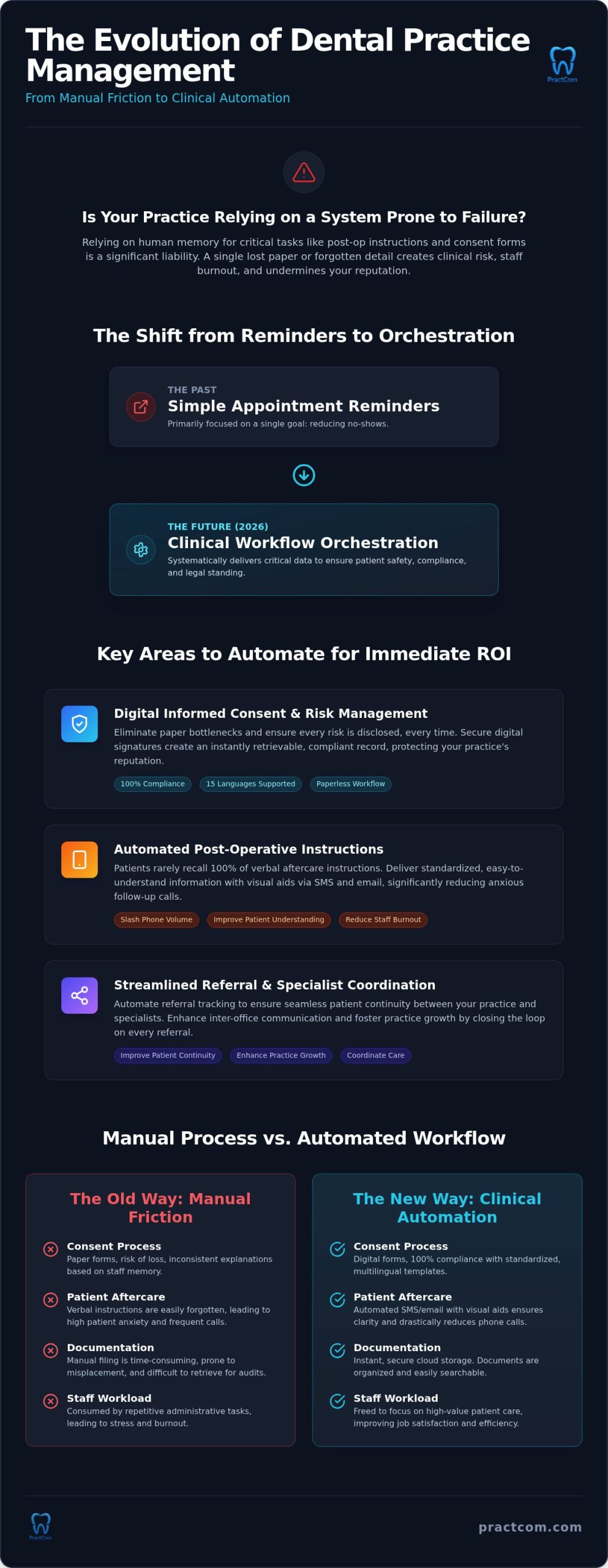
Evaluating ROI: Manual Documentation vs. Automation
Measuring the return on investment for dental patient communication automation requires looking far beyond appointment attendance. While reducing no-shows is valuable, the true clinical ROI lies in eliminating the cumulative “Time-Tax” that manual processes impose on your team. Every minute spent repeating post-operative instructions or searching for a signed paper consent form is a minute diverted from high-value patient care. By moving to a standardized digital system, you replace this operational disorganization with systematic control. This shift provides the psychological security that your practice is running at peak efficiency without sacrificing the quality of the patient experience.
Automated referral management directly impacts your “Referral Conversion Rate” by ensuring cases move through the pipeline without manual intervention. Beyond immediate revenue, this level of automation serves as a guardian of your reputation. Standardized, time-stamped digital documentation in 15 languages provides the regulatory reassurance that can lead to reduced liability premiums. Insurance providers value the consistency of a system where every risk is disclosed and every instruction is documented automatically. A practice performance dashboard acts as your central oversight tool, identifying “leaks” in the patient journey where communication might be failing and allowing you to iterate on engagement strategies in real time.
Hidden Costs of Manual Clinical Workflows
Manual workflows carry significant unseen expenses that erode your margins. When patients lose or misunderstand paper instructions, the resulting high volume of emergency phone calls creates a frantic environment for your front desk. This operational resistance is a leading cause of administrative burnout and high staff turnover rates. You can find strategies to mitigate these issues in our guide on Optimizing Dental Practice Workflow: The 2026 Guide to Clinical Efficiency. Investing in automation is a pre-emptive strike against the exhaustion and errors that drive talented team members away from the profession.
Future-Proofing with a Patient Portal
Modern practices provide psychological security by offering 24/7 access to clinical documents via a secure patient portal. This transparency builds trust and reduces the administrative burden of manual document requests. Additionally, including “Smile Design” visualizations in your automated follow-up sequences provides significant marketing value by showing patients the tangible results of their cosmetic procedures. This blend of technical precision and administrative warmth ensures your practice remains competitive and highly organized. If you’re ready to eliminate bottlenecks and protect your legal standing, start your free trial with PractCom today.
Securing Your Clinical Future with Systematic Control
The shift toward clinical efficiency in 2026 is no longer optional; it’s a professional necessity for any practice aiming to thrive. By embracing dental patient communication automation, you move from a state of operational resistance to one of technical precision. You’ve seen how standardizing informed consent and automating post-op instructions protects your reputation while freeing your staff for high-value interactions. This transition provides the psychological security that your documentation is compliant and your patients are well-informed without the burden of manual repetition.
It’s time to act as the guardian of your reputation by implementing a system designed for the modern dental environment. With support for 15+ languages and a library of 80+ standardized clinical templates, you can ensure every patient receives the highest level of care. Streamline your clinical workflow with PractCom’s automated communication suite and leverage a dedicated Referral Management System to ensure no case falls through the cracks. Your team deserves the confidence that comes with systematic oversight. Start building your clinical safety net today.
Frequently Asked Questions
Is dental patient communication automation HIPAA compliant?
Yes, dental patient communication automation is fully HIPAA compliant when utilizing encrypted delivery methods and secure digital signatures. PractCom acts as a guardian of your reputation by ensuring all patient data is protected both at rest and in transit. This systematic control alleviates the anxiety of practitioners regarding documentation and regulatory compliance. It’s essential to use a platform that prioritizes these security standards to maintain clinical integrity.
Can I automate post-op instructions for different procedures like extractions and implants?
You can easily automate post-op instructions for specific procedures by utilizing a comprehensive library of 80+ standardized templates. Whether you’re managing extractions or complex implants, the system delivers precise clinical data to the patient’s phone. This reduces the volume of emergency phone calls caused by lost paper instructions. It also eliminates the burnout your staff feels from repeating the same manual explanations multiple times every day.
Do I need to replace my current Practice Management Software to use automation tools?
You don’t need to replace your current Practice Management Software to benefit from advanced automation. PractCom is designed as a companion suite that integrates with your current database to fill specific communication gaps. This approach allows you to modernize your clinical workflows without the stress of a full system overhaul. It’s a pragmatic solution for business owners who want technical precision without disrupting their existing administrative operations.
How does multi-language support work in automated dental messaging?
Multi-language support in dental patient communication automation works by automatically mapping clinical templates to the patient’s preferred language. PractCom supports 15 languages for all documents, ensuring that informed consent and aftercare instructions are understood perfectly. This capability is a significant growth lever for serving diverse demographics. It builds immediate trust and eliminates the risk of translation errors that can compromise patient safety or the validity of legal documentation.
Will my older patients be able to use a digital patient portal?
Most older patients find digital portals very accessible when the interface is clean and straightforward. Providing 24/7 access to clinical documents empowers patients of all ages to review their care plan at their own pace. This administrative warmth through consistency helps reduce anxiety for patients who might struggle to remember verbal instructions. It’s about providing a reliable resource that supports their recovery long after they leave the operatory.
What is the difference between RCM automation and clinical communication automation?
RCM automation focuses on the financial side, such as billing and insurance verification. In contrast, clinical communication automation handles the critical data that protects the patient and the practitioner. This includes digital informed consent and standardized aftercare instructions. While RCM is vital for cash flow, clinical automation is an ethical necessity for patient safety. It provides the psychological security that your clinical standards are met every time.
How much time can a typical dental practice save by automating consent forms?
Automating consent forms eliminates the “Time-Tax” associated with printing, scanning, and manually filing paper documents. While every practice is different, removing these administrative bottlenecks can reclaim hours of staff time every week. This allows your team to focus on high-value clinical tasks rather than repetitive paperwork. It’s a pre-emptive strike against the operational resistance that leads to staff burnout and decreased practice efficiency.
Can automated tools help with managing dental referrals between specialists?
Automated tools are highly effective for managing referrals between specialists and general practitioners. A dedicated Referral Management System ensures that patient data and clinical notes are transferred seamlessly without falling through the cracks. This systematic oversight improves your referral conversion rate and provides valuable analytics on practice performance. It transforms a fragmented manual process into a structured, reliable loop that enhances patient continuity and safety.

Article by
Cary Ganz DDS
Dr. Cary H. Ganz is a dentist, prosthodontist, entrepreneur, lecturer, and author with more than 50 years of experience in clinical dentistry and dental technology. Throughout his career, he has combined hands-on patient care with a deep understanding of how technology can improve dental practice operations, communication, documentation, and patient outcomes.
In addition to his clinical background, Dr. Ganz has held significant leadership roles in the dental technology industry, including Past Owner and Vice President of Clinical Affairs at DEXIS Digital Radiography and Past Vice President of Clinical Affairs at Denticon Practice Management Software. His business experience includes product development, clinical strategy, dental software innovation, practice management solutions, and educating dental professionals on the effective use of technology in modern dentistry.
Today, Dr. Ganz continues to focus on creating practical technology solutions for dental practices, including PractCom, a comprehensive dental practice communication platform designed to improve patient communication, documentation, compliance support, referrals, and overall practice efficiency. His work reflects a career-long commitment to helping dentists deliver better care while making their practices more organized, efficient, and protected.
No responses yet