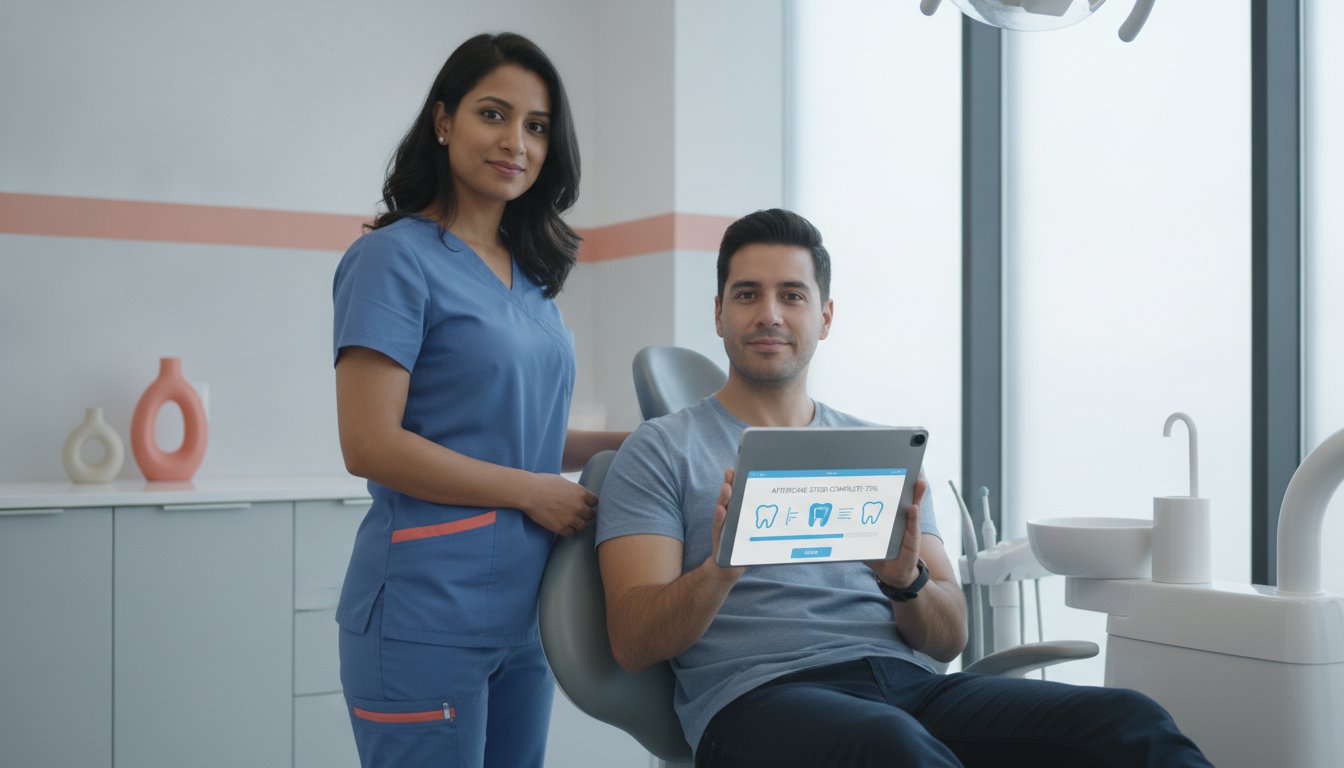
Even with the latest clinical advancements, nearly 53% of planned dental care still goes uncompleted in 2026, leaving both patient health and practice revenue in a state of clinical limbo. You’ve likely felt the operational stress of managing post-operative complications that could’ve been avoided if the patient simply followed the protocol. It’s frustrating when chair time is lost to avoidable excuses or when language barriers create gaps in care that you can’t easily bridge. You aren’t just looking for better cooperation; you’re looking for a way to ensure your clinical excellence isn’t undone by human error once the patient leaves your chair.
This guide demonstrates that improving dental patient compliance is no longer a communication soft skill; it’s a vital clinical infrastructure requirement that must be automated to be effective. You’ll learn how to transform patient adherence from a constant hurdle into a streamlined workflow that protects your practice and improves long-term outcomes. We’ll examine the specific tools and systematic shifts needed to create legally defensible documentation while reducing the administrative friction that slows down your front desk.
Key Takeaways
- Identify the psychological barriers that create the “Compliance Gap” and learn why verbal instructions often fail in high-anxiety clinical settings.
- Secure your practice’s legal standing by implementing digital-first informed consent and verifiable aftercare documentation that acts as a clinical record.
- Master modern strategies for improving dental patient compliance through the use of automated, multi-language digital delivery systems that bridge communication gaps.
- Reduce administrative friction for your front desk by leveraging a standardized library of over 80 clinical templates to ensure team-wide consistency.
- Transition from manual follow-up hurdles to a streamlined, automated workflow that protects both patient outcomes and your professional reputation.
The Compliance Gap: Why Patients Struggle with Dental Instructions
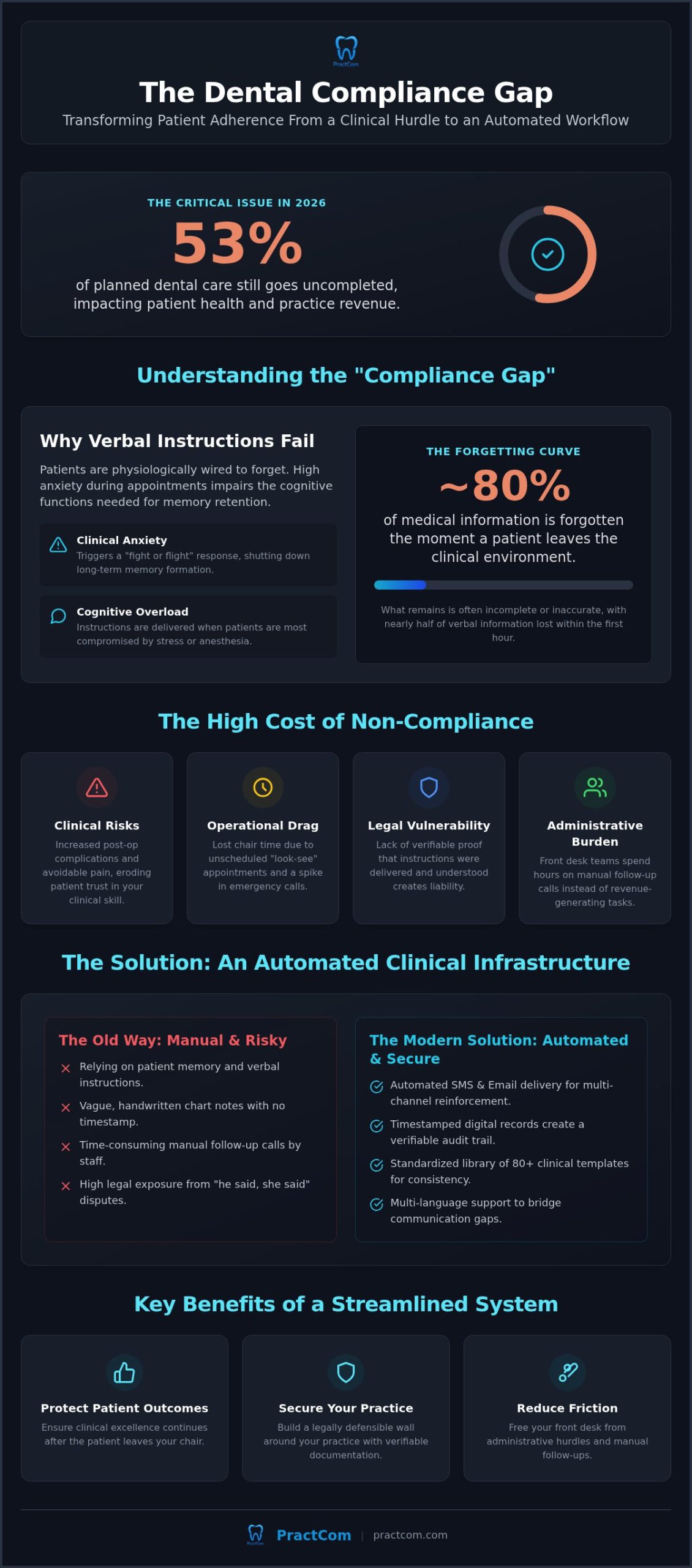
The “Compliance Gap” represents a significant operational risk for modern dental practices. It’s the measurable distance between your clinical expertise and the patient’s actual behavior at home. While your team may provide excellent care in the chair, the success of a procedure often rests on the patient’s ability to follow complex post-operative protocols. Bridging this gap is the primary challenge in improving dental patient compliance, especially as the industry moves toward more complex restorative and surgical procedures in 2026. Relying on verbal instructions is a gamble that most practices can no longer afford.
Research into patient adherence suggests that patients forget approximately 80% of medical information the moment they leave the clinical environment. This isn’t a lack of respect for your authority; it’s a physiological response to the stress of the appointment. High levels of dental anxiety trigger a “fight or flight” response that effectively shuts down the cognitive processes required for long-term memory retention. When you speak to a patient who is still processing the sensory experience of a procedure, your instructions often fail to register in their long-term memory.
The Cost of Non-Compliance
When patients fail to follow instructions, your practice pays the price in several ways. You see it in the spike of emergency phone calls on Friday afternoons and the increase in unscheduled “look-see” appointments that disrupt your production schedule. These complications don’t just consume chair time; they erode the trust you’ve built. A patient who experiences post-op pain due to poor care rarely blames their own memory; they often question the clinician’s skill. Beyond reputation, there’s a heavy administrative burden on your front desk team. They must spend hours on manual follow-up calls to verify that patients are managing their recovery correctly, which pulls them away from more productive tasks like scheduling and billing.
Cognitive Overload in the Dental Chair
Post-treatment instructions are typically delivered during the “recovery” phase, precisely when the patient is most cognitively compromised by anesthesia or lingering stress. The “forgetting curve” in a dental context is a steep decline where nearly half of the verbal information provided is lost within the first hour after discharge. To achieve frictionless compliance, you must move away from a single point of communication. By using multi-channel reinforcement, like immediate SMS or email follow-ups, you provide a digital safety net that the patient can reference once their cognitive fog clears. This systematic approach ensures that improving dental patient compliance is a predictable outcome rather than a lucky coincidence.
This emphasis on utilizing technology to bridge the communication gap is mirrored in other healthcare sectors. To see how AI-powered concierge services are being used to enhance patient recovery and adherence in a specialized setting, you can learn more about Optima Physical Therapy.
Risk Management: Compliance as a Legal Necessity
Clinical excellence alone isn’t enough to protect your practice in the current regulatory climate of 2026. You must be able to prove that instructions were delivered, received, and understood by the patient. Think of your documentation as a “black box” for every procedure; it should provide an irrefutable record of the communication exchange. Without this, you’re vulnerable to “he said, she said” scenarios that can devastate a reputation during malpractice claims. Moving to digital-first protocols ensures that your efforts in improving dental patient compliance are backed by a verifiable audit trail that protects your clinical decisions.
The shift toward digital-first informed consent and aftercare is no longer optional for high-growth practices. Relying on the patient’s memory or a vague chart note creates a liability gap that insurance carriers are increasingly unwilling to cover. Implementing effective dental patient compliance strategies requires a shift from passive verbal advice to active, documented engagement. When you provide a patient with a digital record they can access at any time, you aren’t just helping them heal; you’re building a legally defensible wall around your practice.
The Burden of Proof in Aftercare
A timestamped digital instruction is vastly superior to a handwritten chart note in a legal setting. It provides objective proof of when the information was sent and, in many cases, when it was opened. To maintain security, you must ensure HIPAA compliance when sending clinical instructions via SMS or email, using encrypted platforms that protect sensitive data. Using a standardized library of templates also eliminates “omission” errors, ensuring that every patient receives the exact same high standard of care instructions regardless of which staff member is at the front desk. You can explore how to standardize your practice’s documentation to eliminate these administrative risks.
Informed Consent and Adherence
True compliance begins before the procedure even starts. By linking the consent process to the pre-medication and post-op instruction cycle, you create a continuous chain of communication. Leveraging Digital Dental Informed Consent Forms allows you to capture digital signatures that provide a verifiable audit trail of patient understanding. This system confirms that the patient was aware of the risks and their specific responsibilities during recovery. In a modern legal environment, “I told the patient” is no longer a valid legal defense because it lacks the objective proof required to withstand scrutiny.
Strategies for Improving Dental Patient Compliance in 2026
Traditional rapport-building is a valuable tool, but it’s often insufficient for improving dental patient compliance in a high-volume practice. While paper instructions were once the standard, they are notoriously ineffective for modern demographics who expect digital accessibility. Statistics regarding Dental Patient Compliance and Adherence highlight that non-adherence leads to increased clinical costs and poorer long-term outcomes. By transitioning to digital delivery, you provide a resource that is impossible to lose and easy to revisit when the patient is actually ready to process the information.
The Multi-Language Strategy
Language barriers present a severe risk to patient safety, especially during complex recovery phases. It’s dangerous to provide post-op instructions in a language the patient doesn’t fully master; nuances regarding terms like “antiseptic” or “premedicate” are easily misunderstood. Using a system that offers an automated 15-language library bridges this communication gap instantly. This ensures that every patient, regardless of their primary language, has the clarity needed to avoid medical errors and post-treatment infections. This systematic approach removes the “language friction” that often leads to avoidable emergency calls.
Visual and Interactive Reinforcement
Visual aids significantly increase a patient’s emotional and financial investment in their treatment. Tools like “Smile Design” show the aesthetic goal of a procedure, which motivates the patient to adhere to strict care protocols to protect that future result. Additionally, a patient portal acts as a 24/7 reference point, allowing patients to check their specific care instructions at 2:00 AM without calling your emergency line. Interactive instructions that include links or short videos outperform static paper slips because they cater to different learning styles while improving dental patient compliance through better engagement.
Implementing these systems doesn’t have to be a burden on your team. By optimizing dental practice workflow, you can automate these touchpoints so they happen consistently every time. This shift transforms compliance from a variable “soft skill” into a predictable part of your clinical infrastructure, ensuring that your high standards of care are maintained long after the patient leaves the office.
Implementing Automated Follow-Ups for Frictionless Care
Manual outreach is inherently limited by the constraints of human memory and administrative bandwidth. When your front desk team is juggling phone calls, insurance verification, and patient check-ins, follow-up care often falls to the bottom of the priority list. By shifting to an automated framework, you ensure that improving dental patient compliance becomes a repeatable process rather than a sporadic effort. This systematic approach transforms post-operative care into a clinical infrastructure that operates 24/7 without requiring manual intervention.
The implementation of a frictionless follow-up system follows a logical four-step progression. First, you must standardize your instructions using a library of 80+ clinical templates. This ensures that every patient receives the same high-quality data regardless of which provider performed the procedure. Second, these instructions are delivered via SMS or email immediately following the appointment. This ensures the patient has the information on their mobile device before they even leave the parking lot. Third, you schedule automated 24-hour and 7-day check-ins to monitor the recovery phase and catch potential issues early. Finally, you use a Practice Performance Dashboard to track which patients haven’t confirmed receipt of their instructions, allowing for targeted intervention where it’s needed most.
Automation vs. Manual Outreach
Automated SMS delivery offers significantly higher open rates compared to traditional email, ensuring your message is seen during the critical first hours of recovery. While you must be mindful of notification fatigue, a well-timed sequence of messages provides psychological security for the patient without overwhelming them. This automation frees up your front desk for higher-value patient interactions that require a human touch, such as complex case presentations or financial counseling. The return on investment for automation is realized through a significant reduction in re-treatment cases caused by inadequate home care. You can automate your patient follow-up workflow today to begin protecting your clinical outcomes.
The Referral Compliance Loop
Compliance challenges aren’t limited to post-operative care; they also impact the referral process. Many patients fail to visit a specialist after a GP referral because the transition lacks a clear, guided path. Using referral management software allows you to track the patient journey from the initial GP recommendation to the Specialist’s chair. This ensures that the “referral loop” is closed and that patients receive the necessary advanced care to maintain their overall treatment plan. To learn more about stabilizing this process, you can explore Mastering Dental Referral Management Software to see how digital tracking improves long-term adherence.
PractCom: The Infrastructure for Patient Adherence
While your Practice Management Software (PMS) handles the logistics of billing and scheduling, it often lacks the specialized tools required for improving dental patient compliance through clinical communication. PractCom functions as the essential infrastructure layer that bridges this gap. By utilizing a library of 80+ post-treatment templates, you ensure that every patient receives precise, medically accurate instructions regardless of which team member provides the care. This standardization is your primary defense against the operational disorganization that leads to patient confusion and avoidable clinical complications. The Practice Performance Dashboard provides the clinical oversight you need to verify that your protocols are actually being followed, transforming communication from a subjective “soft skill” into a measurable business metric. If you’re ready to standardize your practice, PractCom provides the automated framework to protect your reputation and your patients’ health.
Standardizing the Patient Journey
Clinician variability is a major source of patient non-adherence. When different providers give slightly different advice, patients become hesitant and less likely to follow through with their recovery plans. PractCom removes this inconsistency by integrating digital informed consent and post-op instructions into a single, cohesive workflow. This ensures that the patient’s legal agreement to treatment is immediately reinforced by the specific steps they must take for a successful recovery. This dual-layered approach maximizes safety because it confirms understanding at two critical points in the clinical journey. For patients who aren’t tech-savvy, the system also supports physical document printing, ensuring that your high standards of care remain accessible to your entire patient population without exception.
Scaling with PractCom for DSOs
For Dental Support Organizations (DSOs), maintaining clinical consistency across multiple locations is an immense administrative challenge. PractCom allows you to manage compliance at scale through a unified dashboard that tracks performance across your entire organization. This level of oversight ensures that your brand’s clinical standards are upheld in every operatory, at every location, every single time. By centralizing your instruction library and consent forms, you eliminate the risk of outdated or non-compliant documents being used at remote sites. You can explore how to implement these systems at scale by visiting our page on PractCom for DSOs to see how we help large groups reduce operational friction while improving dental patient compliance across the board.
Ready to standardize your practice? Streamline your patient communication with PractCom.
Future-Proofing Your Clinical Excellence
The transition from manual patient management to a systematic, digital ecosystem is no longer a luxury for high-growth practices; it’s a regulatory and clinical necessity. By addressing the psychological barriers of the “forgetting curve” and bridging language gaps with verified translations, you protect your clinical outcomes from the variables of human memory. You’ve seen how improving dental patient compliance requires more than just rapport. It demands a structured infrastructure that delivers the right instructions at the right time, every time.
Your path to operational stability involves replacing “I forgot” excuses with verifiable digital footprints. With access to 80+ specialized post-treatment templates, automated SMS and email follow-ups, and digital consent forms in 15 languages, you can finally move from administrative resistance to total clinical control. This standardized approach doesn’t just reduce emergency calls; it safeguards your reputation and ensures your team operates at peak efficiency.
Take the next step in securing your practice’s future. Master patient compliance with PractCom’s instruction library and turn adherence into a frictionless part of your daily workflow. You’ve built a practice based on excellence; now give it the communication framework it deserves.
Frequently Asked Questions
What are the most common reasons for dental patient non-compliance?
Patients typically struggle due to cognitive overload caused by dental anxiety, which prevents the retention of verbal instructions given in the chair. Language barriers and the physical loss of paper handouts also contribute significantly to non-adherence. By providing a digital, permanent record, you remove the reliance on a patient’s memory during the stressful recovery phase.
How does automated SMS improve dental patient adherence?
Automated SMS delivery ensures that instructions reach the patient’s mobile device immediately after their appointment, achieving much higher open rates than traditional email. This method provides a just-in-time reinforcement of clinical protocols, making it easy for patients to reference care steps while they’re at home. It removes the friction of searching for misplaced papers or trying to recall verbal advice.
Can I send post-op instructions in languages other than English?
Yes, providing instructions in a patient’s native tongue is a critical safety requirement for modern practices. PractCom’s library includes templates in 15 different languages, allowing you to bridge communication gaps instantly. This ensures that ESL patients fully understand complex clinical terms like antiseptic or premedicate, which drastically reduces the risk of post-operative complications.
Is it HIPAA compliant to text dental instructions to patients?
Texting clinical instructions is HIPAA compliant as long as the platform uses end-to-end encryption and verified delivery methods. In 2026, regulatory standards emphasize the use of multi-factor authentication and secure links to protect electronic Protected Health Information (ePHI). Using a specialized platform ensures your practice meets these evolving security requirements while maintaining efficient communication.
How do I document that a patient received their aftercare instructions?
You can verify delivery through a Practice Performance Dashboard that provides timestamped receipts for every document sent. This digital audit trail is far more legally defensible than a simple chart note stating instructions were given. It provides objective proof that the information was delivered to the patient’s specific device at a documented time, protecting your practice from liability.
What is the “forgetting curve” in dental patient education?
The forgetting curve refers to the rapid decline in information retention, where patients often lose up to 80% of medical advice immediately after leaving the clinical environment. This is a physiological response to the stress and sensory overload of a dental procedure. Systematic digital reinforcement is necessary to counteract this natural memory loss and ensure instructions are followed correctly.
How can I track if a patient has read their digital consent form?
Digital consent forms track engagement through verifiable audit trails and secure digital signatures. You can monitor the status of these documents in real-time through your communication portal, seeing exactly when a form was opened and signed. This transparency allows your front desk to follow up with patients who haven’t yet completed their required documentation before they arrive for their appointment.
Improving dental patient compliance directly increases revenue by reducing the volume of unpaid look-see appointments and emergency calls that disrupt your production schedule. It also lowers the rate of costly re-treatment procedures caused by inadequate home care. This shift toward proactive oral care is mirrored in other fields; for example, Purrlys highlights how specialized solutions like dental probiotics are becoming essential for maintaining oral health in the veterinary sector. When patients follow protocols and see successful outcomes, they’re more likely to accept future treatment plans and refer others to your practice.
Ultimately, by adopting these automated workflows, practices can achieve the high standard of care found at All Stars Dental, where patient education and clinical excellence go hand-in-hand to ensure long-term success.

Article by
Cary Ganz DDS
Dr. Cary H. Ganz is a dentist, prosthodontist, entrepreneur, lecturer, and author with more than 50 years of experience in clinical dentistry and dental technology. Throughout his career, he has combined hands-on patient care with a deep understanding of how technology can improve dental practice operations, communication, documentation, and patient outcomes.
In addition to his clinical background, Dr. Ganz has held significant leadership roles in the dental technology industry, including Past Owner and Vice President of Clinical Affairs at DEXIS Digital Radiography and Past Vice President of Clinical Affairs at Denticon Practice Management Software. His business experience includes product development, clinical strategy, dental software innovation, practice management solutions, and educating dental professionals on the effective use of technology in modern dentistry.
Today, Dr. Ganz continues to focus on creating practical technology solutions for dental practices, including PractCom, a comprehensive dental practice communication platform designed to improve patient communication, documentation, compliance support, referrals, and overall practice efficiency. His work reflects a career-long commitment to helping dentists deliver better care while making their practices more organized, efficient, and protected.
No responses yet