
Did you know that referral leakage costs the average dental practice between $120,000 and $200,000 in lost annual revenue every single year? It’s a staggering figure that highlights a systemic failure in how offices communicate. You’ve likely felt the stress of this firsthand, whether it’s a patient losing a physical referral slip or a specialist receiving incomplete clinical notes that delay necessary care. We understand that these administrative gaps don’t just hurt your bottom line; they create unnecessary friction for your team and your patients.
Mastering the art of improving dental referral acceptance rates requires a shift from manual guesswork to systematic control. By reading this guide, you’ll gain the clinical and administrative frameworks needed to eliminate leakage and enhance communication between GPs and specialists. We’ll explore how to automate your documentation sharing, reduce staff follow-up time, and implement a tracking system that ensures no patient falls through the cracks. It’s time to replace operational disorganization with a reliable professional ecosystem that protects your reputation and your revenue.
Key Takeaways
- Identify the hidden financial impact of referral leakage and learn how to quantify lost production within your existing network.
- Establish a standardized tracking framework for improving dental referral acceptance rates by implementing digital dashboards with mandatory clinical fields.
- Enhance specialist communication by providing the “clinical why” behind every referral through integrated digital informed consent and documentation sharing.
- Apply the 24-hour rule to patient engagement by using automated SMS tools for frictionless scheduling and immediate follow-up.
- Leverage a dedicated communication platform to bridge the gap between disparate practice systems and identify your highest-performing professional partners.
The Financial and Clinical Impact of Referral Leakage in 2026
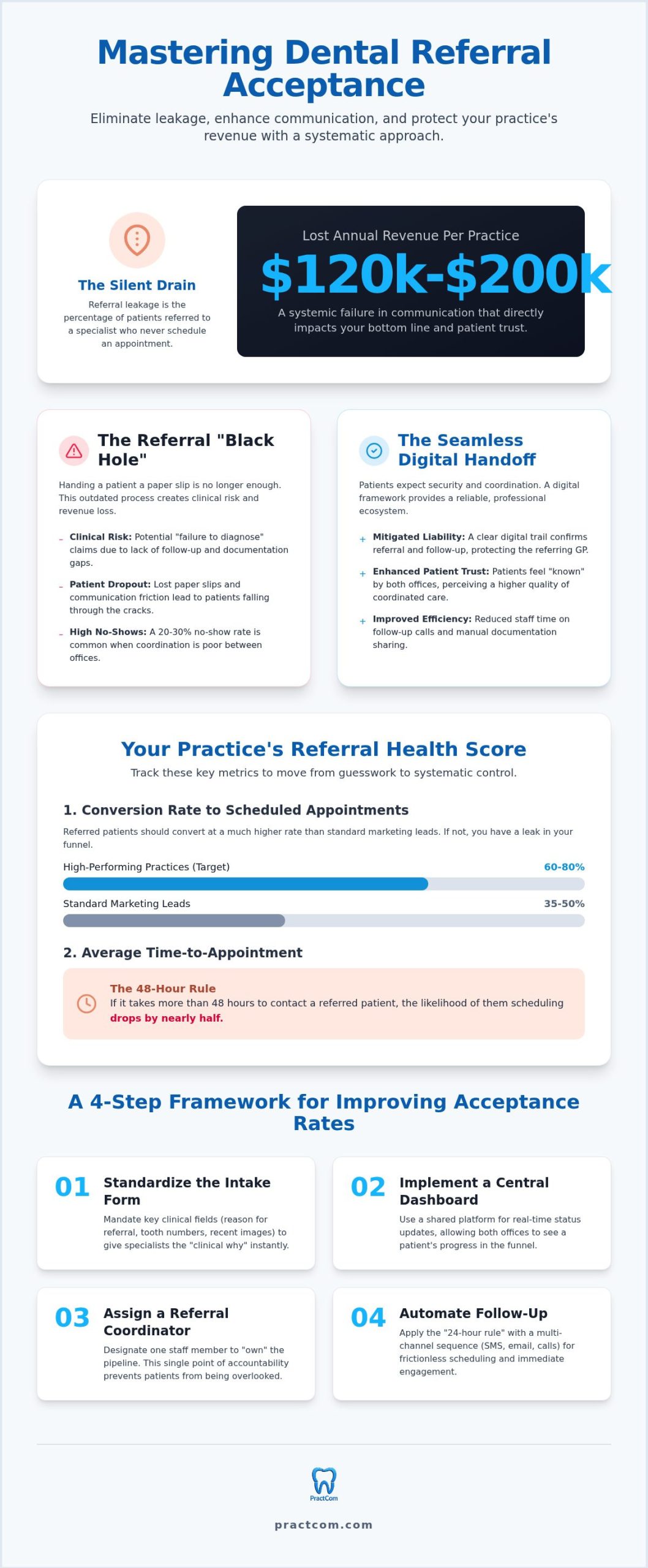
Referral leakage is the silent drain on your practice’s productivity. In simple terms, it is the percentage of patients who are referred to a specialist but never actually schedule an appointment. While it might seem like an administrative nuisance, the financial stakes are massive. Research from 2026 indicates that referral leakage can cost a dental practice between $120,000 and $200,000 in lost annual revenue. When a patient falls out of the medical referral process, you aren’t just losing a single procedure; you’re losing the lifetime value of that patient and the trust of your professional partners.
Beyond the balance sheet, there’s a significant clinical risk. Failing to track a referral creates a documentation gap that can lead to “failure to diagnose” or “failure to treat” claims. If a general practitioner refers a patient for a suspicious lesion or advanced periodontal disease and that patient never arrives at the specialist’s office, the GP may still be held liable for the lack of follow-up. In 2026, patients expect a seamless digital handoff. Handing a patient a paper slip is no longer enough. They want the security of knowing their clinical data has already reached the specialist before they even pick up the phone.
Calculating Your Practice’s Referral Health Score
To begin improving dental referral acceptance rates, you must first understand your data. High-performing practices in 2026 target a conversion rate of 60-80% for referred patients, which is significantly higher than the 35-50% rate seen in standard marketing leads. If your conversion rate is lower, you likely have a “Black Hole” in your funnel. This usually occurs between the moment the referral is generated and the first 24 hours of follow-up. You should track three key metrics: total referral volume, the conversion rate to scheduled appointments, and the average time-to-appointment. If it takes more than 48 hours to contact a referred patient, the likelihood of them scheduling drops by nearly half.
The Relationship ROI Between GPs and Specialists
The bond between a GP and a specialist should be a clinical partnership, not a transactional one. When you implement a transparent tracking system, the patient perceives a higher quality of care because they feel “known” by both offices. This level of coordination reduces the no-show rate, which currently sits between 20-30% for many practices. By using a dedicated system to close the loop, specialists can provide real-time feedback to GPs, ensuring that the “clinical why” behind every referral is understood. This professional synergy is essential for any practice looking to scale its network and protect its reputation. If you’re curious how your current methods stack up against modern standards, you can view our referral system comparison to see where your gaps might exist.
Establishing a Standardized Dental Referral Tracking Framework
Moving from a chaotic, paper-based system to a digital framework is the primary requirement for improving dental referral acceptance rates. It’s not just about technology; it’s about eliminating the ambiguity that leads to patient dropout. A standardized process provides the psychological security your team needs to manage high volumes without burnout. When you create a predictable path for every patient, you move from a reactive posture to one of systematic control.
- Step 1: Standardize the Intake Form. You must mandate clinical fields such as the primary reason for referral, relevant tooth numbers, and the dates of the most recent diagnostic images. This ensures specialists have the “clinical why” immediately.
- Step 2: Implement a Centralized Dashboard. Real-time status updates allow both offices to see exactly where a patient sits in the treatment funnel at any given moment.
- Step 3: Assign a Referral Coordinator. Designate one specific staff member to own the referral pipeline. This accountability prevents patients from slipping through the cracks of a busy schedule.
- Step 4: Create a Multi-Channel Follow-Up Sequence. Use a mix of SMS, email, and phone calls to reach patients where they are most responsive.
Centralizing Data Without a Full PMS Overhaul
Generic Practice Management Software (PMS) modules often fail because they require external offices to log into a specific, often incompatible, system. This creates operational resistance that slows down the entire process. A specialized communication suite offers cloud-based access that works independently of your PMS, making it easier for diverse offices to collaborate effectively. Integrating a Practice Performance Dashboard allows for executive oversight, giving you the ability to identify bottlenecks in real-time without micromanaging your staff. If you’re ready to see how this looks in practice, you can start optimizing your workflow today.
Defining Clear Status Milestones
Transparency is the foundation of professional trust in a clinical setting. By categorizing every referral into specific milestones like ‘Pending,’ ‘Scheduled,’ ‘Completed,’ or ‘No-Show,’ you provide instant clarity to the referring GP. Automating notifications when these milestones are reached can reduce “status inquiry” phone calls by 40%, freeing up your front desk for higher-value tasks. These clear communication lines help strengthen your referrals by proving to your partners that you are a reliable guardian of their patients’ care. This systematic approach transforms a transactional handoff into a clinical partnership that benefits both the practice and the patient.
For practices looking to maximize this reclaimed time and improve overall efficiency, you can discover TurnUp World and its capacity optimization platform designed to act as a copilot for your front desk.
Best Practices for GP-to-Specialist Clinical Documentation
Effective clinical handoffs are the backbone of improving dental referral acceptance rates. When a specialist receives a referral, they shouldn’t have to hunt for the reason the patient is sitting in their chair. Providing the “clinical why” immediately sets the stage for a successful consultation. This includes a summary of the patient’s chief complaint, any previous treatments attempted, and the specific outcome the GP expects. Without this context, the specialist is forced to repeat diagnostic steps, which increases patient frustration and delays the start of treatment.
Standardizing your image sharing is another critical component of a professional handoff. Sending low-resolution radiographs or missing intraoral photos creates a significant diagnostic delay. You should ensure that all high-quality digital files are attached to the referral at the moment of creation. This allows the specialist to review the case before the patient arrives, creating a sense of preparedness that builds immediate trust. When the specialist is fully informed, the transition feels like a continuation of care rather than a disjointed restart.
Closing the Documentation Gap with Informed Consent
Integrating digital informed consent into the referral process acts as a protective shield for both the GP and the specialist. By sharing these documents digitally, you ensure that the patient has reviewed the risks and benefits of the proposed treatment well before their appointment. This reduces clinical anxiety and helps patients feel more prepared for their consultation. Providing this level of transparency is a key part of digital dental informed consent compliance. It ensures that no part of the clinical communication process is left to chance, moving the patient closer to a signed treatment plan.
The Multilingual Necessity in 2026
In 2026, health equity is a standard of care, not an option. Providing pre-treatment instructions in a patient’s native language is one of the most effective ways to increase specialist show-rates. When patients understand exactly what to expect in a language they are comfortable with, their compliance increases dramatically. PractCom’s support for 15 languages allows your practice to bridge the gap between complex professional procedures and general understanding. This eliminates “lost in translation” errors that often lead to no-shows or misunderstood clinical requirements. By removing these linguistic barriers, you create a more inclusive environment that directly supports the goal of improving dental referral acceptance rates across diverse patient populations.
Automating Patient Follow-Up: Closing the Referral Loop
The time between a patient leaving the GP’s office and arriving at the specialist’s practice is the most vulnerable point in the clinical journey. We previously identified this as the “Referral Black Hole,” and it’s where the majority of revenue loss occurs. To succeed in improving dental referral acceptance rates, your office must adopt the 24-hour rule. This rule dictates that the first contact with a referred patient should happen within one business day of the referral being generated. Speed communicates priority; it reassures the patient that their condition is being taken seriously by both offices.
Automation is the only way to maintain this pace without overwhelming your administrative team. By implementing a “Nudge” strategy, you can schedule automated follow-ups for patients who haven’t booked their consultation yet. This moves the burden of memory from your staff to a standardized system. If a patient doesn’t respond to the initial contact, the system sends a polite reminder 48 hours later. This persistent, yet professional, oversight ensures that no patient is forgotten in the shuffle of a busy work week. You can automate your follow-up sequence today to start capturing these lost opportunities.
Leveraging SMS and Email for Patient Engagement
In 2026, text messaging is the gold standard for patient communication. SMS messages boast a 98% open rate, making them far more effective than traditional mailers or even phone calls that often go to voicemail. When using SMS, you must ensure your platform is HIPAA-compliant to protect patient privacy and your practice’s legal standing. A high-utility strategy involves sending automated dental post-op instructions or pre-treatment details during this phase. Providing these resources early reduces anxiety and prepares the patient for the clinical reality of their upcoming procedure, which significantly lowers the no-show rate.
Closing the Loop with the Referring Doctor
True clinical coordination requires a two-way street of information. While a “Referral Thank You” is a nice professional gesture, it doesn’t provide the clinical value that a GP needs. You should automate the delivery of a comprehensive clinical summary once the treatment is complete. This report should include the final outcome, any complications encountered, and the recommended maintenance schedule. By providing this feedback automatically, you secure the GP’s trust and build a “Circle of Care” around the patient. This consistent transparency proves you are a reliable partner, ensuring a steady stream of future referrals and a higher overall standard of care.
Scaling Your Referral Network with PractCom’s Communication Suite
Scaling a referral network requires a system that functions independently of the disparate software used by your professional partners. PractCom serves as the “Universal Translator” in this clinical ecosystem. It allows specialists and GPs to communicate seamlessly, regardless of which primary Practice Management System they use. This interoperability is a foundational requirement for improving dental referral acceptance rates across a broad network. By removing the technical barriers to entry, you encourage higher participation from your referring doctors and ensure that clinical data flows without resistance.
The administrative impact of this systematic control is immediate. Many practices report reducing manual follow-up tasks by 20 or more hours every month. This reclaimed time allows your team to focus on high-value patient interactions rather than chasing down missing files or making repetitive status calls. Using the Referral Management System also provides the data needed to identify your top-performing partners. You can see exactly which offices provide the highest conversion rates, allowing you to invest your relationship-building efforts where they’ll have the most significant impact on the dental patient experience.
PractCom for DSOs and Multi-Location Groups
For larger organizations, standardizing referral workflows across 10 or more locations is often an operational nightmare. PractCom simplifies this by providing a unified platform that ensures every office follows the same clinical and administrative protocols. You can use the performance dashboard to benchmark specialist performance across your entire group, identifying which locations are excelling and which need additional support. This level of executive oversight is essential for maintaining a consistent standard of care. To see how we support large-scale operations, you can learn more about PractCom for DSOs.
Ready to Eliminate Referral Leakage?
The shift from manual tracking to automated clinical communication represents a move from administrative anxiety to psychological security. You don’t have to disrupt your entire daily operation to begin this transition. By implementing a standardized system, you protect your practice’s reputation and ensure your patients receive the coordinated care they deserve. It’s time to replace operational disorganization with a forward-thinking solution that values accuracy and efficiency above all else. If you’re ready to take the next step, start your free trial of PractCom today and experience the difference of a truly integrated referral network.
Future-Proof Your Referral Pipeline
The era of paper referral slips and manual follow-up calls is over. By implementing the frameworks we’ve discussed, you move from a state of operational disorganization to one of systematic control. This shift is the most effective way of improving dental referral acceptance rates while protecting your practice from the clinical liabilities of lost documentation. You’ve seen how closing the loop secures your revenue and strengthens your professional reputation among your peers.
You don’t need to overhaul your entire Practice Management System to see these results. PractCom provides a dedicated communication layer that includes 15-language support for all clinical documents and a library of 80+ post-treatment templates. With digital informed consent integrated directly into the workflow, you can provide a higher standard of care without the administrative friction of manual data entry. It’s time to eliminate referral leakage and restore confidence in your office’s communication process.
Start your free trial of PractCom’s Referral Management System today to build a more resilient and profitable clinical network. We’re here to help you turn every referral into a successful treatment outcome.
Frequently Asked Questions
What is dental referral tracking and why is it important?
Dental referral tracking is a systematic process used to monitor a patient’s journey from the general practitioner to the specialist. It’s vital because it prevents referral leakage, which costs practices between $120,000 and $200,000 in lost annual revenue. By closing this loop, you ensure patients receive necessary care while protecting your practice from clinical liability and the erosion of professional trust between doctors.
How does a referral management system differ from a standard PMS?
A referral management system is a dedicated communication suite designed for inter-office collaboration, whereas a standard PMS focuses on internal scheduling and billing. Unlike a PMS, which often requires both offices to use the same software, a specialized system acts as a universal bridge. This makes improving dental referral acceptance rates easier because it removes the technical barriers that often stall communication between diverse practices.
Can I track referrals without making the other office buy new software?
Yes, modern communication platforms allow you to send and receive secure referral data via web-based portals that don’t require the other office to install anything. This reduces operational resistance by allowing specialists to receive clinical notes and images through a secure, encrypted link. It ensures a seamless handoff without forcing your partners to change their internal workflows or invest in expensive new systems.
What are the best ways to follow up with patients who ignore referral slips?
The most effective method is a multi-channel nudge strategy using automated SMS and email reminders. Since text messages have a 98% open rate, they are far more reliable than paper slips that patients easily lose or forget. Following the 24-hour rule for initial contact ensures the patient feels prioritized, which significantly increases the likelihood that they’ll schedule their specialist consultation immediately.
Is digital dental referral tracking HIPAA compliant?
Digital tracking is HIPAA compliant as long as the platform uses end-to-end encryption and provides a signed Business Associate Agreement. These systems protect patient information during transmission between the GP and specialist, which is much safer than standard email or physical paper. Using a secure digital framework creates an auditable trail of clinical documentation and consent, ensuring your practice meets all regulatory requirements.
How can I measure the ROI of my dental referral network?
You measure ROI by tracking your conversion rates and the total production value generated from specific referral sources. A performance dashboard allows you to compare referral volume against completed appointments to identify your most profitable partners. This data helps you focus your relationship-building efforts on the doctors who provide the highest quality cases and the most reliable patient show-rates for your specialty.
What clinical documents should be included in a dental referral?
A complete referral should include the clinical why, high-resolution radiographs, intraoral images, and digital informed consent forms. Providing this comprehensive documentation allows the specialist to review the case before the patient arrives in their chair. This level of preparedness reduces diagnostic delays and improves the patient experience by ensuring both doctors are aligned on the treatment goals from the very first visit.
How do automated post-op instructions help with referral conversion?
Automated instructions in a patient’s native language build trust and reduce clinical anxiety before the procedure even begins. By providing these details early, you demonstrate a commitment to the patient’s long-term recovery and safety. This proactive communication is a key driver in improving dental referral acceptance rates because it makes the patient feel cared for and prepared for the specialist’s specific care plan.

Article by
Cary Ganz DDS
Dr. Cary H. Ganz is a dentist, prosthodontist, entrepreneur, lecturer, and author with more than 50 years of experience in clinical dentistry and dental technology. Throughout his career, he has combined hands-on patient care with a deep understanding of how technology can improve dental practice operations, communication, documentation, and patient outcomes.
In addition to his clinical background, Dr. Ganz has held significant leadership roles in the dental technology industry, including Past Owner and Vice President of Clinical Affairs at DEXIS Digital Radiography and Past Vice President of Clinical Affairs at Denticon Practice Management Software. His business experience includes product development, clinical strategy, dental software innovation, practice management solutions, and educating dental professionals on the effective use of technology in modern dentistry.
Today, Dr. Ganz continues to focus on creating practical technology solutions for dental practices, including PractCom, a comprehensive dental practice communication platform designed to improve patient communication, documentation, compliance support, referrals, and overall practice efficiency. His work reflects a career-long commitment to helping dentists deliver better care while making their practices more organized, efficient, and protected.
No responses yet