
In 2026, a simple encrypted text message is no longer enough to protect your practice from the evolving scrutiny of a HIPAA audit. You likely feel the daily weight of managing post-operative care while worrying if your current tools actually meet the rigorous standards of clinical truth and legal documentation. It’s a common stressor for modern clinicians who find themselves buried under a high volume of post-treatment phone calls and inefficient referral tracking. Transitioning to a dedicated HIPAA compliant patient communication platform isn’t just about technical encryption; it’s about establishing a stabilizing force that protects your reputation and your patients’ privacy simultaneously.
You’ve probably noticed that manual tasks and the limitations of human memory often lead to patient non-compliance or missed follow-up details. This article promises to show you how to secure your practice reputation and patient data with a communication platform that goes beyond simple texting to provide full clinical compliance. We’ll preview the essential shift toward standardized, legally-sound communication that utilizes digital consent and automated follow-ups to reduce emergency calls and streamline your administrative workflow.
Key Takeaways
- Learn why a HIPAA compliant patient communication platform must function as a comprehensive clinical ecosystem rather than just a messaging app to eliminate professional liability.
- Identify the non-negotiable legal foundations required in 2026, including the absolute necessity of a Business Associate Agreement for all data transfers.
- Discover how standardized post-treatment documentation serves as a proactive risk management tool to reduce emergency calls and improve patient care outcomes.
- Understand the critical role of staff training and secure referral management in building a stabilized, legally-sound administrative workflow.
- Explore how dedicated performance dashboards provide the systematic oversight needed to maintain a high-pressure clinical environment with total confidence.
Beyond Encrypted Texting: Redefining HIPAA Compliance in 2026
By 2026, viewing compliance as a single software installation is a dangerous administrative oversight. A true HIPAA compliant patient communication platform functions as a comprehensive ecosystem rather than a standalone app. It doesn’t just encrypt data; it manages the entire lifecycle of clinical interaction to ensure every touchpoint is legally sound. This systemic approach provides the psychological security you need to focus on patient care without the constant anxiety of a potential data breach.
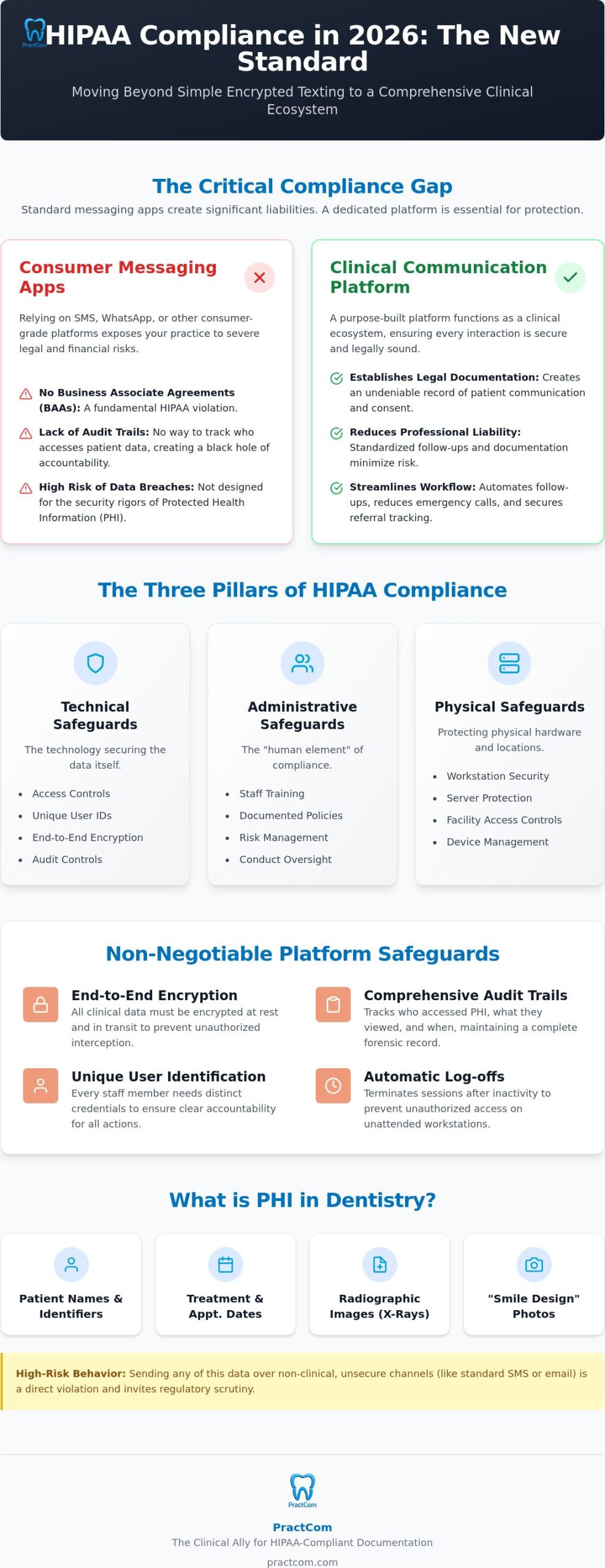
Relying on standard SMS or WhatsApp creates significant clinical liabilities for your practice. These consumer-grade platforms lack the required Business Associate Agreements (BAAs) and robust audit trails mandated by the Health Insurance Portability and Accountability Act. Even if the messages are technically encrypted, the lack of administrative oversight means your practice remains legally exposed. True compliance rests on three distinct pillars that must work in harmony:
- Technical Safeguards: These include access controls, unique user IDs, and encryption protocols for data both at rest and in transit.
- Administrative Safeguards: This involves the “human element,” covering staff training, documented policies, and the active management of professional conduct.
- Physical Safeguards: This ensures the physical protection of workstations and servers where sensitive data is accessed or stored.
This commitment to data sovereignty is a priority for modern professionals across various fields; for example, those managing digital assets often turn to self-hosted solutions like unCoded to maintain full control over their private servers and security keys.
We’re seeing a shift toward “Clinical Communication Security.” This concept moves beyond simple data encryption to prioritize the integrity of the clinical message itself. This focus on precise, industry-specific messaging is vital in any technical field; you can read more about how BCM Public Relations handles strategic communication for sectors like manufacturing and engineering. It ensures that the right instructions reach the right patient at the right time, creating a standardized system that minimizes the risk of human error or memory lapses.
The Legal Reality of PHI in Dental Practices
Protected Health Information (PHI) in a dental context is broad, encompassing patient names, treatment dates, and even radiographic images. Sending unencrypted X-rays or “Smile Design” photos over non-clinical channels is a high-risk behavior that invites regulatory scrutiny. The HIPAA Security Rule specifically requires that all electronically protected health information be safeguarded against any reasonably anticipated threats to its security or integrity. Using a platform designed for clinical data ensures these visual records remain protected while maintaining their diagnostic value.
Why Your Practice Management Software (PMS) Isn’t Enough
Most Practice Management Software platforms act as excellent databases, but they often fail as dynamic communication tools. They lack the specialized layer needed to manage complex clinical documents in multiple languages or track referrals with precision. You need a dedicated communication layer to bridge the gap between your static records and active patient engagement. To see how this integration transforms your daily operations, explore our guide on Optimizing Dental Practice Workflow: The 2026 Guide to Clinical Efficiency.
Essential HIPAA Safeguards: What Your Platform Must Provide
A robust HIPAA compliant patient communication platform must deliver more than just a locked door. It requires a transparent system of accountability. While many vendors focus solely on the ease of software integration, the true standard in 2026 involves a multi-layered defense that protects your practice from both external threats and accidental internal errors. You need a solution that acts as a guardian of your legal standing, ensuring every digital interaction is documented and secure.
- End-to-End Encryption: All clinical data transfers must be encrypted at rest and in transit to prevent unauthorized interception.
- Audit Trails: Your system must track who accessed PHI, what they viewed, and when the access occurred to maintain a forensic record.
- Unique User Identification: Every staff member needs distinct credentials to ensure clear accountability for all administrative actions.
- Automatic Log-offs: Systems must terminate sessions after a period of inactivity to prevent unauthorized access on unattended workstations.
The Business Associate Agreement (BAA) Explained
The BAA is the non-negotiable legal foundation of your relationship with any technology vendor. It functions as a shield for the practice owner by contractually binding the vendor to HIPAA standards. In 2026, you should look for a BAA that explicitly addresses modern data handling practices and clearly outlines the vendor’s liability in the event of a breach. Don’t trust a vendor who claims their software is “HIPAA-friendly” but refuses to sign a formal BAA. This refusal is a significant red flag that leaves your practice entirely responsible for any compliance failures.
Access Control and Patient Authentication
Secure document delivery relies heavily on a dedicated patient portal. This portal creates a secure environment where patients can access sensitive information without the risks associated with standard email. The goal is to achieve “frictionless” security. You want a system that’s easy for patients to navigate but impossible for unauthorized users to penetrate. Following established Provider-to-Provider Communication Rules ensures that even internal discussions regarding patient care remain within the bounds of the law. If you have questions about how these protocols work in a clinical setting, you can review the PractCom FAQ for detailed security specifications. Taking these steps toward securing your practice communication will provide the operational stability your team deserves.
Messaging vs. Clinical Documentation: Bridging the Compliance Gap
There’s a critical distinction between a conversational message and a piece of clinical documentation. While many tools facilitate “chatting” with patients, a true HIPAA compliant patient communication platform must serve as a rigorous record-keeping system. In a high-pressure clinical environment, the line between helpful advice and legally binding instruction can often blur. Relying on casual messaging apps, even if they’re technically secure, leads to a lack of structured proof that specific care protocols were shared with the patient. This gap creates an unnecessary vulnerability for your practice reputation.
Relying on “verbal only” instructions in a litigious environment is a significant risk. Human memory is fallible; when a patient experiences a post-operative complication, the burden of proof rests on the clinician to show that proper care guidelines were provided. Standardized digital documentation transforms your communication from a simple exchange into a proactive risk management tool. It ensures that every patient receives identical, legally-sound instructions every time, removing the variability that leads to administrative failures. This consistency acts as a stabilizing force, providing you with the psychological security that your documentation is always audit-ready.
Standardizing the Post-Treatment Experience
Standardization is the antidote to operational disorganization. By utilizing a library of 80+ post-treatment templates, you ensure that complex clinical truths are communicated with technical precision. Automated delivery systems provide the necessary oversight to ensure no patient is “forgotten” after a procedure, regardless of how busy the front desk becomes. This systematic approach reduces the volume of post-treatment phone calls by providing patients with clear, multi-language resources they can reference at home. For a deeper look at this process, see our guide on Automated Dental Post-Op Instructions: The 2026 Guide to Frictionless Aftercare.
The Role of Digital Informed Consent
Digital informed consent forms represent a major evolution in practice security. Moving beyond paper allows for precise time-stamping and digital signatures that are much harder to dispute in a legal setting. These digital systems can be structured to ensure patients actually read and understand the risks before they sign, rather than just scribbling a signature on a clipboard. This level of verification protects your practice’s legal standing and builds a foundation of trust with the patient. You can explore the technical requirements for these systems in our resource on Digital Dental Informed Consent Forms: The 2026 Guide to Clinical Compliance.
Implementing a HIPAA-Compliant Workflow in Your Practice
Transitioning to a HIPAA compliant patient communication platform is a strategic move that requires more than just a software license. It demands a shift in how your team perceives data security. You’ve likely seen how one missed follow-up or a misdirected email can derail a patient’s recovery and create unnecessary legal stress. The human element of compliance is staff training. Your team must understand that every digital touchpoint is a part of the patient’s clinical record. When your staff is empowered with a standardized system, they move from the resistance of manual tasks to the confidence of a protected workflow.
Modern efficiency tools often ignore the physical realities of a busy clinic. You need to automate follow-ups to reduce the administrative burden that leads to burnout. This automation ensures that no patient is left without guidance, effectively bridging the gap between your practice management software and the patient’s home care. By systematizing these interactions, you create a stabilizing force in your practice that values both time and accuracy. It’s about providing a pre-emptive strike against administrative failures before they impact your legal standing.
Referral Management and Specialist Coordination
Sharing Protected Health Information with specialists is one of the most common points of administrative failure. You must prevent “referral leaks” where sensitive data is sent through unsecure personal channels. A closed-loop referral tracking system ensures that clinical data remains within a secure environment from the moment it leaves your office until the specialist completes their treatment. This level of coordination is an ethical necessity that protects your practice reputation. To learn more about securing these professional connections, read our guide on Mastering Dental Referral Management Software in 2026.
Multi-Language Support as a Compliance Feature
Patient comprehension is a safety requirement, not just a professional courtesy. If a patient doesn’t fully understand their post-operative instructions because of a language barrier, the risk of non-compliance and emergency calls rises significantly. Providing instructions in 15 languages ensures that clinical truth is accessible to everyone in your community. PractCom automates this multi-language delivery through email, text, or even physical document printing, ensuring that every patient leaves your office with a clear path to recovery. You can start building a more inclusive and secure workflow today to see how these tools reduce operational resistance and protect your patients.
PractCom: The Clinical Ally for HIPAA-Compliant Dental Documentation
PractCom isn’t just another software solution; it’s a specialized communication suite built by dental professionals who understand the daily friction of a modern clinic. You understand that a generic messaging app can’t handle the nuances of clinical truth. By choosing a dedicated HIPAA compliant patient communication platform, you’re investing in a stabilizing force that protects your legal standing and your patients’ privacy. Our system functions as a reliable professional ally, anticipating administrative failures and offering a pre-emptive strike against operational disorganization. This approach effectively reduces operational resistance and allows your team to focus on clinical excellence rather than paperwork.
The Practice Performance Dashboard provides the systematic oversight you need to manage a high-volume clinic without the fear of documentation gaps. It allows you to monitor the “communication health” of your practice in real-time, ensuring that every post-op instruction and consent form is delivered and acknowledged. This level of oversight moves your team from a state of constant administrative anxiety to the confidence of a standardized system. The centralized Patient Portal also creates a secure environment where patients can access their entire history of clinical documents. This transparency reduces the need for repetitive, time-consuming phone calls and provides patients with the psychological security they crave during recovery.
The PractCom Difference: Beyond the Chat Box
We believe that clinical communication should be both technically precise and accessible. While our platform is high-tech, we remain grounded in the physical and logistical realities of your profession. This is why we include features like physical document printing for patients who still prefer paper records, alongside our digital library of 80+ post-treatment templates. We also provide email and text support in 15 languages to bridge the gap between complex professional procedures and patient understanding. Our unique “Smile Design” tool allows you to show before-and-after cosmetic changes, building patient trust within a secure environment. You can learn more about our commitment to clinical excellence by visiting our About Us page.
Scalability for DSOs and Multi-Location Practices
Maintaining brand consistency and regulatory compliance across multiple locations is a significant challenge for growing organizations. PractCom provides the standardized communication framework necessary for seamless expansion. By implementing a uniform HIPAA compliant patient communication platform across all sites, you ensure that every patient receives the same high standard of care and documentation. This systematic control is essential for DSOs looking to mitigate risk while scaling operations. By integrating our Referral Management System, you can track specialist coordination across your entire network with total accuracy. It ensures that no part of the professional communication process is left to chance. Explore how we support larger organizations on our PractCom for DSOs page. If you’re ready to reduce operational resistance and secure your practice’s future, start your free trial with PractCom today.
Securing Your Clinical Legacy in 2026
The future of your practice depends on moving from reactive communication to a proactive, standardized system. You’ve seen how a HIPAA compliant patient communication platform acts as a guardian of your reputation by bridging the gap between simple messaging and rigorous clinical documentation. By integrating a dedicated patient portal and a robust referral management system, you eliminate the risks associated with manual tasks and human error. This transition provides the psychological security you need to focus on what matters most: exceptional patient care.
You don’t have to navigate these regulatory complexities alone. With a library of 80+ post-treatment templates and support for 15 languages, you can ensure every patient receives the clear, legally-sound guidance they deserve. It’s time to reduce operational resistance and build a more resilient clinical environment. Secure Your Practice with a Free PractCom Trial and take the first step toward a more organized, compliant future. Your practice deserves the stability and clarity that only a systematic approach can provide.
Frequently Asked Questions
Is texting patients HIPAA compliant in 2026?
Texting is compliant only when conducted through a dedicated HIPAA compliant patient communication platform. Standard SMS lacks the necessary encryption and administrative safeguards required by federal law. Using a secure app ensures that all clinical data remains protected and that your practice maintains a complete audit trail of every interaction. This technical precision is essential for protecting your practice from modern regulatory scrutiny.
Do I really need a BAA for a communication platform?
A Business Associate Agreement (BAA) is an absolute legal necessity for any vendor handling Protected Health Information. It contractually binds the provider to protect your data according to federal standards. Operating without one leaves your practice entirely responsible for any security failures; it essentially acts as an invitation for severe regulatory penalties during a random audit. Always verify that your vendor will sign this foundational document.
What happens if a patient refuses to use a secure portal?
If a patient avoids digital tools, you must provide a secure alternative like physical document printing to ensure they receive their care instructions. While you should encourage portal use for its superior security, you can’t force it. However, you must never revert to unsecure methods like standard email just for convenience. Documenting these preferences in the patient’s record is a critical step for maintaining your administrative safeguards.
How does HIPAA compliance affect dental referrals?
Compliance requires that all provider-to-provider communication remains encrypted and strictly documented. Sharing X-rays or treatment plans via personal messaging apps is a major clinical liability that invites breaches. A secure referral management system ensures that PHI stays within a protected ecosystem. This prevents “referral leaks” that could compromise both patient privacy and your professional standing in the local dental community.
Can I send post-op instructions via standard email?
Sending clinical instructions via standard email is a high-risk behavior because most consumer email services aren’t encrypted. It’s much safer to use a secure patient portal or a HIPAA compliant patient communication platform that automates delivery. This ensures that sensitive post-operative details aren’t intercepted by unauthorized parties. This systematic approach protects the patient’s health and your practice’s legal standing simultaneously.
What are the penalties for a HIPAA violation in a dental practice?
Fines for violations vary based on the level of perceived negligence, but they can reach thousands of dollars per compromised record. Beyond the immediate financial impact, a breach often leads to a permanent loss of patient trust and significant legal fees. Investing in a stabilized, standardized system is a pre-emptive strike against these devastating operational and financial failures that can ruin a practice’s reputation.
How does multi-language support improve HIPAA compliance?
Multi-language support ensures that patients actually understand the risks and care instructions provided to them. This level of comprehension is a foundational element of valid informed consent and safe clinical outcomes. By providing instructions in 15 languages, you reduce the risk of post-op complications and ensure your practice meets the ethical requirements for meaningful patient access. It’s a safety requirement that bridges the gap between complex procedures and patient understanding.
Is digital informed consent as legally binding as paper?
Digital signatures are fully recognized as legally binding and often provide better protection than traditional paper records. They offer precise time-stamping and a clear audit trail that proves exactly when a patient reviewed and signed a document. This technical precision makes digital informed consent forms a superior risk management tool. It eliminates the limitations of human memory and provides a standardized record that’s much harder to dispute in a legal setting.

Article by
Cary Ganz DDS
Dr. Cary H. Ganz is a dentist, prosthodontist, entrepreneur, lecturer, and author with more than 50 years of experience in clinical dentistry and dental technology. Throughout his career, he has combined hands-on patient care with a deep understanding of how technology can improve dental practice operations, communication, documentation, and patient outcomes.
In addition to his clinical background, Dr. Ganz has held significant leadership roles in the dental technology industry, including Past Owner and Vice President of Clinical Affairs at DEXIS Digital Radiography and Past Vice President of Clinical Affairs at Denticon Practice Management Software. His business experience includes product development, clinical strategy, dental software innovation, practice management solutions, and educating dental professionals on the effective use of technology in modern dentistry.
Today, Dr. Ganz continues to focus on creating practical technology solutions for dental practices, including PractCom, a comprehensive dental practice communication platform designed to improve patient communication, documentation, compliance support, referrals, and overall practice efficiency. His work reflects a career-long commitment to helping dentists deliver better care while making their practices more organized, efficient, and protected.
No responses yet