
Most dental referrals don’t fail because of clinical skill; they fail because of a silent communication “black hole” that swallows your patients and their data before they ever reach the specialist’s chair. This breakdown in the dental referral loop is more than a nuisance; it’s an administrative drain that compromises clinical continuity and creates unnecessary professional anxiety. You’ve likely felt the frustration of sending a complex case across town only to realize months later that the patient disappeared or the specialist’s report never arrived for your permanent record. With 2026 regulations like California’s SB 351 and Minnesota’s HF 2779 increasing the pressure on transparency and documentation, manual tracking is no longer a viable strategy for a modern practice.
We understand that your time is best spent on patient care, not playing endless games of phone tag with other offices. This guide will show you how to master your referral process to eliminate patient leakage, ensure clinical compliance, and build a high-performance specialist network. You’ll learn how to implement automated reporting and standardized communication protocols that protect your reputation and legal standing, ensuring you meet the highest standards of professional accountability. We’ll walk through the essential steps to transform your referral process from a source of operational resistance into a seamless, high-utility ecosystem where no part of the patient journey is left to chance.
Key Takeaways
- Clinical Continuity: Establish a secure dental referral loop to ensure the full exchange of patient data, providing a complete clinical record that protects your practice.
- Operational Efficiency: Utilize automated patient engagement triggers to secure appointments immediately, which eliminates the administrative burden of manual follow-ups.
- Regulatory Compliance: Provide standardized instructions in 15 languages to bridge communication gaps, ensuring every patient understands their aftercare regardless of their primary language.
- Strategic Oversight: Leverage a performance dashboard to identify high-value specialist partners, allowing you to build a network based on documented results and transparency.
The Anatomy of the Dental Referral Loop and the ‘Black Hole’ Problem
A true dental referral loop is the secure, bidirectional exchange of clinical data between the general practitioner, the specialist, and the patient. It isn’t just a simple appointment request; it’s a continuous cycle of documentation that ensures the patient’s record remains complete and accurate throughout their entire course of treatment. In a clinical context, a Referral (medicine) acts as a transfer of care that requires absolute precision. When this loop is broken, the results are often described as the “Referral Black Hole.” This is where paper slips, faxes, and verbal instructions vanish, leaving the GP without a report and the patient without care. A closed-loop referral is a clinical necessity for modern dentistry.
The impact of this breakdown is significant. When a patient falls out of the cycle, it compromises their health outcomes and creates a liability gap for the referring doctor. If you don’t have a specialist’s report in your permanent record, you lack the clinical context needed for future treatments. This operational disorganization is a direct threat to the high-pressure environment of a modern practice. It’s a failure of the system that places an unfair burden on both the staff and the patient.
The True Cost of Referral Leakage
Referral leakage is a quiet drain on practice revenue. Some industry data suggests that nearly half of all dental referrals never result in a completed appointment. For a GP, this represents thousands of dollars in lost production that could’ve been captured through better coordination. Beyond the immediate financial loss, there’s a serious reputation risk. When you refer a patient to a specialist who fails to follow up, the patient doesn’t blame the specialist; they blame you for the poor experience. Implementing dental referral management software prevents these financial gaps by providing systematic oversight and ensuring no patient is forgotten.
Why Traditional Communication Methods Fail
In 2026, relying on manual processes is a liability. The healthcare industry still processes billions of faxes annually, but manual data entry is prone to human error and delay. This creates a massive bottleneck for your referral coordinator, wasting hours that could be spent on patient care. From the patient’s perspective, a physical referral slip is a relic of the past. It’s easily lost, ignored, or left in a car door pocket. This friction prevents the patient from taking the next step, effectively killing the dental referral loop before it even begins. Without a digital trigger to keep the process moving, the system relies entirely on the patient’s memory, which is a gamble no professional practice should take.
The Four Essential Stages of a Closed-Loop Referral System
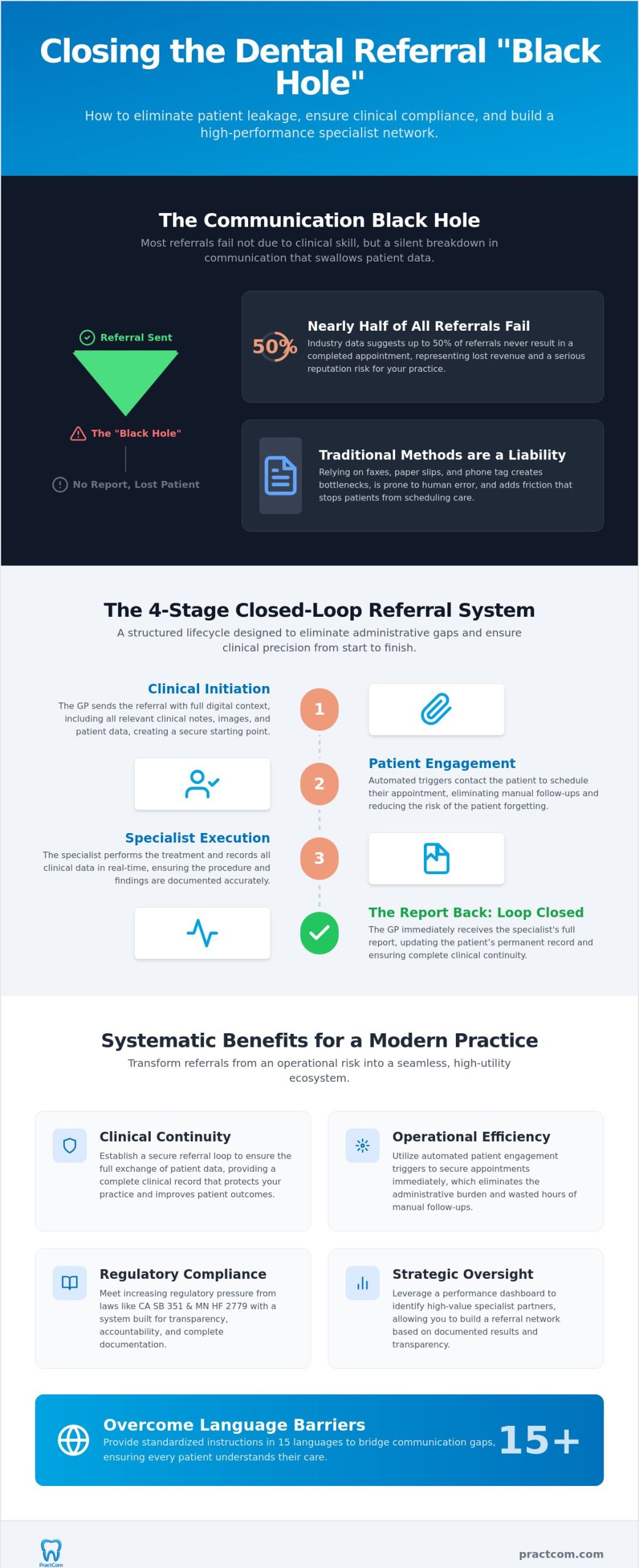
A functional dental referral loop is a structured, four-stage lifecycle designed to eliminate administrative gaps and ensure clinical precision. By following the ADA’s guidelines on specialty referrals, practitioners can move away from fragmented communication toward a standardized system that protects the patient and the practice. This cycle ensures that every stakeholder has the information they need exactly when they need it. The four stages include:
- Clinical Initiation: The GP sends the referral with full digital context, including all relevant clinical data.
- Patient Engagement: Automated triggers ensure the patient is contacted and scheduled without manual staff intervention.
- Specialist Execution: The specialist performs the treatment and records granular clinical data in real time.
- The Report Back: The GP receives the specialist’s findings immediately to update the patient’s permanent record.
When these stages are synchronized, you eliminate the risk of a patient “disappearing” between offices. It’s a system built on accountability and technical precision. If you’re ready to see how this looks in a live environment, you can explore our referral management tools to see the workflow in action.
GP to Specialist: Sending Smarter Referrals
Sending a referral should involve more than just a name and a phone number. For a specialist to provide the best care, they need a comprehensive digital package. This should include high-resolution X-rays and smile design visualizations that clearly communicate the desired cosmetic outcome. You must also ensure the specialist has the patient’s full medical history and current informed consent status. Using secure, HIPAA-compliant channels is an ethical necessity; standard email is a liability that exposes your practice to regulatory risk. When you provide this level of detail, you empower the specialist to hit the ground running, which directly improves the patient’s experience and trust in your professional network.
Specialist to GP: Closing the Circle
The “Specialist Report” is the most critical document in the dental referral loop. It’s the final piece of the puzzle that ensures you aren’t treating a patient in the dark during their next hygiene visit. You should prioritize a system that automates the feedback loop so you’re notified the moment treatment is complete. Centralized dashboards allow you to track the status of all active referrals at a glance, moving you from a reactive state of “phone tag” to a proactive state of systematic oversight. This level of transparency ensures that the loop is truly closed, returning the patient to your care with a fully documented clinical history; for instance, you can explore Kieferorthopädische und ästhetische Zahnbehandlungen at Smile&Co. to see how specialized practices maintain these high-precision standards.
Beyond Tracking: Why Clinical Documentation is the Missing Link
Tracking an appointment is only the administrative half of the equation. A true dental referral loop isn’t actually closed until the patient fully understands their aftercare and the clinical documentation is synchronized across both practices. If a patient leaves a specialist’s office confused about their recovery, the GP often inherits the resulting emergency calls and frustration. Standardizing this information is an ethical and professional necessity. PractCom’s library of 80+ post-treatment instructions ensures consistency across providers, moving you from the resistance of manual documentation to the confidence of a standardized system.
Standardizing Post-Op Care Across the Network
One of the most common points of failure in the referral process is the delivery of conflicting instructions. A patient might hear one thing from their GP and another from the oral surgeon, leading to non-compliance and poor healing. By using automated dental post-op instructions, you ensure the patient receives the same high-quality guidance every time, regardless of which office they are physically in. This systematic control reduces operational stress and protects your reputation. Delivering these instructions via SMS significantly improves compliance because the information is readily available on the patient’s device during the critical first 48 hours of recovery.
Digital Informed Consent as a Shared Risk Strategy
Clinical compliance is a shared responsibility. Both the GP and the specialist face liability risks if informed consent isn’t properly documented and accessible. Transitioning to digital dental informed consent forms allows both parties to verify that the patient has been fully briefed on the risks and benefits of the referred procedure. It’s a problem-solver’s approach to risk management. Storing these forms in a centralized patient portal ensures that all stakeholders have immediate access to the signed documents, creating a clear digital audit trail. This transparency acts as a stabilizing force in high-pressure clinical settings, providing the psychological security that comes from knowing your documentation is airtight and legally sound. By integrating consent into the referral loop, you move beyond mere tracking and into a comprehensive ecosystem of clinical safety.
Overcoming Language Barriers and Compliance in Specialist Care
A patient’s inability to comprehend complex clinical instructions is a primary reason for a broken dental referral loop. When you refer someone to a specialist, you’re asking them to navigate an unfamiliar office and often a complex procedure. If the instructions for that visit are only available in a language the patient isn’t fluent in, the likelihood of them following through drops significantly. Communication isn’t just about sending data; it’s about ensuring understanding. PractCom’s 15-language support bridges this gap, allowing you to provide technical precision in a way that feels personally accessible to every patient in your demographic.
Serving Diverse Patient Populations
Delivering referral instructions in a patient’s native language is a powerful way to reduce clinical anxiety. When a patient receives clear, multi-language consent and aftercare forms, they feel more in control of their health journey. This psychological security directly improves the “show rate” for specialist appointments. You’re no longer leaving the patient’s comprehension to chance. Instead, you’re providing a structured, empathetic path that ensures they arrive at the specialist’s office prepared and informed. This level of administrative warmth builds deep trust between you and your patients.
Maintaining a HIPAA-Compliant Paper Trail
In a high-pressure clinical environment, it’s tempting to use standard texting apps for quick communication. However, this is a significant regulatory risk. Standard SMS isn’t HIPAA-compliant and lacks the necessary encryption for sensitive referral data. Protecting your practice requires a professional-grade system that supports 10DLC registration for dental SMS communications. This ensures your messages are delivered reliably and legally. Using a dedicated patient portal keeps all referral documents secure, ensuring that every step of the dental referral loop is documented and protected. For those who still prefer a physical touch, the ability to print these documents directly from the portal ensures no one is left behind by the digital transition. You can explore our multi-language compliance tools to see how they fit into your existing workflow.
Implementing an Efficient Referral Workflow with PractCom
Transitioning from a disorganized “black hole” to a transparent, automated system is the final step in mastering your dental referral loop. For many practices, the referral process is a source of constant administrative friction that pulls front-desk staff away from high-value patient interactions. By integrating referral management into your daily clinical workflow, you replace manual follow-ups with systematic oversight. This shift doesn’t just save time; it acts as a guardian of your practice’s reputation by ensuring no patient is left waiting for care. Automation allows your team to focus on the patient in front of them while the system handles the logistical heavy lifting in the background.
A high-performance practice requires more than just clinical skill; it requires data-driven decision-making. When you automate the referral cycle, you gain a level of visibility that was previously impossible with paper slips and faxes. This transparency allows you to identify exactly where bottlenecks occur and which specialists are providing the most consistent results for your patients. It moves your practice from a reactive state of uncertainty to a proactive state of total control.
Measuring Success with Performance Dashboards
The PractCom performance dashboard transforms raw referral data into actionable business intelligence. You can track referral conversion rates with precision, seeing exactly which specialists are actually scheduling and treating your patients. Analyzing the time-to-completion for different types of treatments helps you set realistic expectations for your patients, which builds deeper trust. Using this data to strengthen your specialist network ensures you are only referring to partners who respect the dental referral loop as much as you do. This level of auditing is a professional necessity for any practice looking to optimize its external network and ensure clinical compliance.
The PractCom Advantage: All-in-One Communication
A dedicated communication suite is fundamentally superior to a generic referral tool because it addresses the entire patient journey. By combining referral tracking with automated follow-ups and smile design tools, you create a comprehensive ecosystem where no part of the process is left to chance. This integration ensures that informed consent, clinical data, and aesthetic goals are all synchronized before the patient even arrives at the specialist’s office. It’s a modern, tech-savvy approach that remains grounded in the logistical realities of a busy dental practice. If you are ready to eliminate operational resistance and protect your legal standing, you can start a free trial today to test the referral loop in your own practice. This 15-day trial allows you to experience the confidence of a standardized system with no setup fees or long-term contracts.
Securing Your Practice’s External Clinical Network
The strength of your professional reputation is often tied to the care your patients receive outside your four walls. Mastering the dental referral loop is about more than just tracking an appointment; it’s about ensuring clinical continuity and protecting your practice from the risks of documentation gaps. By implementing a standardized system, you move from administrative disorganization to a state of total operational control. You’ve seen how digital consent and multi-language support can bridge communication divides that previously led to patient leakage and professional liability.
Maintaining this standard of excellence is vital for any referral partner; for instance, when considering specialists who focus on technical precision and gentle adjustments for spinal health, you can check out Precision Spinal Care.
With a library of 80+ post-op templates available in 15 languages and secure, HIPAA-compliant tracking, you can provide a seamless experience that builds deep patient trust. Performance dashboards now give you the power to grow your practice using actual conversion data rather than guesswork. It’s time to eliminate the “black hole” and reclaim your staff’s valuable time. Streamline your referral loop and start your free trial with PractCom today. You’re ready to build a more resilient, efficient, and legally sound practice that puts patient outcomes at the center of every decision.
Frequently Asked Questions
What is a dental referral loop?
A dental referral loop is a structured cycle of clinical communication that begins when a general practitioner identifies a need for specialist care and ends when the patient returns with a completed treatment report. It functions as a secure bridge for transferring clinical data, informed consent, and aftercare instructions. This system ensures that no patient falls into administrative “black holes” by maintaining a continuous record across different provider networks.
Why do so many dental referrals fail?
Referral failure often stems from operational friction and the limitations of manual systems like faxes or physical slips. Patients frequently lose interest or forget to schedule when the hand-off isn’t immediate and digital. Additionally, language barriers and conflicting post-op instructions can create confusion, leading patients to skip appointments. Without automated triggers to keep the process moving, the system relies on human memory, which is a significant liability in a high-pressure practice.
How can I track a patient once they leave my office for a specialist?
You can track patient progress in real time by using a centralized referral management system. These platforms provide a dashboard that monitors whether a patient has been contacted, scheduled, or treated by the specialist. Instead of calling the other office for updates, you have immediate visibility into the status of every active referral. This transparency allows your team to intervene if a patient hasn’t taken action, effectively closing the dental referral loop before the patient is lost.
Is dental referral software HIPAA compliant?
Professional referral management tools are built with technical precision to meet HIPAA standards. They utilize end-to-end encryption and secure patient portals to protect PHI during transit. Unlike standard email or basic texting apps, these systems ensure that 10DLC registration and secure login protocols are in place. This regulatory reassurance protects your practice from data breaches and maintains the legal standing of your clinical documentation, providing psychological security for the practitioner.
How do I get specialist reports back more quickly?
The fastest way to receive specialist reports is to automate the feedback loop within your communication platform. When a specialist completes a treatment, the system can trigger an immediate notification and upload the report to your shared portal. Standardizing the reporting format makes it easier for specialists to provide the necessary data quickly. This removes the administrative burden of chasing down paperwork and ensures your patient records are updated without delay, maintaining clinical continuity.
What should be included in a dental referral form?
A comprehensive referral form must include the patient’s full medical history, high-resolution digital X-rays, and specific clinical objectives. You should also attach informed consent status and any relevant smile design visualizations to provide full context. Including the patient’s preferred language and contact details allows the specialist to engage them more effectively. This level of detail ensures the specialist can hit the ground running, which directly improves patient trust and final clinical outcomes.
Can referral management software integrate with my current PMS?
Most modern referral management systems are designed to function as the clinical “glue” that works alongside your existing Practice Management Software (PMS). While they don’t always offer a full two-way sync, they provide a specialized layer for external communication that most PMS systems lack. This allows you to handle complex specialist coordination without disrupting your internal office workflows. It’s a problem-solver’s approach that adds systematic oversight to your existing infrastructure without requiring a total software overhaul.
How does automated follow-up improve referral completion rates?
Automated follow-ups remove the burden of manual patient outreach from your front-desk staff. By sending timed SMS or email reminders to the patient, the system keeps the referral top-of-mind and provides an easy link to schedule. This persistent engagement reduces the “show-up” gap and ensures patients follow through on your clinical recommendations. It’s a high-utility strategy that increases production and ensures patients receive the specialized care they need for optimal health outcomes.

Article by
Cary Ganz DDS
Dr. Cary H. Ganz is a dentist, prosthodontist, entrepreneur, lecturer, and author with more than 50 years of experience in clinical dentistry and dental technology. Throughout his career, he has combined hands-on patient care with a deep understanding of how technology can improve dental practice operations, communication, documentation, and patient outcomes.
In addition to his clinical background, Dr. Ganz has held significant leadership roles in the dental technology industry, including Past Owner and Vice President of Clinical Affairs at DEXIS Digital Radiography and Past Vice President of Clinical Affairs at Denticon Practice Management Software. His business experience includes product development, clinical strategy, dental software innovation, practice management solutions, and educating dental professionals on the effective use of technology in modern dentistry.
Today, Dr. Ganz continues to focus on creating practical technology solutions for dental practices, including PractCom, a comprehensive dental practice communication platform designed to improve patient communication, documentation, compliance support, referrals, and overall practice efficiency. His work reflects a career-long commitment to helping dentists deliver better care while making their practices more organized, efficient, and protected.
No responses yet