Did you know that a single data breach in 2026 can cost a dental practice up to $500,000 in regulatory fines and legal fees? For a growing organization, managing dso patient communication across dozens of locations often feels like a race against administrative burnout and liability risks. You likely worry about inconsistent consent forms or language barriers that could compromise patient safety. It’s difficult to maintain a uniform clinical standard when your teams are stuck in the resistance of manual tasks instead of focusing on care.
Scaling your dental support organization shouldn’t mean sacrificing your peace of mind or your legal standing. This article explores how centralized technology provides the protective oversight you need to standardize the patient experience across every office. You’ll learn how to implement digital informed consent and automated follow-ups that bridge the gap between complex professional procedures and patient understanding. We’ll also preview the 2026 regulatory updates that make standardized documentation an ethical and professional necessity for your continued growth.
Key Takeaways
- Identify why traditional communication models fail at scale and how to transition to a centralized multi-location strategy.
- Learn to mitigate litigation risks by standardizing digital informed consent forms across all affiliated offices.
- Discover how automated post-treatment instructions reduce emergency call volumes and alleviate administrative pressure on your front office.
- Master dso patient communication by implementing a centralized technology layer that ensures clinical compliance without losing the personal touch.
- Explore how to support diverse patient demographics using a professional library of 80+ templates available in 15 different languages.
Defining the DSO Patient Communication Challenge in 2026
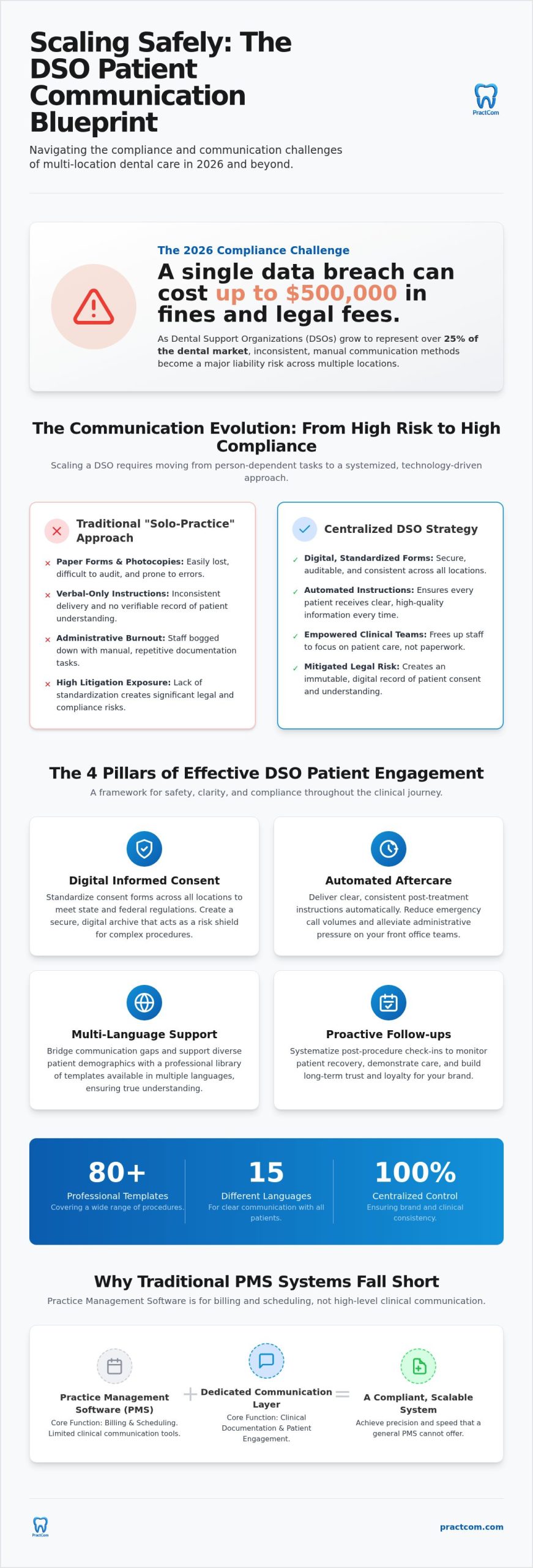
The business of dentistry has undergone a fundamental transformation over the last decade. As of 2026, the Dental Support Organization model now accounts for over 25% of the dental market, signaling a permanent shift toward consolidated administrative operations. While this consolidation offers significant advantages in procurement and billing, it creates a unique vulnerability regarding dso patient communication. When an organization grows to dozens or hundreds of locations, the “solo-practice” approach to patient education-relying on verbal instructions or photocopied handouts-becomes a liability. Scaling requires a move away from manual, person-dependent tasks toward a system that ensures every patient receives the same high standard of care information.
Centralized communication serves as the critical bridge between clinical autonomy and administrative oversight. It allows individual providers to maintain their focus on the patient while the organization ensures that every interaction meets legal and professional standards. Without a unified system, your DSO faces the risk of inconsistent patient experiences that can damage your brand reputation and increase your exposure to litigation. By standardizing how information is delivered, you create a predictable, high-quality environment that supports both the practitioner and the patient.
The Clinical vs. Administrative Split
Modern DSOs succeed when they empower dentists to focus exclusively on clinical treatment. By managing the documentation infrastructure at a corporate level, the DSO removes the exhausting burden of creating and updating consent forms from the individual office staff. This centralized control protects the organization from regional inconsistencies in patient care, ensuring that a patient in one city receives the same robust aftercare guidelines as a patient in another. Standardized workflows don’t just reduce administrative burnout; they build a unified brand identity. Patients feel more secure when they interact with a professional, tech-forward system that provides clear, accessible information throughout their journey.
Why Traditional PMS Systems Fall Short
Most Practice Management Software (PMS) platforms are built for scheduling and billing, not for high-level clinical communication. They often lack the flexibility to manage extensive post-treatment instruction libraries or provide the multi-language support necessary for diverse patient demographics. Relying on a PMS for clinical education usually results in static, uninspiring documents that patients rarely read. A dedicated communication layer is an ethical and professional necessity for multi-location compliance. This specialized technology sits on top of your existing software to provide the precision and speed that a general PMS cannot offer. You can discover more about why PractCom is the right choice for organizations that need to elevate their dso patient communication strategy beyond basic administrative tools.
The Core Pillars of Effective DSO Patient Engagement
While many platforms focus on filling the schedule, the true test of dso patient communication occurs once the patient is in the chair. High-growth organizations need more than just scheduling; they need a framework that ensures safety and clarity throughout the entire clinical journey. According to the Association of Dental Support Organizations (ADSO), maintaining a patient-centered focus is the foundation of successful DSO operations. This focus requires four specific pillars: standardized consent, automated aftercare, multi-language support, and proactive follow-ups. By focusing on what happens after the procedure, you protect your brand reputation and ensure clinical compliance at every location.
Digital Informed Consent as a Risk Shield
Paper forms are a liability in a multi-location model. They’re easily lost, often incomplete, and difficult to audit across 50 locations. Standardizing your consent templates ensures every office meets state and federal regulatory requirements without exception. By 2026, the industry has shifted from physical signatures to secure, digital archives that provide an immutable record of patient understanding. This transition offers the psychological security that your practitioners need to perform complex procedures with confidence. For a deeper dive into this specific requirement, you can explore our 2026 guide to clinical compliance for digital consent.
Centralized Post-Treatment Instruction Libraries
Consistency is the enemy of clinical error. DSOs require a comprehensive library of 80+ templates to cover the full spectrum of modern dentistry, from routine extractions to complex full-arch implants. Managing these document versions centrally ensures that all offices use the latest clinical protocols simultaneously. You don’t have to worry about an associate in one branch using outdated aftercare instructions while another follows the new standard. Automated aftercare systems reduce administrative burnout by 30% by eliminating the need for staff to manually explain and print repetitive instructions.
Effective engagement also means breaking down language barriers. If your DSO operates on a national or regional scale, you’re likely serving diverse communities where English isn’t the primary language. Offering clinical documentation in 15 different languages via SMS or email isn’t just a courtesy; it’s a requirement for informed consent. Mastering dso patient communication requires proactively addressing patient concerns before they turn into emergency room visits or unscheduled phone calls. To see how these systems integrate with your current locations, you can explore our DSO communication suite to find the right fit for your clinical standards.
Standardization vs. Personalization: Solving the DSO Paradox
Scaling dso patient communication often triggers a fear of the “McDonaldisation” of dentistry. You don’t want your patients to feel like they’re in a clinical assembly line where the personal touch is sacrificed for operational speed. However, the paradox is that standardization actually enables better personalization. When you use technology to narrate the patient journey, you ensure that no detail is forgotten and every patient feels seen. Automated SMS and email sequences can be customized with local office branding, allowing a large organization to maintain the intimate feel of a neighborhood practice. This systematic control provides the framework for your staff to spend more time on meaningful human interaction rather than repetitive administrative tasks.
Language Inclusivity at National Scale
For a national DSO, language barriers are a significant source of operational resistance and clinical risk. Providing post-treatment instructions and consent forms in 15+ languages is an ethical necessity that builds immediate trust with diverse patient demographics. When a patient receives aftercare guidelines in their native tongue, compliance rates rise because the instructions are unambiguous and accessible. You must avoid the “Google Translate” trap in clinical documentation, as automated translations often miss critical medical nuances. Professional, pre-vetted templates offer a pre-emptive strike against misunderstandings, ensuring that your organization’s reputation for quality care remains intact across every zip code you serve.
Referral Management and Network Retention
One of the most common failures in multi-location settings is the loss of production when a patient is referred to an outside specialist. A centralized Referral Management System allows you to track patient movement between general dentists and specialists within your own DSO network. By ensuring clinical data follows the patient through a centralized portal, you provide a seamless experience that reinforces the patient’s trust in your brand. This level of oversight turns a fragmented referral process into a cohesive ecosystem where no part of the treatment plan is left to chance. For a deeper understanding of these systems, see our guide on Mastering Dental Referral Management Software in 2026.
Best Practices for Implementing Multi-Location Communication Systems
Moving from a fragmented collection of offices to a unified organization requires a deliberate roadmap. You cannot simply install software and expect immediate results; you must build a system that supports your clinical standards and your staff’s daily reality. Effective dso patient communication is built on five strategic steps that move your organization from operational disorganization to systematic control.
- Step 1: Audit existing methods. Identify every paper form, photocopied handout, and manual text message currently used across your affiliated offices to understand your liability exposure.
- Step 2: Select a communication layer. Choose a centralized platform that sits on top of your various PMS systems, providing a single source of truth for all clinical documentation.
- Step 3: Standardize clinical templates. Lock in your digital informed consent and post-treatment instructions at the corporate level to ensure 100% compliance across every zip code.
- Step 4: Empower regional managers. Provide leadership with performance dashboards that offer real-time oversight into documentation completion and patient engagement rates.
- Step 5: Roll out automation. Deploy automated follow-up sequences that handle routine aftercare questions, which immediately reduces the noise at your front desks.
Training for Consistency
The biggest hurdle in DSO technology adoption isn’t the software; it’s the staff buy-in. Your teams are already under high pressure, so they need to see that a standardized system reduces their manual workload rather than adding to it. Use your practice performance dashboards to identify specific locations where patient engagement is low. This data allows you to provide targeted support rather than broad, unnecessary training sessions. Centralized reporting allows regional leadership to pinpoint specific locations where documentation lag is occurring, effectively identifying clinical bottlenecks before they erode your organizational ROI. When your staff feels supported by a reliable system, they can focus on the technical precision of their clinical work.
Measuring Communication ROI
You can’t manage what you don’t measure. A successful implementation should result in a measurable reduction in post-treatment emergency calls and unscheduled walk-ins. When patients receive clear, multi-language instructions via text or email, they don’t need to call the office for clarification. Additionally, monitoring the use of visual aids and smile design tools can show a direct correlation to increased case acceptance for cosmetic procedures. To understand how these efficiencies fit into your broader operational goals, read our guide on Optimizing Dental Practice Workflow: The 2026 Guide. If you’re ready to see how these systems function in a live environment, you can request a personalized demo of our DSO communication suite to begin your standardization journey.
How PractCom Centralizes DSO Clinical Documentation and Follow-ups
Managing a growing organization requires a shift from fragmented office habits to a centralized command structure. PractCom provides the essential technology layer that transforms dso patient communication into a predictable, high-performance asset. With a single login, your leadership team can manage a library of 80+ post-treatment templates and digital consent forms across 100+ locations simultaneously. This level of systematic control ensures that every office delivers the same professional documentation, protecting your brand reputation and clinical standards regardless of regional staff turnover. By moving away from the resistance of manual paper tasks, you provide your practitioners with the psychological security of a standardized, legally robust system.
A primary differentiator for national DSOs is the ability to serve diverse communities with clinical accuracy. PractCom supports 15 languages across all digital and physical documents, ensuring that informed consent is truly informed for every patient. This multi-language support is delivered via SMS, email, or print, allowing you to meet patients where they are. Furthermore, our performance dashboards provide a bird’s-eye view of your entire network, allowing you to monitor documentation compliance and patient engagement in real-time. This oversight is a professional necessity in 2026, especially as regulatory bodies move toward stricter requirements like the proposed 72-hour breach notification window and mandatory ePHI encryption.
The All-in-One Communication Suite
PractCom is designed to complement your existing Practice Management Software (PMS) rather than replace it. Our platform integrates digital consent, referral management, and automated follow-ups into one seamless workflow that sits on top of your current technical stack. This approach allows you to upgrade your clinical communication without the logistical nightmare of a full software overhaul. By centralizing these functions, you eliminate the operational noise that leads to administrative burnout. You can explore PractCom for DSOs to see how our clinical documentation suite provides the stabilizing force your high-pressure environment needs.
Getting Started with Standardization
DSOs choose PractCom when they need to scale their acquisition rate without a corresponding increase in administrative headcount. Our system acts as a guardian of your legal standing, reducing litigation risk through standardized, multi-language consent forms that are archived securely. This transition from manual disorganization to systematic control increases patient trust and streamlines the entire treatment journey. It’s a pragmatic investment that pays dividends in both clinical safety and operational efficiency. You can schedule a demo or start your free trial today to begin standardizing your DSO communication and protecting your organization’s future.
Future-Proofing Your DSO Through Standardized Communication
In 2026, scaling a dental support organization requires more than just clinical excellence; it demands a systematic approach to patient safety and documentation. You’ve seen how inconsistent aftercare and paper-based consent forms can create significant liability risks for your brand. By centralizing your dso patient communication, you eliminate these vulnerabilities while providing your staff with the technical precision they need to succeed. This transition replaces the anxiety of manual oversight with the psychological security of a unified system that grows alongside your acquisition rate.
PractCom offers the stabilizing force your organization needs to grow with confidence. You gain immediate access to a library of 80+ pre-built clinical templates and support for 15 languages, ensuring every patient receives clear, accurate instructions in their native tongue. Our centralized dashboard provides the multi-location tracking necessary for real-time oversight and long-term brand protection. It’s time to move from operational resistance to a high-utility ecosystem that supports both your clinical and business goals.
Standardize your DSO patient communication-Explore PractCom
Your path to scalable, high-quality care starts with a reliable system that protects your reputation and your patients. We’re ready to help you build a more secure and efficient practice environment today.
Frequently Asked Questions
What is the difference between a DSO and corporate dentistry?
A Dental Support Organization (DSO) focuses on managing the non-clinical, administrative side of a practice while allowing dentists to retain clinical autonomy. Corporate dentistry typically involves a model where the corporation owns the practice and employs the clinical staff directly. This distinction is vital for practitioners who want to offload administrative stress while maintaining control over their technical treatment standards and patient relationships.
How does a DSO manage patient communication across different states?
DSOs manage multi-state requirements by using a centralized platform that can adapt to varying state-level regulatory standards. This ensures that dso patient communication remains compliant with specific local laws regarding consent and privacy while maintaining a core organizational quality standard. Centralization provides the protective oversight needed to prevent regional inconsistencies from becoming legal liabilities for the parent organization.
Why is standardized clinical documentation important for DSOs?
Standardization ensures that every patient receives the same high level of care information regardless of which office they visit. When you use pre-vetted templates for consent and aftercare, you eliminate the risk of an individual staff member providing outdated or incorrect advice. This systematic control protects your brand reputation and provides a reliable framework for your clinical teams to follow without fail.
Can PractCom integrate with multiple Practice Management Softwares simultaneously?
Yes, PractCom is designed to function as a unified communication layer that sits on top of various PMS platforms. This capability is essential for DSOs that grow through acquisitions, as it allows you to maintain standardized communication across newly added offices without the high cost and disruption of a full data migration. You get a single source of truth for all clinical documentation.
How do DSOs use multi-language support to improve patient compliance?
Offering clinical instructions in a patient’s native tongue removes the ambiguity that often leads to post-treatment complications. PractCom provides support for 15 languages, ensuring that clinical accuracy is maintained during the recovery process. When patients fully understand their aftercare guidelines, they are much more likely to follow them, which directly reduces the volume of emergency calls and unscheduled follow-up visits.
What are the key KPIs a DSO should track for patient communication?
Your organization should monitor emergency call volume, documentation completion rates, and patient engagement with digital follow-up messages. These metrics provide a clear view of which locations are meeting your clinical standards and where administrative friction might be occurring. By tracking these KPIs through a centralized dashboard, you can identify clinical bottlenecks and address them before they affect your overall ROI.
How does automated follow-up reduce the administrative burden on DSO staff?
Automation handles the repetitive task of checking in on patients after a procedure, which is a significant source of operational resistance. This system allows your front-desk teams to focus on in-office patient needs instead of spending hours on manual phone calls. It replaces the limitations of human memory with a reliable, tech-savvy solution that ensures no patient is ever forgotten during their recovery.
What is the role of a patient portal in a multi-location DSO model?
A patient portal acts as a secure, central hub where patients can access their clinical records, consent forms, and instructions at any time. In a multi-location model, this provides a seamless experience for patients who may visit different offices within your network. This continuity of care strengthens the patient’s trust in your brand and reinforces the professional identity of your organization.

Article by
Cary Ganz DDS
Dr. Cary H. Ganz is a dentist, prosthodontist, entrepreneur, lecturer, and author with more than 50 years of experience in clinical dentistry and dental technology. Throughout his career, he has combined hands-on patient care with a deep understanding of how technology can improve dental practice operations, communication, documentation, and patient outcomes.
In addition to his clinical background, Dr. Ganz has held significant leadership roles in the dental technology industry, including Past Owner and Vice President of Clinical Affairs at DEXIS Digital Radiography and Past Vice President of Clinical Affairs at Denticon Practice Management Software. His business experience includes product development, clinical strategy, dental software innovation, practice management solutions, and educating dental professionals on the effective use of technology in modern dentistry.
Today, Dr. Ganz continues to focus on creating practical technology solutions for dental practices, including PractCom, a comprehensive dental practice communication platform designed to improve patient communication, documentation, compliance support, referrals, and overall practice efficiency. His work reflects a career-long commitment to helping dentists deliver better care while making their practices more organized, efficient, and protected.
No responses yet