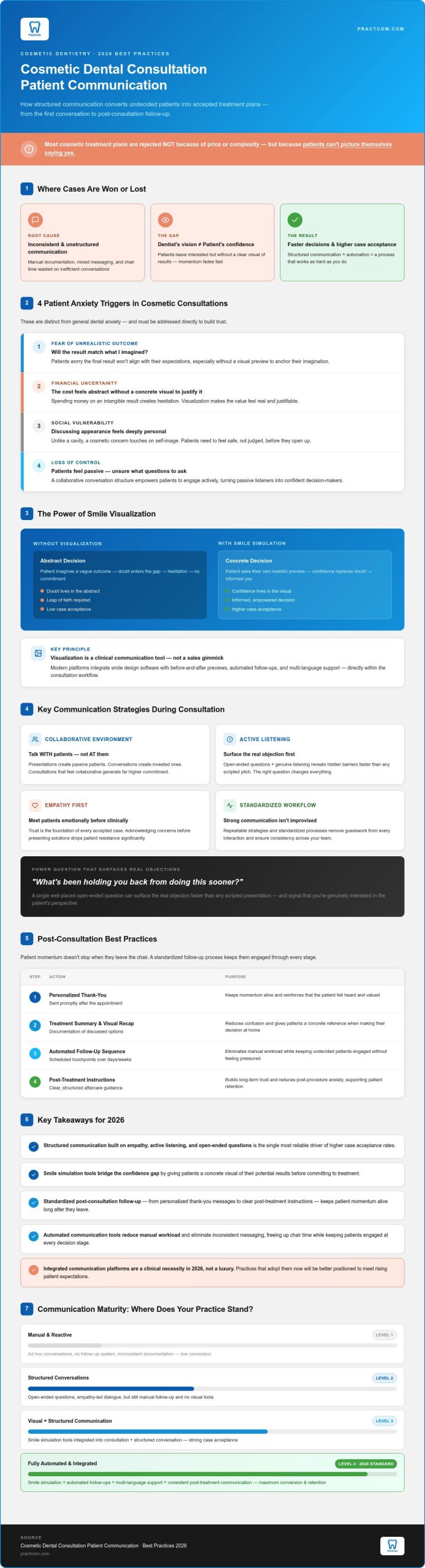
Your clinical skills can close a cosmetic case before the patient ever sits in the chair – but only if your communication does the heavy lifting first. The truth is, most cosmetic treatment plans aren’t rejected because of price or procedure complexity. They’re rejected because patients simply can’t picture themselves saying yes. That gap between a dentist’s vision and a patient’s confidence is where cases are won or lost, and it all comes down to how well your cosmetic dental consultation patient communication is structured from the very first conversation.
You already know the frustration: a patient leaves genuinely interested, but without a clear visual of their potential results or a streamlined follow-up process to keep them engaged, that momentum fades fast. Manual documentation slows you down, inconsistent messaging undermines trust, and chair time gets eaten up by conversations that could be handled more efficiently.
This article walks you through the essential best practices for 2026, covering how to help patients visualize outcomes, how to standardize your consultation workflow, and how to use automated tools to reduce friction at every stage. The result? Faster decisions, higher case acceptance, and a communication process that works as hard as you do.
Key Takeaways
- Structured cosmetic dental consultation patient communication – built on empathy, active listening, and open-ended questions – is the single most reliable driver of higher case acceptance rates.
- Smile simulation tools bridge the gap between clinical expertise and patient confidence by giving patients a concrete visual of their potential results before committing to treatment.
- Standardizing your post-consultation follow-up process – from personalized thank-you messages to clear post-treatment instructions – keeps patient momentum alive long after they leave the chair.
- Automated communication tools reduce manual workload and eliminate inconsistent messaging, freeing up chair time while keeping patients engaged at every stage of the decision-making process.
- Integrated communication platforms are rapidly becoming a clinical necessity, not a luxury – practices that adopt them now will be better positioned to meet rising patient expectations in 2026 and beyond.
What is Effective Patient Communication in Cosmetic Dentistry?
Effective cosmetic dental consultation patient communication is the structured process of engaging patients through clear, empathetic dialogue that helps them understand their treatment options, feel genuinely heard, and develop enough confidence to move forward. It’s not a soft skill layered on top of clinical work. It’s a clinical function in its own right, one that directly influences whether a patient accepts treatment or walks out the door still undecided.
Trust is the foundation of every accepted case. When a patient feels that their concerns have been acknowledged rather than dismissed, their resistance to treatment drops significantly. That shift doesn’t happen through brochures or price lists. It happens through deliberate, structured conversation that meets the patient where they are emotionally before it meets them clinically.
Understanding Patient Anxiety and Building Trust
Cosmetic consultations carry a specific kind of anxiety that general dental visits don’t. Patients aren’t just worried about pain or procedure complexity. They’re worried about looking different, spending money on something they can’t fully picture, and being judged for how their teeth look right now. Common anxiety triggers include:
- Fear of an unrealistic outcome – patients worry the result won’t match what they imagined
- Financial uncertainty – the cost feels abstract without a concrete visual to justify it
- Social vulnerability – discussing appearance feels personal in a way that discussing a cavity doesn’t
- Loss of control – patients often feel passive in clinical settings, unsure of what questions to ask
Addressing these concerns directly, using open-ended questions and active listening, creates the kind of supportive environment where patients feel safe enough to say yes. A single, well-placed question like “What’s been holding you back from doing this sooner?” can surface the real objection faster than any scripted presentation. Effective communication doesn’t just reduce anxiety; it replaces it with informed confidence.
Visual Aids and Their Impact on Patient Understanding
The psychological impact of visualization on patient trust is one of the most underexplored areas in cosmetic consultation strategy. When a patient can see a realistic preview of their potential results, the decision-making process becomes concrete rather than abstract. That shift is significant. Doubt lives in the abstract. Confidence lives in the visual.
Modern cosmetic practices are integrating tools like smile design software that shows before-and-after previews directly within the consultation workflow. Platforms built for dental communication, such as those offering smile design features alongside automated follow-ups and multi-language support, position visualization not as a sales gimmick but as a genuine communication tool. When patients can see their potential outcome before committing, they’re making an informed decision rather than a leap of faith. That’s the kind of trust that converts consultations into accepted treatment plans.
Key Strategies for Enhancing Communication During Consultations
Knowing what to say during a cosmetic consultation is only half the equation. How you structure the conversation, and what tools support it, determines whether a patient leaves ready to commit or still sitting on the fence. Strong cosmetic dental consultation patient communication isn’t improvised. It’s built on repeatable strategies that remove guesswork from every interaction.
Creating a Collaborative Environment
The fastest way to lose a patient’s confidence is to talk at them rather than with them. Consultations that feel like presentations create passive patients. Consultations that feel like conversations create invested ones.
Open-ended questions are the most reliable tool for shifting that dynamic. Questions like “What would you change about your smile if you could?” or “How has this affected your confidence day-to-day?” do more than gather information. They signal that you’re genuinely interested in the patient’s perspective, not just their treatment eligibility. That distinction matters enormously to someone who’s already feeling vulnerable about their appearance.
Active listening reinforces this further. Reflecting back what a patient says, pausing before responding, and resisting the urge to immediately pivot to clinical solutions are all habits that build measurable trust. When patients feel heard, they’re far more likely to ask the questions they’ve been holding back, and those questions are often where the real objections live.
Involving patients directly in decision-making is equally important. Presenting two or three clearly explained options, rather than a single recommended plan, gives patients a sense of control they rarely experience in clinical settings. That sense of agency is one of the most underrated drivers of case acceptance.
Utilizing Technology to Improve Communication
Even the most skilled communicator loses ground when their workflow is fragmented. Manual documentation, inconsistent follow-up, and consent forms that get misplaced don’t just create administrative headaches. They erode the patient experience at exactly the moments when confidence should be building.
Integrated platforms like PractCom address this directly by consolidating the tools that support cosmetic dental consultation patient communication into a single, structured system. The Smile Design feature, which shows before-and-after previews of potential cosmetic changes, works as part of a broader communication workflow rather than a standalone visual aid. Automated follow-ups keep patients engaged after they leave the chair, without requiring your team to manually track every touchpoint. Digital informed consent forms reduce paperwork friction while protecting your practice’s legal standing. And with email and text delivery for all documents across 15 languages, communication barriers that once caused drop-off become far less of a factor.
Post-treatment instructions are another area where technology closes a critical gap. With access to a library of over 80 templates, your team can send precise, procedure-specific guidance immediately after treatment rather than relying on verbal instructions that patients often forget within hours. That level of follow-through signals professionalism and directly supports patient compliance.
If you’re looking to tighten every stage of your consultation process, explore how a structured communication platform can reduce the gaps between patient interest and accepted treatment.
The Role of Smile Simulation in Cosmetic Consultations
There’s a fundamental gap in every cosmetic consultation: the dentist sees the clinical pathway clearly, but the patient is working entirely from imagination. Smile simulation closes that gap. When a patient can see a realistic before-and-after preview of their potential results, the conversation shifts from speculative to concrete. Doubt requires abstraction. Simulation removes it.
The impact on decision-making is direct. A patient who can visualize their outcome isn’t making a leap of faith; they’re making an informed choice. That distinction changes the entire emotional dynamic of the consultation. It also changes what questions patients ask, moving them from “Is this worth it?” to “What’s the next step?” That shift in framing is where cosmetic dental consultation patient communication becomes a genuine case acceptance driver rather than just a preliminary conversation.
Standalone simulation tools have existed for years, but they carry a structural limitation: they operate in isolation. A patient sees a visual, but there’s no connected workflow to capture their preferences, route them into a follow-up sequence, or link that visual moment to their consent documentation. The simulation creates interest without a system to sustain it.
PractCom’s Smile Design feature is built differently. It sits within an integrated communication platform, which means the before-and-after preview isn’t a standalone sales moment; it’s one stage in a connected patient journey. The visualization feeds directly into automated follow-ups, digital informed consent forms, and post-treatment instruction delivery. Every touchpoint reinforces the last.
Integrating Smile Simulation with Informed Consent
The moment a patient sees their simulated outcome is also the highest-value moment to begin the informed consent discussion. Their engagement is at its peak, and their questions are most specific. Documenting patient preferences and expectations immediately after reviewing a simulation, while the visual is still fresh, produces more accurate records than relying on notes taken at the end of a consultation. Digital consent forms delivered via email or text, in the patient’s preferred language from a selection of 15, ensure that documentation is both timely and accessible. This approach keeps your practice aligned with regulatory requirements while reducing the administrative friction that typically delays consent completion.
Maximizing the Impact of Smile Simulations
Presentation matters as much as the simulation itself. Walking a patient through what they’re seeing, rather than simply displaying the image, keeps them engaged and surfaces objections early. Common concerns, such as whether the result looks natural or whether the change is too dramatic, are far easier to address when there’s a visual reference in front of both parties.
Post-consultation follow-up is where simulation impact either compounds or evaporates. Automated follow-up messages that reference the patient’s specific consultation, paired with procedure-specific post-treatment instructions from a library of over 80 templates, maintain the momentum that the simulation created. Without that structured follow-through, even the most compelling visual fades quickly once a patient leaves the practice.
For practices looking to connect cosmetic dental consultation patient communication into a single, structured system, see how PractCom’s integrated approach supports every stage from simulation to case acceptance.
Post-Consultation Best Practices for Patient Communication
The consultation ends, the patient walks out, and that’s precisely where most cosmetic practices lose the case. Not through a bad conversation, but through silence. What happens in the 24 to 72 hours after a consultation determines whether patient interest converts into a scheduled appointment or quietly disappears. Structured post-consultation cosmetic dental consultation patient communication isn’t a courtesy gesture; it’s a clinical necessity with a direct line to case acceptance.
A five-step framework keeps that post-consultation window working for your practice rather than against it:
- Send a personalized thank-you message within 24 hours of the consultation, referencing the specific treatment discussed. Generic messages signal that the patient is a number. Specific ones signal that you were listening.
- Deliver clear, procedure-specific post-treatment instructions tailored to each patient’s care plan, not a one-size-fits-all handout that gets ignored.
- Confirm follow-up appointments via SMS or email at the patient’s preferred channel. Confirmation reduces no-shows and keeps momentum alive without requiring your team to make manual calls.
- Invite questions explicitly and provide direct contact information. Patients who feel they can ask questions without friction are far less likely to stall on a decision.
- Assess satisfaction after each consultation through a brief, structured feedback request. The responses tell you exactly where your process is leaking confidence.
The Importance of Follow-Up Communications
Patient engagement doesn’t plateau at the consultation; it either compounds or erodes depending on what follows. Automated follow-up sequences remove the dependency on your team’s memory and ensure every patient receives consistent, timely communication regardless of how busy the schedule gets. When feedback is collected systematically, patterns emerge quickly. A recurring concern about pricing, outcome clarity, or procedure complexity points directly to where your consultation script needs adjustment. That loop, from patient response to process refinement, is how communication quality improves without guesswork.
Ensuring Compliance Through Clear Instructions
Patient compliance is one of the most reliable predictors of treatment success, and it starts with instructions that patients can actually follow. Verbal guidance delivered at the end of an appointment is the least effective delivery method; patients retain a fraction of what they hear in a clinical setting when they’re already mentally preparing to leave. Written instructions, sent immediately via email or text in the patient’s preferred language, close that retention gap directly.
PractCom’s library of over 80 post-treatment instruction templates gives your team the ability to send precise, procedure-specific guidance within minutes of treatment completion, without drafting anything from scratch. Visual reinforcement within those instructions, such as diagrams or step-by-step formatting, further reduces the risk of misinterpretation. When patients know exactly what to do and why it matters, compliance rates improve and avoidable complications decrease.
A structured post-consultation process doesn’t require more staff hours; it requires the right system. See how automated follow-ups and post-treatment instruction delivery can keep every patient engaged from consultation to case completion.
The Future of Patient Communication in Cosmetic Dentistry
Patient expectations are rising faster than most practices are prepared to meet them. Cosmetic dentistry has always been a trust-driven specialty, but the bar for what “good communication” looks like is shifting significantly. Patients in 2026 expect the same level of personalization, speed, and digital fluency from their dental practice that they receive from every other service in their lives. Practices that treat communication as an afterthought will feel that gap in their case acceptance numbers before they can name the cause.
Technology is reshaping what’s possible at every stage of the consultation journey. Automation isn’t replacing the human elements that build trust; it’s handling the administrative weight that prevents those human elements from doing their job well. When your team isn’t manually chasing follow-ups, reprinting consent forms, or drafting post-treatment instructions from scratch, they have more capacity for the conversations that actually move patients toward a decision. That reallocation of attention is where the real clinical value of integrated communication platforms lives.
The practices positioned to lead in 2026 aren’t waiting to see how technology evolves. They’re building systems now that connect every touchpoint in the patient journey into a single, coherent experience. Cosmetic dental consultation patient communication that runs through a unified platform, from smile simulation through to post-treatment instruction delivery, creates consistency that patients feel even when they can’t articulate why they trust one practice over another.
Building Long-Term Patient Relationships
Loyalty in cosmetic dentistry isn’t built in the consultation room. It’s built in every message a patient receives after they leave. Consistent, personalized communication signals that your practice views patients as ongoing relationships rather than completed transactions. That distinction drives referrals, repeat treatment acceptance, and the kind of word-of-mouth that no advertising budget can replicate. Practices that standardize their messaging across every post-consultation touchpoint, using automated sequences that still feel personal and relevant, are the ones patients recommend without being asked.
Next Steps: Implementing Effective Communication Strategies
Start by auditing where your current process breaks down. Common failure points include inconsistent follow-up timing, post-treatment instructions delivered verbally rather than in writing, and consent documentation that lags behind the consultation itself. Each gap represents a moment where patient confidence erodes.
A comprehensive communication platform addresses these gaps systematically rather than one at a time. PractCom consolidates smile design visualization, automated follow-ups, digital informed consent, multi-language document delivery, and a library of over 80 post-treatment instruction templates into a single workflow. No fragmented tools. No manual tracking. Just a structured system that keeps every patient engaged from first consultation to case completion.
The practices that will lead cosmetic dentistry in 2026 aren’t the ones with the best clinical skills alone. They’re the ones whose communication systems work as precisely as their clinical ones. Start your free trial with PractCom today and build the communication infrastructure your patients already expect.
Your Communication System Is Either Closing Cases or Costing You Them
Cosmetic dental consultation patient communication isn’t a single conversation. It’s a connected system that runs from the first open-ended question through smile simulation, informed consent, and post-treatment follow-up. When every stage works together, patients move from uncertain to committed without friction. When any stage breaks down, momentum stalls and cases go cold.
The practices that will lead in 2026 share one common trait: their communication infrastructure is as deliberate as their clinical work. Structured consultations, integrated visualization tools, and automated follow-up sequences aren’t optional upgrades. They’re the baseline patients now expect.
PractCom brings every one of those touchpoints into a single platform. Thousands of dental professionals are already using it to reduce manual workload, eliminate inconsistent messaging, and keep patients engaged from consultation to case completion. No credit card required to get started, and you’ll have full access to the complete library of patient communication tools from day one.
Start your free PractCom trial today and build the communication system your patients deserve.
Frequently Asked Questions About Cosmetic Dental Consultation Patient Communication
What are the key elements of effective patient communication in cosmetic dentistry?
Effective cosmetic dental consultation patient communication rests on three pillars: active listening, structured dialogue, and consistent follow-through. Active listening means pausing before responding and reflecting back what patients say, not just waiting for your turn to present a treatment plan. Structured dialogue means using open-ended questions to surface real objections early. Follow-through means every post-consultation touchpoint reinforces the trust built in the room.
These elements work together rather than independently. A strong consultation that ends with silence from your practice undoes much of the trust you’ve built. The communication system has to hold up across every stage, not just the appointment itself.
How can technology improve patient engagement during consultations?
Technology improves engagement by removing the administrative friction that pulls attention away from the patient conversation. When consent forms are digital, follow-ups are automated, and post-treatment instructions are sent immediately via email or text, your team can stay focused on the interaction rather than the paperwork. That shift in attention is felt by patients even when they can’t name it.
Integrated platforms consolidate these functions into a single workflow. Rather than toggling between separate tools, your team moves patients through a connected sequence from consultation to case completion without manual tracking at each step.
What role does smile simulation play in enhancing case acceptance?
Smile simulation converts an abstract decision into a concrete one. Patients who can see a before-and-after preview of their potential results are no longer imagining an outcome; they’re evaluating one. That distinction matters because hesitation lives in the gap between what a patient hopes for and what they can actually picture. Simulation closes that gap directly.
The impact compounds when simulation is integrated into a broader communication workflow rather than used as a standalone visual. When the preview connects to automated follow-ups and digital consent documentation, the momentum it creates doesn’t evaporate once the patient leaves the chair.
How should I manage follow-up communications post-consultation?
Start with a personalized message within 24 hours that references the specific treatment discussed. Generic messages signal that the patient is interchangeable; specific ones signal that you were paying attention. From there, automated sequences can handle appointment confirmations, question prompts, and satisfaction check-ins without requiring your team to manually track each patient’s status.
The goal is consistency across every patient, regardless of how busy your schedule gets. Automated follow-up removes the dependency on memory and ensures no patient falls through the gap between consultation and decision.
What are the common patient concerns during cosmetic consultations?
The most common concerns aren’t clinical; they’re emotional. Patients worry about whether the result will look natural, whether the cost is justified without a clear visual to anchor it, and whether they’ll feel judged for how their teeth look right now. These concerns rarely surface unless you ask directly. Questions like “What’s been holding you back?” tend to reveal the real objection faster than any scripted presentation.
Financial uncertainty and fear of an unrealistic outcome are the two concerns most likely to stall a decision. Addressing both directly, using clear visuals and transparent treatment explanations, removes the ambiguity that keeps patients from committing.
How can I ensure compliance with post-treatment instructions?
Written instructions sent immediately after treatment outperform verbal guidance every time. Patients retain very little of what they hear at the end of an appointment when they’re already mentally preparing to leave. Delivering precise, procedure-specific instructions via email or text, in the patient’s preferred language, closes that retention gap before it becomes a compliance problem.
A library of over 80 post-treatment instruction templates, like those available through PractCom, lets your team send accurate guidance within minutes of treatment completion without drafting anything from scratch. Visual formatting and step-by-step structure within those templates further reduce the risk of misinterpretation.
What are the benefits of using an integrated communication platform?
An integrated platform eliminates the fragmentation that erodes patient confidence between touchpoints. When smile design visualization, automated follow-ups, digital informed consent forms, and post-treatment instruction delivery all operate within one system, every stage of the patient journey reinforces the last. There’s no gap where a patient’s momentum quietly stalls because a follow-up got missed or a consent form wasn’t sent.
The operational benefit is equally significant. Your team stops managing multiple disconnected tools and starts working within a single, structured workflow. That reduction in manual overhead frees up capacity for the conversations that actually move patients toward a decision.
How can I address patient anxiety during cosmetic consultations?
Address anxiety by naming it rather than working around it. Patients feel more at ease when a practitioner acknowledges that cosmetic decisions are personal and that uncertainty is normal. Open-ended questions give patients permission to voice concerns they’d otherwise hold back, and those concerns are almost always easier to resolve once they’re in the open.
Giving patients a sense of control also reduces anxiety significantly. Presenting two or three clearly explained treatment options rather than a single recommendation shifts the dynamic from passive recipient to active decision-maker. That sense of agency, combined with a clear visual of potential outcomes, replaces uncertainty with informed confidence.

Article by
Cary Ganz DDS
Dr. Cary H. Ganz is a dentist, prosthodontist, entrepreneur, lecturer, and author with more than 50 years of experience in clinical dentistry and dental technology. Throughout his career, he has combined hands-on patient care with a deep understanding of how technology can improve dental practice operations, communication, documentation, and patient outcomes.
In addition to his clinical background, Dr. Ganz has held significant leadership roles in the dental technology industry, including Past Owner and Vice President of Clinical Affairs at DEXIS Digital Radiography and Past Vice President of Clinical Affairs at Denticon Practice Management Software. His business experience includes product development, clinical strategy, dental software innovation, practice management solutions, and educating dental professionals on the effective use of technology in modern dentistry.
Today, Dr. Ganz continues to focus on creating practical technology solutions for dental practices, including PractCom, a comprehensive dental practice communication platform designed to improve patient communication, documentation, compliance support, referrals, and overall practice efficiency. His work reflects a career-long commitment to helping dentists deliver better care while making their practices more organized, efficient, and protected.
No responses yet