
What if the very forms meant to protect your practice are actually creating a silent liability trap? With the February 16, 2026, deadline for updated substance use disorder protections already behind us, using an outdated Notice of Privacy Practices is no longer a minor oversight; it’s a significant compliance risk. You’ve likely felt the operational stress of paper consent forms slowing down patient intake, especially when managing multi-language requirements that demand absolute clarity. Adopting digital signatures dentistry systems isn’t just about going paperless. It’s a clinical safeguard that ensures the informed part of informed consent is documented and verifiable, providing a stabilizing force for your reputation.
I recognize the anxiety of balancing technical precision with the high-pressure demands of a busy clinic. This guide provides the roadmap to master the legal, clinical, and operational requirements for a fully compliant digital workflow. You’ll discover how to achieve a legally sound office that accelerates patient throughput and improves documentation for risk management. We’ll break down the mandatory MFA safeguards for ePHI and the new May 11, 2026, digital accessibility rules to ensure your practice remains a leader in modern, ethical care.
Key Takeaways
- Secure your practice’s legal standing by mastering the ESIGN Act and UETA frameworks to ensure every digital contract remains as binding as traditional ink.
- Eliminate the risks of manual documentation by implementing a standardized system that verifies patient receipt and acknowledgement of critical post-treatment instructions.
- Implement mandatory HIPAA safeguards, including encryption and multi-factor authentication, to protect your digital signatures dentistry workflows from modern security threats.
- Optimize your operational budget by comparing the hidden costs of paper-based storage against the efficiency and psychological security of a cloud-based signature system.
- Streamline clinical throughput by integrating automated patient follow-ups directly into your electronic documentation and consent process for a seamless patient experience.
The Legal Framework: ESIGN and UETA in Dental Practice
For over two decades, the legal foundation for digital signatures dentistry has remained remarkably stable. You don’t need to guess if your electronic forms will hold up in court; the laws are already designed to protect you. By moving away from the operational disorganization of paper, you adopt a system backed by federal and state mandates that prioritize accuracy and verifiability. This legal framework isn’t just a set of rules; it’s a stabilizing force that provides the psychological security you need to manage a modern clinical environment without the fear of documentation failure.
ESIGN vs. UETA: What Dentists Need to Know
The ESIGN Act is a federal law that ensures electronic signatures are legally valid for interstate commerce. Complementing this is the Uniform Electronic Transactions Act (UETA), which 49 states have adopted to provide consistent legal standing at the state level. New York is the only exception, maintaining its own specific regulations. These laws are your shield in malpractice litigation. They ensure that a digital signature carries the same weight as a traditional ink signature, provided you offer patients a paper copy option if they request it. This dual-layer framework ensures that your digital records are recognized as ethical and professional necessities in any legal setting.
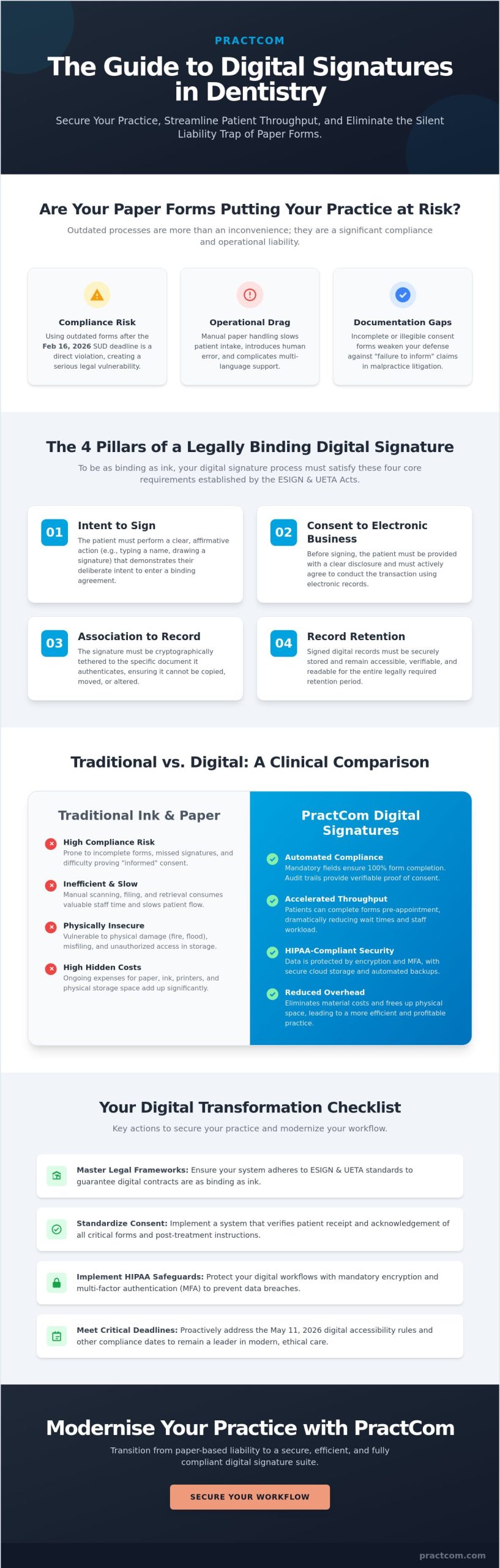
The Four Pillars of a Legally Binding Digital Signature
A signature is more than just a mark on a screen; it’s a verifiable event. To remain compliant, your system must satisfy four specific requirements that transform a simple digital interaction into a binding legal record:
- Intent to sign: The patient must clearly understand they’re entering a binding agreement. A simple accidental click won’t suffice. The action must be deliberate, such as typing a name or drawing a signature, to demonstrate they know exactly what they’re authorizing.
- Consent to do business electronically: You’re legally required to provide a disclosure before the patient signs. They must affirmatively agree to use electronic records. This step acts as a guardian of the user’s legal standing.
- Association of signature to record: The signature must be cryptographically tethered to the specific document. It can’t be a floating image that someone could move from a medical history form to a high-value treatment plan. This ensures the signature cannot be tampered with or repurposed.
- Record retention: You must store these digital files for the same duration as paper records. A reliable system ensures these files are accessible and readable for future audits or legal inquiries.
The “Intent to Sign” is a critical distinction for clinical compliance. In a high-pressure office, it’s easy for patients to feel rushed. A compliant system forces a pause, requiring an affirmative action that demonstrates the patient is fully informed. This protects your reputation and prevents claims of “I didn’t know I was signing that.” If you have questions about how these pillars apply to your specific workflow, our FAQ provides additional clarity on maintaining a legally sound clinical environment.
Clinical Benefits: How Digital Signatures Protect Your Practice
Adopting digital signatures dentistry protocols transforms a simple administrative task into a robust clinical safeguard. While the legal framework provides the foundation, the true value lies in how these tools eliminate human error during the high-pressure reality of patient intake. By standardizing the informed consent process, you ensure that no critical disclosure is skipped. Mandatory form fields act as a pre-emptive strike against incomplete documentation, protecting your reputation from the risks of “failure to inform” claims. This isn’t just a convenience; it’s a stabilizing force in your daily operations.
Clinical accuracy extends beyond the chair. For high-risk cases, you can integrate signature requirements directly with your premedicate protocols. This creates a systematic control where treatment cannot proceed until the patient acknowledges their specific medical requirements. This level of oversight moves your practice from a state of operational resistance to one of confident, standardized care. If you’re ready to see how this looks in practice, you can explore our clinical workflow solutions to see the difference automation makes.
Verification of Patient Understanding
A signature is only as strong as the understanding behind it. Digital systems allow you to verify that a patient has actually engaged with your risk disclosures. Unlike paper forms that can be signed in a blur at the front desk, digital platforms can track the time spent on a page and provide a precise time-stamp. This evidence is vital to prove a patient signed before a procedure began, satisfying the CMS standards for electronic signatures regarding document integrity. Linking these signatures to automated dental post-op instructions creates a complete audit trail of patient education. When a patient acknowledges aftercare instructions digitally, you reduce the volume of emergency phone calls by ensuring they have clear, accessible guidance on their own devices.
Risk Management and Malpractice Defense
In a legal setting, a digital audit trail is far superior to a faded, low-resolution scan of a paper form. Digital signatures dentistry provides a protective barrier by ensuring that every document is legible, unalterable, and securely stored. This is especially critical for complex surgical or cosmetic procedures where the nuances of risk are high. By making specific fields mandatory, you ensure every patient acknowledges the exact potential complications related to their treatment. For practices looking to build a comprehensive compliance framework, understanding the full requirements for digital dental informed consent forms under the 2026 standards is an essential next step. This systematic approach alleviates the anxiety of practitioners. You’ll know that your defense in any potential litigation is rooted in clear, verifiable data rather than human memory. The transition from manual tasks to a digital ecosystem offers the psychological security that your practice is ethically and professionally sound.
Traditional vs. Digital Signatures: A Clinical Comparison
The transition from manual filing to digital signatures dentistry isn’t merely a technological upgrade; it’s a fundamental shift in how your practice values time and security. Traditional paper workflows often create a state of operational disorganization that drains your team’s energy. When you analyze the Total Cost of Ownership, you’ll find that paper, ink, and physical storage space are only the tip of the iceberg. The real cost lies in the administrative hours lost to scanning, shredding, and correcting human errors. A digital system replaces this friction with systematic control, allowing your front-desk team to focus on patient experience rather than paper management.
Security remains a primary concern for any clinical owner. Physical filing cabinets are vulnerable to fire, water damage, and unauthorized access. They lack the protective barriers required in a modern regulatory environment. Encrypted cloud storage, however, provides a standardized safeguard. It ensures that your records are not only protected from physical loss but are also instantly accessible whenever a clinical or legal need arises. This transition offers the psychological security of knowing your documentation is both safe and compliant.
The “Paper Trail” vs. The “Digital Audit Trail”
A traditional paper trail is often incomplete. It lacks the “proof of process” that modern insurers and legal bodies demand. In contrast, a digital audit trail provides granular data that paper simply cannot match. Every signature captured through a paperless dental consent system includes the signer’s IP address, a precise timestamp, and the device ID. This metadata proves exactly when and where the consent occurred. These systems also prevent the common headache of incomplete forms; they require every mandatory field to be finished before the document can be submitted. This eliminates the need for follow-up calls to fix missing signatures. To ensure your forms capture every legally required element, reviewing a comprehensive dental consent form checklist for 2026 compliance is a practical next step for any practice modernizing its documentation workflow.
Operational Efficiency in 2026
Modernizing your workflow means eliminating the “scan and shred” bottleneck that slows down patient throughput. When a patient signs a document digitally, it’s immediately available across your entire ecosystem. You can view signed forms instantly via a patient portal, ensuring that clinicians have the information they need before the patient even enters the operatory. This speed is especially critical when managing the specialist-to-GP loop. Using integrated dental referral management software ensures that consent forms and clinical notes move between offices without delay. This level of order reduces front-desk stress and creates a seamless professional experience for both your staff and your patients.
Implementation: HIPAA Compliance and Technical Standards
Implementing digital signatures dentistry requires more than a simple click-to-sign tool; you must align your technical infrastructure with the HIPAA Security Rule to protect electronic Protected Health Information (ePHI). This means ensuring that every signature is encrypted both in transit and at rest. If your current system doesn’t offer this level of technical precision, you’re leaving your practice vulnerable to regulatory scrutiny. Systematic control over your data isn’t just a legal requirement; it’s a professional necessity that provides the psychological security you need to focus on patient care.
Order and systematic oversight are essential when managing “Can Sign” permissions within your office. Your administrative staff should be able to facilitate the document delivery, but the final clinical acknowledgment often requires the clinician’s specific digital credentials. This prevents operational disorganization and ensures that the right professional is tethered to the right clinical decision. It’s a preemptive strike against administrative failures that could compromise your legal standing.
Handling pediatric consent digitally requires a clear, verifiable path for legal guardian signatures. Your system must allow a guardian to sign on behalf of a minor while maintaining a permanent, encrypted link between the two parties. This protective measure ensures your clinical records remain firm even in complex family situations. By automating this process, you remove the friction of manual verification and move toward the confidence of a standardized system.
Ensuring HIPAA-Compliant Delivery
Standard email is fundamentally insecure for transmitting sensitive consent forms. To meet 2026 standards, you must use secure links protected by Multi-Factor Authentication (MFA). MFA is now a mandatory technical safeguard for any system containing ePHI. You can simplify this process and improve the dental patient experience by sending secure SMS links directly to a patient’s smartphone. This allows them to sign in a private environment while maintaining strict compliance. It transforms a high-pressure intake process into a moment of administrative warmth and efficiency.
Multi-Language Signing Workflows
True informed consent is impossible if the patient doesn’t understand the document they’re signing. Asking a non-native speaker to sign an English-only form is a significant ethical and legal risk. PractCom bridges this gap by supporting documents in 15 languages, including email and text delivery for all forms. This ensures that your translated documents meet the same rigorous legal standards as your English versions. Furthermore, for practices with 15 or more employees, meeting the May 11, 2026, digital accessibility deadline is critical. Providing documentation in a patient’s primary language removes operational resistance and builds immediate trust. You can schedule a demo of our HIPAA-compliant signature platform to see these multi-language workflows in action.
Modernising Your Practice with PractCom’s Signature Suite
Transitioning to digital signatures dentistry is the final step in establishing a truly paperless, high-efficiency office. While your Practice Management Software (PMS) handles billing and scheduling, PractCom bridges the gap by managing the complex nuances of patient communication and ethical documentation. By integrating signature capture directly into our Post-Treatment Instruction Library, you create a seamless clinical loop. The system ensures that aftercare is not just delivered but acknowledged. This level of systematic control transforms a chaotic front-desk experience into a moment of administrative warmth, providing you with the psychological security that every patient is properly informed.
Efficiency in a modern clinic depends on reducing operational resistance. PractCom offers a mobile-first signing experience that allows patients to complete forms on their own devices. This removes the friction of shared office tablets and long wait times in the reception area. Once a signature is captured, the platform triggers automated patient follow-ups to check on recovery progress. This proactive approach acts as a guardian of your reputation. It ensures that no patient feels forgotten after they leave your chair, all while reducing the manual workload on your team.
The PractCom Advantage for DSOs and Private Practices
For growing organizations, scalability is a professional necessity. PractCom provides robust signature management for DSOs across multiple locations, ensuring that every branch maintains the same high standards of compliance. You can monitor progress through centralized performance dashboards that track consent completion rates in real-time. This oversight allows you to identify administrative bottlenecks before they impact your legal standing. Additionally, for cosmetic-focused practices, you can customize templates to include Smile Design visualizations. Patients can sign their consent forms while viewing their projected results, linking the clinical requirement to their personal aesthetic goals.
Getting Started: From Paper to PractCom
Moving your practice into the digital future is a straightforward process designed for the busy professional. Our simple onboarding allows you to import your existing forms into the digital suite, where they are instantly enhanced with mandatory fields and encryption. We also provide the resources you need to train your team. They’ll learn how to explain the benefits of digital signing to hesitant patients, emphasizing the security and ease of the process. This transition moves your practice from the resistance of manual tasks to the confidence of a standardized system. Ready to eliminate the paper bottleneck? Start your free trial with PractCom today and experience the order and speed that modern dentistry demands.
Securing Your Clinical Future Through Digital Transformation
Mastering digital signatures dentistry is no longer a choice for the modern practitioner; it’s an essential safeguard for your legal standing and operational health. You’ve seen how established frameworks like the ESIGN Act provide a foundation of security while new 2026 mandates for digital accessibility demand proactive leadership. By replacing the friction of manual filing with a standardized, encrypted system, you move from the anxiety of potential documentation gaps to the confidence of absolute clinical oversight. This transition ensures your practice remains a stabilizing force for both your team and your patients.
Transitioning to a paperless environment shouldn’t be a source of stress. Our platform offers a pre-emptive strike against administrative failures by providing HIPAA-compliant encryption and support for 15+ languages to ensure true informed consent. With 80+ post-treatment templates included, you can verify that every patient acknowledges their specific aftercare instructions before they leave the office. It’s time to bridge the gap between complex professional procedures and effortless patient communication. Secure your practice and streamline your workflow with PractCom today. Your reputation deserves the protection of a reliable professional ally. Let’s build a more organized and efficient practice together.
Frequently Asked Questions
Are digital signatures legally binding in a dental malpractice case?
Digital signatures are legally binding in malpractice cases because they carry the same weight as ink signatures under the ESIGN Act and UETA. These systems provide a robust audit trail, including IP addresses and timestamps, which offers superior evidence of the informed consent process. This systematic control protects your reputation by proving exactly what the patient acknowledged before treatment began.
Do I need a special device like a tablet for patients to sign digital forms?
You don’t need dedicated office hardware to implement digital signatures dentistry workflows. Most modern systems are mobile-first, allowing patients to use their own smartphones or computers through secure links sent via text or email. This flexibility reduces front-desk congestion and removes the operational resistance of sharing office devices during high-pressure intake periods.
How does HIPAA affect the way I store digitally signed consent forms?
HIPAA requires that you store all digital records using encryption both at rest and in transit. Additionally, as of 2026, Multi-Factor Authentication (MFA) is a mandatory technical safeguard for any system holding electronic Protected Health Information (ePHI). These standards ensure your documentation meets strict federal security requirements and protects patient privacy from unauthorized access.
Can a patient revoke their digital signature after the procedure?
A patient cannot retroactively revoke a signature for a procedure that’s already been completed. While they have the right to withdraw consent for future treatments at any time, the digital record of their initial agreement remains a permanent part of their clinical history. This provides you with the psychological security that your historical documentation is firm and legally verifiable.
What happens if a patient refuses to sign a document electronically?
You’re legally required to offer a paper alternative if a patient refuses to sign electronically. The ESIGN Act stipulates that patients must consent to do business electronically and maintain the right to receive physical copies. Maintaining a small supply of printed forms ensures you can accommodate every patient’s preference without disrupting your clinical schedule or throughput.
Is a typed name considered a legal digital signature in dentistry?
A typed name is considered a legal signature if the system captures clear “intent to sign” and tethers that action to the specific record. The validity doesn’t come from the visual appearance of the mark but from the verifiable process behind it. This includes the patient’s affirmative agreement to the terms and the secure association of their identity with the document.
How do digital signatures work for pediatric patients and guardians?
For pediatric patients, the legal guardian signs the digital form on behalf of the minor. The system captures the guardian’s information and creates a secure, encrypted link to the child’s clinical record. This ensures that the informed portion of the consent is handled by the responsible adult while maintaining a standardized documentation loop for your practice.
Does PractCom integrate with my current Practice Management Software?
PractCom is designed to bridge the gap between your Practice Management Software (PMS) and your patient communication needs. It doesn’t replace your PMS; instead, it functions as an all-in-one platform for managing digital consents, post-op instructions, and automated follow-ups. This creates a comprehensive ecosystem where your administrative efficiency and clinical compliance work in perfect harmony.

Article by
Cary Ganz DDS
Dr. Cary H. Ganz is a dentist, prosthodontist, entrepreneur, lecturer, and author with more than 50 years of experience in clinical dentistry and dental technology. Throughout his career, he has combined hands-on patient care with a deep understanding of how technology can improve dental practice operations, communication, documentation, and patient outcomes.
In addition to his clinical background, Dr. Ganz has held significant leadership roles in the dental technology industry, including Past Owner and Vice President of Clinical Affairs at DEXIS Digital Radiography and Past Vice President of Clinical Affairs at Denticon Practice Management Software. His business experience includes product development, clinical strategy, dental software innovation, practice management solutions, and educating dental professionals on the effective use of technology in modern dentistry.
Today, Dr. Ganz continues to focus on creating practical technology solutions for dental practices, including PractCom, a comprehensive dental practice communication platform designed to improve patient communication, documentation, compliance support, referrals, and overall practice efficiency. His work reflects a career-long commitment to helping dentists deliver better care while making their practices more organized, efficient, and protected.
No responses yet