
In 2026, a signed piece of paper is no longer a reliable legal shield; it’s often just evidence of a failed communication process. You likely feel the constant pressure of keeping up with new mandates, like the February 16 HIPAA updates or the latest ADA sedation protocols, while managing a high-volume clinic. It’s exhausting to worry if a single missing signature or a misunderstood risk could lead to a malpractice suit. Utilizing a comprehensive dental consent form checklist isn’t just about regulatory compliance anymore. It’s about building a bridge of trust between your clinical expertise and your patient’s peace of mind.
We’ve designed this guide to help you master the essential elements of informed consent so you can protect your reputation and improve case acceptance. You’ll learn how to move away from inefficient paper systems toward a standardized, digital workflow that reduces operational resistance. We’ll walk through the specific fields required for legal validity this year, the critical importance of documenting informed refusal, and how providing forms in 15 different languages ensures every patient truly understands their care plan before treatment begins.
Key Takeaways
- Distinguish between implied and expressed consent to ensure you are using the appropriate level of documentation for routine exams versus complex procedures.
- Implement a standardized dental consent form checklist featuring 10 non-negotiable elements, including clear clinical diagnoses and jargon-free treatment descriptions.
- Identify the hidden operational costs of paper-based systems and how digital forms eliminate the “incomplete form syndrome” that creates legal liability.
- Fulfill your ethical and legal obligation to provide informed consent in the patient’s primary language, avoiding the professional risks associated with inaccurate translation tools.
- Modernize your practice by utilizing a centralized library of over 80 dynamic templates to create a repeatable, clinical-first communication workflow.
Understanding the Tiers of Patient Approval: General vs. Informed Consent
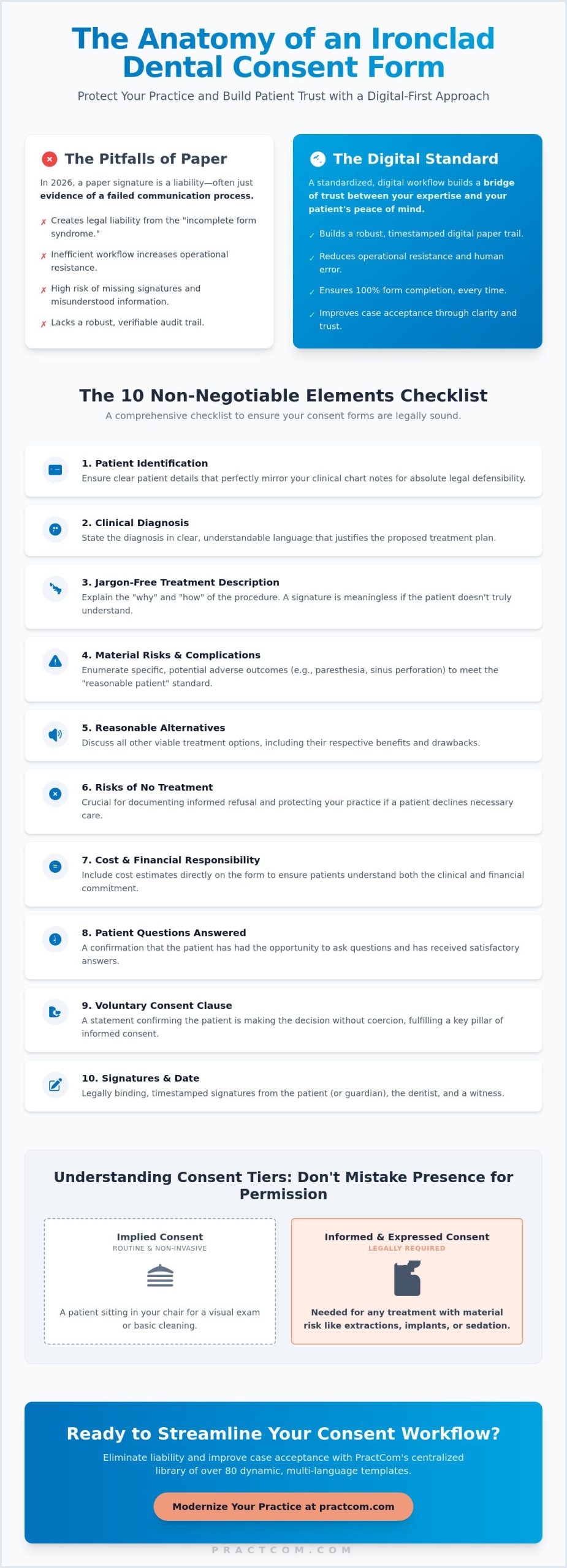
A patient sitting in your chair and opening their mouth is providing implied consent for a basic visual exam, but that silent agreement doesn’t cover a root canal or a complex extraction. In a modern clinical setting, you must distinguish between these tiers of approval to maintain both legal safety and patient trust. General consent is typically sufficient for routine, non-invasive procedures like cleanings or diagnostic X-rays. However, as soon as a treatment carries a material risk, you need expressed, informed consent. Relying on a comprehensive dental consent form checklist ensures you never mistake a patient’s presence for their permission to perform invasive work.
Effective consent is a shared clinical journey rather than a bureaucratic hurdle. It’s a structured conversation where you translate complex dental pathology into a language the patient understands. When you treat this process as a dialogue, you reduce the psychological resistance many patients feel toward expensive or daunting procedures. This transparency doesn’t just lower your liability; it builds the case acceptance necessary for a thriving practice.
The Legal Definition of Informed Consent
To be legally valid, your consent process must rest on three specific pillars: disclosure, capacity, and voluntariness. Understanding Informed Consent requires recognizing that the patient must have the mental ability to make the decision and must do so without any form of coercion. You are responsible for disclosing the nature of the treatment, the risks involved, and any viable alternatives. It’s a common administrative failure to let an assistant handle this entire process. While staff can facilitate the paperwork, the dentist must lead the final clinical discussion to ensure the “reasonable patient” standard for disclosure is met according to your specific state regulations.
When “General” Consent Falls Short
General consent forms often act as a baseline, but they fall short for procedures like endodontics, implants, or any surgery involving sedation. If you perform an extraction based only on a general signature, you risk a legal claim of “battery,” which is defined as unauthorized touching. Negligence claims, on the other hand, often arise when a patient feels they weren’t warned about a specific complication, like paresthesia or sinus perforation. Using a digital dental consent form checklist helps you document the verbal discussion alongside the written signature. By moving to a system like the one found at PractCom, you can ensure that every specific risk is acknowledged and timestamped, creating a robust digital paper trail that protects your reputation.
The Essential Dental Consent Form Checklist: 10 Non-Negotiable Elements
Maintaining a high-standard clinical environment requires more than just clinical skill; it demands administrative precision. A robust dental consent form checklist acts as your operational safety net, ensuring no detail is overlooked during the patient’s transition from diagnosis to treatment. Every form must begin with clear patient identification and a specific clinical diagnosis that mirrors your chart notes. This alignment is critical for legal defensibility. You should then provide a jargon-free description of the proposed treatment. If a patient doesn’t understand the “why” and “how,” the signature is effectively meaningless. Following the ADA Guidelines on Consent helps categorize these requirements effectively, ensuring you meet the professional expectations of 2026.
Your checklist should also prioritize transparency regarding outcomes. This includes enumerating material risks and potential complications, discussing reasonable alternatives, and clearly stating the risks of “no treatment” at all. While optional in some jurisdictions, including cost estimates and financial responsibilities directly on the consent form reduces friction later. It ensures the patient is fully informed of both the clinical and financial commitment. To see how these elements look in practice, you can explore our pre-built clinical templates that integrate these requirements into a single workflow.
Clinical Disclosure Requirements
When listing material risks, your goal is to inform without causing unnecessary alarm. Focus on common complications like pain, swelling, or infection, but also include the possibility of “failure of treatment.” This is a vital safeguard; it prevents the patient from assuming a 100% success guarantee. It’s equally important to address anesthesia risks separately from surgical risks, as many patients have specific anxieties or medical contraindications related to sedation. Verification of these signatures must meet strict standards, as detailed in our guide on Digital Signatures in Dentistry. This ensures that the person signing is indeed the patient or their legal guardian.
Administrative and Legal Safeguards
The role of the witness signature remains a cornerstone of clinical documentation. It provides an additional layer of verification that the consent process actually occurred as described. In 2026, dating and time-stamping have moved beyond manual entries; modern standards require digital audit trails that prove exactly when a document was opened, read, and signed. This level of oversight makes it nearly impossible for a patient to claim they weren’t given enough time to review the information. To further strengthen your position, consider adding “Teach-Back” confirmation fields. These are short sections where the patient briefly acknowledges in their own words that they understand the procedure, which serves as a powerful deterrent to future litigation.
Transitioning to Digital Consent: Why Paper Checklists Fail in 2026
The reliance on physical clipboards and filing cabinets is no longer just an aesthetic choice; it’s a significant operational liability. In a modern clinical setting, paper-based systems create hidden costs that drain your practice’s profitability. You aren’t just paying for the paper and ink. You’re paying for the administrative hours spent scanning documents, the physical square footage required for storage, and the inevitable human error that leads to “incomplete form syndrome.” A digital dental consent form checklist eliminates these risks by utilizing mandatory fields that prevent a document from being submitted until every signature and initial is captured.
Security is the other side of this equation. Paper records are vulnerable to physical damage and unauthorized access, whereas encrypted, HIPAA-compliant cloud storage provides a secure vault for sensitive patient data. Implementing an Effective Informed Consent Process requires a system that moves as fast as your clinical team. By integrating digital consent with your patient portal, you allow patients to complete their documentation before they even step foot in your office. This pre-visit completion ensures that your clinical staff can focus on the patient’s health rather than chasing missing signatures in the waiting room.
Improving Clinical Workflow Efficiency
You can significantly reduce front-office bottlenecks by sending consent forms directly to a patient’s smartphone via SMS or email. This immediate delivery model ensures that forms are reviewed and signed in a timely manner, automatically syncing with your broader dental practice workflow. Digital templates also provide the agility you need to stay compliant. When federal or state regulations change, you don’t have to discard thousands of pre-printed forms. You simply update the master template, and the new version is instantly available across your entire practice ecosystem.
Enhancing the Patient Experience
A paperless office sends a powerful psychological signal to your patients: it tells them your practice is modern, organized, and tech-savvy. Beyond the visual appeal, digital consent allows patients to review complex risks and treatment alternatives in the comfort of their own homes. This reduced pressure leads to better understanding and higher case acceptance rates. By shifting the administrative burden away from the dental chair, you reclaim valuable clinical time. This allows you to focus on the “conversation” aspect of consent, which we established earlier is the true heart of a compliant dental consent form checklist.
Best Practices for Clinical Documentation and Multi-Language Support
Informed consent is only valid if it’s truly informed. If a patient signs a document they can’t read, that signature is legally worthless and leaves your practice vulnerable. You have an ethical and legal obligation to ensure every patient understands the risks and benefits of their treatment in their primary language. Relying on tools like Google Translate for medical documentation is a high-stakes liability risk. These services often miss clinical nuances or technical dental terminology, which can lead to catastrophic misunderstandings and potential litigation. To protect your reputation, you should maintain a library of professionally translated, standardized templates that ensure accuracy across every patient interaction.
A comprehensive dental consent form checklist must include a dedicated step for verifying the patient’s preferred language. This isn’t just a hurdle for compliance; it’s a foundational element of patient trust. When you provide documents in a patient’s native tongue, you demonstrate a deep commitment to their safety and comfort. This level of professional care significantly improves patient satisfaction and case acceptance rates within diverse communities. It’s a proactive strategy that moves your office from simple administrative task completion to high-level clinical excellence.
Managing Non-English Speaking Patients
While bilingual staff members are a valuable asset, they aren’t always qualified medical interpreters. You must determine when a professional interpreter is necessary to ensure clinical accuracy during the consent discussion. Your documentation should explicitly state that the patient received the form in their native language and had the opportunity to ask questions. PractCom simplifies this process by offering a robust library of clinical forms in 15 different languages, ensuring you can meet the needs of your community without the delay of manual translation. Get started with our multi-language consent library today to eliminate these communication barriers.
Standardizing Post-Treatment Instructions
The clinical journey doesn’t end when the patient signs the consent form and the procedure is finished. Your documentation must link the initial consent to the aftercare process to ensure a seamless recovery. If a patient understands the risks beforehand but fails to follow recovery protocols due to a language gap, your liability increases. You need to ensure consistency across all touchpoints by providing clear, translated instructions for the recovery period. Utilizing Automated Dental Post-Op Instructions ensures every patient receives the same high standard of guidance, regardless of the language they speak. This systematic approach closes the loop on patient safety and reinforces the integrity of your dental consent form checklist.
Streamlining Your Consent Workflow with PractCom
PractCom transforms the traditional, static dental consent form checklist into a dynamic digital workflow that eliminates administrative friction. Instead of hunting for the right form in a filing cabinet, you gain access to a centralized library featuring over 80 professionally designed templates for both informed consent and post-treatment instructions. This system does more than just host documents; it actively manages them. Automated patient follow-ups ensure that every required signature is captured before the patient even enters your operatory. To further enhance the “informed” part of consent, our Smile Design tools provide visual before-and-after cosmetic changes. These visual aids help patients visualize outcomes and reduce the gap between clinical expectations and reality, which is a key component of a modern dental consent form checklist.
Why PractCom is the Ally Your Practice Needs
PractCom acts as the vital bridge between your existing Practice Management Software and the actual patient experience. While your PMS handles billing and scheduling, PractCom ensures your clinical communication is airtight and legally defensible. You can monitor your entire operation through the Practice Performance Dashboard, which tracks documentation compliance in real-time. This level of oversight is particularly beneficial for DSOs and multi-location practices. It allows for standardized protocols across every office in your network, ensuring that clinical standards remain high regardless of which provider is in the chair.
Get Started with Compliant Digital Consent
Transitioning from a disorganized paper system to a streamlined digital environment doesn’t have to be a months-long project. Most practices can implement PractCom and begin using their new digital workflows in under 24 hours. The 2026 standards for consent demand precision, multi-language support, and a clear audit trail. PractCom provides all three in one intuitive platform. You can see the difference for yourself by signing up for a Free Trial today. Protect your practice, empower your patients, and reclaim your time with a communication system built for the logistical realities of modern dentistry.
Secure Your Practice with Modern Consent Standards
In 2026, clinical excellence is inseparable from administrative precision. You’ve seen how a robust dental consent form checklist serves as a vital safeguard for your practice’s reputation and legal standing. By moving beyond static paper forms, you eliminate the operational resistance that leads to incomplete documentation and patient misunderstandings. Transitioning to a digital, clinical-first communication system ensures that every procedure is backed by a secure audit trail and clear patient comprehension.
PractCom provides the tools you need to stabilize your workflow, including a library of 80+ templates and support for 15 languages. Our platform handles the complexities of HIPAA-compliant digital signatures so you can focus on providing high-quality care. It’s time to replace outdated filing systems with a standardized process that builds lasting patient trust. This proactive approach protects your license while improving the daily experience for both your staff and your patients.
Download our Digital Consent Implementation Guide or Start Your Free Trial Today to see how easy compliance can be. Your practice deserves the psychological security of a system that never misses a detail. We’re here to help you lead your clinic into a more organized and secure future.
Frequently Asked Questions
Is a verbal consent legally sufficient for dental procedures?
Verbal consent is generally insufficient for invasive dental procedures as it leaves no physical audit trail for legal defense. While implied or verbal agreement might suffice for a routine visual checkup, any treatment involving material risk requires a written signature to meet clinical compliance standards. Documentation is your primary protection against malpractice claims; relying on a patient’s memory of a conversation is a high-stakes liability risk.
How long should a dental practice keep signed consent forms on file?
You should typically keep signed consent forms for a minimum of seven to ten years, though specific requirements vary significantly by state law. For pediatric patients, many jurisdictions require you to retain records until the patient reaches the age of majority plus the statute of limitations period. Utilizing digital storage ensures these records remain accessible and legible throughout the entire retention period without requiring physical shelf space.
Do I need a new consent form for every follow-up visit?
You don’t need a new form for every visit if the treatment remains within the scope of the original signed plan. However, any deviation from the initial diagnosis or the introduction of a new procedure requires an updated discussion and signature. Consistently referencing your dental consent form checklist during treatment planning helps you identify when a clinical change necessitates a fresh round of informed consent.
Can a minor sign their own dental consent form?
Minors generally cannot legally sign their own consent forms; a parent or legal guardian must provide the signature. There are narrow exceptions for emancipated minors or specific emergency situations depending on your local regulations. Always verify the legal status of the person signing to ensure the document remains valid during a clinical audit or legal challenge. Documenting the relationship of the signer to the patient is a critical administrative step.
What happens if a patient refuses to sign a consent form?
If a patient refuses to sign, you must document an “informed refusal” to protect your practice from future negligence claims. This process involves explaining the specific risks of declining treatment and having the patient sign a refusal form that acknowledges they understand those consequences. If they refuse to sign even the refusal form, you should note the discussion in the clinical chart with a witness present to verify the interaction.
Are digital signatures on dental forms HIPAA compliant?
Digital signatures are fully HIPAA compliant provided they are executed through an encrypted, secure platform that creates a permanent audit trail. These systems capture metadata such as IP addresses and timestamps, which offers superior evidentiary value compared to a handwritten signature on a paper form. Switching to a digital dental consent form checklist ensures your documentation meets the technical safeguards required by federal law while streamlining your front-office operations.
Should I include the cost of the procedure on the consent form?
Including cost estimates on the consent form is a best practice that improves case acceptance and reduces financial disputes. When a patient acknowledges the clinical risks and the financial responsibility simultaneously, it creates a more transparent and trusting relationship. This approach ensures there are no surprises regarding out-of-pocket expenses once the procedure is complete, which significantly reduces the administrative stress of post-treatment billing collections.
How often should our practice review and update our consent templates?
Your practice should review and update consent templates at least once a year or whenever significant regulatory changes occur. The 2026 mandates regarding HIPAA and sedation protocols are prime examples of why static forms are a liability. Regular audits of your template library ensure your clinical documentation remains aligned with the latest legal standards and professional guidelines, protecting your license and your reputation from avoidable errors.

Article by
Cary Ganz DDS
Dr. Cary H. Ganz is a dentist, prosthodontist, entrepreneur, lecturer, and author with more than 50 years of experience in clinical dentistry and dental technology. Throughout his career, he has combined hands-on patient care with a deep understanding of how technology can improve dental practice operations, communication, documentation, and patient outcomes.
In addition to his clinical background, Dr. Ganz has held significant leadership roles in the dental technology industry, including Past Owner and Vice President of Clinical Affairs at DEXIS Digital Radiography and Past Vice President of Clinical Affairs at Denticon Practice Management Software. His business experience includes product development, clinical strategy, dental software innovation, practice management solutions, and educating dental professionals on the effective use of technology in modern dentistry.
Today, Dr. Ganz continues to focus on creating practical technology solutions for dental practices, including PractCom, a comprehensive dental practice communication platform designed to improve patient communication, documentation, compliance support, referrals, and overall practice efficiency. His work reflects a career-long commitment to helping dentists deliver better care while making their practices more organized, efficient, and protected.
No responses yet