
If you think moving to paperless dental consent is just about saving trees or clearing desk space, you’re missing the most critical risk to your practice’s legal standing. With the February 16, 2026, deadline for updated Notice of Privacy Practices already behind us and the ADA’s April 2026 sedation mandates in full effect, a simple signature on a PDF isn’t enough to protect you. You’re likely tired of chasing down lost clipboards or watching staff spend hours scanning documents while patients claim they don’t remember the risks of their RCT or perio surgery. It’s a constant drain on your team and a dangerous gap in your clinical defense.
We understand that you want to provide an elite Standard of Care without the administrative friction that leads to burnout. You deserve a system that transforms documentation from a chore into a medico-legal fortress. This guide will show you how to transition to a standardized, digital consent process that ensures 100% compliance with California’s SB 351 and modern HIPAA security standards. We’ll compare the top 2026 solutions to help you find a frictionless platform that improves patient understanding in 15 different languages while securing your practice’s reputation and peace of mind.
Key Takeaways
- Learn how to replace the hidden liability of paper clipboards with a standardized system that meets the 2026 Standard of Care.
- Discover why using vetted templates and supporting 15 languages is critical for bridging communication gaps and ensuring valid informed consent.
- Compare specialized digital suites against generic PMS modules to find a paperless dental consent solution that prioritizes clinical clarity.
- Identify the specific “chaos points” in your current workflow to transition your team from manual scanning to a frictionless digital intake.
- See how integrating your consent forms with a post-treatment instruction library creates a complete medico-legal circle of protection for your practice.
The Evolution of Informed Consent: Why Paperless is the 2026 Standard of Care
The shift toward paperless dental consent isn’t merely a technological trend; it’s a fundamental elevation of the clinical Standard of Care. For decades, the paper clipboard was the industry default, yet it has become a significant medico-legal liability in the modern era. The Evolution of Informed Consent has moved from a simple signature to a requirement for documented, shared decision-making. In 2026, clinicians are held to a higher standard where the quality of communication is just as important as the procedure itself. If a patient claims they weren’t informed about the risks of an RCT or perio surgery, a smudged signature on a coffee-stained paper form offers little protection.
True consent happens when a patient fully understands the clinical journey. Moving to a digital system allows you to prioritize this understanding over administrative speed. It replaces the “chaos” of loose papers with the “control” of a structured, searchable database. This transition ensures that your documentation is as precise as your dentistry, protecting both your reputation and your legal standing in an increasingly litigious environment.
The Hidden Costs of Traditional Paper Forms
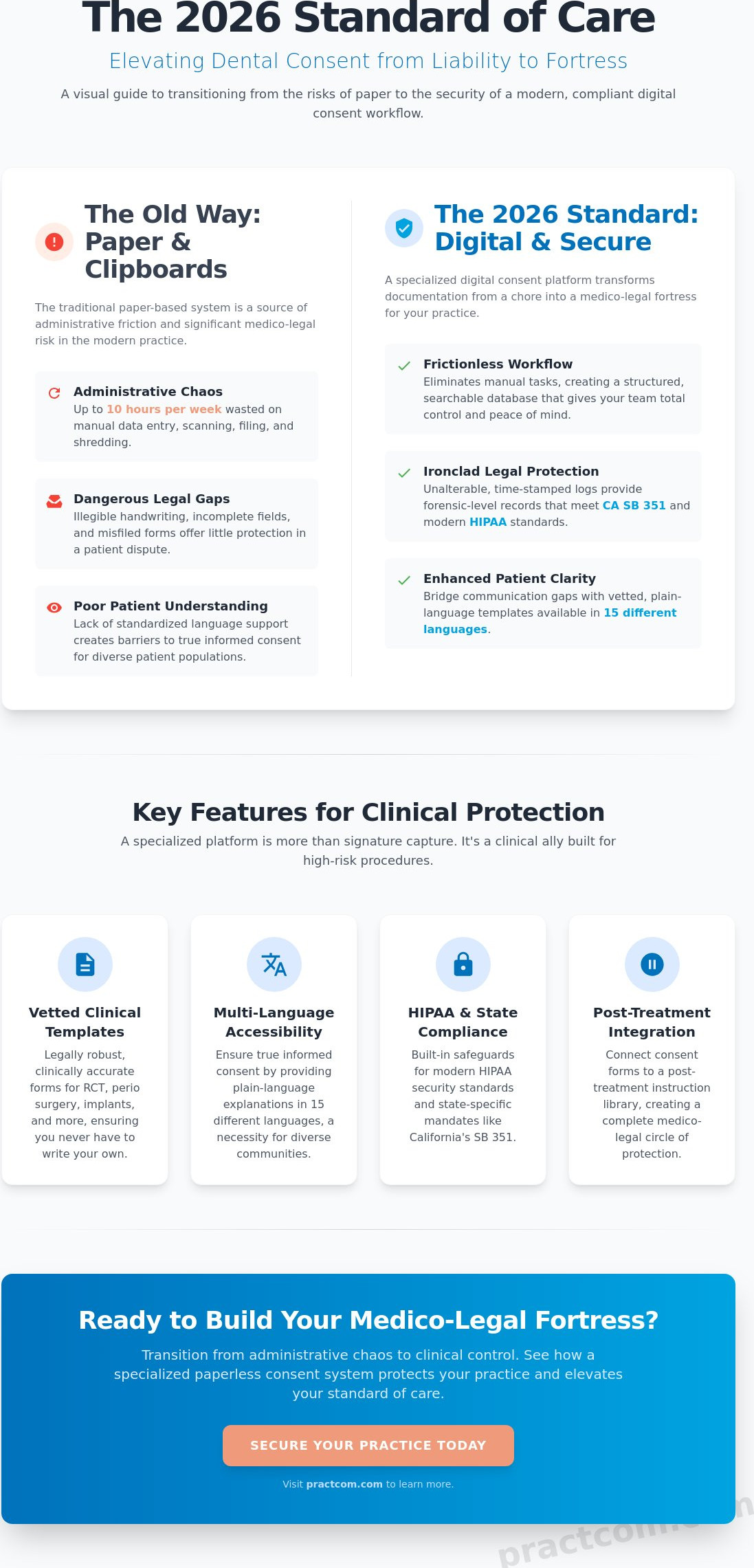
Manual paperwork creates “friction” that drains your team’s productivity. Consider the time spent on manual data entry, scanning, and shredding; tasks that often consume up to 10 hours per week for a typical front office team. Illegible handwriting and incomplete fields are common in high-pressure environments, leaving you vulnerable during a legal audit. Physical storage also creates administrative bottlenecks. Searching for a misfiled consent form during a patient dispute isn’t just stressful; it’s a failure of your practice’s internal controls. Transitioning to a digital system replaces this chaos with total control over your documentation.
Medico-Legal Reassurance in a Digital World
Digital documentation provides the “peace of mind” that paper cannot match. Why it’s critical: time-stamped signatures and unalterable digital logs create a permanent, forensic-level record of the consent process. This is essential for meeting the 2026 California SB 351 standards, which require clear information on risks and alternatives in plain language. A digital system ensures that every patient, regardless of which doctor they see in a multi-provider practice, receives the same vetted information. By standardizing these forms, you bridge the gap between complex clinical procedures and patient comprehension. You can explore how this protects your practice at why PractCom.
Evaluating Digital Consent Platforms: Key Features for Protection
Choosing a paperless dental consent platform isn’t just a software purchase; it’s a strategic decision to fortify your practice’s legal defense. While many generic Practice Management Software (PMS) modules offer basic signature capture, they often lack the clinical depth required for high-risk procedures. A specialized system acts as a “Reliable Clinical Ally,” providing the structure needed to move from administrative chaos to clinical control. This distinction is vital because a signature alone doesn’t prove informed consent; a documented dialogue does.
You shouldn’t be writing your own legal forms. Why it’s critical: a form drafted in-house may miss specific procedural risks or fail to meet the “plain language” requirements of current legislation. A research ethics review of eConsent highlights that the quality of information delivery is paramount for valid consent. Vetted templates ensure that your documentation for RCT, perio surgery, or implants is clinically accurate and legally robust from day one, reducing the risk of a patient claiming they “didn’t know” the potential complications.
Clinical Depth and Multi-Language Accessibility
Modern practices serve diverse populations where language barriers can lead to consent gaps. Providing plain-language explanations in 15 different languages is no longer optional; it’s a necessity for true informed consent. This ensures that every patient, regardless of their primary language, understands the risks and benefits of complex procedures. Specialized platforms allow you to customize these vetted templates without breaking the medico-legal framework, keeping your practice compliant and your patients informed. You can explore these clinical safeguards through a personalized walkthrough of our template library.
User Experience: Reducing Friction for Patients and Staff
A mobile-first design is essential for a frictionless intake process. Patients expect to sign documents comfortably on their own devices before they even step into the operatory. Paperless dental consent systems should offer one-click delivery via email or text, allowing for “anywhere” accessibility. For your team, the benefit is automated tracking. You’ll know exactly when a form was opened and signed, creating an unalterable digital log. This eliminates the “chaos” of searching for missing signatures and ensures that every document is securely stored and easily retrieved during follow-up appointments.
Dedicated communication suites often outperform generic PMS modules because they focus exclusively on the patient’s understanding. While a PMS handles your billing and scheduling, a specialized ally ensures your clinical documentation meets the highest Standard of Care. This focus on specialization removes the administrative friction that leads to staff burnout and patient frustration.
Comparing Solutions: Specialized Suites vs. Generic PMS Modules
Choosing the right architecture for your paperless dental consent workflow often comes down to a choice between built-in convenience and clinical depth. Many practices fall into the “PMS Trap,” assuming that because their Practice Management Software has a checkbox for digital forms, their medico-legal needs are covered. However, generic modules often lack the flexibility required for complex clinical scenarios. While a PMS might handle basic intake well, it rarely provides the granular, procedure-specific templates needed for an RCT or perio surgery. This gap creates a hidden vulnerability in your documentation.
Why it’s critical: Specialized communication suites are designed by clinicians who understand that consent is not a one-size-fits-all administrative task. Unlike all-in-one marketing platforms that bury documentation features under layers of “bloatware” like social media management or reputation tools, a specialized ally focuses entirely on the Standard of Care. By choosing a dedicated system, you avoid paying for features your team doesn’t use while gaining the clinical reassurance of vetted, multi-language documentation. This focus ensures your team stays organized without adding friction to your day.
Specialized Communication Suites (e.g., PractCom)
Specialized suites prioritize clinical clarity over simple data capture. These platforms act as a stabilizing force by providing high-utility features that a generic PMS simply cannot match. For instance, having access to an 80+ template library that includes post-treatment instructions ensures a complete circle of care. These systems also offer 15-language support, which is essential for ensuring true understanding across diverse patient bases. Implementation is typically frictionless, allowing you to upgrade your communication without a full software overhaul or the $179 per month starting support fees associated with major providers like Open Dental.
Practice Management Software (PMS) Modules
The primary appeal of PMS-based forms is the direct sync to the patient record. While this sounds efficient, the reality is often more chaotic. Generic forms are frequently static and difficult to customize for specialized procedures. If your consent form doesn’t explicitly address the April 2026 ADA sedation guidelines or the specific risks of a complex extraction, the “convenience” of a built-in form becomes a liability. You can compare how PractCom fills the gaps in traditional software to see where your current system might be leaving you exposed.
A cost-to-value analysis reveals that enterprise marketing systems often add unnecessary friction to your day. They demand extensive training and high monthly fees for tools that don’t improve your clinical outcomes. In contrast, a specialized system provides a pre-emptive strike against documentation failures. It ensures your practice remains protective, forward-thinking, and fully compliant with the latest 2026 regulatory standards without the administrative bloat.
Implementation Strategy: Moving to a Frictionless Digital Workflow
Transitioning to a paperless dental consent system is more than a software upgrade; it’s a strategic reorganization of your practice’s clinical workflow. To move from the “chaos” of manual scanning to the “control” of a digital system, you must first identify your current friction points. This audit often reveals that staff members are spending hours each week verifying signatures or tracking down missing forms. By standardizing your approach, you ensure that every patient receives the same vetted clinical information, regardless of which provider is performing the procedure. This consistency is the foundation of a modern Standard of Care.
Training your team is the most vital step in this transition. Moving from “here is a clipboard” to “please check your phone” requires a shift in mindset. Your front office and clinical assistants should be empowered to explain the benefits of digital documentation, such as 24/7 access to their own records via the patient portal. For patients who are tech-averse or elderly, your system must remain flexible. Maintaining the ability to provide physical document printing ensures that no patient is left behind, while still allowing your team to digitize the final record without the traditional administrative lag.
Step-by-Step Transition Plan
Start by selecting your core templates for high-volume procedures like extractions, fillings, and RCT. Why it’s critical: An automated follow-up system ensures that 100% of your documentation is complete before the patient ever sits in the chair. This pre-emptive strike against missing forms reduces day-of-procedure stress and prevents costly scheduling delays. We recommend a phased rollout over 30 days to allow your team to become comfortable with the new interface. You can schedule a strategy session with our team to map out your specific implementation timeline.
- Audit all current paper forms for clinical accuracy and 2026 compliance.
- Select a “Reliable Clinical Ally” platform that supports 15 languages.
- Set up automated text and email triggers for all upcoming appointments.
- Train staff on the “Five-Click” system for sending and tracking documents.
Ensuring HIPAA and Medico-Legal Compliance
In a digital environment, your audit trail is your best defense. You must verify that your chosen platform provides unalterable, time-stamped logs for every signature. This level of forensic detail is essential for meeting the April 2026 ADA sedation mandates and the California SB 351 standards. Your staff should be trained on secure data handling, ensuring that all electronic Protected Health Information (ePHI) remains encrypted both at rest and in transit. Understanding the full legal framework around digital signatures in dentistry and 2026 clinical compliance requirements is essential before finalizing your platform choice. This is particularly important when using digital signatures alongside premedicate instructions, where timing and proof of delivery are clinically significant. By following these protocols, you eliminate the legal gaps that paper forms naturally create.
The PractCom Advantage: Beyond the Signature
In the high-pressure environment of a modern dental office, a paperless dental consent system shouldn’t just be a digital version of a clipboard. It needs to act as your “Reliable Clinical Ally,” bridging the gap between complex procedures and patient understanding. PractCom goes beyond the simple signature by creating a protective ecosystem that standardizes your clinical communication. This approach ensures that your team remains in control while your patients receive the clarity they deserve. By automating the delivery of vetted information, you reduce the administrative friction that leads to errors and burnout.
One of the most significant barriers to valid informed consent is the language gap. While many platforms offer basic English and Spanish forms, PractCom provides full support for 15 different languages. This is a critical distinction for practices serving diverse communities. True informed consent requires that the patient understands the risks, benefits, and alternatives in their primary language. By removing this barrier, you aren’t just checking a box; you’re elevating your practice to a higher ethical Standard of Care. This level of precision acts as a pre-emptive strike against future medico-legal disputes and miscommunications.
The Total Communication Ecosystem
Why it’s critical: A consent form is only the first step in the patient journey. For a truly frictionless experience, your documentation must be connected to the clinical outcome. PractCom allows you to link your consent forms directly to our automated post-op instructions. This ensures that a patient who signs for an RCT or perio surgery immediately receives the specific aftercare steps they need. This integrated approach significantly reduces emergency calls, as patients have 24/7 access to clear instructions on their own devices. You’re providing peace of mind at the exact moment the patient needs it most.
Our platform also includes high-utility tools like Smile Design, which helps patients visualize cosmetic changes before they commit to treatment. This tool increases treatment acceptance while simultaneously documenting the patient’s agreement to the aesthetic plan. You can monitor all these interactions through our practice performance dashboard, giving you a bird’s-eye view of your clinical documentation health without adding friction to your day. It’s a comprehensive solution designed for the realities of a busy operatory.
Join the Standard of Care Revolution
Whether you’re a single private practice or managing multiple locations in a DSO, PractCom provides the stabilizing force needed to thrive in 2026. Our “Five-Click” system ensures that your staff can send, track, and file documents in seconds, not minutes. This efficiency allows your team to focus on patient care rather than scanning and shredding. It’s time to move from the chaos of manual paperwork to the confidence of a standardized, digital workflow. You can start your free trial and eliminate paper today to experience the PractCom difference firsthand.
Secure Your Practice’s Future with Modern Documentation
Transitioning to a paperless dental consent system is a commitment to clinical excellence and legal security. You’ve seen how manual clipboards create a dangerous gap in your defense; especially with the 2026 ADA and HIPAA mandates now in effect. Moving to a specialized ally allows you to replace administrative chaos with the confidence of a standardized system. This ensures every patient receives the same high-quality information, whether they’re coming in for an extraction or a complex RCT.
Why it’s critical: PractCom provides the stability you need with 80+ vetted clinical templates and support for 15 different languages. These tools remove the ultimate barrier to patient understanding while providing the medico-legal protection your practice deserves. It’s time to eliminate the friction from your team’s day and focus on providing exceptional dentistry.
Elevate your Standard of Care and start your PractCom Free Trial today. We’re ready to help you protect your reputation and grow your practice with peace of mind.
Common Questions About Digital Consent Systems
Are digital dental consent forms legally binding in 2026?
Yes, digital signatures are fully recognized under the ESIGN Act and the Uniform Electronic Transactions Act (UETA). For a paperless dental consent to be legally robust, it must include a time-stamped audit trail and unalterable digital logs. These features provide a higher level of forensic evidence than a traditional paper signature, which can be easily challenged in court if the document was altered or misfiled. For a deeper understanding of the legal standards governing digital signatures in dentistry and their 2026 compliance requirements, reviewing the full regulatory framework is strongly recommended.
Do I need to replace my current Practice Management Software to use paperless consent?
No, you don’t need to undergo a full software migration to upgrade your communication. PractCom is designed as a specialized clinical ally that works alongside your existing PMS. This allows you to gain the benefit of 80+ vetted templates and 15-language support without the disruption or high support fees often associated with changing your entire management system.
How do paperless consent forms improve HIPAA compliance?
Digital forms eliminate the risk of physical document exposure, such as leaving a clipboard on a front desk where other patients can see it. By using a paperless dental consent system, all electronic Protected Health Information (ePHI) is encrypted both at rest and in transit. This meets the 2026 HIPAA Security Rule requirements for mandatory encryption and multi-factor authentication, providing a much higher level of data protection than physical filing cabinets.
What happens if a patient doesn’t have a smartphone or prefers paper?
You can still maintain a streamlined workflow by utilizing physical document printing for tech-averse patients. Our system allows you to print the vetted forms for a manual signature and then use a “One-Click” upload process to save the document directly to the patient portal. This ensures that 100% of your records remain centralized and searchable, even if the initial interaction happened on paper.
Can digital consent forms be sent in languages other than English and Spanish?
Yes, PractCom provides comprehensive support for 15 different languages. While many generic modules only offer English and Spanish, our platform ensures that you can bridge the communication gap for a much wider patient base. This is a critical component of the modern Standard of Care, as it ensures that every patient truly understands the risks and benefits of their treatment in their primary language.
How does digital consent reduce the number of post-operative emergency calls?
Emergency calls often stem from a patient forgetting clinical details or losing their physical handout. By integrating consent with automated post-treatment instructions, patients have 24/7 access to their specific aftercare steps on their own devices. This clear, consistent communication ensures they know exactly what to expect during recovery, which significantly reduces the volume of “forgotten detail” calls to your office.
Can I customize the digital consent templates to match my specific clinical protocols?
Yes, you have full control to modify any of the 80+ vetted clinical templates to align with your practice’s unique protocols. While our forms are clinically sound and legally reviewed out of the box, we understand that every doctor has specific nuances in how they perform procedures like RCT or perio surgery. You can easily adjust the language to reflect your personal Standard of Care without adding friction to your day.
Is there a limit to how many forms I can store in the patient portal?
No, there are no storage limits within the PractCom patient portal. You can store an unlimited number of consent forms, post-op instructions, and referral documents for every patient in your practice. This provides a permanent, secure, and easily accessible record of the entire patient journey, ensuring you’re always prepared for a clinical review or legal audit.

Article by
Cary Ganz DDS
Dr. Cary H. Ganz is a dentist, prosthodontist, entrepreneur, lecturer, and author with more than 50 years of experience in clinical dentistry and dental technology. Throughout his career, he has combined hands-on patient care with a deep understanding of how technology can improve dental practice operations, communication, documentation, and patient outcomes.
In addition to his clinical background, Dr. Ganz has held significant leadership roles in the dental technology industry, including Past Owner and Vice President of Clinical Affairs at DEXIS Digital Radiography and Past Vice President of Clinical Affairs at Denticon Practice Management Software. His business experience includes product development, clinical strategy, dental software innovation, practice management solutions, and educating dental professionals on the effective use of technology in modern dentistry.
Today, Dr. Ganz continues to focus on creating practical technology solutions for dental practices, including PractCom, a comprehensive dental practice communication platform designed to improve patient communication, documentation, compliance support, referrals, and overall practice efficiency. His work reflects a career-long commitment to helping dentists deliver better care while making their practices more organized, efficient, and protected.
No responses yet