How much of your clinical success is currently being left to chance the moment a patient walks out your front door? You’ve spent years perfecting your surgical technique, yet the final outcome often depends on a patient correctly remembering a verbal instruction or locating a crumpled piece of paper. It’s a common frustration to see your afternoon schedule disrupted by avoidable post-op phone calls that drain your staff’s energy and eat into your production time.
We understand that while your practice management software handles the billing, it often fails to manage the critical clinical bridge between the chair and the home. This is where specialized dental patient communication software becomes an ethical and professional necessity. By implementing a standardized system for aftercare and digital consent, you can significantly reduce administrative friction and improve healing outcomes. In this article, you’ll discover how these clinical communication tools shield your practice from liability, eliminate language barriers, and transform patient anxiety into professional trust. We’ll examine why a dedicated clinical layer is the missing piece in your practice’s digital ecosystem.
Key Takeaways
- Identify the critical distinction between administrative scheduling and the clinical communication necessary for patient compliance.
- Discover how dental patient communication software reduces post-operative complications by delivering standardized, multi-language instructions to every patient.
- Protect your practice from regulatory risk with digital informed consent forms that create a permanent and secure audit trail.
- Close the “referral black hole” by implementing real-time tracking for specialist appointments and patient follow-through.
- Quantify your ROI through reduced administrative friction and a significant decrease in repetitive post-treatment phone calls.
Why Standard Dental Patient Communication Software Falls Short in 2026
Most dental practices rely on their Practice Management Software (PMS) to act as a catch-all for every patient interaction. However, there’s a fundamental difference between administrative communication and the specialized clinical communication required for successful treatment outcomes. While your PMS is designed to manage the ledger and the calendar, it’s often ill-equipped to handle the nuances of post-operative care and informed consent. Clinical communication software is a tool for standardizing the patient’s medical journey post-procedure, ensuring that the transition from the chair to the home is handled with technical precision.
When this clinical layer is missing, your practice pays a steep price through communication friction. This isn’t just a minor administrative annoyance; it’s a direct drain on your bottom line. Every time a patient calls with a basic question about their diet after an extraction or their discomfort levels after a root canal, your front desk loses minutes that should be spent on high-value tasks. This friction leads to avoidable complications, lost chair-time for unnecessary emergency checks, and a general sense of patient anxiety that can damage your reputation.
The Limitation of Appointment Reminders
Standard reminders are effective at getting patients into the chair, but they don’t ensure they heal correctly once they leave. A generic text message doesn’t provide the guidance a patient needs at night when they’re worried about post-op symptoms. For dental patient communication software to be truly effective, automated follow-ups must be procedure-specific. When you provide standardized instructions tailored to the treatment, you transform patient anxiety into professional trust and reduce the volume of repetitive phone calls your staff must field.
Bridging the Clinical Documentation Gap
Legacy systems focus more on the storage of Electronic Health Records (EHRs) than on active patient engagement. This creates a gap where clinical documentation remains trapped in paper-based habits or manual workflows. PractCom acts as the essential clinical layer that sits alongside your existing PMS. It moves your practice toward systematic control by providing a digital-first approach to instruction. Understanding why PractCom is essential for modern workflows is the first step toward protecting your clinical reputation and reclaiming your administrative time.
Standardizing Outcomes with Automated Post-Treatment Instructions
Clinical excellence doesn’t end when the local anesthetic wears off; it’s maintained through the patient’s adherence to your specific protocols. Most practices suffer from ‘phantom’ emergency calls, those evening inquiries that arise because a patient misplaced their paper instructions or simply forgot what was said in the chair. By utilizing specialized dental patient communication software, you can replace these manual failures with a standardized digital system that provides psychological security for the patient and operational order for your team.
A robust platform provides a library of 80+ post-treatment templates covering everything from endodontics to complex periodontal surgery. This variety ensures that every specialty in your practice is supported with technical precision. To maximize compliance, you must provide multiple delivery channels. Offering instructions via SMS, email, and physical print ensures that every patient, regardless of their technological comfort level, has immediate access to their care plan in any of the 15 supported languages.
Ensuring these messages reach patients securely is a legal necessity. Using HIPAA-compliant communication solutions protects your practice from regulatory scrutiny while automating the follow-up process. Timely messages sent hours or days after a procedure reinforce your instructions and keep the healing process on track without requiring manual staff intervention.
Eliminating Post-Op Confusion
Confusion is the primary enemy of clinical success. In a DSO or group practice environment, different providers might give slightly different verbal advice, which leads to patient uncertainty. Standardizing these instructions ensures a unified professional voice across all locations. Clear, simplified language and visual aids improve patient adherence significantly. You can explore more about this in our Automated Dental Post-Op Instructions: The 2026 Guide.
Procedure-Specific Automation
Efficiency increases when your dental patient communication software automatically triggers instructions based on specific procedure codes performed. This removes the burden from your clinical staff, who no longer have to repeat the same verbal instructions dozens of times a day. This reduction in repetitive tasks helps prevent staff burnout and ensures no patient falls through the cracks. Beyond post-op care, tools like Smile Design act as a communication bridge, helping patients visualize cosmetic changes before they commit to treatment. If you’re ready to see how these tools can standardize your clinical aftercare, the transition is simpler than you might expect.
Risk Management Through Standardization
Standardizing your risk disclosure ensures that every patient receives the same high level of information regarding their procedure. Digital forms integrate directly into your clinical workflow, making it nearly impossible to proceed without a verified signature. This systematic control protects your practice from the “forgotten” signatures that often occur during a high-pressure clinical day. By using a platform that mandates completion, you ensure that your documentation is always audit-ready. For a deeper dive into these protocols, see our Digital Dental Informed Consent Forms: Risk Management Guide.
Breaking the Language Barrier
Clinical risk increases significantly when a patient doesn’t fully understand the risks and responsibilities described in a consent form. In diverse communities, relying on a family member to translate complex medical terminology is a dangerous shortcut that leads to “lost in translation” instructions. Providing consent documents in the patient’s primary language is no longer a luxury; it’s a regulatory necessity. PractCom provides a library of documents in 15 languages, ensuring that comprehension is never left to chance. This level of technical precision is especially critical when scaling compliance for DSOs across multiple regions where patient demographics vary widely.
The transition to a paperless office offers more than just physical space savings. It dramatically improves document retrieval speed, allowing you to access a specific patient’s consent history in seconds during a follow-up or a regulatory check. By moving to digital signatures and secure cloud storage, you create a permanent record of every clinical interaction. This shift from operational disorganization to systematic oversight provides the psychological security you need to focus on what matters most: patient care.
Closing the Loop: Referral Management and Specialist Communication
The clinical journey often extends beyond the walls of your own practice. However, many general practitioners struggle with what’s known as the ‘Referral Black Hole.’ Some industry professionals report that up to 50% of dental referrals are never actually completed by the patient. This isn’t just a clinical failure; it’s a breakdown in the professional trust you’ve built. When a patient fails to follow through with a specialist, their condition can worsen, leading to more complex and expensive procedures later on.
Using specialized dental patient communication software allows you to track the status of these patients in real-time. Instead of wondering if the patient ever made it to the endodontist, you can see the progress of the referral through a secure clinical data exchange. This visibility improves the GP-specialist relationship by ensuring that information flows both ways. A dedicated patient portal further empowers the patient, providing them with the necessary documentation and specialist details at their fingertips, which significantly increases the likelihood of appointment follow-through.
Standardizing the Referral Workflow
Relying on paper referral slips is a liability in a modern clinical environment. These slips are easily lost, forgotten, or misplaced in a patient’s vehicle. Moving to a digital system ensures that the referral is recorded and tracked from the moment it’s issued. Automated follow-up messages can be sent to the patient to remind them of the importance of the specialist consult, ensuring that the clinical recommendation remains a priority. To understand the full scope of these systems, you can explore Mastering Dental Referral Management Software.
Data-Driven Practice Performance
Systematic control requires data. By using a Practice Performance Dashboard, you can identify exactly where referral leakage is occurring in your workflow. This allows you to see which specialists are providing the best outcomes and which ones might need a more direct line of communication. Tracking these metrics transforms a vague administrative process into a precise clinical tool. If you’re ready to secure your patient outcomes and eliminate the ‘Referral Black Hole,’ you can start your free trial and close the referral loop today.
Implementing a Clinical Communication Suite: ROI and Next Steps
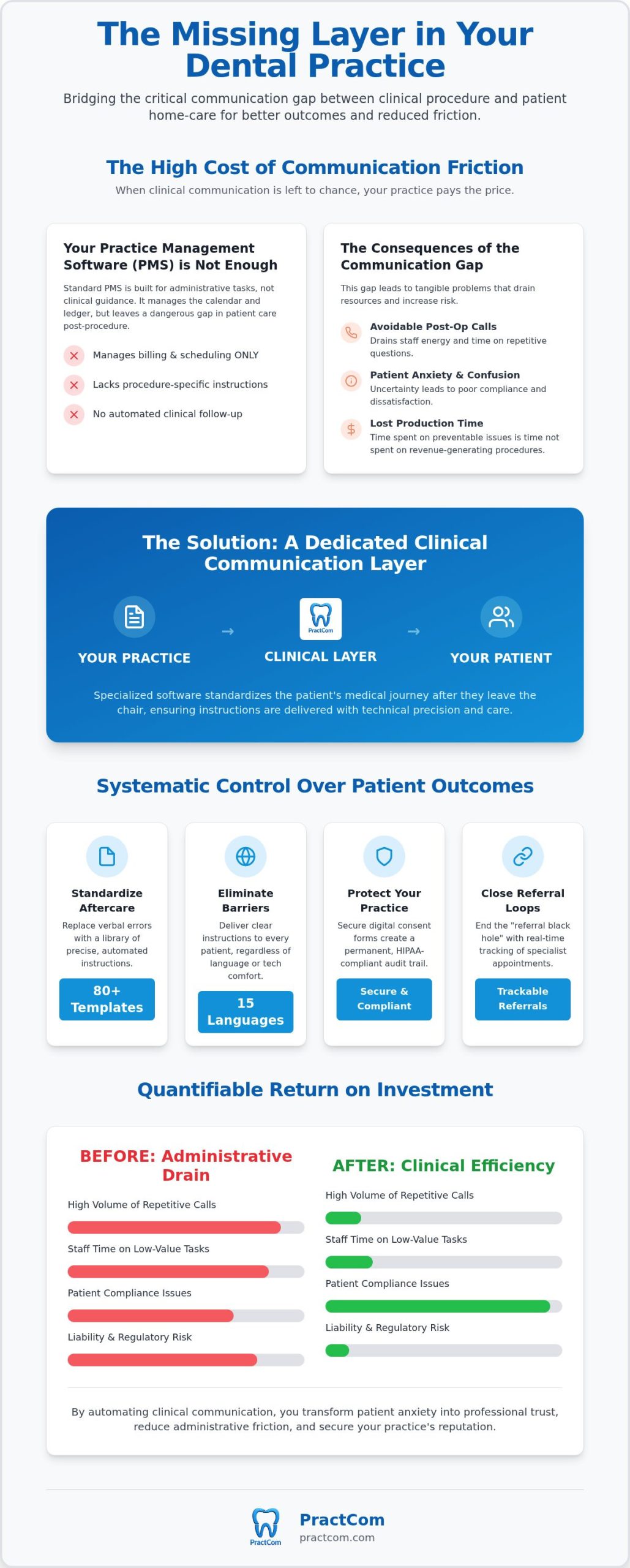
The decision to integrate specialized dental patient communication software is ultimately a pragmatic move toward higher clinical standards and operational efficiency. When calculating your return on investment, the most immediate metric is the reduction in administrative friction. Consider the cumulative hours your front desk spends answering repetitive post-operative questions every week. By automating these responses through a standardized library, you reclaim that time for patient-facing interactions that actually drive production. This shift doesn’t just save money; it elevates the perception of your practice as a modern, tech-savvy clinical environment.
Professionalism in the digital space directly correlates with patient trust and retention. When patients receive clear, multi-language instructions and secure digital consent forms, they feel protected and well-cared for. This sense of psychological security drives positive reviews and organic referrals, which are the lifeblood of a growing practice. Implementing this system is a straightforward 3-step process that involves selecting your core templates, training your clinical staff on the new digital-first workflow, and ensuring seamless integration with your existing PMS.
Measuring Success Beyond Billing
While traditional software focuses on the ledger, a clinical communication suite allows you to track metrics that actually impact healing outcomes. You can monitor the reduction in post-treatment complications and the decrease in unscheduled emergency visits. By observing patient engagement through portal login rates and document open frequencies, you gain a clear picture of how well your patients are following their care plans. If you have questions about how this fits into your current setup, you can review our Frequently Asked Questions about PractCom Integration.
The Future of Clinical Communication
The industry is moving toward a model where automation handles the repetitive educational tasks, allowing clinicians to focus entirely on physical care. Tools like Smile Design visualization are becoming essential for treatment acceptance, as they bridge the gap between complex professional procedures and the patient’s cosmetic goals. Positioning your practice as a patient-first environment requires moving away from operational disorganization and toward a standardized, reliable system. Ready to streamline your clinical communication? Start here.
Securing Your Clinical Reputation Through Systematic Control
The transition from manual, paper-based habits to a standardized digital ecosystem is more than just an administrative upgrade; it’s a commitment to clinical excellence. By implementing specialized dental patient communication software, you protect your practice from the risks of illegible consent and the “referral black hole” that often stalls patient progress. You’ve seen how a dedicated clinical layer sitting alongside your PMS can transform the healing journey from a source of anxiety into a predictable, professional process.
With a library of 80+ templates and support for 15 languages, you ensure that every patient understands their risks and responsibilities. Tools like secure digital informed consent and smile design visualization provide the psychological security both you and your patients deserve. It’s time to move away from operational resistance and toward a system that values technical precision and patient trust. Streamline Your Clinical Workflow-Get Started with PractCom today and experience the stability of a truly patient-first practice. Your team and your patients will thank you for the clarity.
Frequently Asked Questions
Is PractCom a full Practice Management Software (PMS)?
PractCom isn’t a full Practice Management Software (PMS). It’s a dedicated communication and documentation suite that functions as an essential clinical layer alongside your current system. While your PMS handles the administrative side of the business, such as billing and scheduling, PractCom manages the clinical bridge between the chair and the home. This targeted approach ensures that your post-treatment instructions and consent forms are handled with technical precision and standardized oversight.
How many languages are supported for post-op instructions and consent forms?
We support 15 different languages for all clinical documents, including post-op instructions and digital consent forms. This multi-language capability is a regulatory necessity for practices serving diverse communities. You can deliver these documents via SMS, email, or physical print to ensure maximum accessibility. Providing instructions in a patient’s primary language significantly improves compliance and reduces the risk of “lost in translation” errors that could lead to avoidable post-treatment complications.
Can I still print physical documents for patients who prefer paper?
Yes, our dental patient communication software includes physical document printing capabilities for patients who prefer paper. While the platform is built for a digital-first workflow, we understand that some patients feel more secure with a tangible copy. You can easily generate and print any of our 80+ standardized templates. This flexibility ensures that every patient receives clear aftercare instructions, regardless of their comfort level with modern mobile technology or digital patient portals.
Does the software integrate with my existing dental imaging or PMS?
PractCom is designed as a specialized clinical layer that sits alongside your existing PMS. It complements your current system by focusing on the active engagement and documentation phase of the patient journey. While it isn’t a full management system, it provides the specialized clinical tools that standard software often lacks. We recommend checking our compatibility documentation to see how it can best function in tandem with your specific administrative and imaging workflows.
How does automated aftercare reduce practice liability?
Automated aftercare reduces liability by providing a standardized, verifiable audit trail of all patient communications. When you use dental patient communication software to send digital, time-stamped instructions, you have proof that the patient received necessary risk disclosures. This system eliminates the legal vulnerability of relying on verbal advice or easily-lost paper slips. It ensures every provider in your practice delivers a consistent, high standard of care that protects your reputation and legal standing.
What is included in the PractCom Post-Treatment Instruction Library?
The library includes over 80 post-treatment templates covering every major dental specialty, from endodontics to oral surgery. These templates are designed to be clear and actionable for patients while maintaining technical accuracy for clinicians. Each instruction set is available in 15 languages and can be sent automatically based on the procedure performed. This comprehensive resource saves your staff from repetitive tasks and ensures that no critical aftercare step is ever omitted during the discharge process.
Is the patient portal HIPAA compliant?
Yes, the patient portal is fully HIPAA compliant and uses secure encryption to protect patient data. It offers a stabilizing force in high-pressure environments by providing a safe place for patients to sign digital consent forms and access records. This regulatory reassurance is vital for modern practices. It alleviates the anxiety regarding documentation compliance and ensures that your practice meets all current standards for electronic health record management and secure, multi-factor authenticated access.
How does the Smile Design tool help with patient communication?
The Smile Design tool helps bridge the gap between complex professional procedures and the patient’s cosmetic expectations. It provides a visual before-and-after representation of potential cosmetic changes. This visualization transforms patient anxiety into professional trust by making the final outcome feel tangible. When patients can see the value of a procedure before it begins, it leads to higher case acceptance and a more collaborative relationship between the clinical team and the patient.
Article by
Cary Ganz DDS
Dr. Cary H. Ganz is a dentist, prosthodontist, entrepreneur, lecturer, and author with more than 50 years of experience in clinical dentistry and dental technology. Throughout his career, he has combined hands-on patient care with a deep understanding of how technology can improve dental practice operations, communication, documentation, and patient outcomes.
In addition to his clinical background, Dr. Ganz has held significant leadership roles in the dental technology industry, including Past Owner and Vice President of Clinical Affairs at DEXIS Digital Radiography and Past Vice President of Clinical Affairs at Denticon Practice Management Software. His business experience includes product development, clinical strategy, dental software innovation, practice management solutions, and educating dental professionals on the effective use of technology in modern dentistry.
Today, Dr. Ganz continues to focus on creating practical technology solutions for dental practices, including PractCom, a comprehensive dental practice communication platform designed to improve patient communication, documentation, compliance support, referrals, and overall practice efficiency. His work reflects a career-long commitment to helping dentists deliver better care while making their practices more organized, efficient, and protected.
No responses yet