
If 65% of your patients are willing to switch providers for better digital convenience, then your clinical expertise is only half of the success equation in 2026. High-impact dental patient engagement strategies must now move beyond simple appointment reminders to address the psychological and operational gaps that lead to treatment non-compliance. You’ve likely felt the frustration of empty chairs from last-minute cancellations or the administrative strain of manual follow-ups that drain your team’s energy. It’s a common industry pain point that creates a barrier between your clinical skill and the patients who need your care.
We understand that manual tasks often lead to human error and professional anxiety regarding documentation. This article promises to help you bridge that gap, transforming your practice from a service provider into a trusted clinical partner through modern engagement and automated communication. We’ll preview 11 actionable tactics, including multilingual post-op automation and visual smile design, that are designed to reduce operational resistance. By the end of this guide, you’ll know how to achieve higher case acceptance and seamless referral transitions while protecting your staff from burnout and your practice from regulatory risk.
Key Takeaways
- Learn why modern dental patient engagement strategies require a shift from passive reminders to active clinical participation to ensure long-term health outcomes.
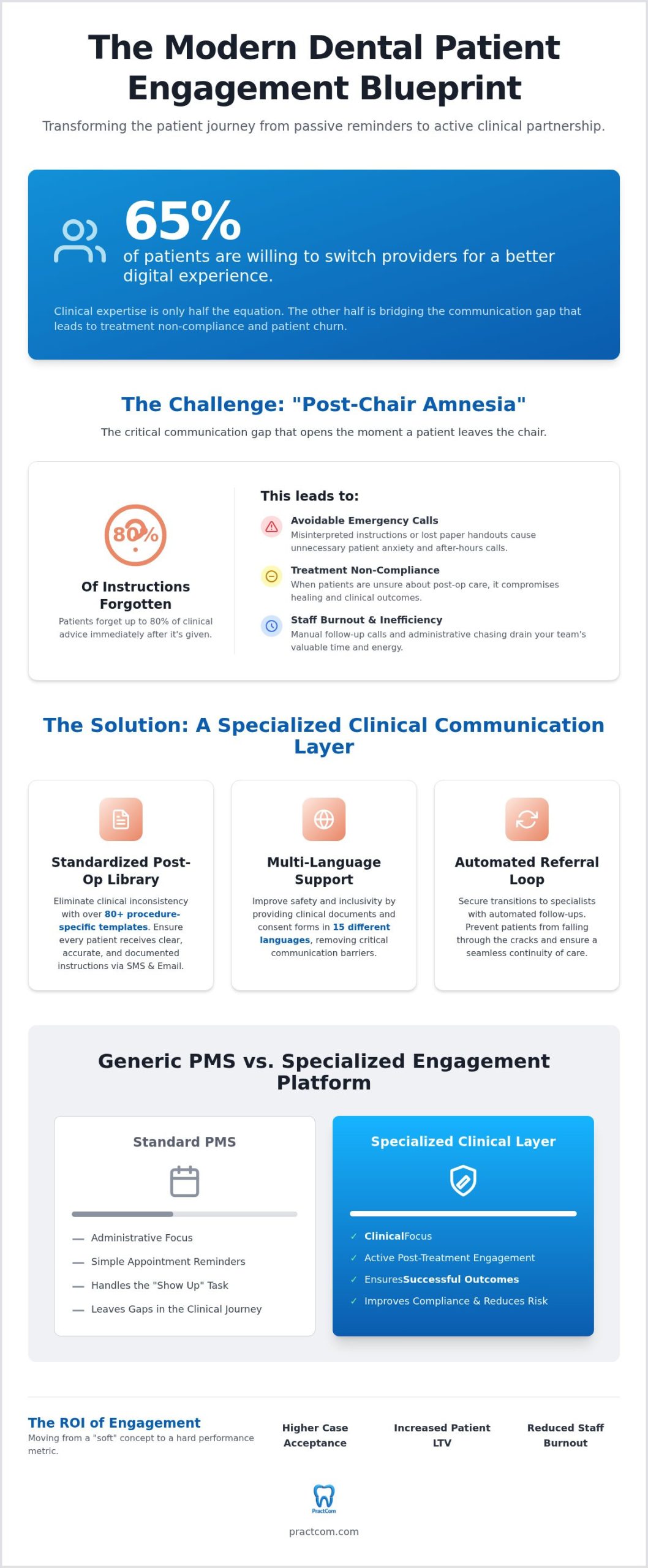
- Combat “Post-Chair Amnesia” by deploying a standardized library of over 80 post-treatment instruction templates that reduce emergency calls and improve compliance.
- Eliminate communication barriers and improve patient safety by providing clinical documents and consent forms in 15 different languages.
- Secure your referral loop through automated follow-ups that prevent patients from falling off the map during transitions to specialists.
- Understand why your practice needs a specialized “clinical layer” to handle communication tasks that a standard practice management software isn’t built to manage.
Redefining Dental Patient Engagement for 2026
Engagement is the measurable level of a patient’s involvement in their own oral health journey. In the current clinical environment, high-impact dental patient engagement strategies focus on converting a passive recipient of care into an active partner. This shift toward patient participation is essential because it addresses the psychological barriers that lead to treatment non-compliance. When you provide clear, accessible communication, you don’t just improve health outcomes; you significantly reduce your practice’s litigation risk. Clear documentation and informed patients are your best defense against misunderstandings that lead to board complaints. For DSOs and growing private practices, engagement has moved from a “soft” concept to a hard performance metric that dictates long-term stability and clinical quality control.
The ROI of an Engaged Patient Base
Every practice faces “silent churn,” where patients stop booking without expressing dissatisfaction. This usually happens because they don’t feel a clinical connection to the provider. An engaged patient base directly correlates to higher case acceptance rates for high-value procedures because trust is already established. By focusing on the patient’s lifetime value (LTV), you shift the focus from a single transaction to a clinical partnership. It’s much more cost-effective to reactivate a dormant patient than to acquire a new one, making engagement a primary driver of practice profitability. For multi-location groups, standardizing these touchpoints ensures that the brand’s reputation remains protected across every chair.
Engagement vs. Simple Appointment Reminders
Reminders are the baseline of your operations, not a comprehensive strategy. While your Practice Management Software (PMS) handles the administrative task of “showing up,” it often leaves significant engagement gaps in the clinical journey. A specialized clinical layer is required to close these gaps and identify the moments between appointments where patients feel most vulnerable. Transitioning from administrative touchpoints to clinical touchpoints means providing value before and after the chair time. This includes digital informed consent and post-treatment education that the patient can review in their own time. Implementing these dental patient engagement strategies ensures your team stays focused on patient care rather than chasing paperwork. When you close these gaps, you reduce operational resistance and eliminate the stress of manual follow-ups.
Bridging the Post-Treatment Communication Gap
The moment a patient leaves the dental chair, their cognitive load drops, leading to a phenomenon clinicians often call “Post-Chair Amnesia.” Statistics indicate that patients forget up to 80% of clinical instructions immediately after they’re delivered. This significant gap is a primary failure point in many dental patient engagement strategies. When a patient loses their physical care sheet or misinterprets a verbal instruction, it results in avoidable after-hours emergency calls and increased anxiety for both the patient and your staff. By moving away from easily misplaced paper handouts toward digital delivery via SMS and email, you ensure the patient has a permanent, searchable record of their care plan that they can access from any device.
Modern practices are now utilizing automated follow-ups to monitor healing progress without adding to the team’s administrative burden. A systematic check-in sent 24 hours after a procedure allows you to identify potential complications before they become emergencies. This integrated approach to patient engagement provides a psychological safety net for the patient while protecting your team from the burnout associated with manual phone calls. It transforms a routine follow-up into a proactive clinical intervention that improves safety and satisfaction. To see how these systems integrate into your daily workflow, you can explore our clinical communication tools.
Standardizing the Post-Op Instruction Library
Relying on individual providers to explain post-operative care leads to clinical inconsistency and potential documentation gaps. You need a standardized library of procedure-specific templates for extractions, implants, and endodontic treatments to maintain accuracy across your entire practice. Implementing Automated Dental Post-Op Instructions ensures every patient receives the same high standard of guidance regardless of which doctor they see. This consistency is especially critical for multi-doctor environments where standardized documentation acts as a safeguard for the practice’s reputation and legal standing.
Digital Informed Consent as an Engagement Tool
Engagement begins before the procedure ever starts. Traditional paper forms are often perceived as a bureaucratic hurdle, adding unnecessary friction to the patient intake experience. Switching to Digital Dental Informed Consent Forms allows patients to review and sign documents on a tablet or their own mobile device. This transparency builds trust and ensures that the patient feels fully informed; it’s a core component of effective dental patient engagement strategies. By digitizing these forms, you eliminate the risk of lost paperwork and ensure that every signature is time-stamped and securely stored for regulatory compliance.
Leveraging Visuals and Multi-Language Support for Inclusivity
In 2026, inclusivity isn’t just a moral choice; it’s a clinical requirement for any growing practice. High-impact dental patient engagement strategies must account for the diverse demographic realities of modern communities. If a patient doesn’t fully grasp their treatment plan due to a linguistic gap, they can’t provide true informed consent. This is where effective dentist-patient communication becomes a lifeline. By providing clinical documentation in a patient’s primary language, you remove the friction that often leads to non-compliance or treatment abandonment. Supporting 15 or more languages across all clinical touchpoints ensures that every patient feels seen, heard, and safe in your chair while protecting your practice from the risks of misunderstood instructions.
Overcoming the Language Barrier in Clinical Care
The risk of surgical aftercare being “lost in translation” is a significant liability for any modern dental practice. When a patient receives post-op instructions in a language they don’t master, the likelihood of errors in medication or wound care increases dramatically. Standardizing 15-language support across a library of more than 80 instruction templates provides a pre-emptive strike against these administrative failures. Automated SMS instructions sent in the patient’s preferred language create an immediate bond of shared professional experience. This system moves the practice beyond simple service provision toward a protective, guardian-like role that values the patient’s psychological security. You can learn more about how this standardized system works on our Why PractCom page.
Visual Case Presentation and Smile Design
Visual learners make up a large portion of your patient base, and they often need to “see” a result before they’ll commit to a high-value procedure. Smile Design tools act as a powerful engagement tool for patients in the middle of their decision-making journey, often referred to as the MOFU stage. By showing before-and-after visualizations of cosmetic changes before the first drill touches a tooth, you tap into the psychology of visual proof. This transparency builds the confidence necessary for case acceptance and reduces the anxiety associated with aesthetic changes. Integrating these visual aids into a secure patient portal allows patients to review their potential results at home with family members. This extended engagement keeps the treatment top-of-mind and effectively counters the “silent churn” mentioned in previous sections. It’s about providing a comprehensive ecosystem where visual and linguistic barriers no longer dictate the quality of care, making it one of the most effective dental patient engagement strategies for the modern era.
Streamlining the Referral Loop and Automated Follow-Ups
Patients often “fall off the map” during the transition from a general practitioner to a specialist. This usually happens because the referral process relies on physical slips or verbal instructions that are easily forgotten or misplaced. Clinical continuity is compromised when there’s no systematic way to track whether a patient actually booked their specialist appointment. Effective dental patient engagement strategies must treat the referral as a critical clinical transition rather than a simple administrative hand-off. By automating this loop, you ensure that the patient receives digital reminders and the specialist receives the necessary clinical context, preventing lost production and poor patient outcomes.
Managing the GP-Specialist Hand-off
Digital referral slips provide the patient with instant access to specialist information, including maps and contact details, sent directly to their mobile device. This reduces the friction of the “black hole” referral where the GP never knows if the treatment was completed. Tracking the status of these referrals allows you to intervene if a patient hasn’t followed through. Mastering Dental Referral Management Software is now a prerequisite for practices that want to maintain high standards of care across a fragmented provider network. This level of oversight turns a potentially lost patient into a successful clinical outcome and ensures that your practice remains the primary coordinator of their oral health journey.
Automated Check-ins and Satisfaction Surveys
The timing of your follow-up is as important as the message itself. Sending an automated text check-in 24 to 48 hours after a procedure shows the patient that you’re invested in their healing process. These check-ins act as a secondary screening for post-op complications while also providing a natural opportunity for satisfaction surveys. Positive feedback can be funneled directly into your online review platforms, enhancing your practice’s reputation without manual effort. Optimizing Dental Practice Workflow through these automated loops removes the burden from your front-office staff while maintaining a high-touch feel that patients appreciate. It’s a logical way to scale your practice’s empathy.
To truly understand which dental patient engagement strategies are delivering results, you need data-driven oversight. Performance dashboards allow you to track referral completion rates, survey responses, and instruction open rates in real time. This visibility enables you to refine your communication approach based on actual patient behavior rather than assumptions. It moves your practice from a reactive state to a proactive, systematic model of care. To implement these automated loops in your own office, get started with our referral management system today.
Choosing a Specialized Engagement Platform vs. Generic PMS
Your Practice Management Software is the operational engine of your office, but it isn’t a substitute for a dedicated clinical communication platform. While a PMS handles billing and basic scheduling, it often lacks the specialized depth required for sophisticated dental patient engagement strategies. This is why we position PractCom as the essential “Clinical Layer” that sits alongside your existing software. By focusing on the high-pressure transitions between chair time and home care, specialized tools provide a level of technical precision that generic SMS reminders simply can’t match. This approach reduces staff training time because the system automates the complex documentation tasks that usually require hours of manual oversight.
A key benefit of this specialized approach is that it integrates into your current workflow without the disruption of replacing your entire PMS. It provides a stabilizing force in the office, allowing your team to move from the resistance of manual follow-ups to the confidence of a standardized system. This shift protects your reputation and ensures that your practice operates with a high level of regulatory reassurance. By removing the burden of human memory from the equation, you allow your clinical team to focus on the patient in the chair rather than the paperwork in the file.
Evaluating the Feature Set for 2026
Your engagement platform must meet a specific checklist to be effective in a modern clinical environment. This includes support for 15 languages, a library of over 80 post-treatment templates, and digital informed consent. While digital delivery via SMS and email is the priority, you must also consider patients who prefer or require paper instructions. PractCom includes physical document printing capabilities to ensure total inclusivity across your entire patient base. Before committing to a platform, See the Comparison to understand why clinical-first tools outperform generic all-in-one solutions that lack specialized documentation depth.
Getting Started with a Patient-First Strategy
Transitioning to automated dental patient engagement strategies doesn’t have to be an overwhelming administrative hurdle. We recommend a 30-day implementation plan that focuses on small, high-impact changes, such as digitizing your most common post-op instructions first. This allows your team to see immediate benefits in reduced phone volume and improved patient compliance. By training your staff to view these tools as a clinical value-add, you elevate the patient experience and reinforce your role as a trusted health partner. It’s a practical, no-nonsense way to secure your practice’s future in an increasingly tech-savvy market. If you’re ready to eliminate operational friction and enhance your clinical oversight, Start Your Free Trial with PractCom today.
Securing Your Practice’s Clinical Future
The transition from a service provider to a trusted clinical partner requires a move away from the operational disorganization of manual tasks. By implementing modern dental patient engagement strategies, you address the psychological security of your patients while alleviating the administrative stress on your staff. We’ve explored how closing the post-treatment communication gap and leveraging multi-language support can transform your practice into a stabilizing force for your community. These aren’t just technical upgrades; they are ethical and professional necessities in a high-pressure clinical environment.
Your Practice Management Software is a vital tool for scheduling, but true engagement happens in the clinical layer. With access to a library of 80+ clinical post-op templates, digital consent in 15 languages, and automated referral tracking, you can ensure no patient falls through the cracks. This systematic approach reduces operational resistance and builds a foundation of trust that drives long-term case acceptance. You have the clinical expertise; now it’s time to provide the communication ecosystem your patients deserve. Streamline your practice engagement with PractCom and start your free trial today.
Frequently Asked Questions
What is the best way to engage dental patients after their appointment?
The most effective method is providing immediate, digital access to post-treatment instructions via text or email. This proactive approach addresses the high rate of clinical amnesia where patients forget 80% of instructions after leaving the chair. By sending automated follow-ups 24 hours later, you show clinical empathy and identify potential healing issues early. This system transforms your practice from a service provider into a trusted clinical partner.
How do automated post-op instructions improve patient engagement?
Automation removes the operational resistance of manual follow-ups and ensures every patient receives consistent, medically accurate guidance. Standardized templates for procedures like extractions or implants reduce patient anxiety and the volume of after-hours emergency calls. When instructions are delivered digitally, patients have a permanent record they can’t lose. This consistency builds professional trust and is a core component of modern dental patient engagement strategies designed to improve clinical outcomes.
Can I send dental consent forms via text or email securely?
Yes, you can securely deliver digital informed consent forms through encrypted text and email links that comply with modern privacy standards. These digital forms allow patients to review and sign documents on their own devices before they enter the consultation room. This process reduces friction in the patient intake experience and ensures all signatures are time-stamped and securely archived. It’s a professional necessity that protects your practice’s legal standing and reputation.
How does multi-language support affect dental practice engagement?
Providing clinical documents in a patient’s primary language is essential for true informed consent and safety. Supporting 15 languages eliminates treatment barriers in diverse communities and ensures that complex surgical instructions aren’t lost in translation. When patients receive care instructions they fully understand, their compliance rates increase and their anxiety levels drop. This inclusive approach broadens your practice’s reach and demonstrates a high level of clinical oversight.
What is a dental referral management system and why do I need it?
A dental referral management system is a specialized tool that automates the GP-to-specialist hand-off to ensure clinical continuity. You need it to prevent patients from falling off the map during transitions, which often leads to lost production and poor health outcomes. By tracking referral status and sending digital slips instantly, you maintain control over the patient’s journey. This systematic oversight ensures that specialists receive the necessary context and patients follow through with treatment.
Is dental engagement software different from my practice management system?
Dental engagement software functions as a specialized clinical layer that sits alongside your Practice Management Software (PMS). While a PMS handles administrative tasks like billing and scheduling, engagement platforms focus on deep communication, such as post-op libraries and digital consent. PractCom integrates into your existing workflow without replacing your PMS, providing the technical precision needed for high-impact dental patient engagement strategies. This distinction allows your team to focus on patient care.
How can visual aids like Smile Design increase treatment acceptance?
Visual aids like Smile Design allow patients to see before-and-after cosmetic changes before the first drill ever touches a tooth. This visual proof taps into the psychology of aesthetic dentistry, helping patients overcome hesitation and commit to high-value procedures. By showing a tangible result, you build the confidence necessary for case acceptance. Integrating these visualizations into a patient portal allows for home viewing with family, keeping the treatment top-of-mind and reducing silent churn.
What are the most effective metrics to track for patient engagement?
The most critical metrics include case acceptance rates, referral completion percentages, and the open rates of digital post-op instructions. Monitoring these data points through a performance dashboard allows you to identify which communication touchpoints are working and which need refinement. You should also track patient satisfaction survey results and the volume of post-treatment emergency calls. These metrics provide a clear picture of your practice’s clinical efficiency and the overall strength of your patient relationships.

Article by
Cary Ganz DDS
Dr. Cary H. Ganz is a dentist, prosthodontist, entrepreneur, lecturer, and author with more than 50 years of experience in clinical dentistry and dental technology. Throughout his career, he has combined hands-on patient care with a deep understanding of how technology can improve dental practice operations, communication, documentation, and patient outcomes.
In addition to his clinical background, Dr. Ganz has held significant leadership roles in the dental technology industry, including Past Owner and Vice President of Clinical Affairs at DEXIS Digital Radiography and Past Vice President of Clinical Affairs at Denticon Practice Management Software. His business experience includes product development, clinical strategy, dental software innovation, practice management solutions, and educating dental professionals on the effective use of technology in modern dentistry.
Today, Dr. Ganz continues to focus on creating practical technology solutions for dental practices, including PractCom, a comprehensive dental practice communication platform designed to improve patient communication, documentation, compliance support, referrals, and overall practice efficiency. His work reflects a career-long commitment to helping dentists deliver better care while making their practices more organized, efficient, and protected.
No responses yet