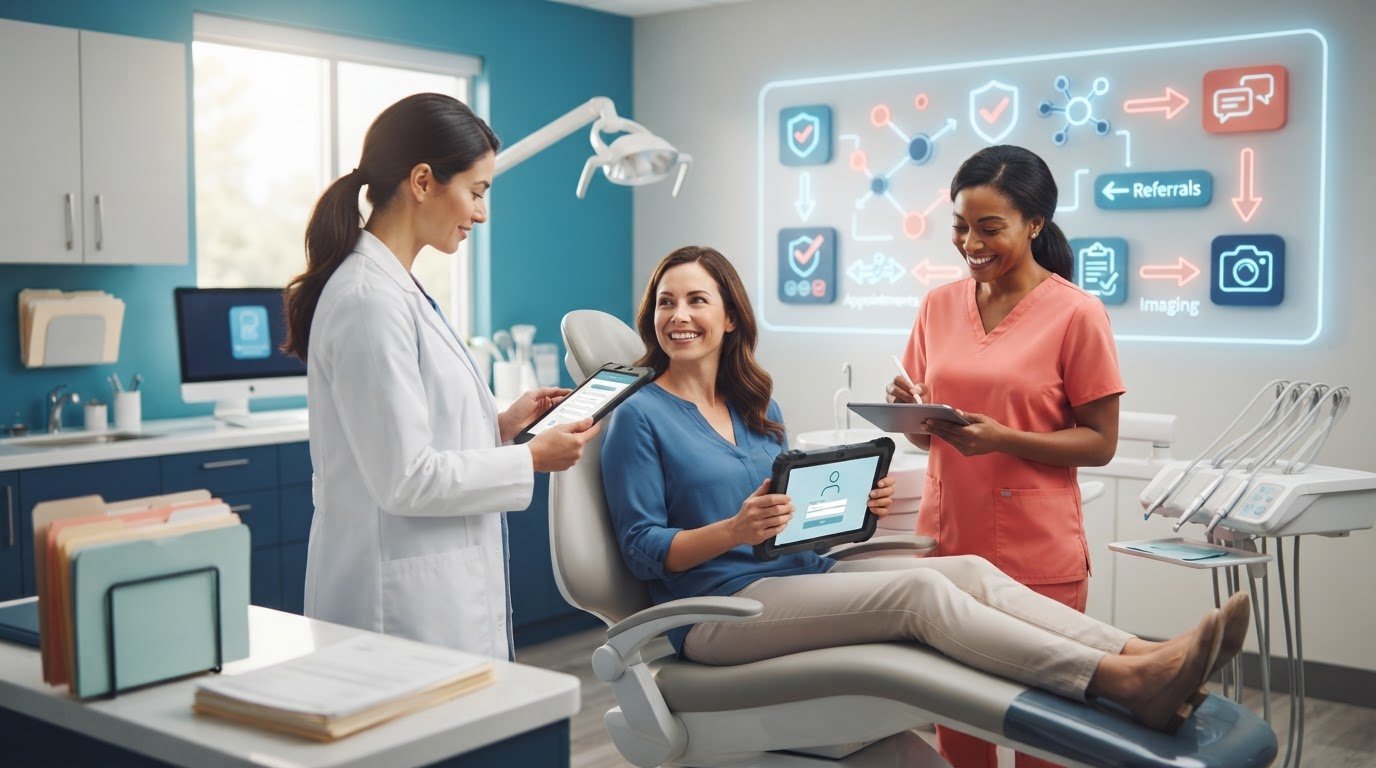
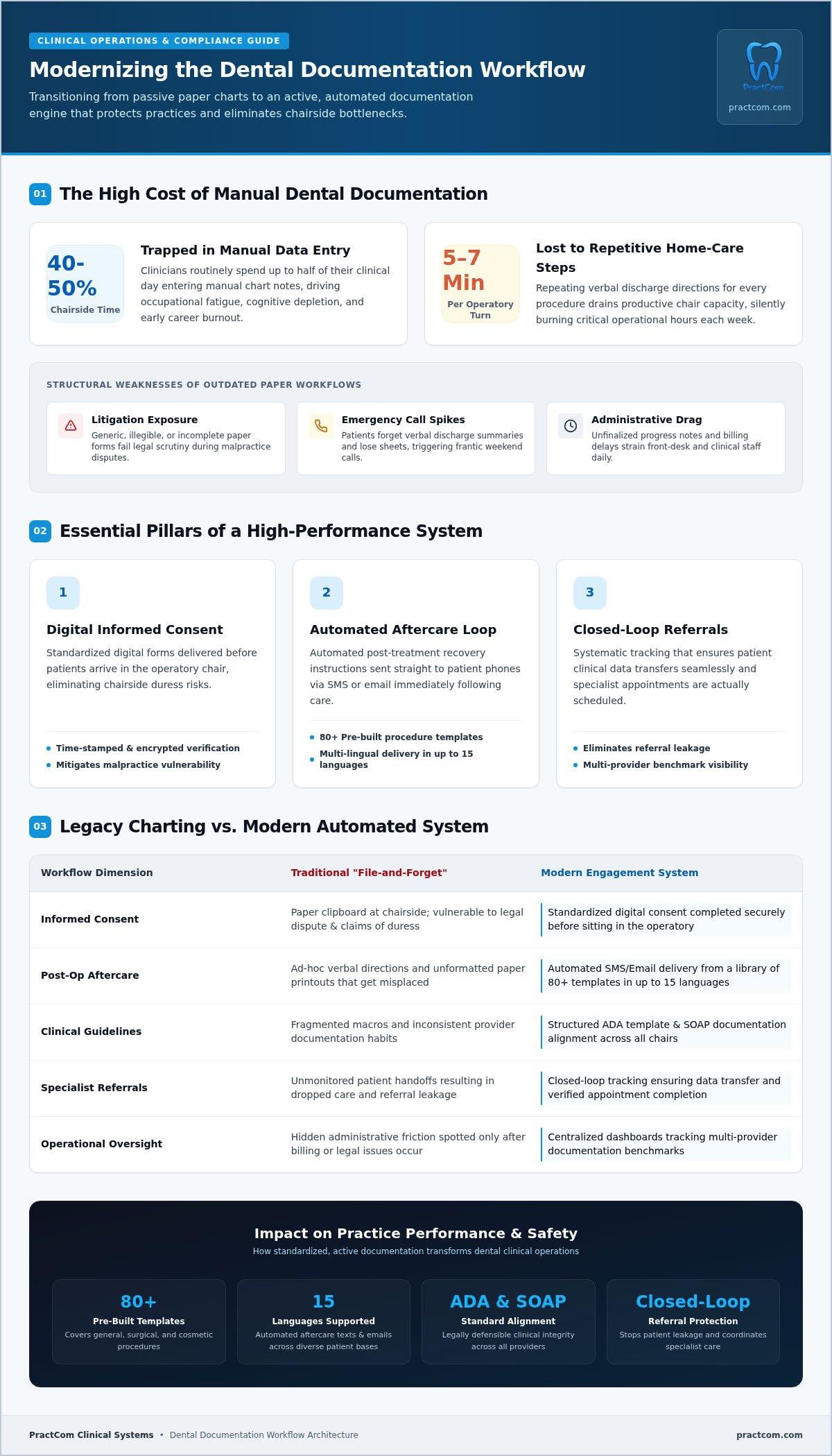
Clinicians routinely spend between 40% and 50% of their chairside time trapped in manual data entry and charting. If your evenings are regularly consumed by unfinalized progress notes and the lingering worry of incomplete consent forms, you aren’t alone. Most practices grapple with these administrative bottlenecks every day. An outdated dental documentation workflow doesn’t just exhaust your clinical staff; it invites severe compliance vulnerabilities, triggers claim delays, and sparks preventable post-op emergency calls.
Clinical records should serve as a protective shield for your practice, not an exhausting operational bottleneck. You don’t have to sacrifice chairside rapport or clinical precision to achieve rapid compliance. In this guide, you’ll learn how to transform your clinical documentation from an administrative burden into a high-performance system that protects your practice and delights your patients. We examine proven strategies to standardize informed consent, deploy automated post-treatment instructions across multiple languages, and eliminate redundant data entry so your office runs smoothly on autopilot.
Key Takeaways
- Modernize your dental documentation workflow by transitioning from passive chart entries to an active, automated communication system that works alongside your existing software.
- Shield your practice against malpractice vulnerabilities by delivering standardized digital informed consent before patients ever sit in the operatory chair.
- Curb after-hours emergency calls through automated post-treatment instructions delivered via text or email in up to 15 languages.
- Eliminate specialist referral leakage with closed-loop tracking that ensures clinical data transfers smoothly and patients actually schedule their care.
- Track multi-provider documentation benchmarks and operational compliance using centralized performance dashboards that spotlight administrative friction before it hurts your bottom line.
The Evolution of the Dental Documentation Workflow in 2026
A modern dental documentation workflow is the end-to-end framework of recording clinical observations, securing regulatory consent, and orchestrating patient communication. Historically, dental boards treated charts merely as ethical records and static archives. Today, that narrow perspective exposes practices to heavy administrative drag. As healthcare digitization accelerates, record-keeping has shifted from passive charting to an active engagement engine that protects revenue, improves clinical adherence, and buffers providers against operational burnout.
Clinicians routinely report that administrative burdens drive early retirement and occupational fatigue. When clinical teams manually coordinate charting, discharge notes, and patient tracking, their cognitive reserves dwindle. Standardizing these steps transforms documentation from an exhausting chore into a dependable safety net.
The High Cost of Manual Documentation Errors
Paper-heavy workflows introduce structural weaknesses at every patient touchpoint. When a practice relies on clipboards or hasty handwritten entries, the vulnerabilities multiply:
- Litigation exposure: Incomplete, generic, or illegible consent forms fail to satisfy legal standards during malpractice disputes, leaving clinicians defenseless.
- Preventable emergency calls: Patients retain only a fraction of verbal discharge summaries. When printed sheets get lost, post-operative complications and panicked weekend calls inevitably spike.
- Hidden time-loss: Repeating identical home-care steps drains roughly five to seven minutes per operatory turn, quietly burning hours of productive clinical capacity each week.
From Paper-Based to Frictionless Digital Systems
The traditional “file-and-forget” mentality treats patient notes as dead storage inside legacy electronic health record systems. In contrast, modern clinical teams layer specialized communication suites directly over their existing core records. Rather than expecting a rigid Practice Management Software (PMS) to handle specialized communication journeys seamlessly, smart teams decouple these tasks. They pair their primary records with purpose-built systems that automate informed consent and follow-up sequences across diverse populations.
To see how dynamic tools eliminate administrative friction across the entire operatory, explore our detailed breakdown on the reasons modern practices adopt PractCom. Standardizing these touchpoints protects your legal standing, gives hours back to your team, and delivers an effortless patient experience.
Essential Components of a High-Performance Documentation System
Every resilient dental documentation workflow rests on three foundational pillars: legally defensible informed consent, systematic post-operative guidance, and closed-loop referral tracking. When these core elements run on disparate paper sheets or fragmented software macros, clinical variability creeps in. Standardizing these workflows aligns your practice with current ADA guidelines on templates and SOAP documentation, protecting clinical integrity while delivering a frictionless patient experience.
Standardized Post-Treatment Instruction Libraries
Relying on ad-hoc verbal discharge or unformatted handouts creates operational vulnerability. Utilizing a standardized library of over 80 pre-built post-treatment templates ensures comprehensive coverage across general, surgical, and cosmetic procedures. Delivering these instructions straight to the patient’s phone via SMS or email keeps recovery directions accessible long after numbness subsides. Standardized aftercare replaces postoperative confusion with clear, structured recovery steps that measurably lower patient anxiety and slash unnecessary follow-up calls.
Digital Informed Consent as a Risk Management Tool
Securing consent on a paper clipboard right before treatment introduces major medicolegal exposure. Paper slips can be lost, signatures get contested, and operatory chairside signing invites accusations of duress. Transitioning to standardized digital dental informed consent forms creates time-stamped, encrypted verification that preserves your practice’s legal reputation. For individuals who still value hard copies, maintaining a print-on-demand option bridges the gap without breaking your paperless chain of custody.
The Multilingual Advantage in Clinical Communication
Language barriers represent one of the most neglected liabilities in clinical record-keeping. When patients fail to understand technical recovery steps, adverse events multiply quickly. True informed consent requires full patient comprehension, not just a signature on an English document they cannot read.
- 15 language translations: Providing both digital consent documents and recovery instructions in 15 distinct languages eliminates linguistic guesswork for diverse patient bases.
- Equitable comprehension: Multi-language document suites translate dense medical terminology into clear, accessible native guidance that bridges the communication divide.
- Unified accessibility: Centralizing these records within a dedicated patient portal lets patients review care guidelines in their preferred language whenever questions arise.
Upgrading to a comprehensive system creates instant administrative relief. If you are ready to modernize your aftercare loops and consent protocols, you can explore PractCom’s clinical communication platform to see how unified templates streamline daily operatory volume.
Automating the Consent and Aftercare Loop
Manual discharge instructions are notoriously fragile. Front-desk teams hand out printed papers that frequently end up left behind in operatory chairs or lost in car consoles. Transitioning to an automated dental documentation workflow closes this operational loop entirely. By establishing a set-and-forget protocol, your practice triggers procedure-specific instructions and consent forms the moment an appointment is scheduled or completed. Far from feeling robotic, automated outreach feels deeply attentive to patients when communications include their name, provider details, and procedure milestones. A comprehensive study on electronic dental record workflows highlighted how heavy documentation tasks create severe operational friction across dental teams. Automating these routine touchpoints removes that friction while generating an ironclad, time-stamped audit trail that verifies exactly when documents were opened and reviewed.
The SMS and Email Advantage
Patients rarely read multi-page paper brochures, but digital messages sent via SMS or email get opened almost immediately. When post-treatment guidance lands directly on a smartphone, patients can reference swelling timelines, pain management protocols, and dietary restrictions at midnight without panic. Having around-the-clock mobile access prevents minor concerns from escalating into after-hours distress. For common implementation questions regarding mobile delivery, review our patient communication FAQ to see how digital delivery integrates into daily office hours.
Eliminating the Follow-Up Bottleneck
Auxiliary staff routinely lose hours each week conducting outbound check-in calls that go straight to voicemail. Automated follow-ups dismantle this bottleneck through structured, digital recovery check-ins sent at targeted intervals post-procedure:
- Proactive complication detection: Digital check-ins prompt patients to report pain scores and symptoms, alerting staff immediately if recovery deviates from expected norms so you can intervene before an emergency develops.
- Pre-medication compliance: Scheduled automated reminders alert patients to take required prophylactic antibiotics or observe fasting rules hours before surgery, eliminating preventable operatory cancellations.
- Reclaimed administrative capacity: Reallocating staff from repetitive telephone tag to high-value chairside care streamlines practice efficiency and reduces clinical stress across the board.
Streamlining Referral Management and Specialist Coordination
Referral leakage quietly drains practice revenue and disrupts patient care. In traditional offices, paper-based referral pathways see only roughly 50% of patients successfully complete their recommended specialty visits. The other half falls through the cracks because paper slips are lost, forgotten, or ignored. Modernizing your dental documentation workflow with digital tracking solves this failure point entirely, pushing specialist appointment completion rates up toward 80%. Transforming this handoff also elevates the dental patient experience by presenting a coordinated, highly attentive care network.
A reliable four-step referral workflow protects your patients from slipping away:
- Step 1: Chairside initiation: The general practitioner enters referral details, clinical notes, and treatment rationale digitally within seconds during the examination.
- Step 2: Instant record transmission: Radiographs, charting, and signed consent files transfer securely to the specialist office without reliance on unencrypted email or physical mail.
- Step 3: Automated patient dispatch: The patient immediately receives the specialist’s office location, contact details, and scheduling instructions via text or email.
- Step 4: Bidirectional status tracking: Both practices receive automated status updates when the consultation is booked, attended, and completed.
The Digital Referral Slip
Paper slips give patients an easy excuse to delay complex treatment. In contrast, digital referral management transfers diagnostic imaging, perio measurements, and clinical narratives directly into the specialist’s workflow instantly. Patients perceive this seamless handoff as unified, elite care. They no longer need to carry envelopes between offices or repeat redundant health histories, which builds immediate confidence in both clinical providers.
Closing the Referral Loop
A successful referral requires absolute visibility from recommendation to post-treatment report. Without closed-loop tracking, referring GPs have no way of knowing whether an endodontic consult or periodontal graft ever happened until the patient returns months later with worsened pathology. Automated notifications bridge this communication gap completely, alerting the referring office the moment an appointment is confirmed or if the patient fails to schedule within a set window. To eliminate leakage across your professional network, start tracking your clinical referrals with PractCom today.
Leveraging Documentation Analytics for Practice Growth
Clinical documentation yields deep operational insights when practices measure administrative execution alongside production figures. Embedding a dedicated Practice Performance Dashboard transforms your dental documentation workflow into a predictive management system. Instead of discovering missing consent forms during an audit or unread discharge notes after a patient complaint, practice leaders gain immediate visibility into operational compliance across every operatory.
Standardizing these workflows accelerates daily operatory throughput. When charting, discharge handoffs, and digital consent forms are completed methodically, operatory turnover times drop without cutting into doctor-patient consultation minutes. Multi-provider practices and dental groups leverage centralized dashboards to track compliance metrics across multiple associates and satellite locations, ensuring clinical protocols remain uniform everywhere.
Tracking Communication ROI
Tracking the practical return on standardized communication demonstrates how operational order influences the bottom line:
- Reduction in nuisance triage: Dashboards log patient engagement with automated post-op messages, correlating rising digital open rates with dramatic drops in inbound telephone triage.
- Reputational dividends: Patients who feel supported throughout recovery leave positive online reviews, turning clear aftercare communication into a steady driver of organic patient acquisition.
- Network standardization: Group practices utilize unified dashboards to monitor same-day charting completion rates, identifying administrative friction before it hampers insurance claims. To see how multi-site groups coordinate these oversight systems, review our strategic guide for PractCom for DSOs.
Visual Documentation: The Smile Design Tool
High-performance record-keeping extends beyond alphanumeric notes and signatures. Integrating visual documentation via Smile Design software showing before and after cosmetic changes creates an indispensable clinical baseline. Presenting precise aesthetic simulations allows patients to evaluate realistic treatment possibilities before restorative procedures begin.
Visual records serve as a powerful catalyst for informed consent. While industry averages for case acceptance linger between 46% and 60%, practices that systematically present treatments alongside visual intraoral simulations and digital financing documents regularly achieve acceptance rates between 70% and 83%. Visual documentation aligns patient expectations with achievable clinical reality, protecting practitioner reputation while driving treatment conversion.
Build a Defensible, Frictionless Practice Today
Modernizing your clinical records is no longer just about cutting down paper waste; it is about protecting your clinical license and providing effortless patient care. By upgrading your dental documentation workflow, you insulate your practice against compliance liabilities, eliminate repetitive phone triage, and ensure patients follow through on vital specialty care. Standardizing these steps removes the daily cognitive fatigue that leads to clinical burnout, allowing your operatory team to focus entirely on exceptional dentistry.
With access to an expansive library of over 80 customizable post-treatment templates, patient communication delivered across 15 languages, and an integrated referral tracking system, your office can standardize operations overnight. You don’t have to overhaul your core software or spend late nights catching up on charting to achieve complete administrative peace of mind. Experience the relief of a fully synchronized, protected operatory when you streamline your clinical workflow with a PractCom free trial.
Frequently Asked Questions
How does a dedicated documentation workflow differ from my PMS?
A dedicated documentation system works alongside your existing software rather than replacing it. While a Practice Management Software handles billing, scheduling, and general charting, it lacks specialized tools for automated aftercare and structured patient communication. Layering a dedicated platform over your system automates informed consent delivery, multilingual instructions, and specialist coordination without disrupting core billing or ledger workflows.
Is digital informed consent as legally binding as a paper signature?
Digital informed consent forms hold full legal validity when they capture encrypted, time-stamped signatures and verifiable audit trails. Digital forms offer superior legal defensibility compared to physical paper because they record exact delivery times, timestamps, and patient acknowledgments. This documentation prevents disputes over chairside duress or missing signatures during malpractice audits.
How many languages should my post-op instructions be available in?
Your post-treatment instructions should ideally support the dominant non-English languages spoken across your patient demographics. PractCom provides complete document translation across 15 languages, ensuring complex recovery steps and risk factors are understood clearly. Multilingual support eliminates dangerous communication gaps that trigger unnecessary emergency calls and post-operative complications.
Can I customize the post-treatment templates for my specific clinical style?
Every template in the 80+ post-treatment library can be tailored to match your specific clinical preferences, prescription protocols, and recovery philosophies. You can modify dietary recommendations, oral hygiene instructions, or milestone timelines. Customization ensures your entire team presents uniform, doctor-approved guidance across every operatory while retaining your practice’s clinical voice.
What happens if a patient refuses to use the digital patient portal?
Physical document printing options ensure no patient gets left behind if they decline digital communication. Your front-desk or clinical team can generate standardized physical copies directly from the template library with a single click. This dual capability maintains consistent clinical instructions across your practice while accommodating personal patient preferences.
How does automated referral management reduce patient leakage?
Automated referral tracking closes the loop between general practitioners and specialists by providing real-time visibility into the patient’s scheduling status. Rather than relying on paper slips, clinical records and diagnostic images transfer securely to the specialist instantly. Automated check-ins notify both practices if an appointment remains unbooked, preventing valuable treatment from falling through administrative cracks.
Is PractCom HIPAA compliant for sending instructions via SMS?
Patient communications adhere strictly to federal privacy standards by sending secure links rather than unencrypted clinical details directly in text message previews. This method ensures that protected health information remains shielded behind encrypted portals. PractCom signs formal Business Associate Agreements to guarantee full regulatory compliance across all digital delivery channels.
Do I need specialized hardware to implement a digital documentation workflow?
No specialized operatory hardware is required to modernize your dental documentation workflow. The platform runs seamlessly in any web browser across your existing operatory computers, front-desk terminals, and standard clinic tablets. This lightweight architecture allows dental practices to upgrade clinical communication and consent protocols without costly IT upgrades or complicated local server configurations.

Article by
Cary Ganz DDS
Dr. Cary H. Ganz is a dentist, prosthodontist, entrepreneur, lecturer, and author with more than 50 years of experience in clinical dentistry and dental technology. Throughout his career, he has combined hands-on patient care with a deep understanding of how technology can improve dental practice operations, communication, documentation, and patient outcomes.
In addition to his clinical background, Dr. Ganz has held significant leadership roles in the dental technology industry, including Past Owner and Vice President of Clinical Affairs at DEXIS Digital Radiography and Past Vice President of Clinical Affairs at Denticon Practice Management Software. His business experience includes product development, clinical strategy, dental software innovation, practice management solutions, and educating dental professionals on the effective use of technology in modern dentistry.
Today, Dr. Ganz continues to focus on creating practical technology solutions for dental practices, including PractCom, a comprehensive dental practice communication platform designed to improve patient communication, documentation, compliance support, referrals, and overall practice efficiency. His work reflects a career-long commitment to helping dentists deliver better care while making their practices more organized, efficient, and protected.
No responses yet