
A busy dashboard can still leave you unsure what to fix. Tracking dental practice efficiency isn’t about collecting more numbers. It’s about finding the operational signals behind delays, missed follow-ups, and communication gaps. When manual tracking is inconsistent, daily activity alone may not reveal what’s working or where to focus.
To assess whether your practice is operating efficiently, start with a small set of indicators tied to patient and business outcomes. Leading measures can flag issues early, while lagging measures show what has already happened. Useful benchmarks also depend on your specialty, practice model, and the workflow you’re reviewing.
This guide explains how to choose meaningful indicators, establish a repeatable review process, and turn trends into practical next steps. You’ll also see how follow-ups, referrals, and other patient communication workflows can inform your review. A performance dashboard, such as PractCom’s, can support oversight of communication processes alongside your existing practice management software, without replacing it.
Key Takeaways
- Tracking dental practice efficiency works best when you start with one operational priority instead of monitoring every available metric.
- Choose measures that fit the workflow you want to understand, such as patient communication, referral handling, or team effort.
- Read counts, rates, and time-based measures in context. A dashboard can show activity, but it doesn’t prove what caused a result.
- Build a repeatable review cycle with a baseline, a process owner, and a cadence your team can maintain.
- PractCom can support oversight of communication and documentation workflows alongside your existing practice management software. It doesn’t replace a full PMS.
What Does Tracking Dental Practice Efficiency Actually Measure?
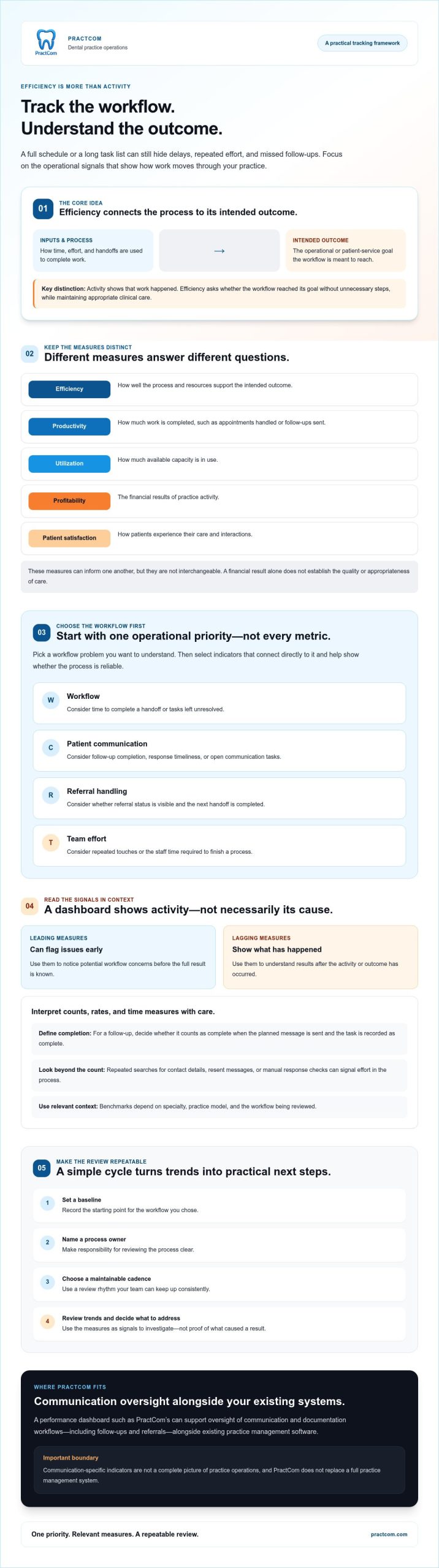
Dental practice efficiency measures how reliably a practice achieves operational and patient-service goals using appropriate time and resources. Tracking dental practice efficiency means examining how work moves through the practice, not simply counting appointments or tasks completed. The broader idea of Practice management includes organizing people and processes. Efficiency tracking helps you see where those processes support dependable service and where they create avoidable effort.
A full schedule can still hide delays, repeated data entry, or patients who need multiple reminders. Activity shows that work happened. Efficiency asks whether the workflow reached its intended outcome without unnecessary steps, while maintaining appropriate clinical care.
Efficiency, productivity, and performance: how are they different?
Efficiency relates inputs and processes to intended outcomes. Productivity focuses on the amount of work completed, such as appointments handled or follow-ups sent. Utilization looks at how much available capacity is in use. Profitability concerns financial results, while patient satisfaction reflects how patients experience their care and interactions. These measures can inform one another, but they answer different questions.
For example, a team may complete many follow-ups, suggesting strong productivity. But if staff repeatedly search for contact details, resend messages, or check manually whether a patient responded, the workflow may require more effort than necessary. A useful measure considers both completion and the process behind it. Financial performance and clinical quality also need separate interpretation: a financial result alone doesn’t establish the quality or appropriateness of care.
Which parts of a dental practice can you track?
Start with the handoffs and workflows you want to understand. Practice-wide measures may draw on your existing practice management software (PMS) and other records to review scheduling, team capacity, or overall financial performance. Communication-specific indicators focus on patient-facing processes and shouldn’t be treated as a complete picture of practice operations.
For a clearer view, consider tracking workflows such as:
- Administrative handoffs: whether information reaches the next team member and where a task pauses.
- Patient communication: whether instructions or consent forms are sent and how often staff need to repeat a step.
- Referrals: whether referral information is passed along and follow-up tasks are completed.
- Patient follow-ups: whether planned messages are sent and how much staff effort the process requires.
Choose indicators that match the question you’re trying to answer, and consider patient-service outcomes alongside time and effort. For more on mapping processes before selecting measures, consult a dental practice workflow guide.
How to Choose Dental Practice Efficiency Metrics That Matter
Start with a workflow problem, not a dashboard. If referral handoffs are getting lost, tracking every scheduling, financial, and patient-service figure at once won’t clarify the cause. Choose one operational priority, then select indicators that show whether the process is reliable and where it needs attention.
Useful candidates fall into four groups:
- Workflow: time to complete a handoff or the number of tasks left unresolved.
- Patient communication: follow-up completion, response timeliness, or open communication tasks.
- Referral handling: referral status visibility and whether the next handoff is completed.
- Team effort: repeated touches or staff time required to finish a process.
These are options to evaluate, not a required checklist. Select measures that connect directly to your priority. Resources such as Spear Education’s Essential Dental Practice Metrics can offer additional context, but your own definitions and workflow should guide how you interpret the measures.
Which indicators can reveal communication bottlenecks?
For a follow-up process, define completion clearly. For example, decide whether a task counts as complete when the planned message is sent and the task is recorded as complete. Response timeliness can show how long a communication task remains open. For referrals, review whether staff can see the status and whether the handoff reaches its intended next step. These measures can help locate friction, but they don’t explain its cause by themselves.
If you use a communication platform’s dashboard, first confirm which measures and filters it currently supports. Don’t assume a particular follow-up, response-time, or referral metric is available. PractCom offers a performance dashboard and communication tools, but choose indicators only when your data source can substantiate them.
How many efficiency metrics should a practice track?
Begin with a small group tied to your selected priority. Before collecting data, document each measure’s definition, source, review frequency, and responsible owner. If you’re examining follow-up completion, for example, agree on what counts as complete, where the record comes from, who checks it, and how often the team reviews it.
Set a baseline using your own workflow, then compare periods only when definitions and collection methods stay consistent. Generic industry targets can mislead if they reflect a different specialty, practice model, or process. Look for changes from your baseline and investigate the workflow behind them before drawing conclusions.
Once your measures are clear, explore a more organized approach to patient communication.
How to Interpret Dental Efficiency Data Without Misleading Yourself
A dashboard can make a change visible, but it can’t automatically explain why it happened. If follow-up completion improves after a new process begins, the timing alone doesn’t prove that the process caused the change. Staffing levels, case mix, seasonal shifts, or inconsistent data entry may also affect the numbers. A metric is a signal to investigate, not proof of causation.
Read each measure according to what it captures. Raw counts show volume, rates put activity in proportion to an eligible group, and time-based measures show how long a process takes. Consider this illustrative example for follow-ups:
| Measure type | Illustrative measure | What it can show |
|---|---|---|
| Raw count | Follow-ups completed | Total completed tasks, but not the share of tasks due. |
| Rate | Completed follow-ups divided by follow-ups due | Completion in relation to the eligible workload, if both figures are recorded consistently. |
| Time-based | Elapsed time from task creation to completion | How long the workflow takes, provided start and end points are defined. |
None of these measures tells the whole story. A count may rise because more follow-ups were due. A rate may shift if the team changes which tasks qualify. A shorter completion time may reflect a different staffing pattern rather than a more effective process. Tracking dental practice efficiency means checking the context behind a trend before making operational or clinical judgments.
How should you establish a useful baseline?
Choose an observation period that fits the workflow and the data you can collect reliably. Record the measure’s definition, source, and relevant exclusions so future comparisons use the same rules. Compare like with like, such as the same workflow under similar operating conditions, and note changes that could affect results, including staffing, case mix, or seasonal demand. Flag changes to data entry practices too. Otherwise, a difference in recording may look like a change in performance.
What can a dashboard show, and what can it not prove?
A dashboard organizes the information available to it. Its value depends on the completeness and accuracy of those inputs, as well as which measures the tool provides. It can help you spot an observed pattern, such as unresolved communication tasks accumulating, but it can’t establish the cause or replace professional judgment about care.
Communication analytics can add visibility into follow-ups, referrals, and patient-document workflows. Treat them as a complement to practice-wide reporting from your practice management software (PMS), not a replacement. Review the underlying records and workflow with the team before deciding what action a trend supports.
How to Build a Repeatable Efficiency Tracking Process
Tracking dental practice efficiency becomes useful when the team follows the same review steps each time. This simple cycle connects measurement to action without creating another layer of busywork:
- Define the problem. Name the workflow concern, such as follow-ups staying open longer than expected.
- Select measures. Choose indicators that show whether the workflow is moving as intended, and define how each will be counted.
- Establish a baseline. Record the current result using a consistent data source and definition.
- Review the trend. Assign a process owner and choose a recurring review cadence that fits the workflow and your available data.
- Adjust and reassess. Agree on a practical change, note when it starts, and review the same measure again.
The process owner coordinates the review and brings the relevant information. The team closest to the work can explain what the numbers miss. A brief discussion may uncover a handoff delay, unclear task ownership, or duplicate effort before anyone changes the process.
How do you turn a metric into a workflow improvement?
Take one observed bottleneck and map the steps around it. If follow-up tasks remain unresolved, for example, trace how they’re created, assigned, sent, and marked complete. Ask staff where the work pauses or repeats. Then agree on one small process change, document its start date, and recheck the same measure after implementation. Treat the result as evidence to review, not a promised improvement.
For a focused look at the communication steps involved, see this automated patient follow-up guide.
How can you keep the tracking process manageable?
Use existing reports or tools when their definitions and data sources are clear. Before adding a spreadsheet or manual tally, check whether a reliable workflow record already captures the information. Duplicate tracking adds effort and can create conflicting totals. Keep the review focused on the selected priority, and revisit whether each measure still helps the team make a decision.
If you’re assessing tools for communication workflows, review this patient communication platform comparison as part of your evaluation. A clear, repeatable process can help you see whether communication tasks are moving through the practice as intended. Explore an organized approach to patient communication.
Where PractCom Fits in Tracking Dental Practice Efficiency
PractCom supports patient communication and documentation workflows. It isn’t a replacement for a practice’s core management system. The platform includes digital informed consent forms, a post-treatment instruction library with more than 80 templates, automated patient follow-ups, referral management, a patient portal, and a performance dashboard. Used alongside your existing practice management software (PMS), these tools can help bring communication processes into view as part of tracking dental practice efficiency.
This distinction matters. A PMS may inform practice-wide reporting, while a communication platform can support oversight of specific patient-facing workflows. PractCom is not full practice management software, and its dashboard shouldn’t be assumed to cover every operational or financial measure your practice needs.
Which efficiency questions can a communication platform help you review?
Consider the questions you identified during measurement. Are follow-up tasks being completed as intended? Can staff see the status of a referral handoff? Are patient documents reaching people through the communication methods your practice uses? PractCom’s follow-up, referral, documentation, and dashboard capabilities may be relevant to reviewing these workflows.
The dashboard can support performance oversight, but don’t assume a particular metric, filter, or outcome is available. Confirm its current capabilities and compare them with your reporting requirements. A dashboard can help organize relevant information, but your practice still needs clear measure definitions and context to interpret it.
What should you verify before evaluating a solution?
Before deciding whether a platform fits, confirm the details that affect your measurement process and day-to-day work:
- Dashboard: Ask which measures are currently available, what data sources they use, and what user roles can access them.
- Reporting fit: Check whether the available information supports the communication questions your team wants to review. Confirm current integration details directly rather than assuming data synchronizes with your PMS.
- Document delivery: Assess how email, text, or physical printing, along with document support in 15 languages, fits your existing patient communication workflows.
Use your priority workflow as the test: identify what you need to track, then verify that the relevant data and process records are available. Explore PractCom for your practice and assess whether its communication and documentation tools fit your team’s needs.
Turn Clearer Measures Into Practical Next Steps
Tracking dental practice efficiency doesn’t require an oversized dashboard. Choose a small set of measures tied to a real workflow concern, define them consistently, and review the trend with the team. Use the data to identify questions worth investigating, rather than assuming a metric explains the cause. A repeatable review process helps you make considered adjustments and see how the workflow changes over time.
For patient communication and documentation, PractCom offers automated follow-ups, referral management, a performance dashboard, and more than 80 post-treatment instruction templates. Documents can be delivered by email, text, or print in 15 languages. These tools can complement practice-wide reporting, but PractCom is not a full practice management software system. Confirm that its current dashboard capabilities and workflows match your practice’s needs.
Explore PractCom for your practice to assess whether its communication tools fit the workflows you want to review. Start with one priority, keep the process manageable, and build from what your team learns. Small, consistent steps can bring greater clarity to daily operations.
Frequently Asked Questions
What does tracking dental practice efficiency mean?
Tracking dental practice efficiency means consistently reviewing how workflows use time and resources to achieve intended operational and patient-service outcomes. You might examine follow-ups, referral handoffs, or administrative steps. Define the workflow and the result you want first, then choose a measure that helps assess it. Efficiency isn’t simply seeing more patients or generating more revenue; those figures don’t explain how smoothly the underlying work gets done.
Which KPIs should a dental practice track?
Choose a few KPIs that relate directly to the operational issue you want to understand. For a communication workflow, you might consider follow-up completion, response timeliness, or referral status visibility. Define what counts for each measure and identify its data source before comparing results. There’s no universal KPI set for every specialty, team structure, or patient communication process, so select measures that answer your practice’s specific question.
How often should a dental practice review efficiency metrics?
Set a recurring schedule that fits the workflow and gives your team enough consistent data to identify useful patterns. You might review an operational indicator regularly and examine longer-term trends less often, depending on workflow volume and data quality. Keep the schedule consistent, assign someone to prepare or review the information, and record process changes that could affect results. Adjust the cadence if the data isn’t reliable or useful for decisions.
Can a dashboard show whether a dental practice is efficient?
A dashboard can organize available measures and make changes easier to notice, but it can’t determine efficiency on its own. Decide which outcome matters, then check whether the underlying information is complete and reliable. A trend can prompt a closer look at a workflow, but it doesn’t prove that a particular process or tool caused the change. Interpret dashboard information alongside operational context and appropriate professional judgment.
How do dental practices establish an efficiency baseline?
Choose a clearly defined workflow and record its current performance using a consistent data source and observation period. Write down how the measure is calculated and who records it so the practice can repeat the process. Note relevant changes, such as staffing adjustments or a new workflow step. The baseline gives you a reference for later comparisons. It isn’t a verdict on how your practice measures up against every other office.
Is PractCom a practice management software system?
No. PractCom is a dental patient communication and documentation solution, not a full practice management software system. Its tools include post-treatment instructions, digital informed consent forms, automated patient follow-ups, referral management, a patient portal, and a performance dashboard. Practices should identify which operational reports they need from their existing systems, then confirm directly whether PractCom’s current features support their communication-related tracking requirements.
How can patient communication tools support efficiency tracking?
Patient communication tools can help organize workflows such as sending post-treatment instructions, completing follow-ups, and managing referrals, making those processes easier to review. The measures available depend on the tool, so confirm its current dashboard capabilities and data sources before evaluating it. Use communication information alongside relevant practice reports. It can add workflow context, but it isn’t a substitute for clinical judgment or a complete view of practice-wide performance.

Article by
Cary Ganz DDS
Dr. Cary H. Ganz is a dentist, prosthodontist, entrepreneur, lecturer, and author with more than 50 years of experience in clinical dentistry and dental technology. Throughout his career, he has combined hands-on patient care with a deep understanding of how technology can improve dental practice operations, communication, documentation, and patient outcomes.
In addition to his clinical background, Dr. Ganz has held significant leadership roles in the dental technology industry, including Past Owner and Vice President of Clinical Affairs at DEXIS Digital Radiography and Past Vice President of Clinical Affairs at Denticon Practice Management Software. His business experience includes product development, clinical strategy, dental software innovation, practice management solutions, and educating dental professionals on the effective use of technology in modern dentistry.
Today, Dr. Ganz continues to focus on creating practical technology solutions for dental practices, including PractCom, a comprehensive dental practice communication platform designed to improve patient communication, documentation, compliance support, referrals, and overall practice efficiency. His work reflects a career-long commitment to helping dentists deliver better care while making their practices more organized, efficient, and protected.
No responses yet