
Your patient portal isn’t failing because your patients are tech-averse; it’s failing because it’s an island in your clinical workflow. Research shows that 87% of patients will engage with a portal when their provider actively encourages it, yet many practices leave this tool as a digital afterthought. If you’re struggling with how to get patients to use a patient portal, you’ve likely realized that simply providing a link won’t stop the flood of post-op phone calls or the headache of lost paper referral slips. You need a strategy that embeds digital documentation into every clinical touchpoint.
We understand the operational friction of a front desk team buried under manual follow-ups and the anxiety of maintaining regulatory compliance. It’s time to move from administrative resistance to the confidence of a standardized system. This 2026 guide reveals how to transform your portal from a ghost town into a high-engagement hub using automated workflows and multi-language support. We’ll explore how to leverage high-value incentives like Smile Design visualizations and automated post-treatment libraries to drive consistent logins. You’ll learn exactly how to reduce administrative overhead and improve patient satisfaction scores by making the portal a professional necessity rather than an optional extra.
Key Takeaways
- Identify why portals often fail by auditing friction points and shifting the portal from an optional convenience to a mandatory clinical delivery method.
- Learn how to get patients to use a patient portal by utilizing tokenized, one-click SMS links that bypass the traditional password hurdles that stop engagement.
- Anchor portal adoption in the initial visit by requiring digital informed consent forms as the “hook” that establishes the portal as your primary communication hub.
- Drive sustained logins and reduce post-op phone calls by providing continuous value through an automated library of 80+ post-treatment instructions available in 15 languages.
- Accelerate cosmetic case acceptance by using Smile Design visualization tools as a high-value incentive for patients to access and review their digital records.
The Portal Paradox: Why Most Dental Patient Portals Remain Unused
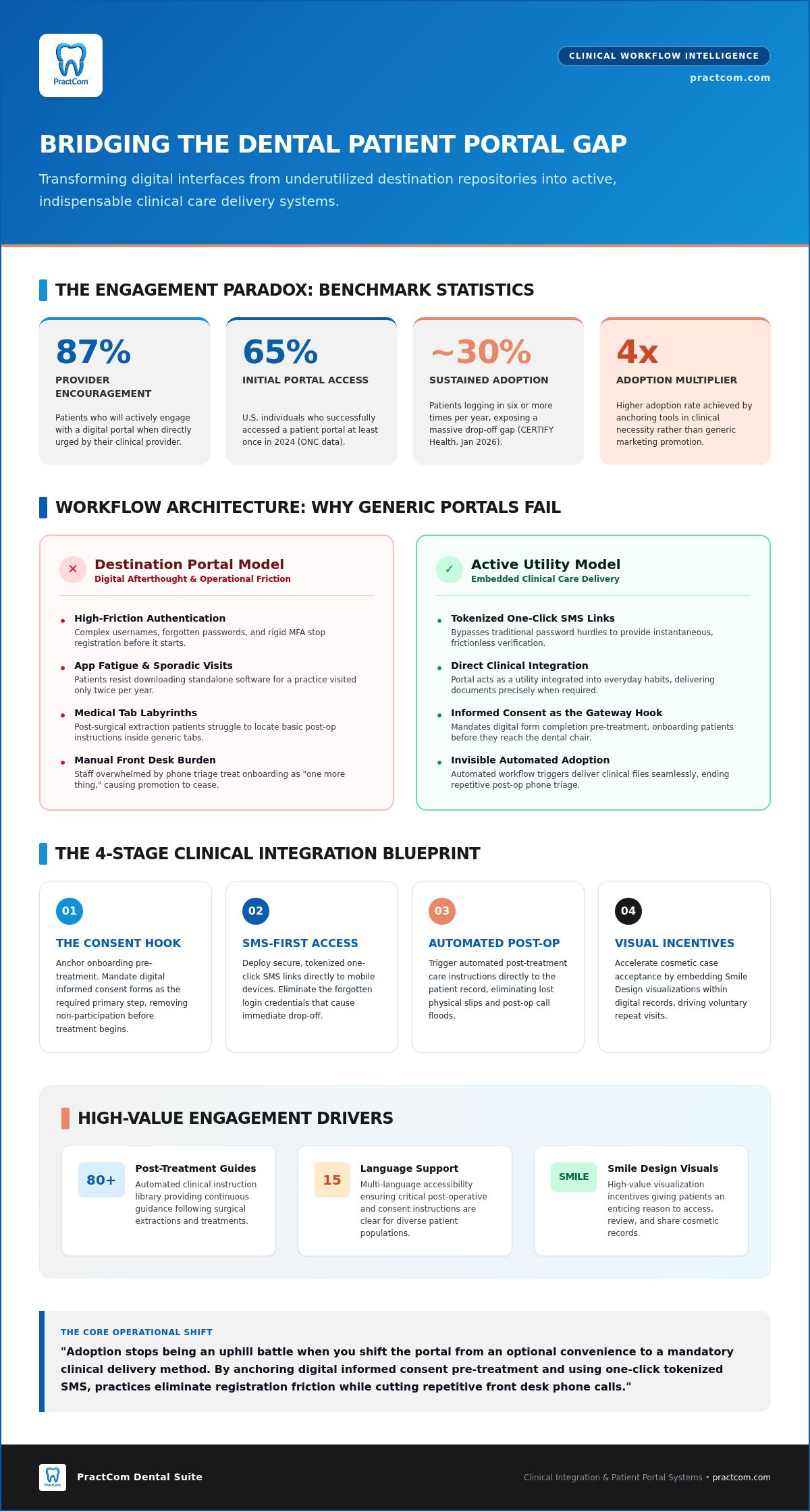
Many dental practices invest heavily in technology only to find their digital interfaces resemble a ghost town. While Patient portals are designed to streamline operations, having the technology does not automatically guarantee user engagement. According to data from the Office of the National Coordinator for Health Information Technology (ONC), 65% of individuals in the U.S. accessed a patient portal in 2024. However, sustained engagement remains low; CERTIFY Health reported in January 2026 that only about 30% of patients log in six or more times per year. This gap highlights a distinct disconnect between software deployment and active user adoption.
The primary barrier preventing consistent utilization is a high-friction login process. Complex usernames, forgotten passwords, and rigid multi-factor authentication steps frequently cause patients to abandon the system before completing registration. Competitors often view adoption merely as a financial performance metric, ignoring the psychological barriers patients face. In reality, a critical mismatch exists between generic portal features and the specific needs of dental patients. A patient recovering from a complex surgical extraction does not want to navigate a labyrinth of medical tabs just to find their post-op care instructions. To bridge this gap, the 2026 dental benchmark for successful portal engagement requires shifting the platform from an optional repository to an active, integrated component of clinical care delivery.
The Friction Factor: Why Patients Abandon Registration
App fatigue presents a significant hurdle for modern dental practices. Patients are increasingly unwilling to download standalone software for a business they may only visit twice a year. When practices introduce complex registration forms, adoption rates plummet. A destination portal relies on the patient remembering to visit a website, which introduces operational resistance. Conversely, a utility portal integrates directly into daily life by delivering immediate value when the patient needs it most. Eliminating traditional login barriers is essential to solving the puzzle of how to get patients to use a patient portal effectively.
Administrative Burnout and the “One More Thing” Problem
Front desk staff are frequently overwhelmed by telephone triage, scheduling adjustments, and insurance verifications. When a portal requires manual onboarding, overextended teams often fail to promote it, viewing it as just one more administrative burden. This lack of promotion directly fuels an increased volume of phone calls for routine post-operative questions, creating a cycle of operational disorganization. To break this cycle, practices must transition to a model of invisible adoption. By utilizing automated triggers within the workflow, the system handles enrollment automatically, removing the promotion burden from your administrative team and ensuring clinical documentation is delivered seamlessly.
Embedding the Portal into the Clinical Workflow
Many practices treat their digital tools as a marketing extra, but clinical necessity drives 4x higher adoption than simple promotion. If you’re wondering how to get patients to use a patient portal, the answer lies in making the technology a mandatory part of the care journey. By shifting the portal from an optional convenience to the primary delivery method for clinical documentation, you remove the choice of non-participation. This workflow-centric approach is the most reliable strategy for how to get patients to use a patient portal without adding manual labor for your front desk.
The ONC’s Patient Engagement Playbook emphasizes that integrating these tools into the standard clinical workflow is the most effective way to ensure staff buy-in and patient uptake. It’s not about selling a feature; it’s about securing the clinical relationship and ensuring data is handled with technical precision. When the portal becomes the exclusive vehicle for essential documents, adoption stops being a goal and starts being a reality.
The Consent Hook: Starting Engagement Pre-Treatment
Registration shouldn’t be a hurdle patients encounter later. It should happen before they even sit in the chair. Sending Digital Dental Informed Consent Forms through the portal creates a natural hook. Patients are motivated to complete these forms to proceed with their treatment, which ensures high registration rates because the action is tied to their immediate health needs. Beyond adoption, digital signatures provide essential legal protection. Every document is time-stamped and stored securely, which mitigates liability and ensures your practice meets 2026 regulatory standards for documentation.
Post-Op Instructions: The Value-Add for Every Procedure
After a procedure, patients often feel overwhelmed and forget verbal instructions. Delivering Automated Dental Post-Op Instructions exclusively through secure digital links provides a high-value reason for them to log in once they’re home. This approach significantly reduces emergency phone calls because patients have 24/7 access to clear, procedure-specific guidance on their mobile devices. It’s a pragmatic way to improve clinical compliance while simultaneously boosting patient satisfaction scores. If you want to see how this looks in a live environment, you can explore a modern dental communication platform that automates these vital touchpoints.
SMS-First Strategies: Meeting Patients Where They Are
Email is failing your portal adoption strategy. While many practices still rely on email-based alerts, the data suggests this channel is no longer effective for immediate clinical action. Research from 2025 indicates that text messages maintain a 98% open rate, while emails struggle to reach 20%. If you’re solving for how to get patients to use a patient portal, you must meet them on the devices they check constantly. By prioritizing SMS, you transform the portal from a hidden repository into an accessible utility.
The most effective method to drive engagement is the “One-Click” access model. This utilizes secure, tokenized SMS links that allow patients to view their specific documents without navigating a traditional login screen. This approach directly solves the password friction identified in earlier sections. To ensure these messages actually reach your patients, 10DLC registration is a professional necessity. This regulatory standard for business texting prevents your links from being flagged as spam by carriers, ensuring high deliverability for critical clinical alerts. From a compliance standpoint, these links must be sent through a secure, encrypted platform to satisfy HIPAA requirements regarding Protected Health Information (PHI). You can secure your practice’s communication by implementing a HIPAA-compliant SMS suite today.
Language Accessibility as an Adoption Driver
Trust is the foundation of clinical compliance. When patients receive complex post-operative instructions in a language they don’t fully master, they’re less likely to engage with the digital tool. Providing documentation in 15 different languages significantly increases portal use within diverse communities. It removes the psychological barrier of misunderstanding and establishes an immediate bond of professional empathy. Automated translation within the portal is far more efficient than manual interpreting, as it ensures the technical precision of the clinical instructions remains intact across every version.
Automated Follow-ups: Keeping the Portal Top-of-Mind
Engagement shouldn’t end when the patient leaves the office. A structured 24-hour post-op follow-up sequence serves as a vital reminder to check the portal for care instructions. These automated wellness checks via SMS drive long-term retention by positioning the portal as a continuous source of support rather than a one-time registration task. PractCom’s automated system functions as the engine for this sequence, triggering messages based on procedure codes to ensure the right information reaches the right patient at the right time. This systematic oversight reduces the administrative burden on your staff while ensuring no patient is left to manage their recovery without guidance.
A 5-Step Staff Implementation Plan for High Adoption
Successful implementation is the bridge between owning technology and actually utilizing it to its full potential. If you’re struggling with how to get patients to use a patient portal, the solution isn’t staff bonuses or vague incentives; it’s a repeatable, granular workflow. You must first audit your current communication touchpoints to identify “Portal Gaps” where information is still shared via vulnerable paper slips or unencrypted emails. Once these gaps are identified, standardize a “Portal Pitch” for both clinical and administrative teams to ensure a unified message. Next, set up automated triggers for every major procedure category. This ensures that when a procedure code is entered, the corresponding clinical documents are sent immediately. Finally, monitor adoption metrics through your Practice Performance Dashboard and iterate based on patient feedback to eliminate any remaining friction points.
The 30-Second Chairside Introduction
Assistants play a vital role in adoption during the transition periods of an appointment. Instead of a vague mention at the front desk, use a benefit-focused script during the “waiting” periods in the chair. A simple prompt works best: “I’ve sent your specific recovery plan and the post-op videos to your phone so you have them the moment you get home. It’s all waiting for you in your secure portal.” This approach answers the question of how to get patients to use a patient portal by positioning the tool as a clinical service rather than an administrative task. For digitally hesitant patients, you can utilize physical document printing as a temporary backup, but always emphasize that the digital version is the primary, most accessible resource for their long-term care.
Leveraging Your Practice Performance Dashboard
Data provides the psychological security needed to manage a modern practice in 2026. Use your Practice Performance Dashboard to pinpoint which specific procedures have the lowest engagement rates. If your hygiene patients are logging in at high rates but your surgical patients are not, you have a specific workflow breakdown to address. Identifying “Super-Users” among your staff allows for peer-led training, which is often more effective than top-down mandates. Additionally, refining your referral management tracking through the portal interface ensures that no patient data is lost during transitions of care. This systematic oversight reduces operational resistance and guarantees that your documentation meets all regulatory standards. To see these metrics in action, you can optimize your practice workflow with a specialized dental communication suite.
Scaling Engagement with PractCom’s Specialized Dental Suite
Sustaining high engagement requires moving beyond initial registration to providing continuous value. If your portal contains only a single consent form, patients have no reason to return after their first visit. PractCom functions as the essential communication layer on top of your existing Practice Management System (PMS), transforming the portal into a high-utility hub. By offering a comprehensive library of 80+ post-treatment templates available in 15 languages, the platform ensures that every procedure, from a simple cleaning to complex implant surgery, is supported by procedure-specific digital resources. This variety directly addresses the challenge of how to get patients to use a patient portal by ensuring the tool remains relevant throughout the entire lifecycle of their care.
The transition from a “ghost town” to a high-engagement hub happens when the portal provides information that patients actually want to see. While clinical necessity drives the first login, specialized dental tools provide the incentive for long-term retention. By integrating these high-value features, you move from administrative resistance to a standardized system that protects your reputation and improves clinical compliance.
Smile Design: The Visual Adoption Hook
Cosmetic patients are driven by visual outcomes. The “Smile Design” tool allows patients to view “Before and After” cosmetic changes directly within their secure account. This creates a powerful psychological hook; patients don’t just log in to read instructions, they log in to see their future results. Because these visualizations are hosted within the portal, it encourages patients to share their potential transformations with family and friends, naturally increasing the frequency of logins. This visual approach is a cornerstone of The Dental Patient Experience, as it builds trust through transparency and visualization rather than just text-based communication.
Referral Management: Closing the Loop
Referral leakage is a significant operational failure in many practices. When patients are handed a paper slip for a specialist, the information is often lost or forgotten, leading to a break in the care cycle. PractCom’s Referral Management System prevents this by hosting specialist information, maps, and specific referral instructions within the portal. Patients can track their referral status and access the necessary documentation from their mobile devices at any time. This systematic oversight ensures that patients stay on track with their treatment plans while allowing your practice to monitor the status of every outbound referral. If you’re wondering how to get patients to use a patient portal for long-term clinical success, closing the loop on specialty care is essential. Ready to transform your patient communication? Start your free trial today.
Securing Your Practice Reputation Through Digital Excellence
Transitioning from administrative disorganization to a standardized system is no longer a luxury; it’s a professional necessity. You’ve learned that the secret of how to get patients to use a patient portal lies in embedding the tool into your clinical touchpoints and prioritizing SMS delivery over failing email strategies. By removing login friction and automating your follow-up sequences, you protect your team from burnout while ensuring every patient receives technical precision in their care instructions.
Scaling this engagement requires a high-utility environment that offers continuous value. Whether you are utilizing the 80+ clinical post-op templates, supporting your community with multi-language documentation in 15 languages, or driving cosmetic acceptance with the Smile Design visualization tool, your portal must serve as a guardian of the patient experience. Moving to a standardized communication suite provides the psychological security your practice needs to thrive in 2026. Automate your patient engagement with PractCom; Start Here. You have the tools to turn your digital hub into a stabilizing force for your entire clinical workflow.
Frequently Asked Questions
What is the average patient portal adoption rate for dental practices in 2026?
In 2026, benchmarks for patient portal adoption continue to rise. Data from the ONC in 2024 showed that 65% of individuals in the U.S. were offered and accessed their portal. While adoption is high, sustained engagement is the current industry challenge. Practices that integrate these tools into clinical workflows see much higher retention than those treating them as optional marketing features. This shift ensures the portal remains a high-utility hub for every patient visit.
How do I get older patients to use a digital patient portal?
Engaging older demographics requires focusing on the pragmatic benefits of digital tools rather than the technology itself. You can overcome resistance by highlighting how the portal prevents the loss of paper referral slips or instructions. Since many seniors prefer physical copies, using a system that allows for physical document printing alongside digital access ensures they feel supported. Clear, simplified language and multi-language support in 15 languages also bridge the accessibility gap.
Does using a patient portal actually reduce phone calls for my front desk?
Yes, an active portal significantly reduces administrative overhead. Practices with high engagement report 20 to 30% lower no-show rates and a substantial decrease in post-operative inquiries. By delivering procedure-specific guidance through an automated follow-up sequence, you provide patients with immediate answers. This prevents the ghost town effect and stops your front desk from becoming a manual triage center for routine questions that a secure digital library easily handles.
Are patient portals HIPAA compliant for sharing post-op instructions?
Patient portals are designed specifically to meet HIPAA and 21st Century Cures Act requirements for secure data access. Standard email and SMS are not compliant for sending Protected Health Information (PHI). However, using a secure portal to host your post-treatment instruction library ensures that sensitive clinical data is encrypted and audit-logged. This provides the psychological security practitioners need regarding documentation and compliance in a high-pressure regulatory environment.
Can I send portal login links via text message (SMS)?
You can send portal access links via SMS, provided you use a secure, encrypted platform. Modern strategies for how to get patients to use a patient portal rely on tokenized links that bypass traditional password friction. To ensure deliverability in 2026, your practice must use 10DLC registered numbers. This professional standard prevents carriers from flagging your clinical alerts as spam, ensuring patients receive their documentation without operational resistance.
What features do patients value most in a dental patient portal?
Patients value convenience and visual clarity above all else. High-engagement features include the ability to view Smile Design visualizations for cosmetic changes and accessing post-op instructions in their native language. PractCom’s support for 15 languages and a library of 80+ templates provides the continuous value patients expect. By offering these high-value incentives, you transform the portal from a static repository into a high-engagement hub that improves overall patient satisfaction scores.
How does a portal help with dental malpractice and risk management?
Digital portals function as a guardian of your practice’s legal standing. By using digital informed consent forms with time-stamped signatures, you create an immutable record of patient agreement. This standardized system reduces the risk of human memory failures and documentation gaps that often lead to liability issues. Having all clinical instructions and follow-up wellness checks documented within a secure communication suite provides a robust defense in any risk management audit.
Do I need a full PMS to have an effective patient portal?
You don’t need to replace your entire Practice Management Software (PMS) to implement a high-engagement portal. PractCom is designed as a specialized communication layer that integrates into your existing clinical workflow. It focuses on documentation, consent, and patient engagement rather than billing or scheduling. This allows you to solve how to get patients to use a patient portal without the high cost and disruption of a full software overhaul.

Article by
Cary Ganz DDS
Dr. Cary H. Ganz is a dentist, prosthodontist, entrepreneur, lecturer, and author with more than 50 years of experience in clinical dentistry and dental technology. Throughout his career, he has combined hands-on patient care with a deep understanding of how technology can improve dental practice operations, communication, documentation, and patient outcomes.
In addition to his clinical background, Dr. Ganz has held significant leadership roles in the dental technology industry, including Past Owner and Vice President of Clinical Affairs at DEXIS Digital Radiography and Past Vice President of Clinical Affairs at Denticon Practice Management Software. His business experience includes product development, clinical strategy, dental software innovation, practice management solutions, and educating dental professionals on the effective use of technology in modern dentistry.
Today, Dr. Ganz continues to focus on creating practical technology solutions for dental practices, including PractCom, a comprehensive dental practice communication platform designed to improve patient communication, documentation, compliance support, referrals, and overall practice efficiency. His work reflects a career-long commitment to helping dentists deliver better care while making their practices more organized, efficient, and protected.
No responses yet