
The “paperless office” is a persistent myth that might actually be compromising your practice’s legal security. While digital transformation is essential, the reality of clinical operations often requires the tactile reliability of physical documentation. You likely feel the daily friction of manual data entry errors and the nagging worry that your current printable dental patient forms don’t meet the mandatory February 2026 HIPAA Notice of Privacy Practices updates. It’s a high-pressure environment where one illegible signature or an outdated consent form can lead to significant liability.
We understand that your documentation is more than just paperwork; it is the guardian of your professional reputation. This guide provides a definitive roadmap for modernizing your workflow through a sophisticated hybrid approach. You’ll discover how to standardize your intake process, bridge language gaps with multi-language support, and ensure your digital assets meet the 2026 WCAG accessibility standards. We’ll explore the essential templates every modern practice needs and show how a seamless transition between paper and digital records creates a fail-safe ecosystem that protects your patients and your peace of mind.
Key Takeaways
- Understand why physical documentation remains a critical backup and accessibility tool in a digital-first 2026 environment.
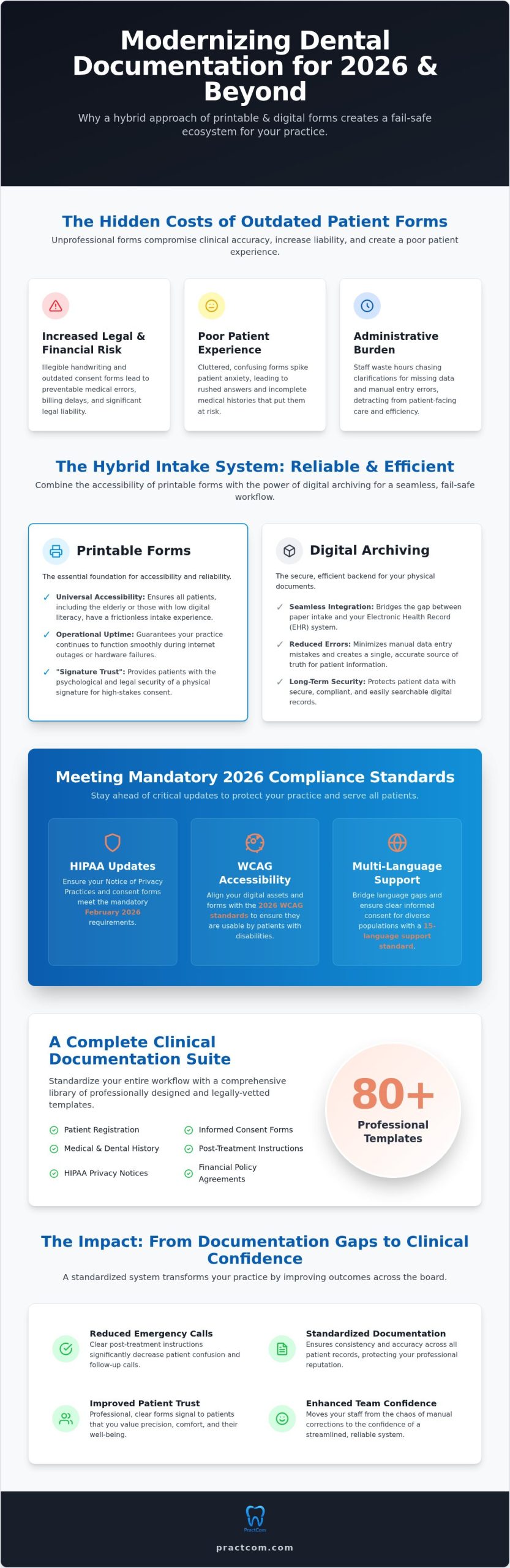
- Learn to implement a hybrid intake system that utilizes printable dental patient forms for immediate accessibility while maintaining seamless digital archiving.
- Identify the specific 2026 HIPAA and WCAG updates required to keep your patient records legally compliant and accessible to all.
- Discover how a 15-language support standard reduces administrative friction and ensures clear informed consent for diverse patient populations.
- Explore how a library of 80+ professional templates can standardize your clinical documentation and significantly reduce post-treatment emergency calls.
The Evolution of Printable Dental Patient Forms in 2026
The clinical environment in 2026 demands a sophisticated blend of digital speed and physical reliability. While the industry has pushed toward the Electronic Health Record (EHR) as the primary source of truth, the physical intake process remains a critical operational touchpoint. Professional printable dental patient forms aren’t just relics; they serve as a bridge for patients who find digital interfaces intimidating or inaccessible. By treating these documents as a strategic clinical tool rather than a legacy burden, you create a fail-safe documentation ecosystem that protects your practice from data gaps and technical failures. Moving beyond the generic PDF to brand-aligned documentation signals to your patients that you value technical precision as much as their comfort.
Why Practices Still Rely on Physical Documentation
Modern clinical workflows must accommodate every patient, regardless of their technological proficiency. Relying solely on tablets or kiosks can alienate elderly patients or those with limited digital literacy, creating immediate friction during the first five minutes of their visit. Physical forms provide a universal interface that ensures no patient is left behind. It’s about providing administrative warmth in a high-pressure setting where first impressions dictate patient retention.
The reliability factor is equally paramount. Internet outages or hardware malfunctions shouldn’t bring a digital-only practice to a standstill. Having a standardized set of printable dental patient forms ensures your clinical flow continues uninterrupted during technical downtime. Many patients also experience “Signature Trust.” For high-stakes procedures and informed consent, the act of applying physical ink to paper often carries more psychological weight, providing a greater sense of legal and personal security than a digital stylus on a glass screen.
The Cost of Poorly Designed Patient Forms
A cluttered or unprofessional form does more than just look bad; it actively compromises your clinical accuracy. Illegible handwriting remains a leading cause of preventable medical errors and administrative billing delays, often requiring your front-desk team to spend hours chasing clarifications. When a layout is disorganized or the font is too small, patient anxiety spikes, leading to rushed answers and incomplete medical histories that put your practice at risk.
The ‘Documentation Gap’ is the space between clinical intent and patient understanding. By closing this gap with clear, professional design, you ensure that every data point captured is accurate, compliant, and useful for the long-term health of the patient. High-quality forms reduce the mental load on your staff and provide a stabilizing force in the office, moving your team from the chaos of manual corrections to the confidence of a standardized system.
Essential Form Categories for Modern Dental Practices
A complete set of printable dental patient forms provides the structural integrity your practice needs. It isn’t just about collecting a name and address; it’s about building a comprehensive clinical profile that meets the HIPAA Privacy Rule standards. Every document in your clipboard or portal acts as a layer of defense, ensuring that Protected Health Information (PHI) is handled with the technical precision required by federal law. Moving beyond generic templates allows you to capture specific data that informs better clinical outcomes and protects your reputation.
Registration and Medical History Fundamentals
Capturing demographic data is the easy part. The real value lies in a robust medical and dental history. In 2026, your forms should identify systemic health factors, such as cardiovascular issues or diabetes, that directly impact periodontal health and surgical recovery. Standardizing these forms allows your team to identify past dental trauma or specific phobias before the patient even sits in the chair. This proactive approach reduces chairside anxiety and improves the overall patient experience by creating a bond of shared professional experience. Learn more about PractCom’s clinical documentation suite to see how standardized templates can transform your intake.
Informed Consent and Liability Protection
There’s a vital distinction between a patient giving “permission” and providing “informed consent.” A generic waiver is often insufficient in a legal setting because it fails to document the specific transfer of risk. Professional documentation must clearly outline the procedure details, potential complications, and alternative treatments. Using procedure-specific consent forms ensures that the patient acknowledges the unique risks of an extraction versus a root canal. This level of technical precision creates psychological security for both the practitioner and the patient. For deeper insights into the digital side of this process, see our guide on Digital Dental Informed Consent Forms: The 2026 Guide to Clinical Compliance.
Post-treatment instructions are the most overlooked “form” in the dental office, yet they are essential for preventing unnecessary emergency calls. When patients leave with clear, physical documentation of aftercare, they feel supported and less likely to panic over normal post-op symptoms like minor swelling or sensitivity. This reduces the administrative load on your staff, as it preempts the “is this normal?” phone calls that disrupt the clinical schedule. It reinforces your role as a protective guardian of their health during the critical recovery window. You can easily browse our library of 80+ post-treatment templates to find the right fit for your specialty.
Digital vs. Printable Forms: Building a Hybrid Patient Intake System
Many consultants argue for a 100% paperless office, but this often ignores the logistical realities of a busy clinic. A hybrid system recognizes that while digital tools offer speed, printable dental patient forms provide an essential fallback and accessibility layer. This approach balances the efficiency of automated systems with the tactile reliability required for certain patient demographics. By mapping your workflow from the physical clipboard to digital archiving, you can implement strategies to reduce “double entry.” Modern scanning and indexing allow you to move data from paper to your digital records efficiently, ensuring your team doesn’t waste time on repetitive manual tasks.
When to Use Printable Forms
Paper remains the gold standard for specific clinical scenarios where immediate accessibility is paramount. High-volume clinics often find that handing a clipboard to a new patient is faster than troubleshooting a tablet’s Wi-Fi connection or battery life. For senior patients who may struggle with small touchscreens or complex interfaces, physical forms provide a familiar, low-stress interface. This administrative warmth helps build an immediate bond of shared professional experience. Additionally, printable forms are indispensable for:
- Specialist referrals where physical records must travel with the patient for immediate review.
- Off-site consultations or community health events where internet access is unreliable.
- Post-operative instructions that serve as a physical reminder on a patient’s refrigerator, significantly reducing the likelihood of forgotten aftercare steps.
When to Transition to Digital
Digital forms shine when it comes to post-intake management and remote authorizations. Transitioning data to a digital format allows for automated follow-ups and reminders, ensuring that patients stay engaged with their treatment plan without increasing your staff’s manual workload. Digital consent is particularly effective for pre-treatment authorizations, allowing patients to review and sign documents from the comfort of home before their appointment. This reduces chairside administrative time and allows the clinical team to focus entirely on the procedure. To see how these systems stack up against legacy workflows, you can compare PractCom to traditional communication methods.
Finding the right balance between environmental impact and clinical necessity is a hallmark of a mature practice. While reducing paper waste is a noble goal, it shouldn’t come at the expense of patient safety or documentation accuracy. Using printable dental patient forms strategically allows you to maintain a high standard of care while leveraging digital tools for the heavy lifting of data management and long-term storage. This hybrid ecosystem ensures that no part of the professional communication process is left to chance, providing the psychological security your team needs to perform at their best.
Ensuring Compliance and Multi-Language Accessibility
Compliance isn’t a static checkbox; it’s a dynamic responsibility that requires constant vigilance. By February 16, 2026, all HIPAA-covered dental practices must update their Notice of Privacy Practices to include specific language regarding the use and disclosure of Substance Use Disorder (SUD) records. This regulatory shift means your printable dental patient forms must reflect these changes to avoid the average $100,000 fine associated with outdated risk assessments. Maintaining this level of technical precision ensures your practice remains a stabilizing force, protecting both your patients’ privacy and your professional reputation.
Securing Physical Patient Information
A printed form is a physical asset that requires rigorous oversight to prevent accidental data breaches. Implementing a “Clean Desk” policy at the front office ensures that Protected Health Information (PHI) isn’t visible to other patients or unauthorized visitors during the busy intake process. Once information is digitized, physical records should be destroyed using cross-cut shredding to maintain the highest security standards. Maintaining strict version control for your clinical forms is a legal necessity to prove that your practice was using the most current regulatory language at the exact time of treatment.
Overcoming Language Barriers in Documentation
In 2026, providing forms only in English and Spanish is no longer sufficient for a modern, inclusive practice. Linguistic diversity in the United States has expanded significantly, and failing to provide documentation in a patient’s native tongue can compromise informed consent and clinical safety. When instructions lose nuance in translation, the risk of post-operative complications and patient anxiety increases. PractCom bridges this communication gap by delivering instructions and consent forms in 15 different languages, ensuring every patient understands their care plan with total clarity.
Standardizing your documentation across multiple languages protects your practice from liability while improving patient compliance. This level of technical precision ensures that a patient receives the same high-quality clinical guidance regardless of their primary language. You can explore how these shifts are shaping the industry in our guide on The Future of Dental Patient Communication Technology: 2026 Trends. If you’re ready to modernize your compliance strategy and reach a more diverse patient base, access our multi-language template library today.
Streamlining Documentation with PractCom’s Communication Suite
PractCom functions as the essential bridge between traditional printable dental patient forms and the requirements of a modern digital workflow. While many platforms force a binary choice between paper and screen, our suite prioritizes a ‘One-Click Print’ workflow for practices that value the tactile reliability of physical documentation. This system ensures that your administrative team can produce professional, compliant forms in seconds, maintaining technical precision without sacrificing the warmth of a traditional intake process. By accessing a library of over 80 post-treatment templates, you eliminate the operational resistance of creating documents from scratch, ensuring every specialty in your office follows a standardized protocol.
From Printable Instructions to Automated Follow-ups
The true power of a hybrid system lies in its ability to link physical touchpoints with digital automation. When you provide a patient with a printed instruction sheet, the system can simultaneously trigger an automated SMS follow-up to check on their recovery progress. This dual-layered approach reduces patient anxiety by providing peer-reviewed aftercare instructions they can hold, while the digital reminder ensures they don’t feel abandoned once they leave the chair. This systematic control over the post-operative window significantly reduces the volume of non-emergency calls, allowing your clinical staff to focus on high-value procedures. You can start your free trial of PractCom’s documentation tools to experience this seamless integration firsthand.
Scaling for DSOs and Multi-Location Practices
For Dental Support Organizations (DSOs) and multi-location practices, maintaining documentation consistency is a major operational hurdle. Disparate offices often use varied versions of printable dental patient forms, which creates legal vulnerabilities and administrative clutter. PractCom offers a centralized solution where every location utilizes the same standardized, compliant templates, protecting the brand’s reputation across the entire network. Centralized performance dashboards allow leadership to track form completion rates and patient engagement levels in real-time, moving the organization from guesswork to data-driven oversight. Explore our PractCom solutions for DSOs to see how we help large-scale operations maintain clinical excellence at every chair.
Integrating referral management and patient follow-ups directly into the form process transforms your documentation from a passive record into an active communication tool. It ensures that no part of the referral loop is left to chance, providing the psychological security that your patients are being tracked and cared for at every stage of their journey. This comprehensive ecosystem doesn’t just manage forms; it functions as a guardian of your practice’s legal standing and professional integrity.
Standardizing Your Practice for a Compliant Future
Refining your documentation strategy is a vital step toward protecting your practice’s legal standing and improving the patient experience. A hybrid approach to printable dental patient forms provides the tactile reliability needed for diverse populations while leveraging digital automation for long-term efficiency. By implementing standardized, peer-reviewed templates and meeting the 15-language standard, you ensure every clinical instruction is delivered with technical precision. This systematic control doesn’t just reduce administrative friction; it acts as a guardian of your professional reputation in a high-pressure environment.
PractCom is ready to serve as your reliable professional ally. Our platform features a library of 80+ clinical templates and 15-language support, all designed by dental professionals specifically for clinicians. It’s time to move from the stress of manual tasks to the confidence of a standardized system. Modernize your practice documentation with PractCom and start your journey toward a more organized, compliant, and patient-centered clinical workflow today.
Frequently Asked Questions
Are printable dental forms still HIPAA compliant in 2026?
Physical printable dental patient forms remain fully HIPAA compliant as long as they adhere to the latest regulatory updates. The February 16, 2026, deadline requires specific language regarding the disclosure of Substance Use Disorder records. You must ensure your printed Notice of Privacy Practices is updated and available for patient review in the office. Secure storage and proper shredding protocols are also essential to maintain compliance for all physical Protected Health Information.
What are the most important forms for a new dental patient?
A comprehensive new patient intake requires several foundational documents to ensure clinical safety and legal protection. These include:
- Patient Registration and Demographic Data
- Comprehensive Medical and Dental History
- HIPAA Notice of Privacy Practices acknowledgment
- General Consent for Treatment
- Financial and Cancellation Policies
Capturing these data points accurately allows your team to identify systemic health factors and past dental trauma before treatment begins.
How can I translate my dental patient forms into multiple languages?
Professional translation is necessary to ensure clinical instructions don’t lose nuance. PractCom simplifies this process by providing a library of documents available in 15 different languages. This multi-language support bridges the communication gap for diverse patient populations, ensuring informed consent is truly informed. Using a standardized system for translations protects your practice from the liability of inaccurate or confusing instructions that often occur with generic online translation tools.
Is it better to have patients sign consent forms on paper or digitally?
The choice between paper and digital depends on your specific clinical workflow and patient demographic. Digital signatures offer speed and ease of archiving, making them ideal for remote authorizations. However, many patients feel a greater sense of “Signature Trust” with physical ink for high-stakes procedures. A hybrid system allows you to offer both, ensuring accessibility for tech-resistant patients while maintaining the efficiency of a digital-first documentation ecosystem.
Can I print post-op instructions directly from PractCom?
Yes, PractCom features integrated physical document printing capabilities designed for clinicians who value the reliability of paper. You can select from over 80 post-treatment templates and print them with a single click. This allows you to hand the patient a physical “take-home” value add that reinforces their aftercare. Providing these printable dental patient forms at the chairside significantly reduces patient anxiety and preempts common post-operative questions that disrupt your schedule.
What should be included in a dental surgical consent form?
A robust surgical consent form must document the specific transfer of risk to ensure legal protection. It should include the procedure name, a clear description of potential complications, and a list of alternative treatments. The form must also feature a section for the patient to acknowledge they have had their questions answered. This technical precision creates psychological security for the practitioner, as it proves a comprehensive discussion occurred before the surgical intervention.
How do I manage physical dental records in a paperless office?
Managing physical records in a paperless office requires a systematic scanning and archiving workflow. Once you collect physical printable dental patient forms, scan them into your digital records immediately to maintain a single source of truth. After verification, shred the physical copies using cross-cut shredding to prevent data breaches. This hybrid approach ensures you capture the benefits of tactile documentation without the operational disorganization of physical filing systems.
Why should I use procedure-specific post-op forms instead of generic ones?
Procedure-specific forms are superior because they provide granular details that generic waivers often miss. A patient recovering from a root canal needs different guidance than one who received a dental implant. Using a specialized library of 80+ templates ensures that aftercare is precise and relevant to the specific clinical outcome. This level of detail reduces emergency calls and improves recovery times by closing the gap between clinical intent and patient understanding.

Article by
Cary Ganz DDS
Dr. Cary H. Ganz is a dentist, prosthodontist, entrepreneur, lecturer, and author with more than 50 years of experience in clinical dentistry and dental technology. Throughout his career, he has combined hands-on patient care with a deep understanding of how technology can improve dental practice operations, communication, documentation, and patient outcomes.
In addition to his clinical background, Dr. Ganz has held significant leadership roles in the dental technology industry, including Past Owner and Vice President of Clinical Affairs at DEXIS Digital Radiography and Past Vice President of Clinical Affairs at Denticon Practice Management Software. His business experience includes product development, clinical strategy, dental software innovation, practice management solutions, and educating dental professionals on the effective use of technology in modern dentistry.
Today, Dr. Ganz continues to focus on creating practical technology solutions for dental practices, including PractCom, a comprehensive dental practice communication platform designed to improve patient communication, documentation, compliance support, referrals, and overall practice efficiency. His work reflects a career-long commitment to helping dentists deliver better care while making their practices more organized, efficient, and protected.
No responses yet