
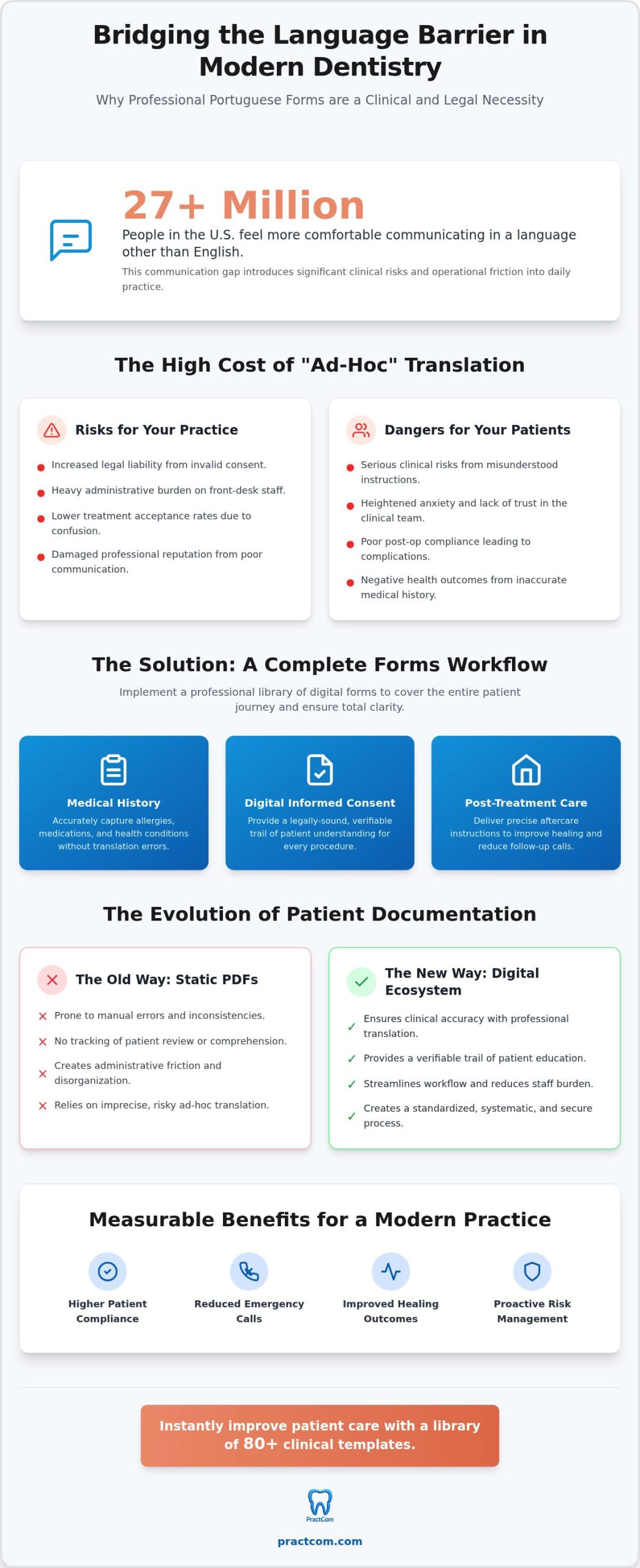
More than 27 million people in the United States currently feel more comfortable communicating in a language other than English. If your practice operates in a diverse community, you’ve likely experienced the stress of a patient nodding in agreement while their eyes reflect total confusion. It’s a significant clinical risk. Relying on hand gestures or imprecise, manual translations isn’t just a daily headache; it’s a liability. Implementing professional dental office forms in Portuguese is the most direct way to bridge this gap, ensuring your clinical expertise is understood and your practice remains protected.
You deserve the psychological security of knowing your informed consent is legally sound and your post-op instructions are actually followed. This guide will show you how to implement a standardized system for Portuguese dental forms to reduce the high volume of confused follow-up calls and protect your professional reputation. We’ll explore how modernizing your documentation transforms a language barrier into a streamlined clinical workflow. This transition creates higher patient satisfaction scores and removes the heavy administrative burden from your front-desk staff, moving your practice from operational disorganization to systematic control.
Key Takeaways
- Understand why professional translation is a critical risk management requirement that protects your practice from the legal and clinical dangers of inaccurate, “ad-hoc” translation methods.
- Identify the essential dental office forms in Portuguese required for a safe clinical workflow, including comprehensive medical history and digital informed consent templates.
- Learn how to replace static PDFs with a digital ecosystem to eliminate operational friction and reduce the daily administrative burden on your front-desk staff.
- Discover actionable strategies for training your team to seamlessly integrate multilingual documentation into your existing patient intake and follow-up processes.
- Explore how a standardized library of 80+ clinical templates can immediately improve patient compliance and provide the psychological security of a professional, systematic workflow.
The Strategic Importance of Dental Office Forms in Portuguese
Modern US dental practices serve an increasingly diverse patient base. Providing professional dental office forms in Portuguese is no longer a niche service; it’s a strategic necessity for growth and risk management. When you eliminate the language barrier, you transition your practice from operational disorganization to systematic control. Ad-hoc translation tools often fail to capture specific clinical nuances. A mistranslated post-operative instruction regarding blood clots or medication schedules can lead to serious complications. Professional forms ensure your clinical expertise is accurately conveyed, building immediate trust with the Lusophone community.
Bridging the Communication Gap in Clinical Settings
Patient anxiety often peaks when they cannot fully grasp the details of a procedure. Explaining a complex surgery or restorative plan in a patient’s primary language provides immediate psychological security. This clarity directly impacts your treatment acceptance rates. People don’t agree to procedures they don’t understand. By moving beyond a “check the box” mentality, you foster genuine patient understanding. Clear communication leads to several measurable benefits:
- Higher patient compliance with home-care instructions.
- Reduced volume of post-operative emergency calls.
- Increased confidence in the clinical team’s recommendations.
- Improved healing outcomes through precise adherence to protocols.
This organized approach ensures that your message remains consistent across every patient interaction. It removes the friction of manual explanations and allows your clinical staff to focus on care rather than translation.
Regulatory Reassurance: Documentation as a Legal Shield
Informed consent is a non-negotiable legal cornerstone of modern dentistry. Providing these documents in a language the patient understands is a critical part of a proactive risk management strategy. Standardized dental office forms in Portuguese act as a professional shield, protecting your practice against malpractice claims rooted in a “failure to inform.” In a high-pressure clinical environment, you cannot rely on the limitations of human memory or a relative’s informal translation. Professional documentation ensures you meet professional standards for inclusive care while safeguarding your reputation. This systematic oversight replaces the stress of potential non-compliance with the confidence of a standardized, legally-sound workflow. It positions your brand as a guardian of patient safety and professional integrity.
Essential Portuguese Dental Forms for Your Clinical Workflow
A high-functioning practice relies on precision at every touchpoint. While many offices focus on basic intake, a comprehensive suite of dental office forms in Portuguese covers the entire patient journey. This includes medical history updates, referral slips, and specific restorative consents. Capturing accurate medical data is the first line of defense. If a patient cannot clearly communicate their allergies or current medications due to a language barrier, the clinical risk increases exponentially. Using professionally translated forms ensures that patients with Limited English Proficiency (LEP) provide the same level of granular detail as English-speaking patients.
Digital Informed Consent: More Than Just a Signature
Consent is a process, not a piece of paper. For complex procedures like third molar extractions or implant placement, the documentation must translate intricate clinical risks into accessible language. Digital systems allow you to track when a patient opened the form and how long they spent reviewing it. This provides a verifiable trail of education. Routine restorative consents for fillings or crowns require different language than surgical forms. Having a standardized library ensures your staff doesn’t have to guess which version to provide. This level of systematic oversight protects your license and your patient’s health.
The Post-Treatment Library: Managing Aftercare Effectively
Post-treatment instructions are often the most underutilized tool for driving patient satisfaction. When a patient leaves the chair, they are frequently numb, tired, and overwhelmed. Handing them a generic English flyer or relying on oral instructions is a recipe for a late-night emergency call. A robust library of dental office forms in Portuguese should include specific guides for:
- Post-extraction care and blood clot maintenance.
- Endodontic recovery and pain management.
- Implant hygiene and loading protocols.
- Scaling and root planing (SRP) aftercare.
Pre-empting common questions through translated guides significantly reduces administrative friction. Automated delivery via text or email ensures the patient actually receives the information on their mobile device. If you want to see how a pre-translated clinical library can transform your workflow, start by evaluating your current post-op protocols. Standardizing referral slips is equally vital. It ensures that specialists receive clear clinical context in a format they can easily interpret, maintaining the continuity of care across different offices.
Static PDFs vs. Digital Communication Systems
There’s a fundamental flaw in how most practices handle multilingual documentation: they treat a PDF as a solution. It isn’t. A static file sitting in a shared drive, printed on demand, and handed to a patient at the front desk is simply a paper problem wearing a digital costume. The operational friction it creates is real, measurable, and entirely avoidable.
Operational Resistance: The Hidden Cost of Paper
Every time a staff member hunts for the correct Portuguese version of a form, prints it, explains its contents to a patient who still has questions, and then files the completed copy, your practice absorbs a cost. That cost isn’t just measured in minutes. It’s measured in the cognitive load placed on a front-desk team already managing phone calls, insurance verifications, and appointment scheduling simultaneously. Physical documents also disappear. They get misfiled, left in operatories, or simply lost in the shuffle of a high-volume day. A missing consent form isn’t just an administrative inconvenience; it’s a liability gap. Storage and retrieval of paper-based records in a second language adds another layer of complexity, particularly when a clinical note needs to be cross-referenced quickly during a patient call.
The Digital Advantage: Speed, Accuracy, and Tracking
Digital delivery fundamentally changes the equation. The moment a patient leaves the chair, automated systems can push the relevant dental office forms in Portuguese directly to their mobile device via SMS or email. No printing. No staff intervention. No guessing which version to use. The patient receives a mobile-friendly interface they can review on their own time, in their preferred language, at their own pace. That shift alone removes a significant point of operational resistance.
Tracking capability is where digital systems create a genuine clinical advantage over static alternatives. With digital consent and instruction delivery, you can verify that a patient received their post-operative guide, opened it, and had adequate time to review it. That audit trail is something no printed PDF can replicate. Automated follow-ups extend this further, functioning as a built-in guardian of the patient’s recovery process by checking in at clinically appropriate intervals without requiring a single manual task from your team.
The cost-benefit case is straightforward. Reducing staff time spent on form management, eliminating reprinting costs, and cutting the volume of confused follow-up calls all represent measurable returns. Platforms like PractCom are built specifically for this workflow, delivering automated multilingual follow-ups and email or text delivery of documents across 15 languages, including Portuguese. That’s systematic control replacing operational disorganization, one automated touchpoint at a time.
Implementing Multilingual Patient Documentation: Best Practices
Transitioning from a reactive approach to a proactive documentation strategy requires more than just a folder of translated files; it demands a structured protocol. Successful implementation begins with a thorough audit of your current library to identify gaps in clinical accuracy. Many practices discover that while they have basic intake paperwork, they lack specialized dental office forms in Portuguese for high-risk procedures or complex aftercare. Filling these gaps ensures that every patient receives a consistent standard of care, regardless of their primary language. This systematic oversight replaces the stress of “making do” with the confidence of a professional, standardized system.
Your front-desk team acts as the first line of defense against communication failures. Training staff to identify when a patient would benefit from non-English documentation is essential. This shouldn’t be a cumbersome manual task. Instead, integrate a language preference field into your initial intake process. When a patient is tagged for Portuguese, the system should automatically prepare the relevant documents. Security remains paramount during this digital transition. With 93% of patients now opting in to receive text messages from healthcare providers, according to 2026 industry data, your delivery methods must be secure. Ensure your platform uses encrypted channels to maintain HIPAA compliance, especially following the February 16, 2026, deadline for updated Notice of Privacy Practices regarding SUD records.
Ensuring Technical and Clinical Accuracy
Clinical translation is a specialized field that generic linguistic services often misunderstand. In a dental setting, using simplified language for patient-facing terms is more effective than literal technical translations. For example, a patient needs to understand the practical implications of “pulpitis” or “alveolitis” in their native tongue. Professional dental office forms in Portuguese bridge the gap between complex professional procedures and general understanding. Regularly updating this library is a professional necessity to reflect evolving clinical standards and regulatory requirements, acting as a guardian of your practice’s reputation.
Frictionless Integration with Clinical Workflows
The most efficient way to manage multilingual communication is through automated triggers tied to your procedure codes. When a clinician completes a root canal or an extraction, the system should instantly push the corresponding Portuguese instructions to the patient’s mobile device. This level of automation removes the resistance of manual tasks and ensures that nothing is left to chance. Centralizing these documents within a patient portal allows for easy retrieval and oversight. You can link these interactions to your practice performance dashboard to monitor engagement and compliance rates across your entire patient base. To see these best practices in action, you can start your professional documentation journey today and eliminate operational friction for good.
Optimizing Portuguese Patient Care with PractCom
Transitioning to a multilingual practice model shouldn’t feel like adding another layer of administrative complexity. PractCom functions as an all-in-one ecosystem designed to absorb the operational stresses of patient communication. While generic form builders leave the heavy lifting of translation and clinical formatting to your staff, PractCom provides a specialized library of 80+ pre-translated templates. This includes professional dental office forms in Portuguese that are ready for immediate deployment. By providing a standardized system for every procedure, you move your practice from a state of constant administrative friction to one of systematic control.
Positioning your practice as a leader in inclusive, tech-forward care requires more than just translated intake paperwork. It requires a commitment to the entire patient journey. PractCom extends your clinical reach by automating follow-ups and referral management in 15 different languages. This ensures that your Lusophone patients receive the same high-utility guidance as your English-speaking base, fostering a deep sense of trust and professional reliability. This isn’t just about convenience; it’s about establishing your brand as a guardian of patient safety and health equity.
The PractCom Advantage for High-Pressure Clinics
In a modern clinical environment, time is your most valuable asset. Reducing operational resistance through one-click digital delivery allows your team to focus on high-value tasks rather than document management. Our Digital Informed Consent Forms provide the psychological security you need by protecting your practice’s legal standing with verifiable tracking and time-stamped reviews. For those focusing on aesthetic growth, integrating smile design tools into your workflow enhances communication for cosmetic procedures. Showing patients their projected results in a language they fully understand significantly improves treatment acceptance and satisfaction scores.
Scaling Multilingual Support across DSOs and Private Practices
Maintaining consistency across multiple locations is a significant challenge for growing DSOs and busy private practices. PractCom allows you to standardize your communication protocols across every office using one centralized library of dental office forms in Portuguese. This ensures that every clinician and staff member follows the same professional standards for documentation and aftercare. You can leverage the practice performance dashboard to monitor patient compliance and identify specific areas where communication could be improved. This level of granular oversight transforms your patient communication from a manual chore into a strategic business asset. To see how a standardized system can protect your reputation and streamline your clinical workflow, start your free trial with PractCom today.
Securing Your Practice Reputation Through Systematic Communication
Transitioning to a professional documentation system is about more than just translation; it’s about establishing a standard of care that protects both your clinical reputation and your patients’ health. By moving away from static PDFs and manual explanations, you eliminate the operational resistance that leads to staff burnout and patient confusion. Implementing standardized dental office forms in Portuguese ensures that every Lusophone patient leaves your chair with the psychological security of clear, actionable instructions.
A digital-first approach provides the regulatory reassurance you need in a high-pressure environment. With a library of over 80 post-treatment templates in 15 languages and digital consent tracking for enhanced risk management, you can finally replace administrative guesswork with systematic oversight. Automated follow-ups work behind the scenes to reduce phone volume while keeping you informed of patient progress. It’s time to move your practice toward a more inclusive and tech-forward future.
Streamline your practice with PractCom’s multilingual form library and take the first step toward a more organized, protective, and patient-centered workflow.
Frequently Asked Questions
Do I need a separate Portuguese form for every dental procedure?
Yes, procedure-specific documentation is essential for clinical accuracy and patient safety. Standardizing dental office forms in Portuguese for treatments like extractions, root canals, and implants ensures patients understand their unique risks and recovery steps. Providing generic forms often leads to confusion and non-compliance, which increases your clinical liability. A specialized library provides the precise templates needed to maintain a high standard of care across your entire patient base.
Is digital informed consent in Portuguese legally binding in the US?
Digital signatures are legally binding under the ESIGN Act and UETA, provided they meet specific verification requirements. Using professional dental office forms in Portuguese for informed consent helps you meet the ethical duty to ensure genuine patient understanding. Digital systems enhance this protection by providing a verifiable audit trail. This shows exactly when the patient reviewed and signed the document, offering much stronger legal standing than traditional paper signatures.
How do Portuguese dental forms improve my practice’s online reviews?
Clear communication directly correlates with higher patient satisfaction scores and positive feedback. When patients feel understood and supported in their primary language, they’re more likely to share their experiences online. Providing professional documentation in Portuguese demonstrates a commitment to inclusive care. This reduces post-operative anxiety and complications, leading to a smoother recovery process that patients frequently highlight in their reviews of your practice.
Can I send Portuguese post-op instructions via SMS text message?
Yes, you can deliver all documents via secure SMS or email. With 93% of patients preferring text communication from healthcare providers in 2026, mobile delivery is the most effective way to ensure instructions are read. Automated systems push these translated guides directly to the patient’s device the moment they leave the chair. This eliminates the risk of lost paper flyers and ensures the information is always accessible.
Will using Portuguese forms slow down my front-desk workflow?
Actually, it streamlines your workflow by reducing operational resistance. Automated systems eliminate the need for staff to manually hunt for, print, and explain translated documents. When you use procedure-specific triggers, the correct form is delivered without any manual intervention. This reduces the administrative burden on your front-desk team and significantly cuts down on the volume of confused follow-up phone calls from patients who didn’t understand their instructions.
How does PractCom handle updates to clinical instructions in other languages?
PractCom maintains a centralized library that is updated to reflect evolving clinical standards and regulatory requirements. When a template is updated in English, the corresponding versions in all 15 supported languages, including Portuguese, are automatically synchronized. This ensures your documentation remains technically accurate and compliant without requiring manual effort from your team. It functions as a guardian of your practice’s reputation by keeping your clinical instructions current.
Do I need to be a full Practice Management Software user to use PractCom Portuguese forms?
No, PractCom is a dedicated communication and documentation solution, not a full Practice Management Software (PMS). It’s designed to work alongside your existing setup as a specialized suite of tools. You don’t need to overhaul your entire administrative system to benefit from the 80+ post-treatment templates and digital consent forms. This allows you to add robust multilingual capabilities to your practice without the complexity of a total software migration.
Are these forms compliant with HIPAA regulations for patient privacy?
Yes, our platform is built with a strong focus on regulatory reassurance and data security. All digital forms and communications are sent through encrypted channels to maintain strict HIPAA compliance. This includes meeting the February 16, 2026, deadline for updated Notice of Privacy Practices language. We ensure that patient data is protected throughout the entire communication cycle, from initial intake to automated post-operative follow-ups.
Article by
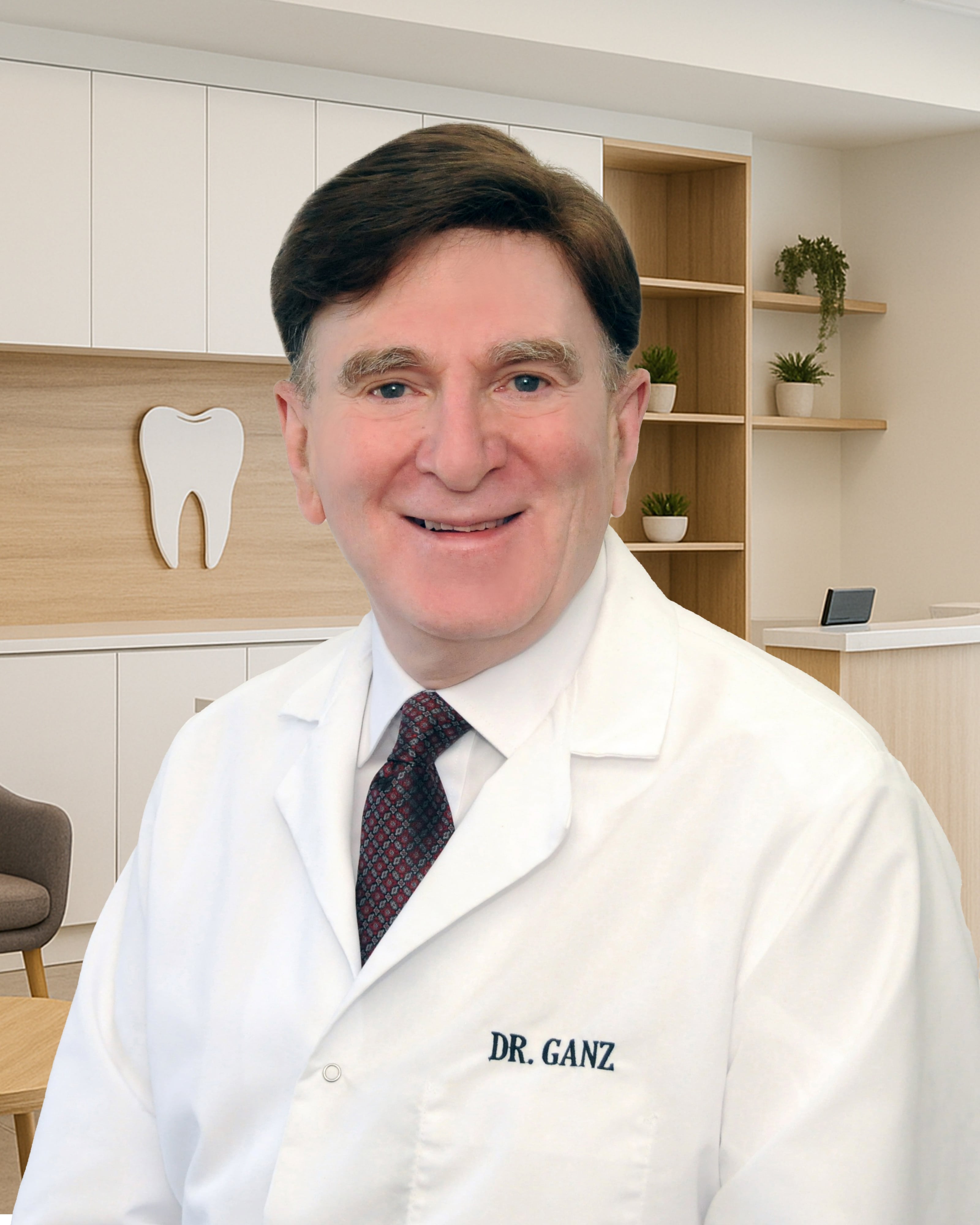
Cary Ganz DDS
Dr. Cary H. Ganz is a dentist, prosthodontist, entrepreneur, lecturer, and author with more than 50 years of experience in clinical dentistry and dental technology. Throughout his career, he has combined hands-on patient care with a deep understanding of how technology can improve dental practice operations, communication, documentation, and patient outcomes.
In addition to his clinical background, Dr. Ganz has held significant leadership roles in the dental technology industry, including Past Owner and Vice President of Clinical Affairs at DEXIS Digital Radiography and Past Vice President of Clinical Affairs at Denticon Practice Management Software. His business experience includes product development, clinical strategy, dental software innovation, practice management solutions, and educating dental professionals on the effective use of technology in modern dentistry.
Today, Dr. Ganz continues to focus on creating practical technology solutions for dental practices, including PractCom, a comprehensive dental practice communication platform designed to improve patient communication, documentation, compliance support, referrals, and overall practice efficiency. His work reflects a career-long commitment to helping dentists deliver better care while making their practices more organized, efficient, and protected.
No responses yet