
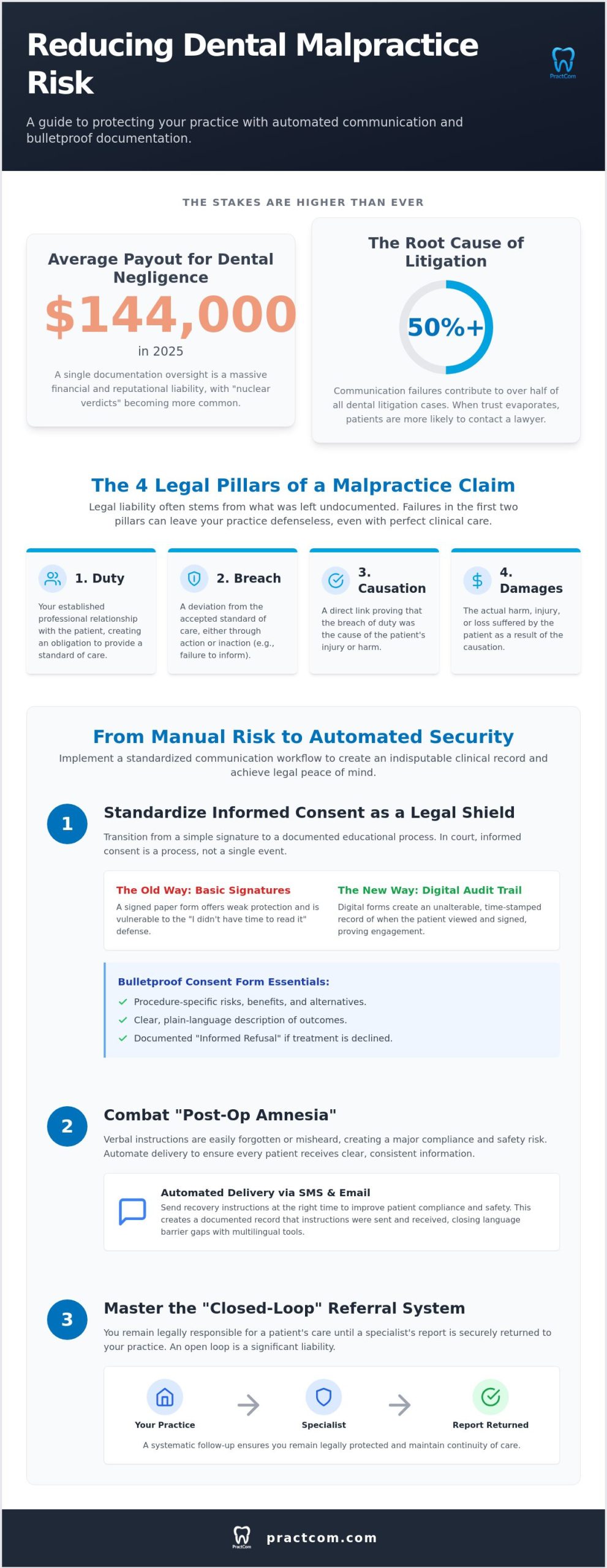
With the average payout for dental negligence reaching $144,000 in 2025, a single documentation oversight is no longer just a mistake; it’s a massive financial and reputational liability. You likely feel the mounting pressure of rising lawsuits and the nuclear verdicts that are becoming more common in 2026. If you’ve ever worried about a board complaint or felt the anxiety of inconsistent post-op instruction delivery, you’re not alone. The administrative burden of manual consent processes often leads to human error, which is exactly where most claims begin. Focusing on reducing dental malpractice risk is no longer an optional safety measure; it’s a fundamental requirement for a stable, modern practice.
We understand that your priority is clinical excellence, not endless paperwork. This guide will show you how to protect your practice and your professional standing by automating the communication and documentation workflows that prevent malpractice claims. By moving from manual tasks to a standardized system, you can ensure every patient interaction is recorded with absolute precision. We’ll explore the essential strategies for building a bulletproof clinical record, from digital informed consent to automated follow-ups, so you can achieve legal peace of mind and better patient compliance without slowing down your team.
Key Takeaways
- Identify the four legal pillars of a malpractice claim and why communication breakdowns trigger over half of all dental litigation cases.
- Transition from basic signatures to procedure-specific digital informed consent forms that document the entire patient education process.
- Combat “post-op amnesia” by automating the delivery of recovery instructions via SMS and email to improve patient compliance and safety.
- Master the “closed-loop” referral system to ensure you remain legally protected until a specialist’s report is securely returned to your practice.
- Implement a standardized communication workflow for reducing dental malpractice risk by replacing manual documentation with an automated, indisputable clinical record.
What is Dental Malpractice Risk and Why is it Rising?
In the clinical world, dental malpractice risk is often misunderstood as purely a failure of surgical skill. The reality in 2026 is that legal liability frequently stems from what was left unsaid or undocumented. To understand what constitutes dental malpractice, we must look at the four legal pillars: duty, breach, causation, and damages. Duty represents your established relationship with the patient; breach is a deviation from the standard of care; causation links that breach to an injury; and damages are the actual harm suffered. While you might provide perfect clinical care, a failure to document the “duty” and “breach” phases can leave you defenseless in court.
Claims are increasing because of a major psychological shift in patient behavior. Patients now expect a seamless, transparent experience. When communication breaks down, trust evaporates. A patient who feels ignored or confused is far more likely to contact a lawyer than one who feels well-informed. Research indicates that communication failures contribute to over 50% of dental litigation cases. This makes reducing dental malpractice risk as much about your administrative systems as it is about your handpiece. We’re also seeing a rise in “informed refusal” claims. This happens when a patient declines treatment but the practitioner fails to document that the patient was fully warned of the risks of doing nothing. Without a standardized record, it’s simply your word against theirs.
The Rationale for Systematic Risk Management
Moving from a reactive defense to a proactive documentation system is the only way to stay protected. Standardized protocols reduce the cognitive load on your clinical team. They don’t have to remember every specific warning for every procedure because the system handles it. This consistency doesn’t just protect you legally; it increases patient satisfaction. You can learn more about how these systems provide security by exploring why a standardized approach is essential for modern practices.
Common Clinical Communication Gaps
Most practices suffer from invisible gaps. You might give a verbal warning chairside, but if it isn’t in the chart, it didn’t happen. If your front desk provides aftercare instructions differently than your assistants, you’ve created a loophole for a claim. Language barriers are another critical risk. In diverse populations, a misunderstanding of a post-op instruction can lead to a preventable emergency. Reducing dental malpractice risk requires closing these gaps with automated, multilingual tools that ensure every patient receives the same high standard of information.
Standardizing Informed Consent as a Legal Shield
Many practitioners believe a signed piece of paper is a complete legal shield. It isn’t. In 2026, the courts view informed consent as an ongoing process of education rather than a single administrative event. If you want to be serious about reducing dental malpractice risk, you must ensure your consent process proves the patient actually understood the risks. This is why digital dental informed consent forms are becoming the industry standard. They allow for a structured, time-stamped sequence that documents the “informed” part of the equation, not just the “consent.”
Digital signatures offer more than just convenience. They provide an unalterable audit trail that records exactly when a patient viewed the document and when they signed it. This prevents the “I didn’t have time to read it” defense in court. By providing comprehensive documentation of this timeline, you create a verifiable history of the patient’s engagement with the clinical facts. This systematic control replaces the operational disorganization of verbal-only warnings, giving you the psychological security that your practice is protected.
Essential Elements of a Bulletproof Consent Form
A generic form is a liability. For high-risk procedures like extractions, endodontics, or implants, procedure-specific forms are mandatory. Your documentation must include:
- Clear Clinical Outcomes: A plain-language description of what the procedure aims to achieve.
- Risk and Alternative Disclosure: An explicit list of common and severe risks, along with the potential consequences of declining treatment.
- Question Confirmation: A dedicated section where the patient acknowledges they had the opportunity to ask questions and received satisfactory answers.
The Vulnerability of Paper-Based Documentation
Paper is a significant liability in a modern legal environment. Illegible handwriting or a missed signature on a physical form can turn a strong defense into a legal nightmare. Physical records are also notoriously difficult to retrieve quickly during a surprise audit or a records request. Transitioning to a secure, cloud-based repository ensures your legal documents are permanent, searchable, and retrievable in seconds. You can explore how to digitize your consent library to eliminate the physical risks of paper-based systems. This shift from manual resistance to automated confidence is a cornerstone of reducing dental malpractice risk while improving your team’s daily efficiency.
Post-Treatment Instructions: Bridging the Compliance Gap
Patients forget up to 80% of what you tell them the moment they leave the chair. This phenomenon, often called “Post-Op Amnesia,” creates a dangerous gap between your clinical advice and the patient’s actual behavior at home. If a patient experiences a complication because they couldn’t remember how to manage their surgical site, your practice is at risk. Utilizing strategies for effective dentist-patient communication is a vital step in reducing dental malpractice risk. By providing written, digital instructions, you replace a fleeting verbal interaction with a permanent, accessible record.
Automated delivery via SMS or email ensures that instructions are never “forgotten” at the front desk. This proactive approach also pre-emptively answers common post-treatment questions, which significantly reduces the volume of unnecessary emergency calls. When patients have clear, step-by-step guidance in their pockets, they’re more likely to comply with your instructions and less likely to feel anxious about the healing process. This systematic control alleviates the operational stress on your team while building a stronger, safer relationship with your patients.
Why Automated Dental Post-Op Instructions are Essential
Relying on manual delivery for aftercare instructions is a gamble. Busy schedules and human error mean that some patients might leave without the paperwork they need. Automation removes this variable by ensuring 100% delivery consistency regardless of which assistant is on duty. This system also tracks patient engagement, allowing you to see exactly when a patient opened their instructions. In the event of a legal challenge, this data acts as a digital receipt, proving that you fulfilled your duty to inform. It’s about moving from the hope of compliance to the certainty of documentation.
The Role of Multi-Language Communication
Legal risks increase significantly when a language barrier exists. If a patient doesn’t fully grasp the post-treatment requirements in English, the claim of “failure to inform” becomes much harder to defend. Providing standardized templates in 15+ languages ensures that every patient receives the same high-quality clinical instructions. PractCom solves this translation gap for complex procedures, allowing your team to provide clarity with the push of a button. This professional oversight is a fundamental requirement for reducing dental malpractice risk in diverse patient populations.
Referral and Follow-Up Systems: Closing the Loop
One of the most overlooked liabilities in a dental practice is the “lost referral.” From a legal standpoint, your responsibility to the patient doesn’t necessarily end the moment you hand them a specialist’s business card. If a patient fails to follow through on a referral for a suspicious lesion or a complex surgical case, you could be held liable for a failure to ensure continuity of care. This administrative gap is a primary target when reducing dental malpractice risk. You must be able to prove not only that you made the referral, but that you informed the patient of its urgency and attempted to close the loop with the specialist.
A closed-loop communication system ensures that the specialist’s report actually returns to your office and is reviewed by the GP. Without this, critical clinical information can vanish into an administrative void. By moving away from manual tracking and adopting a systematic approach, you protect your reputation and ensure that no patient falls through the cracks. This transition from operational disorganization to systematic control provides the psychological security that your practice is meeting the highest standards of professional oversight.
Closing the Loop on Specialist Referrals
The traditional “referral slip” method is a significant point of failure in modern dentistry. These slips are easily lost, and they offer no way to track whether the patient ever scheduled their appointment. A digital referral management system establishes a secure digital handshake between the GP and the specialist. This allows you to track the patient’s status in real-time and document every attempt to facilitate the consultation. If a patient chooses to ignore the referral, your system creates an indisputable record that you fulfilled your clinical duty.
Automated Follow-ups: The 24-Hour Safety Check
The first 24 hours after a high-risk procedure, such as an extraction or implant placement, represent the highest risk for patient anxiety and post-operative error. This is the window where a minor misunderstanding of aftercare can escalate into a clinical emergency or a lawsuit. Using automated texts to check on patient comfort acts as a critical safety net. These follow-ups allow you to identify “red flags” early, such as excessive bleeding or unexpected pain, before they become legal complications. This proactive strategy is an essential component of reducing dental malpractice risk because it demonstrates a high level of post-treatment care. To see how these safeguards can protect your practice, you can explore our automated follow-up tools today.
Implementing a Risk-Mitigation Communication Workflow
Transitioning to a comprehensive risk-mitigation strategy requires more than just new software; it needs a fundamental shift in how your team handles every patient interaction. By integrating automated communication tools directly into your dental practice workflow, you eliminate the clinical variability that leads to legal exposure. This systematic approach ensures that every team member, from the surgical assistant to the front desk coordinator, follows the same defensive protocols. Training your staff to prioritize standardized, time-stamped documentation over subjective manual notes is a critical step in reducing dental malpractice risk. It moves the burden of memory from your team to a reliable, automated system.
Visibility is the key to long-term protection and professional peace of mind. Using practice performance dashboards allows you to monitor practice-wide compliance with risk protocols in real-time. You can quickly identify if consent forms are being bypassed or if post-op instructions are failing to reach the patient. This level of systematic oversight transforms documentation from an administrative chore into a verifiable business requirement. If you’re uncertain about where your current vulnerabilities lie, you can start a free trial to audit your communication gaps and see exactly where your practice needs reinforcement.
The Shift to a Paperless, Protected Office
Standardization is your strongest defense. By utilizing a library of over 80+ templates, you can cover every clinical scenario in the practice with legally vetted language. This ensures all patient communication is HIPAA-compliant and securely stored in a cloud-based repository, ready for retrieval at a moment’s notice. Automation significantly reduces “operational resistance” among staff because it makes the right way to document also the easiest way. You no longer have to worry about missing signatures or illegible notes that could compromise your defense in a malpractice claim.
Evaluating Your Practice’s Current Risk Level
To begin reducing dental malpractice risk, you must first identify the “single points of failure” in your current patient journey. Conduct a self-audit using this checklist: Are your consent forms procedure-specific? Can you prove a patient opened their post-op instructions? Is there a digital record of every referral follow-up? Identifying these gaps allows you to implement pre-emptive strikes against potential litigation. Beyond legal protection, this commitment to accuracy positions your practice as a leader in patient experience and safety. When patients see a highly organized, tech-savvy communication system, their trust in your clinical expertise increases, naturally lowering the likelihood of disputes.
Securing Your Professional Legacy with Automated Precision
The dental landscape of 2026 demands a move from manual documentation to a standardized, automated ecosystem. By closing the loop on referrals and providing time-stamped digital informed consent audit trails, you eliminate the human error that often leads to litigation. We’ve explored how procedure-specific consent and automated aftercare instructions act as your primary defense. These systems don’t just protect your reputation; they alleviate the psychological stress of potential board complaints and administrative failures. If you find that these professional pressures are impacting your mental well-being, you can check out Amandine Baptista for specialized support in managing stress and anxiety.
Protect your practice and start your free trial with PractCom today to replace operational resistance with the confidence of a protective workflow. Your reputation is your most valuable asset. It’s time to treat it with the professional protection it deserves.
Frequently Asked Questions
What is the most common reason for dental malpractice claims?
Communication breakdowns are the leading cause of dental malpractice claims, contributing to over 50% of litigation cases. While clinical errors occur, most lawsuits are triggered by a patient’s feeling of being ignored or misinformed. When expectations aren’t managed through clear documentation, trust evaporates. This makes systematic communication the most effective tool for reducing dental malpractice risk in a modern clinical setting.
Can digital consent forms hold up in a court of law?
Yes, digital consent forms are highly defensible in court because they provide a time-stamped, unalterable audit trail. Unlike paper forms that can be lost, damaged, or altered, digital records prove exactly when a patient viewed and signed the document. This level of technical precision makes it difficult for a patient to claim they weren’t given enough time to review the risks before a procedure.
How does automated communication reduce my clinical liability?
Automated communication reduces your clinical liability by ensuring 100% delivery consistency for every patient. It eliminates the human error of a staff member forgetting to hand out a post-op sheet during a busy afternoon. By creating a digital receipt that shows when instructions were sent and opened, you have indisputable evidence that you fulfilled your duty to inform, which is critical for reducing dental malpractice risk.
Do I still need to give verbal instructions if I send them via SMS?
You should always provide verbal instructions chairside, but they must be reinforced with digital delivery. Verbal communication alone is vulnerable to post-op amnesia, where patients forget up to 80% of what they’re told. Sending instructions via SMS provides a permanent reference the patient can check later; it also creates the necessary clinical record that the information was provided in a format the patient could understand.
What should I do if a patient refuses to sign a consent form?
If a patient refuses to sign a consent form, you must document their informed refusal in detail. This means recording that you explained the risks of not proceeding with the treatment and that the patient understood those consequences. In most cases, if a patient won’t sign a standard consent form for a high-risk procedure, it’s safer to decline treatment rather than proceed without a legal shield.
How long should dental practices keep communication records for risk management?
Most experts recommend keeping communication records for at least 7 to 10 years, though requirements vary by state. Because some malpractice claims can be filed years after a procedure, maintaining a secure, cloud-based repository is essential. Digital systems make this long-term storage easy and searchable; this ensures you can retrieve a patient’s full communication history if a legal audit occurs years later.
Does malpractice insurance require specific documentation standards?
Yes, most malpractice insurance carriers expect you to maintain a thorough clinical record as a condition of your coverage. Failing to meet documentation standards can lead to higher premiums or even a denial of coverage in the event of a claim. Insurance providers value standardized systems because they provide the objective evidence needed to mount a strong defense against negligence allegations and protect your reputation.
How can I manage risk for patients who speak a different language?
You can manage risk for non-English speaking patients by providing standardized consent forms and post-op instructions in their native language. Relying on an ad-hoc translator or a family member is a significant liability. Using a system that offers professional templates in 15 or more languages ensures that every patient receives the same high standard of information, closing a major loophole in your risk management strategy.

Article by
Cary Ganz DDS
Dr. Cary H. Ganz is a dentist, prosthodontist, entrepreneur, lecturer, and author with more than 50 years of experience in clinical dentistry and dental technology. Throughout his career, he has combined hands-on patient care with a deep understanding of how technology can improve dental practice operations, communication, documentation, and patient outcomes.
In addition to his clinical background, Dr. Ganz has held significant leadership roles in the dental technology industry, including Past Owner and Vice President of Clinical Affairs at DEXIS Digital Radiography and Past Vice President of Clinical Affairs at Denticon Practice Management Software. His business experience includes product development, clinical strategy, dental software innovation, practice management solutions, and educating dental professionals on the effective use of technology in modern dentistry.
Today, Dr. Ganz continues to focus on creating practical technology solutions for dental practices, including PractCom, a comprehensive dental practice communication platform designed to improve patient communication, documentation, compliance support, referrals, and overall practice efficiency. His work reflects a career-long commitment to helping dentists deliver better care while making their practices more organized, efficient, and protected.
No responses yet