
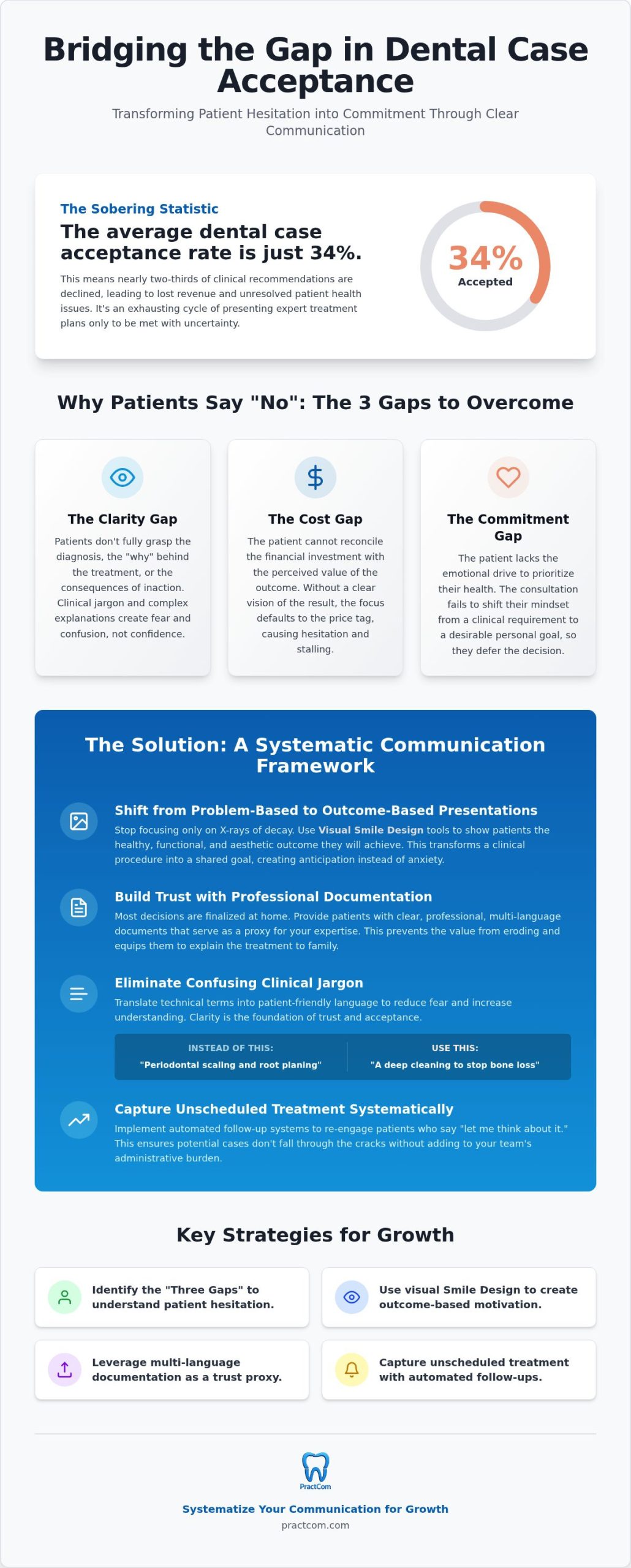
With industry data showing the average dental case acceptance rate sits at just 34%, nearly two-thirds of your clinical recommendations are likely walking out the door without a commitment. It’s an exhausting cycle where your expertise is met with “maybe” or “let me think about it,” often due to unaddressed patient anxiety or administrative friction. You’ve likely felt the frustration of seeing comprehensive treatment plans stall because the patient couldn’t bridge the gap between your diagnosis and their personal budget. Improving dental case acceptance requires moving beyond the chairside pitch and into a standardized communication ecosystem that eliminates post-consultation uncertainty.
This article provides a systematic framework to help you secure higher ROI on your diagnostics by building patient trust through precision and clarity. You’ll learn how to leverage advanced tools like digital informed consent and visual smile design to replace confusion with confidence. We’ll examine how standardized documentation and multi-language support can reduce no-shows and create a seamless presentation workflow that protects your reputation and your bottom line.
Key Takeaways
- Identify the “Three Gaps” of clarity, cost, and commitment to understand why patients hesitate during complex treatment presentations.
- Transition from problem-based clinical explanations to outcome-based motivation through the use of visual Smile Design tools.
- Leverage professional, multi-language documentation as a trust proxy for your clinical expertise while improving dental case acceptance.
- Capture unscheduled treatment through automated follow-up systems that don’t add to your team’s administrative friction.
- Minimize post-operative emergency calls and operational resistance by implementing a standardized Post-Treatment Instruction Library for every procedure.
The Psychology of Choice: Why Dental Patients Say No
Most clinicians assume a declined treatment plan is a direct rejection of their skill or the clinical necessity of the procedure. In reality, patients usually say “no” because of a breakdown in the psychological framework required for a “yes.” We define this breakdown through the “Three Gaps”: Clarity, Cost, and Commitment. If a patient doesn’t fully grasp the diagnosis (Clarity), can’t reconcile the investment (Cost), or lacks the emotional drive to prioritize their health (Commitment), they will hesitate. This hesitation is the primary barrier to improving dental case acceptance in a modern practice.
This psychological resistance is often exacerbated by dental anxiety. When a patient feels vulnerable in the chair, their cognitive processing shifts from rational analysis to emotional survival. They aren’t listening to your explanation of crown margins; they’re calculating an exit strategy. By understanding the shared decision-making process, you can transform the consultation into a collaborative effort that lowers these biological defenses. Without a structured approach to Choice Architecture, your practice suffers from “Leaky Bucket” syndrome. You spend significant resources on marketing to bring patients in, only for them to leave with a “maybe” that never matures into a scheduled appointment.
Understanding the Burden of Clinical Jargon
Technical terms act as a significant barrier to patient emotional buy-in. When you use complex clinical language, you inadvertently trigger a patient’s fear of the unknown. Replacing “periodontal scaling and root planing” with “a deep cleaning to stop bone loss” provides the plain-language clarity needed to reduce procedural fear. The Case Acceptance Rate is the primary practice growth metric that calculates the percentage of recommended treatment plans that patients actually commit to and schedule. Using simplified language ensures this metric moves in the right direction by making the “yes” feel safe and logical.
The ‘After-Office’ Decision Phase
The consultation doesn’t end when the patient leaves your building. Most high-value decisions happen at the kitchen table, where the patient must explain your diagnosis to a spouse or family member. If they don’t have a clear, professional proxy for your expertise, the perceived value of the treatment erodes quickly. Standardized documentation serves as a physical or digital anchor for the value you’ve established. It prevents the erosion of trust that occurs when a patient tries to recall a complex procedure from memory alone. Providing these resources through a platform like PractCom ensures your clinical recommendations remain persuasive even after the patient has left your office.
Leveraging Smile Design and Visual Treatment Planning
Visual communication acts as the primary bridge between clinical diagnosis and patient commitment. While traditional radiography is essential for identifying pathology, it often fails to motivate a patient toward treatment because it focuses exclusively on the problem. Improving dental case acceptance in 2026 requires a shift from “Problem-Based” to “Outcome-Based” presentations. Instead of merely showing a patient their bone loss or decay, you must help them visualize the health, function, and aesthetics they will regain. This shift transforms the consultation from a list of clinical requirements into a collaborative pursuit of a shared goal.
Complex restorative work often carries a high emotional and financial weight. When patients cannot see the end result, they default to focusing on the cost and the discomfort of the procedure. Visual clarity is the cornerstone of a successful consultation. You can explore how visual tools drive commitment to see these principles in action within a modern workflow.
The Role of Smile Design Tools
Cosmetic visualizations create a sense of emotional urgency that clinical descriptions simply cannot match. When you use a Smile Design tool during a high-value case consultation, you provide a tangible preview of the investment’s ROI. This is particularly effective for porcelain veneers or full-arch rehabilitations where the patient’s primary concern is their appearance. By showing a side-by-side comparison of their current state and the proposed outcome, you reduce hesitation and replace it with anticipation. This visual “contract” builds psychological security, as the patient feels they are buying a specific, desirable result rather than an abstract clinical process.
Annotated Findings vs. Visual Goals
A balanced presentation addresses clinical necessity without overwhelming the patient with fear. While AI-annotated X-rays are excellent for proving the existence of a problem, they must be paired with hopeful treatment outcomes to be effective. Utilizing chairside tablets or large digital displays allows you to toggle between the “scary” findings and the “hopeful” goals. This interactive approach keeps patients engaged and prevents them from disengaging due to dental anxiety. Once the visit ends, ensuring these materials are accessible via a patient portal is vital. It allows the patient to review the visual goals at home, reinforcing their decision and preventing the “maybe” from turning into a no-show. This systematic use of imagery is a powerful ally in improving dental case acceptance across diverse patient populations.
Building Trust Through Documentation and Multi-Language Support
When a patient leaves your operatory, the only physical reminder of your expertise is the documentation they carry home. Professional, branded materials act as a critical “trust proxy” for your clinical skill. If aftercare instructions are photocopied, illegible, or disorganized, the patient may unconsciously project that lack of order onto your clinical work. Improving dental case acceptance depends on maintaining a high standard of professionalism across every touchpoint, especially the documents that explain the “What’s Next” of their treatment journey.
We must shift the perspective on informed consent from a mere legal requirement to a vital tool for patient education. When documents are clear and accessible, they reduce the anxiety that often leads to buyer’s remorse once a patient is away from your office. By providing standardized instructions through a Post-Treatment Instruction Library, you ensure that every patient receives the same high-quality guidance regardless of which team member handles the discharge. This consistency stabilizes the patient experience and reinforces the value of the care you provide, making it much harder for them to talk themselves out of necessary treatment later.
Digital Informed Consent as a Professional Differentiator
The patient experience of signing a stack of paper forms feels antiquated and creates unnecessary administrative friction. Transitioning to streamlined digital signatures creates an immediate sense of modern efficiency that patients appreciate. Clear, Digital Informed Consent Forms reduce liability by ensuring every required field is completed while simultaneously increasing patient confidence. This professional approach signals that your practice values both their time and regulatory compliance. For a deeper look at best practices, you can review our Digital Dental Informed Consent Forms guide to clinical compliance.
The 15-Language Advantage in Case Acceptance
Language barriers represent one of the most overlooked obstacles in improving dental case acceptance. In diverse communities, a patient’s inability to fully understand a complex procedure in English often leads to a polite “no” simply because they don’t feel safe. Providing instructions and consent forms in a patient’s native tongue is a powerful business strategy that builds immediate trust. When you offer documents in 15 different languages, you eliminate the confusion that breeds hesitation. This level of inclusivity captures underserved segments of your local market and ensures that every patient feels seen and understood. The ROI of this approach is reflected in higher commitment rates and a significant reduction in post-operative emergency calls caused by simple misunderstandings.
Closing the Gap: Automated Follow-ups and Referral Management
The moment a patient leaves your front desk, the probability of them scheduling a complex procedure begins to decline. While established patients have a case acceptance rate between 50% and 60%, new patients commit at a much lower rate of 25% to 35%. This discrepancy highlights a critical gap in the “at-home” decision phase. Improving dental case acceptance requires a proactive strategy that extends beyond the operatory. By focusing on the “Second Impression,” you can address lingering doubts and financial concerns that only surface once the patient has left your clinical environment.
Automating the management of your unscheduled treatment list is the most effective way to maintain momentum without burdening your administrative team. Manual follow-ups are often the first task sacrificed during a busy day, leading to lost revenue and fragmented patient care. Utilizing a Practice Performance Dashboard allows you to track which follow-up cadences convert best, providing the data needed to refine your approach. You can see how automated systems capture unscheduled treatment by exploring our communication tools.
Strategic Automated Follow-up Protocols
Effective follow-up isn’t about generic reminders; it’s about a strategic cadence that mirrors the patient’s psychological journey. We recommend a 24-hour, 72-hour, and 1-week protocol for high-value cases. The initial 24-hour message should focus on clarity and answering immediate questions. The 72-hour touchpoint provides reassurance regarding the clinical outcome, and the 1-week follow-up acts as a gentle nudge toward scheduling. Personalizing these automated messages ensures the patient feels their specific health concerns are being prioritized. For more on the relationship between communication and operational ease, see our sibling article on Why Clear Aftercare Reduces Post-Treatment Phone Calls.
Managing Referrals to Maintain Momentum
Patients often get “lost” in the transition between a general practitioner and a specialist. This friction is a major contributor to treatment drop-off, as the patient must navigate a new office, new paperwork, and a new clinical team. A Referral Management System closes this loop by ensuring the specialist has immediate access to the necessary digital consent forms and clinical instructions. This seamless transition maintains the momentum established in your office and protects the patient’s trust. By providing specialists with a standardized documentation package, you ensure the patient receives a consistent message, which is essential for improving dental case acceptance in complex, multi-disciplinary cases.
The PractCom Solution: Systematizing Your Communication for Growth
PractCom functions as a specialized communication layer that integrates into your existing clinical workflow without the complexity of being a full Practice Management Software (PMS). It addresses the operational disorganization that often stalls high-value cases by providing a centralized system for every patient touchpoint. By automating the delivery of essential documents through the Post-Treatment Instruction Library, you reduce the administrative overhead that typically falls on your front desk or clinical assistants. This systematic control is essential for improving dental case acceptance because it ensures that no patient falls through the cracks due to human memory limitations or busy schedules.
The Practice Performance Dashboard offers a high-level view of your communication efficiency, allowing you to identify specific bottlenecks where patients are hesitating. Whether the issue is a lack of follow-up on unscheduled treatment or a language barrier in a specific demographic, the data provides a clear path for adjustment. For DSOs and multi-location practices, this level of oversight is a professional necessity. It allows for the standardization of clinical communication across dozens of locations, ensuring that every patient receives the same authoritative and empathetic experience regardless of which office they visit.
Standardizing the Patient Journey
A consistent brand voice from the initial consent to the final post-op follow-up builds a sense of psychological security. When your digital forms, text messages, and emails all share a professional aesthetic, you reinforce your reputation as a reliable clinical ally. The Patient Portal further empowers patients by providing a secure space to review their treatment plans and visual smile designs at their own pace. This autonomy reduces the pressure of the chairside consultation and allows for a more relaxed decision-making process. Standardization in patient communication is the foundation of clinical scalability in 2026.
Getting Started with a Frictionless Implementation
Transitioning from fragmented, paper-based systems to a comprehensive digital communication suite doesn’t have to disrupt your daily operations. PractCom is designed for frictionless implementation, allowing your team to move from manual tasks to automated workflows with minimal resistance. While the focus is on digital efficiency, we recognize the logistical realities of the profession. Our physical document printing feature ensures you can still cater to patients who prefer traditional paper instructions without breaking your standardized workflow. For organizations looking to implement these systems across multiple sites, our guide on PractCom for DSOs provides specific strategies for large-scale clinical compliance and growth, helping you maintain excellence while improving dental case acceptance.
Securing Clinical Commitment through Standardized Systems
Improving dental case acceptance is the natural result of a practice that values clarity as much as clinical skill. By moving from problem-based diagnoses to outcome-based visualizations, you eliminate the ambiguity that leads to patient hesitation. Standardizing your communication ensures that every patient, no matter their native language, feels fully informed and respected during the decision-making process. When you bridge the gap between clinical necessity and patient understanding, commitment becomes a logical next step.
Standardization as a Business Requirement: Implementing a structured ecosystem allows your team to focus on care rather than administrative friction. With access to a Post-Treatment Instruction Library of 80+ templates and support for 15 languages, you remove the barriers that cause treatment drop-off. A branded patient portal keeps your expertise front and center during the critical at-home phase, reinforcing the value of your recommendations. Implementation takes just minutes, but the impact on your workflow and ROI is immediate.
Start your free trial of PractCom to transform your patient communication today.
Your clinical excellence deserves a communication framework that reinforces patient trust at every touchpoint. We look forward to helping you build a more resilient, patient-centered practice.
Improving Dental Case Acceptance: Frequently Asked Questions
What is a healthy dental case acceptance rate for 2026?
A healthy case acceptance rate for 2026 generally targets 85% to 90% for single-tooth treatments, though the industry average remains significantly lower at approximately 34%. For comprehensive or elective procedures, aiming for 50% to 65% by dollar value is considered a strong benchmark. Tracking these metrics through a Practice Performance Dashboard helps you identify where your team can bridge the gap between clinical diagnosis and patient commitment while improving dental case acceptance.
How can I improve case acceptance for high-value restorative treatments?
You can improve case acceptance for high-value restorative treatments by shifting from problem-based explanations to outcome-based visualizations. Utilizing tools like Smile Design allows patients to see the tangible end result of their investment, which reduces psychological resistance. Additionally, offering third-party financing can increase acceptance on plans over $1,000 by 15% to 25%, making the financial commitment feel more manageable for the patient during the consultation.
Does providing multi-language support actually increase revenue?
Yes, providing multi-language support directly impacts your bottom line by capturing underserved segments of your local market. When you offer consent forms and instructions in 15 different languages, you eliminate the confusion that often leads to a polite “no.” This level of inclusivity builds immediate trust with diverse patient populations, ensuring that language barriers don’t stand in the way of necessary clinical care or improving dental case acceptance.
How do automated follow-ups help with patient retention?
Automated follow-ups improve patient retention by maintaining a professional connection after the patient leaves the office. These systems ensure that “maybe” answers don’t turn into lost opportunities by sending personalized messages at strategic intervals, such as 24 hours or one week post-visit. This consistent touchpoint reinforces your role as a reliable clinical ally and reduces the likelihood of patients seeking care elsewhere because they felt forgotten or confused by the initial presentation.
Can digital informed consent forms really protect my practice from liability?
Digital informed consent forms provide superior protection by ensuring that every required field is completed and time-stamped before treatment begins. Unlike paper forms that can be lost or partially filled, digital systems create a standardized, unalterable record of the patient’s agreement. This level of regulatory reassurance alleviates the anxiety of practitioners regarding documentation and compliance, while simultaneously building patient confidence through a modern, professional, and tech-savvy signing experience.
What is the difference between a PMS and a communication suite like PractCom?
A Practice Management Software (PMS) focuses on scheduling, billing, and clinical charting, whereas PractCom is a dedicated patient communication and documentation suite. PractCom integrates into your existing workflow to handle specialized tasks like the Post-Treatment Instruction Library and Smile Design visualizations. It functions as a stabilizing force in high-pressure settings by automating the administrative tasks that a traditional PMS often leaves to manual staff entry or human memory.
How does Smile Design software influence a patient’s decision to proceed?
Smile Design software acts as a powerful motivational tool by replacing abstract clinical descriptions with concrete visual goals. When a patient sees a before-and-after cosmetic visualization of their own teeth, it creates an emotional urgency that clinical jargon cannot replicate. This visual contract helps the patient internalize the value of the procedure, making them more likely to proceed with comprehensive restorative or cosmetic treatment plans that they might otherwise decline.
How do I handle patients who say they need to talk to their spouse first?
When patients need to consult a spouse, you must provide them with a professional proxy for your expertise. Giving them access to a branded patient portal or a printed summary of their Smile Design ensures the after-office decision phase is based on accurate information. This standardized documentation prevents the erosion of trust that occurs when a patient tries to explain complex clinical procedures from memory, keeping the momentum toward acceptance alive at home.

Article by
Cary Ganz DDS
Dr. Cary H. Ganz is a dentist, prosthodontist, entrepreneur, lecturer, and author with more than 50 years of experience in clinical dentistry and dental technology. Throughout his career, he has combined hands-on patient care with a deep understanding of how technology can improve dental practice operations, communication, documentation, and patient outcomes.
In addition to his clinical background, Dr. Ganz has held significant leadership roles in the dental technology industry, including Past Owner and Vice President of Clinical Affairs at DEXIS Digital Radiography and Past Vice President of Clinical Affairs at Denticon Practice Management Software. His business experience includes product development, clinical strategy, dental software innovation, practice management solutions, and educating dental professionals on the effective use of technology in modern dentistry.
Today, Dr. Ganz continues to focus on creating practical technology solutions for dental practices, including PractCom, a comprehensive dental practice communication platform designed to improve patient communication, documentation, compliance support, referrals, and overall practice efficiency. His work reflects a career-long commitment to helping dentists deliver better care while making their practices more organized, efficient, and protected.
No responses yet