
What if a simple signature from a step-parent today leads to a malpractice claim tomorrow? You likely feel the weight of every clinical decision, but it’s often the administrative details that keep you up at night. Managing pediatric dentistry consent form requirements shouldn’t feel like navigating a legal minefield while you’re trying to provide quality care. Between the February 16, 2026, HIPAA Privacy Rule updates and the constant complexity of verifying legal guardianship, the pressure to maintain perfect documentation is higher than ever.
We understand that your primary goal is the health of the child, not filing endless paperwork. You deserve a system that protects your reputation and your license without adding to your daily stress. This guide will help you master the legal and clinical essentials of pediatric dental consent to protect your practice and improve patient trust. We’ll provide a foolproof checklist for your forms, break down the latest 2026 regulatory changes including new CDT codes, and show you how a paperless intake process can turn administrative friction into clinical efficiency.
Key Takeaways
- Understand the legal distinction between general and informed consent to ensure your documentation stands up to the heightened scrutiny of pediatric care.
- Identify the core elements of pediatric dentistry consent form requirements, including non-clinical treatment descriptions and comprehensive risk disclosures that foster parental confidence.
- Master the complexities of guardianship laws to handle joint custody disputes and surrogate consent scenarios without delaying necessary treatment.
- Reduce administrative friction by integrating HIPAA-compliant digital consent forms directly into your pre-appointment SMS and email communications.
- Gain peace of mind by utilizing a standardized library of over 80 digital templates designed to meet the technical and ethical demands of 2026 compliance.
Understanding Pediatric Dentistry Consent Form Requirements
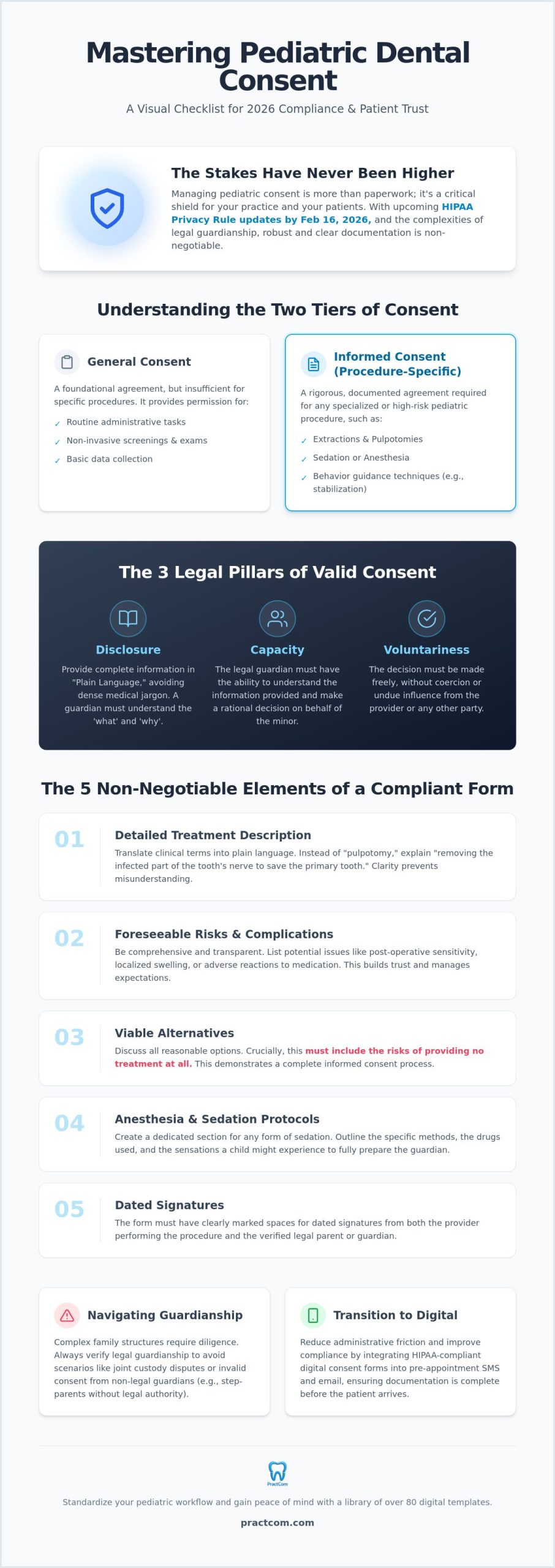
In the evolving regulatory environment of 2026, the distinction between a patient simply agreeing to an exam and providing true informed consent has never been sharper. While general consent covers routine administrative tasks and non-invasive screenings, pediatric dentistry consent form requirements demand a much more rigorous approach. Because you are treating a minor who lacks the legal capacity to make medical decisions, the documentation must serve as a shield for both the child’s safety and your practice’s reputation. This standard is significantly higher than in adult dentistry; you aren’t just communicating with the patient, but rather ensuring a third-party guardian fully grasps complex clinical outcomes.
At its core, pediatric informed consent is the documented agreement between a provider and a legal guardian that authorizes specific clinical actions.
The American Academy of Pediatric Dentistry (AAPD) emphasizes that consent must also cover communicative behavior guidance. This means your forms shouldn’t just list the “what” of the procedure, but also the “how” regarding patient management. Whether you’re using nitrous oxide or specific physical stabilization techniques, these methods require explicit authorization to prevent misunderstandings that could lead to clinical friction or legal liability. Clarity is your best defense.
The Legal Doctrine of Informed Consent
To remain compliant, you must view consent through the lens of three pillars: Disclosure, Capacity, and Voluntariness. Understanding Informed Consent requires recognizing that “Capacity” in this context applies specifically to the parent or legal guardian’s ability to process and act on information. By 2026, regulatory bodies expect “Plain Language” in all medical documentation. This shift moves away from dense medical jargon toward clear, accessible explanations. If a guardian doesn’t understand the risks because the form is too technical, the consent may be considered legally invalid.
General vs. Procedure-Specific Consent
A general “consent to treat” form is a helpful starting point, but it’s insufficient for specialized pediatric procedures. High-risk interventions like extractions, pulpotomies, or sedation require separate, procedure-specific documentation. This ensures that the guardian is not just giving broad permission, but is specifically aware of the unique complications associated with that day’s work. Utilizing tools like Smile Design can help bridge this communication gap; by showing parents the expected cosmetic and functional changes before treatment begins, you create a visual record of the agreed-upon outcome. This level of clarity reduces administrative burden and builds a foundation of psychological security for the family. You can learn more about how standardized systems create this security by exploring why PractCom is the preferred choice for modern pediatric practices.
Core Elements of a Compliant Pediatric Consent Form
Ensuring your documentation meets 2026 standards requires a granular approach to content. A compliant form isn’t just a legal hurdle; it’s a blueprint for parental trust. To satisfy pediatric dentistry consent form requirements, you must translate clinical jargon into plain language. For instance, instead of merely stating a child needs a “pulpotomy,” your form should explain that you’re removing the infected part of the tooth’s nerve to save the primary tooth. This transparency reduces parental anxiety and creates a record that the guardian truly understood the procedure.
Every form must include five non-negotiable elements to remain defensible. First, a detailed description of the proposed treatment. Second, a clear listing of all foreseeable risks and potential complications, such as post-operative sensitivity or localized swelling. Third, a discussion of viable alternatives, which must explicitly include the risks of providing no treatment at all. Fourth, a dedicated section for anesthesia and sedation protocols, outlining the specific sensations a child might experience. Finally, the form must provide space for dated signatures from both the provider and the legal representative. Following the AAPD Informed Consent Guidelines ensures your practice remains aligned with the highest ethical and clinical standards in the profession.
Risk Disclosure for Common Pediatric Procedures
Specific procedures require targeted risk disclosures. When documenting white (composite) fillings, you should mention the potential for marginal leakage or sensitivity to temperature. For pulpotomies, you must note that if the treatment fails, extraction may become necessary. If you use Nitrous Oxide or oral sedation, your documentation must detail the monitoring protocols and the child’s expected recovery time. When parents suggest a “wait and see” approach for caries management, your form should clearly document the risk of abscess or systemic infection. This shifts the burden of that choice from your shoulders to the guardian’s record.
Standardizing the Documentation Process
Human memory is fallible, but a standardized system is not. Transitioning to digital dental informed consent forms eliminates the risk of a staff member forgetting a core element during a busy afternoon. Digital platforms provide timestamped signatures and unalterable audit trails to ensure your practice meets 2026 compliance standards. By using templates, you ensure every guardian receives the same high-quality information every time. You can explore how automation protects your practice while freeing your team to focus on patient care rather than paper management.
Navigating Guardianship and Surrogate Consent Challenges
Determining who has the legal authority to sign a document is often the most stressful part of the intake process. You aren’t just a clinician; in these moments, you’re a gatekeeper for legal compliance. Meeting pediatric dentistry consent form requirements becomes exponentially more difficult when a child is brought in by someone other than a custodial parent. Without a clear system to verify guardianship, your practice remains vulnerable to liability claims and internal administrative chaos. You need a protocol that acts as a stabilizing force when family dynamics get complicated.
The Acrimonious Divorce Scenario
When parents are divorced, the “right to consent” is rarely a simple split. You must determine if one parent has sole legal custody or if joint legal custody exists. In joint custody cases, many states allow either parent to consent to routine care, but invasive procedures often require a consensus that is difficult to reach. To protect your practice, you should store legal decrees within a secure Patient Portal for instant access. This ensures that when a dispute arises, your team isn’t scrambling for paper records; they’re acting on verified data. This proactive approach reduces practice liability and prevents your office from becoming a battleground for parental disagreements.
Surrogates and Temporary Guardians
It’s common for grandparents, older siblings, or nannies to bring a child to their appointment. However, these individuals cannot legally sign for treatment without a “Consent by Proxy” or a “Power of Attorney for Healthcare” on file. You should develop a standardized “Surrogate Consent” template for recurring appointments to streamline this process. This document allows the legal guardian to pre-authorize specific individuals to consent to routine care on their behalf, a task that can be completed in under 60 seconds within a modern digital system.
Verifying identity through digital portals is the most efficient way to ensure legal compliance in these scenarios. It creates a digital trail that proves you performed due diligence before starting treatment. If you find yourself frequently answering questions about these legal nuances, referring to a practice FAQ can help educate parents before they arrive. In true emergency situations where a parent is unreachable and the child’s health is at immediate risk, the legal doctrine of “implied consent” may apply, but this should always be a last resort documented with extreme precision.
Transitioning to Digital Consent: Compliance and Efficiency
Moving your documentation from physical clipboards to a digital ecosystem isn’t just a tech upgrade. It’s a strategic move to satisfy pediatric dentistry consent form requirements while reclaiming hours of administrative time. When you eliminate paper, you remove the risk of illegible handwriting, incomplete fields, and lost folders. A digital transition allows you to standardize the consent process, ensuring that every legal guardian receives the same high-quality information regardless of which team member is at the front desk. This systematic control transforms a chaotic intake process into a streamlined clinical entry point.
To execute this transition effectively, follow these four foundational steps:
- Step 1: Platform Selection. Choose a HIPAA-compliant digital platform that prioritizes document delivery security. This ensures that sensitive patient data remains protected during transmission, providing the regulatory reassurance your practice needs.
- Step 2: Workflow Integration. Embed your consent forms directly into a pre-appointment SMS or email workflow. By sending documents 24 to 48 hours before the visit, you allow parents to review risks in a low-pressure environment, which significantly improves the quality of informed consent.
- Step 3: Language Accessibility. Implement multi-language support to serve your entire community. Providing forms in a parent’s primary language isn’t just a courtesy; it’s an ethical requirement that ensures the “informed” part of consent is actually met.
- Step 4: Automated Archival. Set up a system that automatically archives signed documents into the patient record. This removes the “human memory” variable from your filing process, ensuring your audit trail is always complete and accessible.
Multi-Language Support as an Ethical Requirement
Relying on family members, especially children, to act as translators for legal consent is a significant liability risk. It often leads to “error code -1” communication breakdowns where the legal guardian signs a document they don’t truly understand. By offering Digital Informed Consent Forms in 15 languages, you provide technical precision and administrative warmth to diverse populations. This accessibility bridges the gap between complex professional procedures and general understanding, protecting your practice from claims of inadequate disclosure.
Security and Accessibility: The Digital Advantage
Digital signatures are far more defensible in a legal setting than a smudged or faded paper signature. Every digital interaction creates a timestamped audit trail, proving exactly when the guardian viewed and signed the document. Furthermore, using a platform with 10DLC registration ensures your secure dental messaging actually reaches the parent’s device without being flagged as spam. For more detailed strategies on clinical integration, you can explore our guide on Optimizing Dental Practice Workflow. If you’re ready to modernize your intake process, start your free trial today to see how automation can safeguard your reputation.
Standardizing Your Pediatric Workflow with PractCom
Implementing a standardized system is the only way to ensure pediatric dentistry consent form requirements are met consistently across every operatory. PractCom provides a centralized library of over 80 digital consent and post-op templates. This library acts as a protective shield for your practice. It gives you the psychological security of knowing every form meets 2026 compliance standards without requiring your team to become legal experts. By using these pre-vetted resources, you eliminate the operational resistance of manual document creation and move toward a more predictable business model. It’s about moving from the anxiety of “did we include that clause?” to the confidence of a proven system.
Beyond the Signature: The Post-Treatment Connection
The consent process shouldn’t end when the guardian puts down the digital pen. It should lead directly into aftercare education to ensure the best possible clinical outcome. PractCom allows you to close the loop by automatically sending post-treatment instructions once consent is realized and the procedure is finished. You can use the Practice Performance Dashboard to track which parents have actually reviewed these instructions. This visibility allows for a pre-emptive strike against common post-op complications. By delivering these instructions in the parent’s primary language, you significantly reduce the volume of unnecessary emergency calls that disrupt your clinical schedule and increase staff stress.
Scale Your Pediatric Practice with Confidence
For those managing multiple locations, PractCom for DSOs offers the systematic oversight needed to maintain uniform compliance across your entire organization. It ensures that every branch follows the same high standards for pediatric dentistry consent form requirements and patient communication. While the system is modern and tech-savvy, it remains grounded in the logistical realities of the profession. This includes offering physical document printing for parents who still prefer hard copies for their home records. You don’t have to choose between digital efficiency and parental preference; you can provide both within a single, high-utility ecosystem.
You deserve a partner that functions as a guardian of your reputation and legal standing. To see our specialized pediatric library in action and experience the ease of a standardized system, start a free trial today. It’s time to replace administrative friction with the clinical focus your young patients deserve.
Securing Your Practice’s Future with Standardized Compliance
Mastering pediatric dentistry consent form requirements is about more than just checking a box; it’s about building a foundation of trust with every family you serve. You’ve seen how clear risk disclosure and verified guardianship protocols act as a stabilizing force in a high-pressure clinical environment. By transitioning to a digital ecosystem, you don’t just eliminate the friction of paper forms; you gain a reliable professional ally that protects your reputation and your legal standing. Standardizing your workflow ensures that no detail is left to chance, allowing you to focus on providing exceptional care for your young patients.
You can take a pre-emptive strike against administrative failures today. With a library of over 80 digital consent and post-op templates, multi-language support in 15 languages, and HIPAA-compliant delivery via SMS and email, you can ensure your practice remains ahead of 2026 standards. Streamline your pediatric compliance with PractCom’s digital consent library to see the difference a standardized system makes. We’re here to help you move from operational resistance to clinical confidence with ease.
Frequently Asked Questions
Who is legally authorized to sign a pediatric dentistry consent form?
Legal authorization typically rests with biological parents who have custodial rights or court-appointed legal guardians. In cases of joint custody, either parent can often consent to routine care, but invasive procedures may require consensus depending on state law. You must verify these rights and keep a copy of the legal decree in the patient’s digital file to ensure your practice remains compliant with pediatric dentistry consent form requirements.
Do I need a new consent form for every single dental appointment?
A general “consent to treat” covers routine exams and cleanings for a specified period, but you need a new, procedure-specific form for invasive treatments. Any change in the treatment plan, such as moving from a simple filling to a pulpotomy, requires a fresh informed consent discussion and signature. This practice ensures the guardian is fully aware of the specific risks and alternatives for that day’s clinical work.
Can a stepparent sign a consent form for a minor?
A stepparent cannot legally sign a consent form unless they have legally adopted the child or possess a signed “Consent by Proxy” from a legal guardian. Even if the stepparent is the primary caregiver bringing the child to appointments, they lack the inherent legal capacity to authorize medical treatment. Your front office should proactively request a proxy form from the custodial parent before the appointment starts.
Is a digital signature on a dental consent form legally binding in 2026?
Digital signatures are fully legally binding provided they are captured through a HIPAA-compliant platform that creates a timestamped audit trail. These digital records are often more defensible than paper because they provide verifiable proof of when the document was viewed and signed. Using a secure system ensures that your pediatric dentistry consent form requirements are met with technical precision while protecting patient privacy during transmission.
What happens if a parent refuses to sign the consent form for a necessary procedure?
You cannot legally perform any non-emergency procedure without a signed consent form. If a parent refuses, you should clearly document the discussion, the risks of non-treatment, and the parent’s specific objections in the patient’s record. While you can offer a referral for a second opinion, proceeding without consent opens your practice to significant legal liability and claims of battery, regardless of the clinical necessity.
How long must pediatric dental consent forms be kept in the patient record?
While state laws vary, the general standard is to keep pediatric records until the patient reaches the age of majority plus the statute of limitations for malpractice. In many jurisdictions, this means retaining the forms for seven to ten years after the patient turns 18. Digital archiving is the most efficient way to manage this long-term requirement without the physical burden and security risks of paper storage.
What should be included in a consent form for nitrous oxide or sedation?
The form must detail the type of sedation, the specific sensations the child may experience, and all foreseeable risks like nausea or respiratory depression. It should also outline the monitoring protocols your team will use during the procedure. Including clear pre-operative and post-operative instructions ensures the guardian understands their role in the child’s safety before and after the clinical intervention.
How do I handle consent for a minor who arrives at the office alone?
You must have a pre-signed “Consent for Treatment of a Minor in the Absence of a Parent” on file before the appointment begins. If the minor arrives alone without this prior authorization and the situation is not a life-threatening emergency, you must delay treatment. In these cases, sending a digital consent form via SMS or email to the parent for an immediate signature can save the appointment.

Article by
Cary Ganz DDS
Dr. Cary H. Ganz is a dentist, prosthodontist, entrepreneur, lecturer, and author with more than 50 years of experience in clinical dentistry and dental technology. Throughout his career, he has combined hands-on patient care with a deep understanding of how technology can improve dental practice operations, communication, documentation, and patient outcomes.
In addition to his clinical background, Dr. Ganz has held significant leadership roles in the dental technology industry, including Past Owner and Vice President of Clinical Affairs at DEXIS Digital Radiography and Past Vice President of Clinical Affairs at Denticon Practice Management Software. His business experience includes product development, clinical strategy, dental software innovation, practice management solutions, and educating dental professionals on the effective use of technology in modern dentistry.
Today, Dr. Ganz continues to focus on creating practical technology solutions for dental practices, including PractCom, a comprehensive dental practice communication platform designed to improve patient communication, documentation, compliance support, referrals, and overall practice efficiency. His work reflects a career-long commitment to helping dentists deliver better care while making their practices more organized, efficient, and protected.
No responses yet