
A signature on a dotted line isn’t a legal shield; it’s merely the final step in a complex clinical conversation that many practices still struggle to document correctly. With the April 2026 ADA guideline updates now requiring precise BMI documentation and weight-based dosing records, the stakes for informed consent for sedation dentistry have never been higher. You likely feel the pressure of this responsibility every time you prepare a patient, worrying if a single missed detail in your manual paperwork could leave your reputation vulnerable to a malpractice suit or a regulatory audit.
We understand that your clinical expertise belongs at the chairside, not wasted on administrative friction or chasing physical signatures from anxious patients. This guide will help you master the latest legal and clinical requirements while streamlining your documentation workflow for maximum protection. We’ll examine the specific elements of a bulletproof consent process, the impact of the February 2026 HIPAA updates regarding substance use records, and how to transition to a systematic approach that improves patient comprehension and secures your practice against modern operational risks.
Key Takeaways
- Understand the 2026 ADA guideline updates to ensure your practice remains compliant with new documentation mandates for BMI and weight-based dosing.
- Identify the essential clinical components required for informed consent for sedation dentistry to protect your reputation against malpractice claims and legal scrutiny.
- Eliminate the operational risks of manual paperwork by adopting a digital workflow that captures signatures via SMS or email before the patient ever reaches the chair.
- Enhance patient comprehension and trust by providing detailed consent forms and post-treatment instructions in 15 different languages to accommodate all demographics.
- Streamline your administrative intake with automated triggers and a library of professional templates that ensure no critical safety information is overlooked.
Defining Informed Consent for Sedation Dentistry in 2026
At its core, informed consent for sedation dentistry is the ethical and legal process of ensuring a patient fully understands the specific risks, benefits, and alternatives of a sedative procedure. It’s a specialized requirement that goes far beyond the standard consent used for a filling or a crown. While a routine procedure focuses on the tooth, sedation consent focuses on the patient’s systemic safety and physiological state. This emphasis on whole-body health is shared by functional practices like 5280 Restorative Medicine, which help individuals optimize their vitality. Effective sedation consent is a multi-step communication protocol rather than a one-time document signature. It requires an active dialogue where you, the provider, verify that the patient isn’t just signing a form, but is truly comprehending the pharmacological impact of the treatment.
The Legal and Ethical Foundation
The legal weight of Informed Consent rests on the “reasonable patient” standard. This standard dictates that you must disclose any information that a reasonable person would find significant when making a decision about their care. Sedation requires a much higher threshold of documentation than local anesthesia because it involves the depression of the central nervous system. Under the April 2026 ADA guideline updates, your responsibility now includes documenting specific physiological baselines like BMI and weight-based dosing calculations. Your role as a clinician is to act as a guardian of patient safety; you must confirm their comprehension through a verifiable process that proves they were capable of making an autonomous choice before any sedative was administered.
Levels of Sedation and Consent Nuance
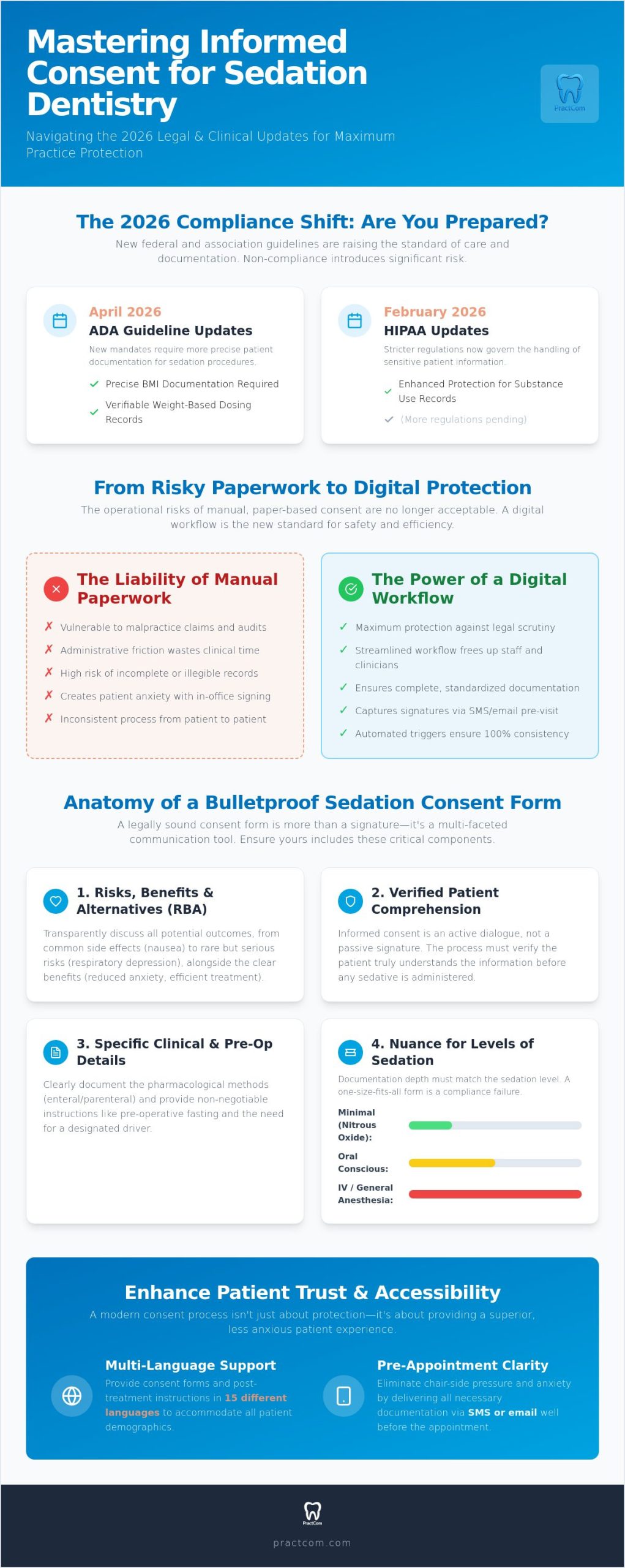
The complexity of your documentation must mirror the depth of the sedation provided. A one-size-fits-all form often fails to meet the specific legal requirements for different modalities. Consider how the risks shift across these levels:
- Nitrous Oxide: While considered minimal sedation, consent must still cover the risks of nausea or over-sedation and the rapid reversal process.
- Oral Conscious Sedation: This requires more rigorous documentation regarding pre-operative fasting and the necessity of a designated driver, as the patient’s cognitive functions remain impaired for hours.
- IV Sedation and General Anesthesia: These carry the highest risk profile. Your consent process must detail the potential for respiratory depression and the specific hemodynamic monitoring protocols you’ll use during the procedure.
As the level of sedation deepens, the consent form must become more granular to ensure full compliance. Transitioning from a manual, paper-based system to a standardized digital workflow helps eliminate the operational friction that leads to incomplete records. By using a systematic approach, you ensure that every patient receives the same high standard of disclosure, regardless of the procedure’s complexity. If you’re looking to understand how a structured system can protect your practice, you can explore why PractCom provides the stabilizing force needed in a high-pressure clinical environment.
Essential Components of a Sedation Consent Form
A robust informed consent for sedation dentistry document acts as your practice’s primary defense against litigation and clinical misunderstanding. It must provide more than a vague overview; it requires a granular breakdown of the specific pharmacological approach being used. By detailing whether you’re employing enteral or parenteral methods, you give the patient the psychological security needed to proceed while satisfying the ADA Guidelines for Sedation and Anesthesia. This transparency isn’t just about compliance; it’s about building a foundation of trust before the first milligram is administered.
Risks, Benefits, and Alternatives (RBA)
Every consent process must follow the RBA framework to ensure the patient is making a truly autonomous decision. You need to address common side effects like nausea and prolonged grogginess, but you must also include rare, serious risks such as respiratory depression or allergic reactions. Clearly state the benefits, such as reduced anxiety and the ability to complete complex treatments in a single visit, so the patient can weigh these against the risks. It’s equally vital to document the “No Treatment” alternative. Explaining that forgoing sedation might lead to incomplete care or heightened trauma provides a justification for the sedative choice, making the consent legally bulletproof. Finally, always include a dedicated section for patient questions and clinician verification to prove a two-way dialogue occurred.
Pre-Sedation and Post-Sedation Instructions
The safety of the procedure depends heavily on patient compliance before they even enter your office. Your consent form should incorporate NPO (fasting) instructions directly into the document to ensure they aren’t overlooked. You must also explicitly state the requirement for a designated driver and adult supervision for at least 24 hours post-operatively. Linking your consent process to automated dental post-op instructions creates a seamless continuity of care. This systematic approach ensures that the patient has all necessary safety information in hand well before the appointment begins. By providing these details early, you reduce the risk of last-minute cancellations due to NPO violations or missing escorts. If you’re ready to eliminate these common administrative failures, consider standardizing your consent forms with a professional digital suite.
The Liability of Manual Documentation: Why Paper Fails
Relying on physical paper for informed consent for sedation dentistry creates a dangerous point of failure in your clinical risk management strategy. Paper is inherently fragile, easily lost, and frequently illegible, which makes it an unreliable witness in a legal dispute. If you’re ever forced to defend your clinical judgment in court, a coffee-stained or poorly scanned document won’t provide the protection you need. Proving “true” informed consent requires a verifiable trail of communication that paper simply cannot sustain. When documents are physically stored, the time wasted on retrieval during an audit or legal inquiry creates unnecessary operational stress and exposes your practice to significant administrative vulnerability. You shouldn’t have to worry if a critical document survived a filing error or a physical mishap.
The April 2026 ADA guideline updates have added layers of complexity to sedation records, including BMI and precise weight-based dosing. Attempting to track these evolving variables on static paper forms increases the likelihood of missing data. If a patient claims they weren’t fully informed of a specific risk, your only defense is the documentation you produced at the time of the encounter. If that documentation is incomplete or missing a clinician’s verification stamp, your legal standing is compromised before the case even begins.
Incomplete Forms and Malpractice Risk
In a high-volume clinical environment, human error is an ever-present threat. A single missing checkmark or a forgotten date can invalidate a consent defense, leaving you exposed to clinical negligence claims. We’ve seen how easily a signature is missed when a patient is anxious or when the front desk is managing a crowded waiting room. Standardization acts as your shield, ensuring that every required field is completed before the procedure begins. By removing the “forgotten signature” trap, you move from a state of administrative anxiety to the confidence of a standardized system. This level of oversight is essential for protecting your professional reputation and ensuring that every patient receives a consistent, high-quality disclosure process.
The Burden of Physical Record Keeping
The financial cost of manual documentation extends beyond legal risk. Modern dental offices face high square footage costs, and using that space for filing cabinets is an inefficient use of your overhead. The manual process of scanning and digital filing is a repetitive task that drains your team’s productivity without adding clinical value. Transitioning to a more efficient digital workflow allows you to reclaim that space and refocus your staff on patient care. Digital systems provide instant retrieval and permanent storage, ensuring your records are always audit-ready and protected from physical damage. If you’re ready to see how a standardized system can stabilize your practice, you can explore why PractCom is the right choice for modern clinical environments.
Standardizing Your Sedation Documentation Workflow
Transitioning from a static document to a functional process is the most effective way to manage clinical risk. A standardized workflow ensures that informed consent for sedation dentistry is never a rushed, last-minute hurdle. By moving this essential communication into a structured sequence, you eliminate the administrative friction that leads to errors and incomplete records. This systematic approach transforms consent into a verifiable event that protects both your patient and your professional license. Following a specific protocol allows your team to focus on clinical preparation rather than administrative troubleshooting.
Implementation of a high-utility workflow follows these five logical steps:
- Step 1: Send digital consent forms via SMS or email 48 hours before the appointment.
- Step 2: Use automated triggers to ensure forms are signed and returned before the patient arrives.
- Step 3: Review the digital form with the patient chairside for final clinical verification.
- Step 4: Securely store the timestamped, IP-verified signature in the patient portal for permanent record keeping.
- Step 5: Automatically trigger post-sedation instructions immediately following the procedure to ensure aftercare continuity.
The Pre-Appointment Consent Phase
Moving the consent process to the home environment significantly reduces chairside “paperwork fatigue.” When patients read about risks in a low-stress setting, their comprehension levels increase. This proactive approach allows them to process complex information without the immediate pressure of a clinical environment. For your team, this means verifying signatures before you ever prepare the sedation suite. It prevents the operational disruption of a patient refusing a procedure or raising concerns only after the clinical staff has already invested time and resources into setup. You’ll find that an informed patient is a more compliant patient.
Chairside Verification and the Final Dialogue
The digital form serves as a valuable visual aid during your final clinical consult. Rather than just asking for a signature, you can use the digital record to guide the conversation, ensuring every risk and alternative has been addressed. Documenting the specific “Q&A” session within the digital record provides an extra layer of legal protection, proving that a two-way dialogue occurred. This final “time-out” before administering sedation is a critical safety check. It ensures that the patient’s status hasn’t changed since the form was sent and that all pre-operative instructions, like fasting, were followed. If you’re ready to move away from disorganized paperwork, you can start your free trial of our digital consent suite today.
Transforming Compliance with PractCom’s Digital Suite
PractCom’s Digital Suite serves as the final piece of the risk management puzzle, providing the infrastructure needed to execute a bulletproof documentation strategy. While the clinical requirements for informed consent for sedation dentistry continue to evolve, our platform offers a library of over 80 digital consent and post-op templates designed to keep your practice ahead of regulatory changes. These aren’t just static forms; they are dynamic tools that integrate seamlessly into your existing digital dental informed consent forms protocols. By automating the delivery and tracking of these documents, you remove the possibility of human memory failing during a busy clinical day. This systematic control replaces operational disorganization with a reliable, repeatable process.
Breaking Language Barriers in Sedation
Consenting a patient who doesn’t speak English as their primary language presents a significant and often overlooked legal risk. If a patient cannot clearly articulate their understanding of the risks, the consent is legally invalid, regardless of the signature obtained. PractCom’s 15-language support mitigates this communication-based liability by ensuring every patient can review critical safety information in their native tongue. This feature transforms the consent process from a checkbox exercise into a genuine ethical interaction. When a patient understands the procedure in the language they’re most comfortable with, their anxiety decreases and their trust in your clinical expertise grows. It’s a simple change that provides profound psychological security for both the patient and the provider.
Efficiency Through the Practice Dashboard
For DSOs and multi-location practices, maintaining a consistent standard of care across different teams is an immense operational challenge. The PractCom Practice Performance Dashboard allows you to track consent completion rates in real-time, identifying administrative bottlenecks before they impact your clinical schedule. You can see exactly which forms are pending and which have been verified, reducing the friction that often occurs between the front office and the clinical team. This level of systematic oversight ensures that no patient reaches the sedation suite without a completed, IP-verified record. By bridging the gap between initial consent and post-treatment recovery with automated follow-ups and referral management, you create a comprehensive ecosystem where no part of the communication process is left to chance. Discover why PractCom is the clinical ally your modern practice needs to thrive in a high-pressure environment.
Securing Your Practice with a Standardized Consent Protocol
Mastering informed consent for sedation dentistry is no longer just about clinical safety; it’s about building a bulletproof administrative barrier against liability. You’ve seen how manual forms create gaps in your defense and how language barriers can invalidate even the most thorough clinical dialogue. By adopting a digital-first approach, you ensure that every risk is disclosed, every signature is timestamped, and every patient truly understands their care plan before they ever reach the treatment room. This transition moves your practice from a state of administrative anxiety to the confidence of a standardized, protective system.
It’s time to replace operational resistance with the confidence of a systematic oversight tool. With access to over 80 clinical templates and support for 15+ languages, our platform provides the regulatory reassurance your practice deserves. You can secure your reputation and streamline your intake process with HIPAA-compliant digital signatures that are audit-ready at a moment’s notice. This level of organization allows your team to focus on the patient instead of the paperwork.
Start Your Free Trial of PractCom’s Consent Suite and transform your clinical documentation from a liability into a professional asset. You have the clinical expertise to provide world-class care; we provide the tools to ensure that care is always protected. Let’s work together to make your practice more efficient and secure.
Frequently Asked Questions
What is the most critical element of a sedation informed consent form?
The most critical element is the verifiable documentation of the patient’s understanding of specific risks, benefits, and alternatives. Under the April 2026 ADA guidelines, this now includes capturing physiological baselines like BMI and weight-based dosing calculations. A form that merely lists risks without proving the patient comprehended them fails the “reasonable patient” standard of disclosure and leaves your practice vulnerable to legal challenges.
Does a signed consent form protect a dentist from all malpractice claims?
No, a signed form is not an absolute shield against negligence or malpractice. It serves as evidence that a communication process occurred, but it doesn’t excuse a clinician from maintaining the standard of care. If a practitioner fails to monitor vital signs or ignores the April 2026 mandates for supplemental oxygen, the consent form won’t provide protection against claims of clinical incompetence or procedural errors.
Can a patient withdraw consent after signing the form but before sedation?
Yes, a patient has the legal and ethical right to withdraw their consent at any point before the sedative is administered. Autonomy is a continuous right, meaning a signature doesn’t lock a patient into a procedure they no longer want. If a patient expresses new anxiety or changes their mind, you must stop the process and document the withdrawal clearly in their digital record to avoid battery charges. For patients whose severe anxiety leads to such outcomes, it may be beneficial to explore Psychiatric Evaluation to address the underlying psychological barriers to care.
How long should a dental practice keep sedation consent records?
Practices should typically maintain these records for seven to ten years, though requirements vary significantly by state and patient age. For pediatric patients, many jurisdictions require you to keep the informed consent for sedation dentistry records until the patient reaches the age of majority plus the statute of limitations. Digital storage is the most reliable way to ensure these files remain legible and accessible for the entire duration.
Is a digital signature as legally binding as a paper signature in dentistry?
Yes, digital signatures are legally binding under the ESIGN Act and the Uniform Electronic Transactions Act (UETA). In many clinical scenarios, a digital signature is actually superior to paper because it provides an unalterable audit trail. This trail includes IP addresses and precise timestamps, offering a level of verifiable security that physical paper simply cannot replicate during a regulatory audit or a legal inquiry.
What happens if a patient cannot sign their own sedation consent form?
If a patient lacks the capacity to sign, a legal guardian or an individual with a durable Power of Attorney must sign on their behalf. This is standard protocol for minors or adults with cognitive impairments that prevent them from making an autonomous medical decision. You must verify the signer’s legal authority and store a copy of that authorization within the patient portal before any sedation is administered.
Should the sedation consent be separate from the procedure consent?
Yes, clinical experts recommend keeping sedation consent as a distinct document or a clearly partitioned section. Because the risks of depression of the central nervous system are entirely different from the risks of a tooth extraction, a separate form ensures the patient isn’t overwhelmed. This clarity helps prove that the patient gave specific, informed permission for the pharmacological management of their anxiety and pain.
How does multi-language support affect informed consent legality?
Multi-language support is essential for the “informed” part of informed consent for sedation dentistry to be legally valid. If a patient signs a document in a language they don’t fluently understand, the consent is often considered void in a court of law. Providing forms in the patient’s native tongue, such as through PractCom’s 15-language library, mitigates communication-based liability and ensures true patient comprehension.

Article by
Cary Ganz DDS
Dr. Cary H. Ganz is a dentist, prosthodontist, entrepreneur, lecturer, and author with more than 50 years of experience in clinical dentistry and dental technology. Throughout his career, he has combined hands-on patient care with a deep understanding of how technology can improve dental practice operations, communication, documentation, and patient outcomes.
In addition to his clinical background, Dr. Ganz has held significant leadership roles in the dental technology industry, including Past Owner and Vice President of Clinical Affairs at DEXIS Digital Radiography and Past Vice President of Clinical Affairs at Denticon Practice Management Software. His business experience includes product development, clinical strategy, dental software innovation, practice management solutions, and educating dental professionals on the effective use of technology in modern dentistry.
Today, Dr. Ganz continues to focus on creating practical technology solutions for dental practices, including PractCom, a comprehensive dental practice communication platform designed to improve patient communication, documentation, compliance support, referrals, and overall practice efficiency. His work reflects a career-long commitment to helping dentists deliver better care while making their practices more organized, efficient, and protected.
No responses yet