
Only 53% of dentists felt confident in their practice at the end of 2025, a sharp decline that highlights a growing disconnect in the chairside experience. When you’re presenting a $8,000 smile makeover, the difference between a signed consent form and a “let me think about it” usually comes down to your cosmetic dentistry patient communication strategy rather than your clinical skill. You know the frustration of a patient loving their digital mockup but stalling when it’s time to commit. It’s a common hurdle that stems from a lack of systematic clarity and psychological security during the consultation process.
You likely agree that managing aesthetic expectations is the most taxing part of your day, especially with the 2026 HIPAA updates and new teledentistry standards adding to your administrative load. This guide will show you how to bridge the gap between what a patient imagines and what you can clinically deliver by using a structured communication framework. We’ll explore how to leverage visual proof, automate follow-ups to reclaim your staff’s time, and create documentation that protects your reputation. By the end, you’ll have a roadmap to increase treatment acceptance while reducing the post-treatment phone calls that drain your practice’s energy.
Key Takeaways
- Identify the common causes of the “subjective success” trap where clinical perfection fails to meet a patient’s emotional expectations.
- Improve your cosmetic dentistry patient communication by using visual tools like Smile Design to create a shared vision before treatment begins.
- Reduce legal and clinical risk by implementing standardized digital informed consent forms that provide clear, professional documentation.
- Minimize administrative burden and post-op complications by automating follow-ups and providing accessible post-treatment instruction libraries.
- Build a resilient practice culture by adopting a systematic communication framework that remains consistent across your entire clinical team.
The High Stakes of Cosmetic Dentistry Patient Communication
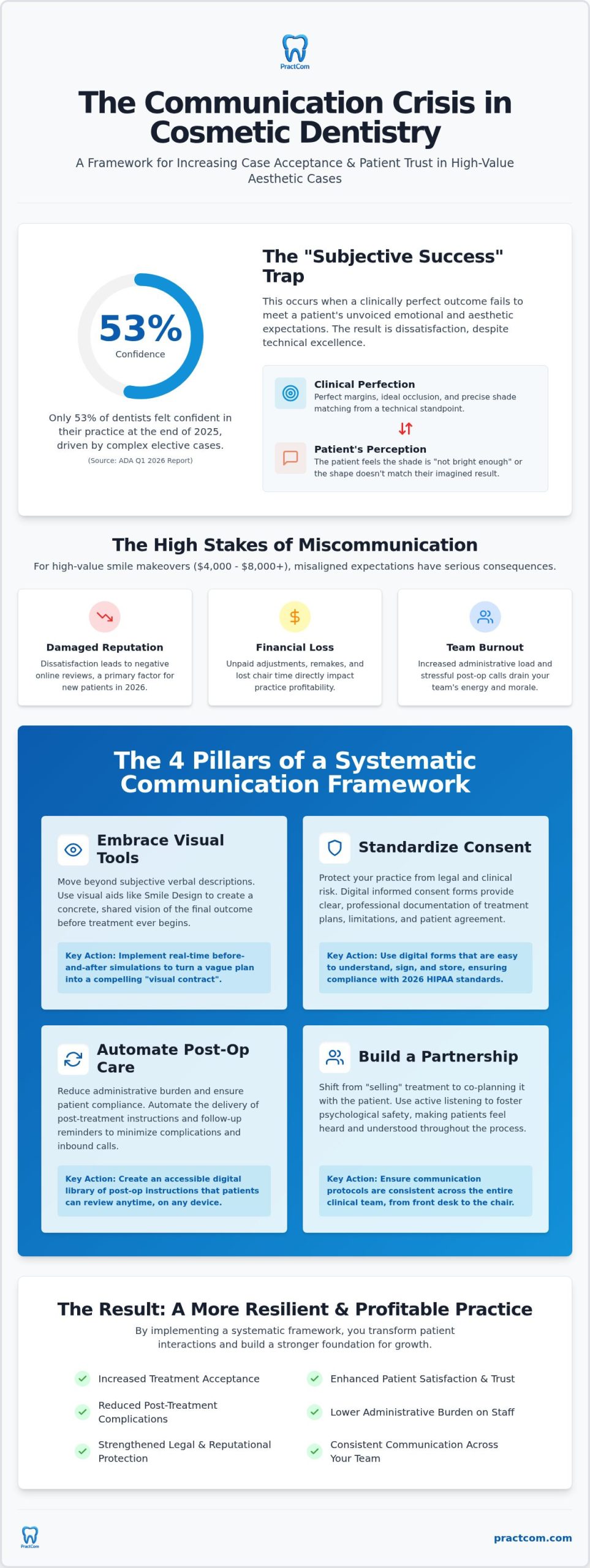
Cosmetic dentistry isn’t just about clinical outcomes; it’s about managing a patient’s self-image. While a standard filling addresses a functional need, a veneer case addresses an emotional one. This shift changes the requirements for cosmetic dentistry patient communication. You aren’t just explaining a procedure; you’re navigating a high-ticket emotional investment. According to the ADA Q1 2026 State of the U.S. Dental Economy Report, only 53% of dentists felt confident in their practice, likely due to the rising pressures of these complex elective cases. When the financial stakes are high, the communication lifecycle must be airtight from the initial inquiry to the final reveal.
The “Subjective Success” trap occurs when clinical excellence meets misaligned expectations. You might achieve perfect margins and occlusion, but if the patient feels the shade is “too bright” or “not bright enough,” the case is a failure in their eyes. This creates a cycle of unpaid adjustments and lost chair time. To avoid this, you must establish a systematic approach that prioritizes psychological safety. Patients need to feel that their aesthetic desires are heard and that the clinical limitations are clearly defined before the first prep is made.
Financial and Emotional Gravity in Cosmetic Care
Elective procedures carry a high risk of buyer’s remorse. When patients spend $4,000 to $8,000 on a smile makeover, they expect perfection. If your communication fails during the “window of doubt” between the preparation and the final seat, dissatisfaction grows. Poorly managed expectations lead to negative online reviews, which are a primary factor in how patients choose cosmetic providers in 2026. Systematic communication acts as a stabilizer. It ensures the patient feels secure throughout the lifecycle of their care, reducing the anxiety that leads to mid-treatment complaints or requests for costly changes.
The Shift from Persuasion to Partnership
Successful case acceptance relies on psychological safety. You must move away from “selling” and toward collaborative treatment planning. Active listening allows you to identify the specific aesthetic goals that matter to the individual. This partnership is anchored by the principle of informed consent, which serves as both an ethical foundation and a legal safeguard. Professional documentation isn’t just a regulatory chore; it’s a tool for building long-term trust. It ensures the patient understands the limitations of clinical results, protecting your reputation from the fallout of mismatched expectations. By standardizing this process, you create a clinical safety net for every high-ticket case.
Bridging the Expectation Gap with Visual Communication Tools
Verbal descriptions are notoriously subjective in aesthetic medicine. When you describe a result as “natural,” your patient might be envisioning a monochromatic bleached shade while you are planning a polychromatic restoration that mimics youthful enamel. This linguistic disconnect is a primary driver of post-treatment dissatisfaction. Effective cosmetic dentistry patient communication requires moving away from adjectives and toward objective visual evidence. By providing a concrete visual goal, you eliminate the ambiguity that often leads to the “Subjective Success” trap discussed previously. Visuals serve as a universal language, ensuring that both the clinician and the patient are looking at the same destination before the first unit of anesthetic is delivered.
The Role of Smile Design in Case Acceptance
Visual simulations are no longer a luxury; they are a clinical necessity for case conversion in 2026. Integrating a Smile Design tool allows you to show before-and-after cosmetic changes in real time, which drastically reduces the psychological resistance associated with elective care. This process creates a digital mock-up that aligns the patient’s desires with what is clinically possible, acting as a functional boundary for those with unrealistic expectations. PractCom’s Smile Design capabilities provide this essential clarity, transforming a vague dental plan into a compelling visual contract. When patients can see the projected outcome on their own face, their confidence increases, and the “I’ll think about it” response decreases. You can see how visual clarity drives case acceptance by standardizing this part of your consultation workflow.
Visual Aids Beyond the Smile
While the final aesthetic result is the patient’s focus, you must also communicate the underlying clinical necessity. High-quality clinical photography and anatomical models are vital for explaining why certain procedures, like crown lengthening or orthodontic alignment, are required to support the final restorations. Documenting this visual journey within a dedicated patient portal ensures the patient remains engaged between appointments. This transparency builds a layer of trust that verbal explanations alone cannot achieve. It also serves a protective function; while visuals build excitement, they also form a core part of the permanent clinical record. This alignment with ADA guidance on consent ensures that the patient’s agreement is based on a clear, visual understanding of the proposed changes. By using tooth loss charts and high-resolution images, you provide the “clinical safety net” needed to justify complex treatment plans to a discerning 2026 demographic.
Protecting the Practice: Standardized Consent and Clinical Documentation
Paper consent forms are a significant liability in 2026. They’re difficult to audit, easily misplaced, and often lack the precise language required by recent regulatory shifts. For example, the mandatory HIPAA update deadline on February 16, 2026, required all practices to revise their Notice of Privacy Practices regarding substance use disorder records. If you’re still using physical stacks of paper, you’re likely trailing behind these compliance requirements. Beyond the legal risks, paper clipboards feel antiquated to a patient about to invest thousands in their smile. Transitioning to a digital system provides an iron-clad audit trail while reinforcing the professional authority necessary for successful cosmetic dentistry patient communication.
The psychological impact of a digital consent process shouldn’t be underestimated. When a patient signs a high-resolution digital form on a tablet, it signals that your practice is meticulous and modern. This creates a sense of psychological security. It tells the patient that their case is being handled with technical precision, which is a vital component of building trust in elective care. A standardized digital approach ensures that nothing is left to human memory, protecting both the practitioner’s reputation and the patient’s health.
The Digital Consent Workflow
Transitioning from physical clipboards to digital informed consent forms removes a major administrative bottleneck. When your team can pull up a specific template for veneers, dental implants, or whitening, the process becomes seamless. Digital signatures are instantly captured and stored in the patient portal, eliminating the need for manual scanning or filing. This efficiency allows your staff to focus on the patient rather than the paperwork. By linking consent to specific cosmetic procedures, you ensure that the risks, benefits, and alternatives are clearly presented and documented for every unique case.
Reducing Liability Through Clarity
Informational overload is a common pitfall that can actually invalidate consent. If a form is a dense wall of clinical jargon, the patient isn’t truly informed. Evidence-based research on effective dentist-patient communication highlights that clarity and accessibility are the most important factors in patient comprehension. This is why 15-language support is no longer a luxury in a diverse 2026 market; it’s a requirement for true informed participation. Providing documentation in a patient’s native language ensures they fully grasp the clinical journey, which drastically reduces the risk of post-treatment disputes. See how PractCom’s digital consent reduces practice risk by providing clear, concise, and multi-language templates that protect your legal standing and your patient relationships simultaneously.
The Post-Treatment Journey: Ensuring Compliance and Satisfaction
The first 24 hours after a cosmetic procedure are the most volatile for patient satisfaction. This is when the “Compliance Gap” is widest. Patients often leave the chair in a post-operative haze, forgetting up to 80% of verbal instructions within minutes of exiting the operatory. If your cosmetic dentistry patient communication ends at the front desk, you’re leaving your clinical results to chance. Frictionless aftercare requires a digital bridge that delivers precise instructions directly to the patient’s mobile device via SMS or email. This ensures the information is accessible exactly when the patient needs it, reducing the anxiety that leads to unnecessary emergency calls.
Systematic delivery of aftercare is a professional necessity that protects your clinical work. When a patient understands how to care for their new restorations, the risk of early failure or dissatisfaction drops significantly. By shifting from verbal reminders to automated digital delivery, you create a permanent reference for the patient. This doesn’t just improve outcomes; it builds a sense of psychological security, positioning your practice as a guardian of their investment long after they’ve left the building.
Systematizing Aftercare Documentation
Consistency is the antidote to post-operative anxiety. Using a library of 80+ post-treatment templates ensures that every patient receives the same high standard of care, regardless of which staff member is assisting. For complex cosmetic reconstructions, such as full-arch rehabilitations or multi-unit veneers, generic advice isn’t enough. You need specific, customized aftercare that addresses the nuances of the case. By providing these in the patient’s native language, supported in 15 languages, you eliminate the confusion that leads to frantic phone calls. Learn more about automated dental post-op instructions to see how this system stabilizes your clinical workflow.
Automated Follow-ups as a Practice Multiplier
Manual follow-ups are an administrative drain on your team’s time. In a high-pressure 2026 clinical environment, your staff should be focused on high-value tasks, not playing phone tag. Automated patient follow-ups act as a practice multiplier by setting up “Check-in” triggers at specific intervals. These proactive digital touchpoints catch minor issues before they escalate into clinical failures or negative reviews. The ROI of reducing non-clinical administrative phone time is immediate, allowing you to scale your cosmetic volume without increasing your headcount. This systematic oversight turns a stressful post-op period into a predictable, positive experience for the patient. You can automate your follow-up workflow today to reclaim your team’s time and enhance patient satisfaction.
Implementing a Systematic Communication Framework in 2026
Efficiency in a modern clinical environment demands more than just a functional Practice Management Software (PMS). While your PMS handles the logistics of billing and scheduling, it often lacks the specialized tools necessary for high-stakes cosmetic dentistry patient communication. Relying on individual staff members to develop their own communication styles creates a lack of predictability that can damage your brand. To achieve higher treatment acceptance, you must move toward practice-wide standards where every interaction is governed by a structured framework. This systematic approach ensures that the emotional and clinical needs of the patient are met with technical precision every time.
Standardization doesn’t mean your communication becomes robotic; it means it becomes reliable. When your team follows a unified protocol, you eliminate the administrative variance that leads to mismatched expectations or forgotten follow-ups. Using a dedicated communication layer allows you to maintain oversight without micro-managing. Performance dashboards provide a clear view of communication efficacy, showing you exactly where patients are stalling in the treatment lifecycle. This data-driven approach allows for targeted team training, transforming your staff into a cohesive unit that prioritizes both clinical safety and administrative warmth.
The Clinical Communication Tech Stack
PractCom functions as the essential communication layer that sits on top of your existing software, providing the “clinical safety net” that a general PMS cannot offer. This specialized stack includes tools like the Smile Design visualization and a comprehensive library of 80+ post-treatment templates. While 2026 trends favor digital delivery via SMS and email, the system also supports physical document printing. This is a critical requirement for serving tech-averse demographics or providing tangible take-home materials for complex reconstructions. You can compare your current process with the PractCom framework to see how a dedicated communication system reduces operational resistance.
Scaling with DSOs and Multi-Location Practices
For DSOs and multi-location practices, the challenge is maintaining a consistent brand voice across dozens of providers. Centralizing your referral management system ensures that specialist coordination remains seamless, preventing high-ticket cosmetic patients from falling through the cracks during a hand-off. A unified patient portal allows for a standardized experience, regardless of which office the patient visits. This centralized control is the only way to scale a high-end cosmetic brand while protecting your legal standing and reputation. Ready to standardize your communication? Start your free trial today.
Securing Your Clinical Reputation through Systematic Communication
Success in elective care requires a shift from manual tasks to a standardized system that protects both the patient and the practitioner. You’ve learned that bridging the expectation gap with visual tools like Smile Design is the most effective way to secure case acceptance. Additionally, replacing clipboards with digital informed consent forms provides the regulatory reassurance and clinical safety net your practice needs to thrive. Optimizing your cosmetic dentistry patient communication is no longer just a soft skill; it’s a structural necessity for any practice aiming to lead in 2026.
By leveraging 80+ clinical templates and support in 15+ languages, you can serve a diverse demographic with technical precision. This systematic approach reduces the Compliance Gap and ensures that clinical excellence is matched by patient satisfaction. It’s time to move toward a future of systematic control and psychological security. Streamline your cosmetic practice with PractCom and start your free trial today. Your journey toward higher treatment acceptance and iron-clad documentation begins with a single, efficient step.
Frequently Asked Questions
How can I improve patient communication in my cosmetic dental practice?
Start by standardizing every touchpoint from the initial consultation to post-operative care. You can improve cosmetic dentistry patient communication by integrating visual aids like Smile Design to create a shared clinical goal. Moving away from manual, individual styles toward a practice-wide framework ensures consistency. This reduces administrative variance and builds psychological security, making patients feel more confident in their high-ticket elective investments.
What are the most common communication mistakes in cosmetic dentistry?
The most frequent error is relying on subjective adjectives like “natural” or “white” instead of objective visual mock-ups. Clinicians also often fail to provide clear, written documentation in the patient’s native language, leading to mismatched expectations. Another mistake is neglecting the post-treatment journey; verbal instructions are forgotten almost immediately. These failures create the “Subjective Success” trap where clinical perfection doesn’t translate to patient satisfaction.
Is digital informed consent legally binding for cosmetic procedures?
Digital informed consent is legally binding and often more defensible than paper forms in a 2026 clinical setting. Modern systems capture precise timestamps and digital signatures, creating an iron-clad audit trail for risk management. These digital records are easier to store, retrieve, and audit during regulatory reviews. Standardizing this process ensures that every patient receives the same level of risk disclosure, protecting your practice from liability.
How do automated post-op instructions reduce patient anxiety?
Automated instructions provide a permanent, accessible reference that patients can consult the moment they feel uncertain. By delivering these via SMS or email immediately after treatment, you bridge the Compliance Gap caused by post-operative haze. This proactive delivery reduces the anxiety of the unknown and minimizes the need for frantic after-hours phone calls. Consistent aftercare documentation helps patients feel protected and cared for throughout their recovery journey.
Why is multi-language support important for dental patient communication?
Multi-language support ensures that every patient fully understands the complexities and risks of their procedure, which is the foundation of true informed consent. In a diverse 2026 market, providing documents in 15 different languages removes linguistic barriers that could lead to clinical misunderstandings. It demonstrates a high level of professional empathy and administrative warmth. This inclusivity builds deeper trust with high-end demographics and reduces the risk of post-treatment disputes.
Can better communication actually increase my case acceptance rates?
Better cosmetic dentistry patient communication directly correlates with higher treatment acceptance because it builds the psychological safety necessary for elective spending. When patients see a clear visual roadmap and receive professional, structured documentation, their hesitation decreases. Reducing administrative friction and providing clear visual proof moves the conversation from sales to partnership. This systematic clarity helps eliminate the “I’ll think about it” response by addressing patient concerns before they arise.
What features should I look for in dental patient communication software?
Look for a dedicated communication layer that offers a library of 80+ clinical templates and automated follow-up capabilities. Essential features include multi-language support, digital informed consent, and visual tools like Smile Design. The software should be independent of your PMS to ensure specialized oversight of the patient experience. Accuracy, speed, and ease of use are critical for reducing operational resistance in a high-pressure modern dental office.
How does Smile Design software help with patient expectations?
Smile Design software transforms vague verbal descriptions into a concrete visual contract between the clinician and the patient. It allows you to show before-and-after cosmetic changes on the patient’s own face, setting objective boundaries for what is clinically possible. This alignment prevents the dissatisfaction that occurs when a patient’s imagination exceeds clinical reality. By creating a shared visual goal, you ensure that success is defined by mutual understanding rather than subjective interpretation.

Article by
Cary Ganz DDS
Dr. Cary H. Ganz is a dentist, prosthodontist, entrepreneur, lecturer, and author with more than 50 years of experience in clinical dentistry and dental technology. Throughout his career, he has combined hands-on patient care with a deep understanding of how technology can improve dental practice operations, communication, documentation, and patient outcomes.
In addition to his clinical background, Dr. Ganz has held significant leadership roles in the dental technology industry, including Past Owner and Vice President of Clinical Affairs at DEXIS Digital Radiography and Past Vice President of Clinical Affairs at Denticon Practice Management Software. His business experience includes product development, clinical strategy, dental software innovation, practice management solutions, and educating dental professionals on the effective use of technology in modern dentistry.
Today, Dr. Ganz continues to focus on creating practical technology solutions for dental practices, including PractCom, a comprehensive dental practice communication platform designed to improve patient communication, documentation, compliance support, referrals, and overall practice efficiency. His work reflects a career-long commitment to helping dentists deliver better care while making their practices more organized, efficient, and protected.
No responses yet