
If over half of dental practices are currently struggling with staffing shortages in 2026, why is your front desk still spending hours manually tracking down missing specialist consult notes? You understand the “referral black hole” all too well. It begins with a paper slip and often ends with a patient who never books or a specialist report that never arrives, leaving your clinical records incomplete and your revenue leaking. This operational disorganization doesn’t just waste time; it creates a gap in the continuity of care that puts your practice’s reputation at risk.
By adopting dental referral workflow automation, you can transform the traditional referral process into a tracked, digital journey that provides psychological security for both your team and your patients. We’ll show you how to close the communication loop, eliminate manual follow-up tasks, and standardize documentation across your entire referral circle. You’ll discover a systematic approach to strengthening specialist bonds while ensuring that every referred patient actually receives the care they need, moving your practice from administrative resistance to total clinical control.
Key Takeaways
- Learn how to replace unreliable paper slips with a cloud-based tracking system that ensures no patient is lost during the transition to a specialist.
- Discover how dental referral workflow automation closes the communication loop by instantly synchronizing clinical notes and digital consent forms between practices.
- Address the root causes of referral leakage to capture the 30-50% of production typically lost when patients fail to schedule their specialist consultations.
- Eliminate clinical confusion by standardizing post-treatment instructions, ensuring patients receive consistent guidance that reduces unnecessary emergency visits.
- Explore how a dedicated communication platform acts as a stabilizing force for your team, providing regulatory reassurance and psychological security for every referral.
What is Dental Referral Workflow Automation?
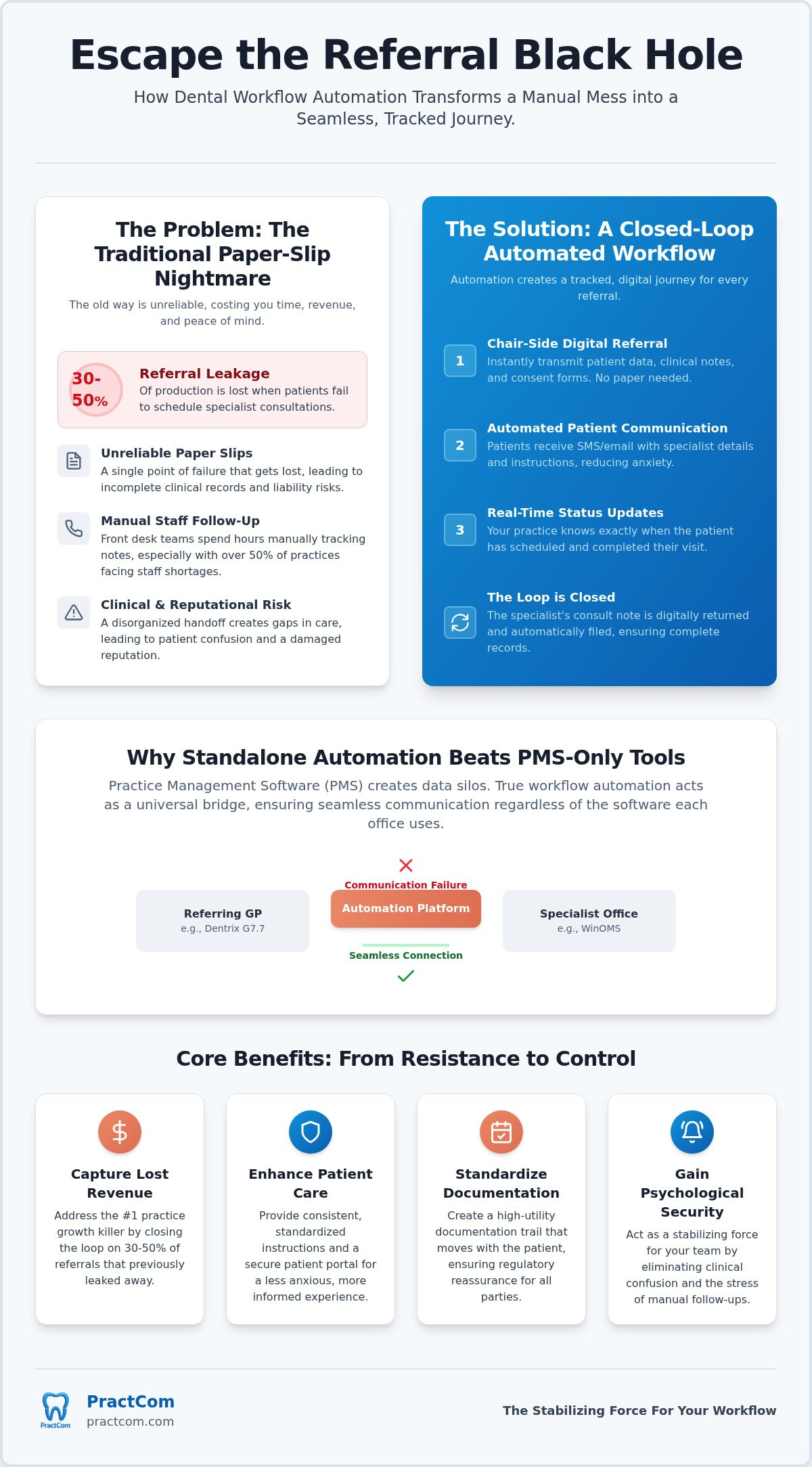
At its core, dental referral workflow automation is a specialized digital ecosystem designed to track a patient’s journey from the initial referral chair-side at a GP office to the specialist consultation and back again. It moves beyond the limitations of the traditional “referral slip,” which is often a piece of paper that represents a single point of failure. Instead, this technology creates a living, tracked record that ensures no clinical details are lost in transit. By 2026, the shift from analog paper to cloud-based, real-time tracking has become a clinical necessity rather than a luxury. This transition provides a stabilizing force in high-pressure environments where human memory and manual tracking often fail.
Modern clinical safety standards now demand a “closed-loop” communication system. This means that for every referral sent, there must be a verified receipt, a scheduled appointment, and a returned consult note. Without this loop, practices face significant liability risks and “referral leakage.” Since the average annual patient attrition rate currently sits at 17%, losing a patient during a specialist handoff is a growth killer you can’t afford. Automation solves this by acting as a guardian of your reputation, ensuring that every Electronic Health Record (EHR) and radiograph reaches its destination securely and on time.
The Anatomy of an Automated Referral
A truly automated system functions as a seamless extension of your clinical routine. It begins with the instant digital transmission of patient data, eliminating the need for patients to carry physical folders or for staff to spend hours on the phone. Once the referral is initiated, the system triggers automated SMS and email notifications directly to the patient. These messages contain specialist details and preparation instructions, which reduces patient anxiety and confusion. For the referring GP, the system provides real-time status updates. You’ll know exactly when a patient has scheduled their visit and when the specialist has completed the treatment, providing the psychological security of knowing your patients are being cared for.
Why Standalone Automation Beats PMS-Only Tools
Many practices rely solely on their Practice Management Software (PMS) for referrals, but this often leads to operational resistance. A GP might use Dentrix G7.7 while their preferred oral surgeon uses WinOMS. These systems rarely communicate effectively across different platforms. Standalone dental referral workflow automation bridges this gap by providing a standardized communication protocol that works regardless of which software each office uses. It allows you to implement a high-level system without the trauma of a full software migration. This approach values your time and accuracy, offering a pre-emptive strike against the administrative failures that typically occur when data is trapped in siloed systems. You can explore how this specialized layer adds value by reviewing our comparison of communication tools.
The Mechanics of Closing the Referral Loop
Closing the clinical loop isn’t just a matter of convenience; it’s a professional necessity that ensures patient safety and practice growth. The process of dental referral workflow automation begins at the chair-side. Instead of handing a patient a paper slip, your team captures digital informed consent and clinical notes directly into the system. This initial step creates a high-utility documentation trail that moves with the patient, providing regulatory reassurance from the very start.
Once the GP office completes the referral, the system manages the automated delivery of the referral package. This includes radiographs, clinical notes, and patient history. For this to work across different practices, a high level of healthcare interoperability is required. Automation ensures that your data reaches the specialist regardless of the software they use, effectively bridging the gap between independent offices. Patients then receive access to a secure Patient Portal, where they can view their referral details and specialist information in a central, organized location.
The loop remains open until the GP receives a digital consult note back from the specialist. Automation monitors this timeline, providing a structured remedy for the “missing report” problem. If a consult note isn’t received within a set timeframe, the system can prompt the specialist’s office, ensuring your clinical records remain complete without requiring manual front-desk intervention. You can explore how automated loops protect your clinical standing by viewing our system capabilities.
Automated Patient Follow-ups
Many referrals fail because patients lose momentum once they leave your office. Automated SMS nudges provide a gentle reminder to book the appointment, significantly reducing the “forgotten referral” syndrome. These notifications include specialist maps and contact info, removing operational resistance for the patient. By using dental referral workflow automation for these follow-ups, you also create an opportunity to gather patient feedback, allowing you to monitor the quality of the specialist experience you’re recommending.
Performance Tracking and Dashboards
To truly optimize your practice, you need to see the data behind your professional network. A Practice Performance Dashboard allows you to visualize your referral ROI by identifying which specialists have the highest treatment acceptance rates. You can measure the average time from the initial referral to the actual consultation. This data-driven approach transforms your referral circle into a high-performance network, ensuring your patients receive timely care while maximizing your practice’s production potential.
Addressing Referral Leakage: The #1 Practice Growth Killer
Industry data reveals a staggering reality for many clinicians. Between 30% and 50% of dental referrals never actually result in a scheduled appointment. This phenomenon, known as referral leakage, represents a massive gap in both clinical care and practice revenue. When a patient leaves your office with nothing but a paper slip and a verbal instruction, they often enter a “black hole” of confusion and anxiety. Without a structured follow-up, the urgency of the treatment fades, and the patient’s health remains at risk while your production numbers suffer.
Implementing dental referral workflow automation transforms this fragmented experience into a high-tech, high-touch patient journey. By providing immediate, digital confirmation of the referral, you offer the regulatory reassurance that patients need to feel secure. They don’t have to wonder if the specialist received their files or if they’ll be “lost in the system.” Instead, they receive consistent, professional communication that reinforces your role as a protective guardian of their health. This level of oversight moves the patient from a state of administrative resistance to the confidence required to proceed with specialist care.
The Role of Multi-Language Support
Barriers to care aren’t always logistical; they’re often linguistic. If a patient doesn’t fully understand the specialist’s role or the necessity of the procedure, they won’t show up. Our system addresses this by providing support for 15 different languages across all documents and notifications. This ensures that informed consent is truly “informed” for every demographic in your community. When patients receive instructions in their primary language, specialist show-rates increase because the operational resistance of a language barrier has been removed. It’s a simple, systematic way to ensure compliance and safety across diverse populations.
Strengthening the GP-Specialist Bond
Specialists value referral partners who make their clinical lives easier. When you use dental referral workflow automation, you provide specialists with clean, standardized documentation every single time. Their staff won’t have to waste hours chasing missing radiographs or clarifying clinical notes. This efficiency creates a stabilizing force in the professional relationship, making you a preferred partner in the referral circle. You can learn more about mastering dental referral management software in 2026 to further professionalize these vital clinical connections. By reducing the administrative friction for the specialist’s team, you ensure your patients are prioritized and your consult notes are returned promptly.
Standardizing Post-Treatment Instructions in the Referral Workflow
One of the most significant points of clinical failure occurs during the transition from the specialist back to the general practitioner. Patients often find themselves caught in a web of conflicting instructions, where the GP says one thing and the specialist says another. This inconsistency doesn’t just breed anxiety; it leads to a direct increase in emergency calls to both offices. Standardizing these hand-offs through dental referral workflow automation ensures that every provider in the circle of care is speaking with one voice, providing the patient with a single, authoritative source of truth for their recovery.
By integrating a comprehensive Post-Treatment Instruction Library into the referral hand-off, you eliminate the reliance on verbal instructions that are easily forgotten. Instead of a photocopied sheet that gets lost in a car door, patients receive digital access to their aftercare via text or email. This ensures they have the information on their phone exactly when they need it, whether that’s late at night or during a weekend. This systematic approach values the patient’s time and provides a structured remedy for post-operative confusion, effectively reducing the administrative burden on your front-desk team. You can standardize your patient instructions today to see an immediate reduction in non-clinical follow-up calls.
Standardization as Risk Management
From a clinical standpoint, consistency is your best defense against liability. Automation creates a definitive paper trail of exactly what instructions were given, when they were sent, and whether the patient accessed them. When you pair this with Digital Dental Informed Consent Forms, you build a robust shield of regulatory reassurance around your practice. This level of documentation is an ethical necessity in 2026, moving your practice away from the risks of manual oversight toward the confidence of a standardized, legally defensible system. Consistent messaging also reinforces patient trust, as they see a unified front between their primary dentist and the specialist.
The Smile Design Tool: Visualizing the End Goal
Complex referrals often involve procedures that can feel intimidating or purely “surgical” to the patient. To bridge the gap between clinical necessity and patient desire, our system includes a Smile Design tool that allows patients to visualize cosmetic before-and-after changes. This visual aid is a powerful motivational force, especially for multi-stage referral cases like implants or full-mouth reconstructions. It shifts the patient’s focus from the immediate procedure to the ultimate result, building excitement for the treatment plan. By showing the end goal early in the referral process, you increase treatment acceptance and ensure the patient remains committed to the journey across both clinical settings.
Implementing PractCom: The Stabilizing Force for Your Workflow
Adopting dental referral workflow automation doesn’t require the operational trauma of a full software migration. PractCom functions as a specialized communication layer that integrates with your existing routine without attempting to replace your Practice Management Software (PMS). It acts as a stabilizing force, providing the technical precision needed to close clinical gaps while maintaining the administrative warmth your patients expect. This “Peer-to-Peer” approach is fundamental to our design; the system was built by dental professionals who understand the physical and logistical realities of a high-pressure clinical environment. We don’t just provide a tool; we offer a systematic way to move from administrative chaos to total clinical control.
For larger organizations, managing the referral circle becomes exponentially more complex. Scaling communication for DSOs and multi-site groups requires a platform that can maintain standardized documentation across dozens of locations and hundreds of specialist partners. PractCom ensures that whether you are a single-doctor practice or a large group, your referral protocol remains consistent, professional, and fully tracked. This level of oversight protects your reputation and ensures that your growth is built on a foundation of efficient, closed-loop communication rather than intensive manual labor.
Why PractCom is the Ethical Choice
Choosing to automate your referral workflow is an ethical decision that prioritizes patient safety and understanding. By providing simplified, multi-language documentation in 15 different languages, you ensure that every patient, regardless of their background, can navigate their specialist care with confidence. This systematic oversight ensures that no patient “falls through the cracks” of a manual tracking system, which is a common failure point in traditional offices. Protecting your practice’s reputation starts with professional, branded communication that signals to your patients and specialist partners that you are a forward-thinking, protective guardian of their health.
Getting Started with Automation
The first step toward systematic control is evaluating your current referral completion rate. Most practices are surprised to find a 10-15% gap between production and collections, often driven by referral leakage. Once you identify these gaps, you can begin setting up your customized library of 80+ post-treatment templates to ensure your clinical messaging is consistent and clear. Our mission is to bridge these clinical communication gaps and provide the psychological security that comes with a standardized system. You can learn more about our About Us mission and how we support the daily operational demands of the modern dental profession. By replacing operational resistance with automated ease, you allow your team to focus on patient care rather than administrative follow-up.
Taking Control of Your Clinical Communication Cycle
The transition from manual, paper-based referrals to dental referral workflow automation is more than a technical upgrade; it’s a commitment to clinical excellence and patient safety. By closing the communication loop, you eliminate the operational resistance that causes patients to fall through the cracks. A standardized system provides the regulatory reassurance needed in 2026, ensuring that every specialist hand-off is tracked, documented, and professional.
You can implement these vital safeguards without the stress of a full PMS switch. With support for 15 languages and a comprehensive library of 80+ clinical templates, your practice can provide clear, authoritative guidance to every patient demographic. This systematic approach doesn’t just protect your reputation; it builds a foundation of trust with your specialist partners and ensures your clinical notes never go missing again.
Start your free trial of PractCom’s referral management system today to move from administrative chaos to systematic control. Your team deserves the psychological security of a workflow that actually works, and your patients deserve the continuity of care that only modern automation can provide. We’re here to help you bridge the gap and strengthen your professional circle.
Frequently Asked Questions
How does dental referral workflow automation reduce referral leakage?
Dental referral workflow automation reduces leakage by replacing vulnerable paper slips with a digital tracking system that follows the patient from your chair to the specialist’s office. It uses automated SMS and email nudges to remind patients to book their consultations, ensuring the referral doesn’t get forgotten once they leave your practice. This consistent follow-up closes the loop and captures the 30-50% of production typically lost in manual systems.
Can I use referral automation if I am not using a specific Practice Management Software?
You can absolutely use this technology without switching your current Practice Management Software. Our system functions as a specialized communication layer that bridges the gap between different clinical platforms, such as Dentrix or WinOMS. This allows you to standardize your referral process and maintain systematic control even if you and your specialist partners use entirely different software systems.
Is automated referral tracking HIPAA compliant?
Yes, our automated referral tracking is designed with a primary focus on HIPAA compliance and data security. It provides regulatory reassurance by encrypting all electronic Protected Health Information (ePHI) both in transit and at rest. This protects your practice’s legal standing while ensuring that sensitive clinical data remains accessible only to authorized providers within the referral circle.
How do specialists receive the referral information from an automated system?
Specialists receive a secure digital package that includes radiographs, clinical notes, and patient history instantly. This eliminates the need for their staff to spend hours chasing missing documents or manually entering data from a faxed sheet. It creates a seamless hand-off that values their time and accuracy, positioning your practice as a reliable and professional referral partner.
What languages are supported for patient instructions and consent forms?
We support 15 different languages for all patient instructions, consent forms, and referral notifications. This multi-language support ensures that every patient truly understands their treatment plan and aftercare requirements. By removing language barriers, you increase specialist show-rates and ensure that informed consent is truly “informed” across all demographics in your community.
Will automation make my practice feel less personal to my patients?
Automation actually enhances the patient experience by providing “administrative warmth” and consistent communication. It removes the “black hole” effect that occurs when patients feel abandoned after a referral is made. By providing timely updates and easy access to specialist details on their mobile devices, you’re acting as a stabilizing force and a protective guardian of their care journey.
How do I track if a patient actually scheduled their specialist appointment?
You can track the patient’s progress in real-time through a dedicated Practice Performance Dashboard. The system provides status updates, such as “Appointment Scheduled” or “Consultation Completed,” once the specialist’s office confirms the booking. This visibility allows you to monitor your referral ROI and identify exactly which patients need a gentle nudge to move forward with their care.
What happens if a patient loses their physical referral slip?
If a patient loses their physical slip, it doesn’t disrupt their care because all necessary information is stored digitally. They can access specialist maps, contact info, and pre-op instructions through their secure Patient Portal or via their text history. This eliminates the operational resistance of having to call your office for a replacement, saving your front-desk team valuable time.

Article by
Cary Ganz DDS
Dr. Cary H. Ganz is a dentist, prosthodontist, entrepreneur, lecturer, and author with more than 50 years of experience in clinical dentistry and dental technology. Throughout his career, he has combined hands-on patient care with a deep understanding of how technology can improve dental practice operations, communication, documentation, and patient outcomes.
In addition to his clinical background, Dr. Ganz has held significant leadership roles in the dental technology industry, including Past Owner and Vice President of Clinical Affairs at DEXIS Digital Radiography and Past Vice President of Clinical Affairs at Denticon Practice Management Software. His business experience includes product development, clinical strategy, dental software innovation, practice management solutions, and educating dental professionals on the effective use of technology in modern dentistry.
Today, Dr. Ganz continues to focus on creating practical technology solutions for dental practices, including PractCom, a comprehensive dental practice communication platform designed to improve patient communication, documentation, compliance support, referrals, and overall practice efficiency. His work reflects a career-long commitment to helping dentists deliver better care while making their practices more organized, efficient, and protected.
No responses yet