
What if the greatest risk to your practice isn’t a clinical error, but a communication breakdown you haven’t even noticed yet? You likely feel the daily strain of high-volume post-op calls and the persistent anxiety that your documentation might not meet the 2026 ADA sedation guidelines. It’s a common struggle to balance technical precision with the administrative warmth patients now expect. By prioritizing dental patient journey mapping, you can transform these scattered touchpoints into a robust safety net that protects your reputation and your peace of mind.
We agree that relying on human memory in a high-pressure environment is a recipe for operational resistance. This guide will show you how to master the art of journey mapping to eliminate communication gaps, reduce liability, and build lasting patient trust through systematic oversight. We will preview the essential steps to standardize your clinical outreach, use visualizations to improve case acceptance, and leverage automation to ensure every referral is tracked with absolute certainty.
Key Takeaways
- Understand how dental patient journey mapping serves as a protective clinical layer, shielding your practice from preventable liability and administrative gaps.
- Close the “Evaluation Gap” by utilizing digital documentation and visualization tools to build patient trust before the first procedure.
- Mitigate post-surgical anxiety by deploying automated, multi-channel aftercare instructions that decrease the volume of non-emergency phone calls.
- Eliminate “referral leaks” through standardized digital hand-offs that maintain visibility and clinical continuity between providers.
- Leverage systematic automation to meet 2026 regulatory requirements while reducing the operational burden on your clinical staff.
What is Dental Patient Journey Mapping in 2026?
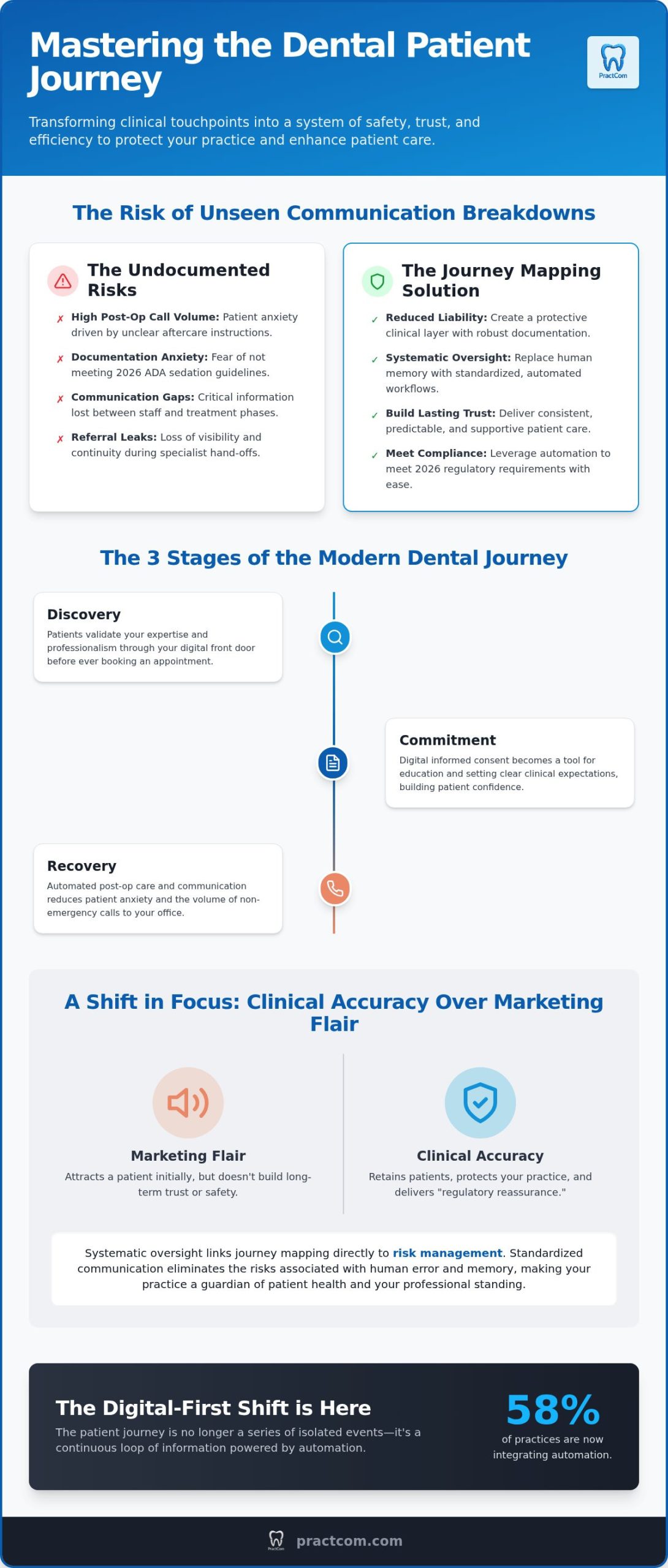
In the current clinical landscape, your practice operates as a high-stakes communication environment where every digital and physical touchpoint carries weight. Dental patient journey mapping is the strategic visualization of every interaction between the patient and your team. This process differs fundamentally from a marketing funnel because its primary goal is clinical safety rather than just acquisition. While a retail customer journey mapping model might prioritize speed, your clinical map must prioritize technical precision and regulatory compliance. Documentation acts as the “silent partner” in this journey, working behind the scenes to ensure that no critical information is lost during transitions between staff members or treatment phases.
The 2026 shift toward digital-first, paperless interactions has changed how we define the patient experience. With 58% of practices now integrating automation, the journey is no longer a series of isolated events. It’s a continuous loop of information. By mapping this journey, you replace operational disorganization with systematic control. This ensures that every patient receives a consistent standard of care, regardless of the complexity of their procedure. It positions your practice as a reliable professional ally that anticipates patient needs before they become administrative burdens.
The Stages of the Modern Dental Journey
The modern journey is divided into Discovery, Commitment, and Recovery. In the Discovery phase, patients validate your expertise via digital front doors. Commitment is the stage where informed consent becomes a tool for setting clinical expectations. Finally, Recovery is the often-neglected phase where poor communication leads to high post-op call volumes. Unlike competitors who focus primarily on the physical reception space, dental patient journey mapping covers the entire clinical lifecycle, ensuring that the patient feels supported from the initial search to the final follow-up.
Why Clinical Accuracy Trumps Marketing Flair
Marketing flair might attract a patient, but clinical accuracy is what retains them and protects your practice. We prioritize “regulatory reassurance” because it alleviates the anxiety practitioners feel regarding compliance. Standardizing your instructions reduces patient fear more effectively than a modern waiting room ever could. This systematic oversight links journey mapping directly to risk management. When your communication is standardized, you eliminate the risks associated with human error and memory. This makes your practice a guardian of the patient’s health and your own professional standing, ensuring no part of the professional communication process is left to chance.
Mapping the Pre-Treatment Phase: Consent and Visualization
The transition from diagnosis to commitment is often where practices lose momentum. We call this the “Evaluation Gap.” It occurs when a patient understands the clinical need but lacks the psychological security to proceed. Effective dental patient journey mapping identifies this specific friction point and addresses it through standardized visualization and documentation. A recent dental patient journey case study highlights that mapping these early touchpoints allows clinicians to align their communication with patient expectations before the chair is even reclined. By identifying where patients stall, you can deploy targeted tools to move them forward with confidence.
Standardizing the intake process is the first step in creating this confidence. When your intake is digital and systematic, you ensure no clinical data is missed. This creates a professional environment that prioritizes accuracy over administrative flair. It also sets the tone for the rest of the journey, signaling to the patient that their care is managed by a highly organized team. By utilizing dental patient journey mapping, you transform the intake process into a strategic bridge that reduces the resistance of manual tasks for your staff, ensuring they have the time to focus on the patient’s immediate concerns.
Digital Informed Consent as a Journey Anchor
Moving beyond the traditional paper clipboard is now a professional necessity. Digital Dental Informed Consent Forms transform a legal requirement into a comprehensive education experience. These forms provide time-stamped, digital documentation that protects your practice against liability. By using a standardized system, you alleviate the anxiety associated with compliance, especially following the April 2026 ADA sedation guideline updates. This creates a regulatory safety net that human memory simply cannot replicate. It ensures that every patient receives the same high standard of information, regardless of which team member is assisting them.
Visualizing Success with Smile Design
Patients often struggle to commit to cosmetic changes because they cannot visualize the outcome. Smile design tools bridge this communication gap by showing before-and-after results instantly. This visualization provides the psychological security necessary for high-value case acceptance. When a patient sees their future smile, their commitment level shifts from curiosity to conviction. It’s a pragmatic tool for any business owner looking to reduce operational resistance during the consultation phase. In 2026, patients expect this level of transparency; providing it demonstrates that you are a forward-thinking provider who values their input and peace of mind.
To see how these tools integrate into your workflow, you can explore our systematic communication suite today.
The Post-Treatment Danger Zone: Aftercare Automation
The post-treatment danger zone occurs when the clinical setting is replaced by the isolation of home. Patients feel most vulnerable 2-4 hours after treatment. As the anesthesia fades, anxiety rises. If your practice lacks a structured follow-up, this vulnerability transforms into “friction.” This friction manifests as a high volume of post-op phone calls that disrupt your front office and increase your team’s stress. A robust strategy for dental patient journey mapping ensures that patients don’t feel abandoned the moment they leave your operatory. By understanding patient journey mapping as a clinical safety net, you can provide a stabilizing force that guides patients through the first 48 hours of recovery.
Automated follow-ups serve as a pre-emptive strike against administrative failure. They provide the psychological security patients need by delivering clinical instructions exactly when they are most likely to be forgotten. We understand the limitations of human memory, especially after a stressful procedure. Relying on verbal instructions or hand-written notes is an operational risk. Moving toward a standardized system allows you to replace resistance with the confidence of systematic control. This approach doesn’t just improve the patient experience; it acts as a guardian of your practice’s legal standing by ensuring documentation is consistently delivered and tracked.
Standardizing Post-Op Instructions
Relying on hand-written notes or generic photocopies is a liability in 2026. Standardizing your outreach with a library of 80+ templates ensures technical precision for every procedure. These Automated Dental Post-Op Instructions answer common recovery questions before they turn into emergency calls. When you provide clear, procedure-specific guidance, you reduce the anxiety that leads to unnecessary office visits. This consistency is an ethical necessity that protects both the patient and your reputation. It transforms a chaotic post-op period into a predictable, managed recovery phase.
Multi-Channel Delivery: SMS, Email, and Print
Accessibility is a cornerstone of modern dental patient journey mapping. Patients in 2026 prefer the immediacy of SMS for clinical alerts, but physical print options remain essential for compliance and accessibility. Your system must bridge the gap between digital speed and logistical reality. Multi-channel delivery ensures that no patient is left behind due to a technology barrier. Furthermore, offering instructions in 15 languages is no longer optional; it is a clinical requirement for ensuring post-op compliance across diverse patient populations. Providing clear directions in a patient’s native language removes the final barrier to a successful recovery and reinforces the trust you’ve built throughout the journey.
Mapping the Specialist Hand-off: Referral Management
The moment a patient leaves your office with a referral is the moment your treatment plan is most at risk. We identify this as the “Referral Leak,” a critical friction point where patients fail to schedule with specialists, leading to stalled care and lost revenue. In the context of dental patient journey mapping, the hand-off to a specialist is not just a clinical suggestion; it is a vital communication loop that requires systematic oversight. When you lose visibility into whether a patient has followed through, you lose control over the clinical outcome and your practice’s reputation. Establishing a secure, digital connection between general practitioners and specialists ensures that the patient journey remains continuous and protected.
Automated referral tracking acts as a guardian of your professional standing. By centralizing clinical data within a patient portal during these hand-offs, you provide a seamless transition that reduces patient anxiety. This high-utility approach replaces the uncertainty of manual follow-ups with the confidence of a standardized system. It allows you to function as a reliable professional ally, ensuring that the specialist has all necessary documentation while the patient feels supported throughout the transition. This level of organization is an ethical necessity in a modern clinical environment where the limitations of human memory can lead to administrative failure.
Eliminating the “Referral Slip” Mentality
Relying on paper slips is the weakest link in your communication strategy. These slips are easily lost or ignored, creating a significant gap in the patient experience. To provide true regulatory reassurance, you must move toward a secure, digital ecosystem. Mastering Dental Referral Management requires a shift from passive “slips” to active, tracked digital hand-offs. This transition reduces operational resistance for your team and ensures that every referral is documented with technical precision. By 2026, patients expect their clinical data to move as fast as they do, and a digital system is the only way to meet that expectation.
Closing the Loop with Practice Dashboards
Performance dashboards allow you to track referral status in real-time, providing a pre-emptive strike against patient drop-off. By monitoring these metrics, you can identify bottlenecks in the specialist journey before they result in a negative patient experience. This level of systematic control is essential for building long-term patient loyalty. When you can see exactly where a patient stands in the referral process, you can intervene with administrative warmth and technical accuracy. This proactive approach ensures that no part of the professional communication process is left to chance, reinforcing the trust you’ve worked hard to build.
To eliminate referral leaks and secure your patient journey, get started with our referral management system today.
Optimizing Workflows: The PractCom Systematic Approach
A truly optimized practice requires more than just clinical skill; it demands a communication layer that bridges the gaps between diagnosis, treatment, and recovery. By adopting dental patient journey mapping, you transition from a reactive posture to one of systematic control. This approach integrates seamlessly into your daily huddles, allowing your team to identify which patients require specific outreach or multi-language support. In a modern clinical environment, providing instructions in 15 different languages is not merely a courtesy. It is a fundamental requirement for ensuring patient safety and regulatory compliance. PractCom functions as the guardian of these standards, offering a pre-emptive strike against the communication failures that lead to patient anxiety and legal risk.
We understand the operational stresses of a high-pressure setting. This is why our system focuses on reducing operational resistance through automation. When your team uses standardized templates instead of drafting unique messages for every case, they regain valuable time. This efficiency allows you to maintain administrative warmth without sacrificing technical precision. You aren’t just sending a text; you are providing a structured remedy to a common professional pain point. This systematic oversight ensures that no part of the patient experience is left to chance, creating an immediate bond of trust through consistent, professional interaction.
Beyond the Practice Management Software (PMS)
Many practitioners mistakenly believe their PMS handles all necessary communication. While a PMS is essential for scheduling and billing, it often lacks the specialized clinical depth required for high-utility patient education. Optimizing dental practice workflow requires a dedicated toolset that sits alongside your primary software. A specialized library of 80+ post-treatment templates offers a level of detail that generic PMS templates cannot match. This distinction is critical for risk management; specialized instructions provide the regulatory reassurance needed to alleviate practitioner anxiety regarding documentation. By using a dedicated communication layer, you ensure that your clinical standards are reflected in every digital touchpoint.
Getting Started with Journey Mapping
Transitioning to a standardized system begins with a clear audit of your current patient touchpoints. Identify where your team spends the most time on manual tasks or where patients frequently express confusion. Once these friction points are identified, you can deploy automated workflows to seal the leaks. You can start a free trial to test how these automated sequences reduce your front-office workload while improving patient compliance. The path from operational disorganization to systematic clinical control is paved with standardized tools. By embracing this forward-thinking approach, you protect your reputation and ensure your practice remains a stabilizing force in your patients’ lives.
Secure Your Practice with Systematic Clinical Communication
Mastering dental patient journey mapping is the most effective way to transition your practice from operational resistance to systematic control. By standardizing every touchpoint, you don’t just improve efficiency; you act as a guardian of your patient’s safety and your own professional reputation. Identifying the “Evaluation Gap” and the “Post-Op Danger Zone” allows you to deploy targeted remedies that human memory simply cannot match. You’ve worked hard to build your clinical expertise; your communication system should reflect that same level of precision.
Whether you are utilizing our library of 80+ clinical templates or ensuring compliance through our 15-language support, you are building a foundation of trust that lasts far beyond the final appointment. Our referral management suite ensures that no patient is lost during a specialist hand-off, providing the regulatory reassurance every modern practitioner needs. It’s time to move away from fragmented communication and embrace a comprehensive ecosystem designed for the high-pressure realities of 2026.
Streamline your clinical journey with PractCom and start your free trial today. You have the expertise to provide world-class care; let us provide the system that ensures your patients feel that commitment at every step. We are ready to help you build a more secure, efficient, and trusted practice.
Frequently Asked Questions
What is the most common “weak link” in a dental patient journey map?
The most frequent breakdown occurs in the “Post-Treatment Danger Zone,” specifically the first two to four hours after a patient leaves the office. This gap exists because verbal instructions are often forgotten as anesthesia wears off, leading to patient anxiety and a high volume of repetitive phone calls. By utilizing dental patient journey mapping, you can identify this specific friction point and bridge it with automated, digital instructions that provide immediate clinical clarity.
How does digital informed consent improve the patient journey?
Digital informed consent transforms a legal requirement into a trust-building educational experience that sets clear clinical expectations. It provides the technical precision of time-stamped documentation, which is essential for meeting the April 2026 ADA sedation and anesthesia guidelines. This systematic approach reduces your practice’s liability while offering patients the psychological security of a standardized, professional intake process that respects their time and understanding.
Can automated post-op instructions really reduce phone calls to the office?
Automated instructions significantly lower the volume of incoming calls by preemptively answering common recovery questions before they turn into office interruptions. When you deploy a library of 80+ standardized templates via SMS or email, you ensure every patient receives accurate, procedure-specific guidance. This proactive strategy eliminates the inconsistencies of human memory, allowing your team to maintain administrative warmth without being overwhelmed by routine post-surgical inquiries.
Why is multi-language support important for patient journey mapping?
Multi-language support is a clinical necessity that ensures post-operative compliance and safety across diverse patient populations. Providing documentation in 15 languages removes the communication barriers that often lead to medication errors or recovery complications. It functions as a protective layer for your practice, ensuring that every patient, regardless of their primary language, receives the same high standard of care and technical instruction throughout their recovery.
How do I map a patient referral to a specialist?
Mapping a referral involves replacing outdated paper slips with a digital, closed-loop communication system. You must track the patient’s progress from the moment the referral is generated to the final specialist report using a dedicated referral management suite. This level of systematic oversight prevents “referral leaks” and ensures that you remain a reliable professional ally by maintaining visibility into the patient’s entire clinical journey.
Is journey mapping only for large dental service organizations (DSOs)?
Solo practices often benefit the most from dental patient journey mapping because it reduces the operational resistance caused by limited staffing. Automation allows smaller teams to provide a high-utility, standardized experience that rivals much larger organizations. By implementing a dedicated communication suite, solo practitioners can achieve systematic control over their workflows, ensuring that no administrative detail is overlooked despite the pressures of a busy clinical schedule.
How often should a dental practice update its journey map?
You should audit your journey map annually or immediately following significant regulatory changes to ensure continued compliance. For example, the February 2026 HIPAA updates regarding SUD records and the April 2026 ADA sedation guidelines required practices to update their Notice of Privacy Practices and consent protocols. Regular reviews allow you to identify new bottlenecks and ensure your documentation remains a stabilizing force in a shifting regulatory environment.
What tools are essential for mapping the 2026 dental patient experience?
The essential toolset includes digital informed consent forms, a comprehensive library of post-treatment instructions, and a robust referral management system. You also need visualization tools, such as smile design software, to bridge the “Evaluation Gap” during cosmetic consultations. These components should integrate into a single communication layer that sits alongside your practice management software, providing the systematic oversight necessary for a modern, tech-savvy practice.

Article by
Cary Ganz DDS
Dr. Cary H. Ganz is a dentist, prosthodontist, entrepreneur, lecturer, and author with more than 50 years of experience in clinical dentistry and dental technology. Throughout his career, he has combined hands-on patient care with a deep understanding of how technology can improve dental practice operations, communication, documentation, and patient outcomes.
In addition to his clinical background, Dr. Ganz has held significant leadership roles in the dental technology industry, including Past Owner and Vice President of Clinical Affairs at DEXIS Digital Radiography and Past Vice President of Clinical Affairs at Denticon Practice Management Software. His business experience includes product development, clinical strategy, dental software innovation, practice management solutions, and educating dental professionals on the effective use of technology in modern dentistry.
Today, Dr. Ganz continues to focus on creating practical technology solutions for dental practices, including PractCom, a comprehensive dental practice communication platform designed to improve patient communication, documentation, compliance support, referrals, and overall practice efficiency. His work reflects a career-long commitment to helping dentists deliver better care while making their practices more organized, efficient, and protected.
No responses yet