
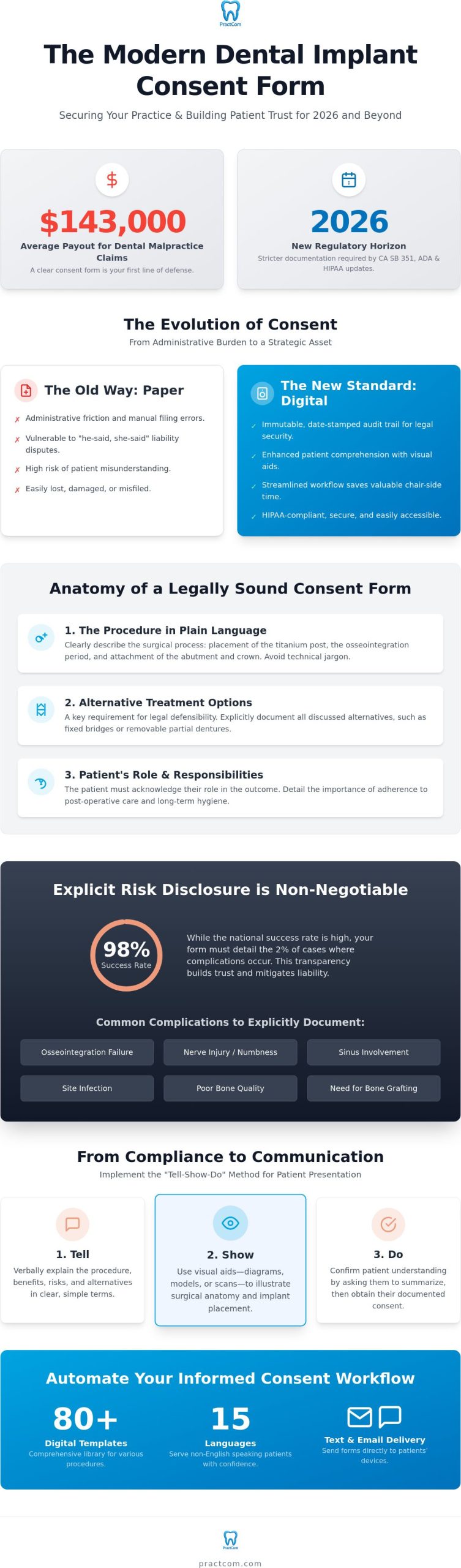
Did you know that the average payout for dental malpractice claims reached $143,000 last year? For a high-stakes procedure, your dental implant surgery consent form is more than just a piece of paper; it’s a vital shield for your professional reputation. You likely feel the constant stress of ensuring every risk is disclosed while trying to keep your chair-side time focused on the patient. With new 2026 mandates like California SB 351 and updated ADA sedation guidelines, the margin for error in your documentation has never been smaller.
We understand that manual filing and misunderstood risks are major pain points for your team. You’ll learn the critical components of a legally sound consent form and how digital automation protects your practice while improving patient trust. This guide previews the essential clauses for 2026, strategies for managing non-English speaking patients, and ways to transform your consent process into a streamlined digital workflow that saves time and secures your legal standing.
Key Takeaways
- Identify the mandatory clinical components required for a dental implant surgery consent form to ensure full regulatory compliance and risk mitigation.
- Transition from a simple signature to a documented clinical dialogue supported by visual aids that enhance patient comprehension of surgical anatomy.
- Evaluate the security advantages of digital signatures over traditional ink to reduce liability and administrative friction in your daily workflow.
- Implement the “Tell-Show-Do” presentation method to effectively address patient anxiety regarding surgical risks and improve treatment compliance.
- Learn how to automate your documentation using a library of 80+ digital templates that can be sent via text or email in 15 different languages.
Essential Components of a Robust Dental Implant Surgery Consent Form
A well-crafted dental implant surgery consent form acts as a bridge between your clinical expertise and your patient’s peace of mind. It isn’t merely a checklist for the front desk; it’s a critical tool that ensures your patients understand the biological and technical reality of their procedure. By aligning with the foundational principles of informed consent, you move beyond simple disclosure to a state of shared clinical decision-making. This protects your reputation while grounding patient expectations in reality.
Every effective form must begin with a clear, plain-language description of the surgical process. Avoid overly technical jargon that might obscure the nature of the treatment. Instead, describe the placement of the titanium post, the healing period required for osseointegration, and the eventual attachment of the abutment and crown. You must also explicitly document alternative treatment options, such as fixed bridges or removable partial dentures. This ensures the patient has evaluated all pathways to restoration, which is a key requirement for legal defensibility in 2026.
Patient responsibility is the final pillar of a robust document. Your form should clearly state that the success of the implant depends heavily on the patient’s adherence to post-operative care and long-term hygiene appointments. By signing, the patient acknowledges their role in the clinical outcome, which creates a mutual contract of care that extends well beyond the surgical chair.
Clinical Risk Disclosures and Complications
Precision in risk disclosure is non-negotiable. While the national success rate for dental implants remains high at approximately 98%, your dental implant surgery consent form must explicitly detail the 2% of cases where things don’t go as planned. You must document the risk of osseointegration failure and potential implant loss due to infection or poor bone quality. Specific clinical complications like nerve injury, which can cause persistent numbness in the lip or chin, and sinus involvement during upper jaw procedures must be highlighted. If there’s a possibility that additional procedures like bone grafting or sinus lifts will be required mid-surgery, these should be addressed as potential necessities rather than surprises.
Legal and Administrative Requirements
The administrative integrity of your consent process is just as vital as the clinical content. You need a system that verifies patient identity and ensures they have the cognitive capacity to provide consent. In a modern practice, this means your dental implant surgery consent form should include a digital, date-stamped signature that creates an immutable audit trail. Following the HIPAA updates effective February 16, 2026, your digital forms must also ensure secure data handling and clear privacy notifications. This level of systematic oversight eliminates the “he-said, she-said” scenarios that often lead to costly litigation, providing you with the psychological security to focus on surgery rather than paperwork.
Understanding Surgical Risks: Why Explicit Disclosure Matters
Informed consent isn’t a single event; it’s an ongoing clinical dialogue that begins the moment a patient considers tooth replacement. Your dental implant surgery consent form shouldn’t be treated as a hurdle to clear before surgery. Instead, view it as a roadmap for the clinical process of informed consent. This approach ensures patients aren’t just signing a document but are actively participating in their care path.
Using visual aids during this consultation is essential. When you show a patient exactly where the implant will sit in relation to their nerves or sinus cavities, you transform abstract risks into concrete understanding. This clarity is your best defense. Explicit risk disclosure reduces the likelihood of post-surgical litigation because it eliminates the element of surprise if a complication occurs. When patients feel fully informed, their trust in your expertise grows, even when faced with potential challenges. It’s about moving from a culture of compliance to a culture of communication.
To see how a specialized clinic leads by example in these complex restorative cases, discover Padden Dental.
Common Surgical Complications to Include
Your documentation must be specific to be effective. A vague mention of “risks” isn’t enough to protect your practice or educate your patient. Ensure your dental implant surgery consent form explicitly covers these three areas:
- Site Infection: Detail the necessity of antibiotic compliance and the signs of localized infection that require immediate attention.
- Nerve Injury: Clearly explain the potential for temporary or permanent numbness in the lip, chin, or tongue, especially with mandibular implants.
- Sinus Penetration: For upper jaw cases, describe the proximity to the maxillary sinus and the possibility of sinus complications.
The Connection Between Consent and Aftercare
The consent process is the foundation of the entire dental patient experience. By establishing clear expectations for the healing phase during the initial consultation, you reduce patient anxiety and improve post-operative compliance. This is where your consent form should directly link to your Post-Treatment Instruction Library. When a patient understands the risks, they’re more likely to follow the recovery steps designed to mitigate them.
Using standardized digital templates ensures that no specific risk is overlooked, providing a consistent safety net for every procedure. This systematic approach removes the limitations of human memory and ensures every patient receives the same high standard of disclosure. You can explore how automated documentation bridges this gap and strengthens patient trust from day one.
Paper vs. Digital Consent: Managing Practice Liability in 2026
The transition from paper to digital isn’t just about modernizing your office aesthetics; it’s a strategic move to insulate your practice from liability. While traditional paper forms were once the standard, they carry inherent risks that a modern clinical environment can no longer afford. Physical documents are prone to being lost, damaged, or filed incorrectly, creating gaps in your legal defense. In contrast, a digital dental implant surgery consent form provides an immutable record that’s securely backed up in the cloud, ensuring you always have access to the documentation you need during an audit or dispute.
Digital systems also solve the growing challenge of serving a diverse patient base. In 2026, providing forms in a patient’s native language is a professional necessity that builds immediate trust. Leading platforms now offer consent documentation in 15 different languages, ensuring that every patient, regardless of their primary tongue, fully understands the surgical risks you’ve disclosed. This level of systematic oversight eliminates the administrative friction of finding translators or using generic, unverified templates that might not hold up in court.
Efficiency Gains in the Clinical Workflow
Adopting digital consent eliminates the “paper bottleneck” at the front desk. Your staff no longer needs to waste time scanning documents or manually entering data into your records. By integrating these forms into your broader dental practice workflow, you allow patients to review and sign their dental implant surgery consent form remotely via text or email before they even step into the office. This pre-appointment completion speeds up the check-in process and gives patients more time to process the information in a low-pressure environment, which significantly improves their comprehension of the procedure.
Regulatory Compliance and Legal Protection
Maintaining version control is a nightmare with physical binders. You risk a patient signing an outdated form that doesn’t include the latest 2026 regulatory updates or ADA guidelines. Digital platforms solve this by ensuring every patient signs the most current, compliant version of your documents. When evaluating digital dental informed consent forms, look for systems that provide timestamped signatures and IP tracking. These digital breadcrumbs provide a robust audit trail that proves exactly when and where the consent was given, offering a level of legal protection that a simple ink signature on paper can’t match.
Best Practices for Presenting Consent Forms to Patients
How you present your documentation is just as critical as the clinical language within the document itself. Handing a patient a multi-page dental implant surgery consent form on a clipboard minutes before surgery is a recipe for anxiety and confusion. Instead, adopt the “Tell-Show-Do” method adapted for adult clinical communication. Tell the patient about the necessity of the form, show them the specific risks and anatomical considerations using digital visual aids, and then have them complete the signing process. This structured approach transforms a legal requirement into a supportive educational experience.
Addressing patient anxiety about surgical risks is your primary hurdle. It’s natural for patients to feel overwhelmed when reading about nerve injury or sinus complications. You can mitigate this by using a patient portal to provide early access to all documentation. When patients review the dental implant surgery consent form in the comfort of their own home, they arrive at your office feeling prepared rather than pressured. This early exposure allows them to digest the information at their own pace, leading to more meaningful questions and a higher level of true comprehension.
Overcoming Communication Barriers
The Psychology of Informed Consent
Transparency is your most powerful tool for building patient loyalty. Don’t shy away from discussing potential complications; being upfront about the realities of surgery actually increases patient confidence in your expertise. It shows you’re a protective guardian of their health. Ensure you allow adequate time for a two-way dialogue. Before the patient signs, ask for a brief verbal recap of what they’ve understood. This simple step confirms comprehension and provides documented proof of a shared decision-making process. If you’re ready to modernize your presentation and improve patient trust, start your free trial with PractCom today and access our full library of automated templates.
Automating Your Informed Consent Workflow with PractCom
Managing a high-volume surgical schedule requires a system that eliminates administrative resistance. While the clinical necessity of a dental implant surgery consent form is clear, the manual effort required to manage these documents often leads to operational bottlenecks. PractCom provides a stabilizing force in this high-pressure environment by offering immediate access to a comprehensive library of over 80 informed consent templates. This resource ensures your documentation is always current, legally robust, and ready for immediate deployment.
The practice performance dashboard transforms documentation from a chore into a strategic asset. You can track the status of every dental implant surgery consent form in real-time, seeing exactly which patients have reviewed their documents and who still needs to sign. This level of systematic oversight acts as a pre-emptive strike against administrative failures, ensuring no patient enters the operatory without the proper legal safeguards in place. You can distribute these forms via secure email or text, allowing patients to complete the process on their own devices, which significantly improves the patient experience.
Integration is the final step in creating a frictionless workflow. Once consent is secured, the system naturally transitions into your automated patient follow-ups. This creates a comprehensive ecosystem where the initial risk disclosure is directly linked to post-operative care instructions. By connecting these stages, you ensure that the clinical dialogue remains consistent from the first consultation through the final healing phase, reinforcing the trust you’ve built with your patient.
Why PractCom is the Peer-to-Peer Solution
PractCom wasn’t developed in a vacuum; it was designed by dental professionals to solve the real-world gaps that occur in a busy clinic. We understand that human memory has limits, which is why our platform provides the standardized control you need to protect your reputation. Beyond consent, we focus on mastering dental referral management software in 2026 to ensure seamless communication between GPs and specialists. If you want to see how our technical precision compares to other tools, you can request a PractCom comparison to evaluate our full suite of features.
Getting Started with Digital Documentation
You don’t have to overhaul your entire office to see immediate benefits. Setting up your customized digital consent library takes only minutes, allowing you to scale professional communication across a single location or a large DSO with ease. Our platform remains grounded in the logistical realities of your profession, providing the psychological security of knowing your documentation is HIPAA-compliant and audit-ready. If you’re ready to modernize your workflow and reduce operational stress, start your free trial today and experience the confidence of a standardized system.
Secure Your Practice and Patient Trust for 2026
Transitioning your practice to a modern, digital documentation system is no longer a luxury; it’s a fundamental requirement for clinical risk management. You’ve seen how a robust dental implant surgery consent form functions as a protective shield, bridging the gap between surgical complexity and patient comprehension. By replacing manual paperwork with automated, cloud-based systems, you eliminate the risk of lost records and ensure every patient receives clear, timestamped disclosures in their primary language.
PractCom provides the technical precision and administrative warmth needed to stabilize your high-pressure workflow. Our platform was designed by dental professionals for clinical accuracy, giving you the psychological security to focus on excellent patient outcomes. With a library of 80+ post-treatment templates and support for 15+ languages, we help you remove operational resistance and build lasting patient trust. Streamline your clinical compliance; start your PractCom free trial today.
You have the clinical expertise to transform your patients’ lives. Let us provide the standardized system that protects your reputation and secures your practice’s future.
Frequently Asked Questions
What is the legal difference between a paper and a digital consent form?
Legally, both formats are binding under the ESIGN Act and UETA, but digital forms offer a significantly stronger defense in court. Digital versions capture immutable data points like IP addresses and exact timestamps, providing a verifiable audit trail that a simple ink signature cannot match. This systematic oversight ensures that the validity of the signature is nearly impossible to dispute during a legal audit.
Do I need a separate consent form for bone grafting and dental implants?
Yes, you should use distinct sections or separate documents for bone grafting because it is a unique surgical procedure. While your dental implant surgery consent form covers the placement of the post, bone grafting carries separate risks like graft rejection or donor site complications. Explicitly separating these procedures ensures the patient has provided informed consent for every clinical stage of their restoration.
How long should I keep a signed dental implant consent form on file?
Retention requirements vary by state, but the standard recommendation is to keep these records for seven to ten years after treatment is completed. For pediatric patients, the clock usually doesn’t start until they reach the age of majority. Cloud-based storage is the most effective way to meet these long-term requirements without the physical burden of filing cabinets or the risk of document degradation.
Can a patient revoke their consent after signing the form?
A patient has the legal right to revoke their consent at any time before the surgical procedure begins. Consent is a voluntary agreement, not a permanent contract, so you must respect a patient’s change of heart immediately. If this occurs, you should document the conversation in the clinical notes and halt the procedure to avoid any potential claims of battery or lack of consent.
What happens if a patient refuses to sign certain parts of the consent form?
If a patient refuses to acknowledge specific risks, you must document this as an “informed refusal” in their record. You’ll need to evaluate if the refusal compromises your ability to perform the surgery safely. If the patient won’t acknowledge critical risks like nerve injury, it’s often best to decline the case to protect your practice’s legal standing and the patient’s safety.
How does multi-language support improve informed consent compliance?
Multi-language support ensures that patients with limited English proficiency truly understand the technical risks you’re disclosing. Providing a dental implant surgery consent form in one of 15 native languages satisfies federal requirements for meaningful access and builds immediate trust. This level of administrative warmth prevents the “lack of comprehension” defense that often arises in malpractice litigation involving language barriers.
Is a digital signature HIPAA compliant for dental surgery forms?
Digital signatures are fully HIPAA compliant as long as the platform uses end-to-end encryption and secure access controls. To meet 2026 standards, your system must maintain data integrity and provide an unalterable audit trail. PractCom’s digital forms are built with these specific protections, ensuring that sensitive patient information is handled with the technical precision required by modern privacy laws.
Should the consent form include the specific cost of the procedure?
While the primary focus of consent is clinical risk, including a reference to the financial estimate is a best practice for transparency. Patients in 2026 expect a detailed breakdown of costs as part of their decision-making process. Linking the clinical consent to the financial agreement ensures there is no confusion regarding the scope of treatment, which reduces administrative friction and prevents payment disputes later.

Article by
Cary Ganz DDS
Dr. Cary H. Ganz is a dentist, prosthodontist, entrepreneur, lecturer, and author with more than 50 years of experience in clinical dentistry and dental technology. Throughout his career, he has combined hands-on patient care with a deep understanding of how technology can improve dental practice operations, communication, documentation, and patient outcomes.
In addition to his clinical background, Dr. Ganz has held significant leadership roles in the dental technology industry, including Past Owner and Vice President of Clinical Affairs at DEXIS Digital Radiography and Past Vice President of Clinical Affairs at Denticon Practice Management Software. His business experience includes product development, clinical strategy, dental software innovation, practice management solutions, and educating dental professionals on the effective use of technology in modern dentistry.
Today, Dr. Ganz continues to focus on creating practical technology solutions for dental practices, including PractCom, a comprehensive dental practice communication platform designed to improve patient communication, documentation, compliance support, referrals, and overall practice efficiency. His work reflects a career-long commitment to helping dentists deliver better care while making their practices more organized, efficient, and protected.
No responses yet