
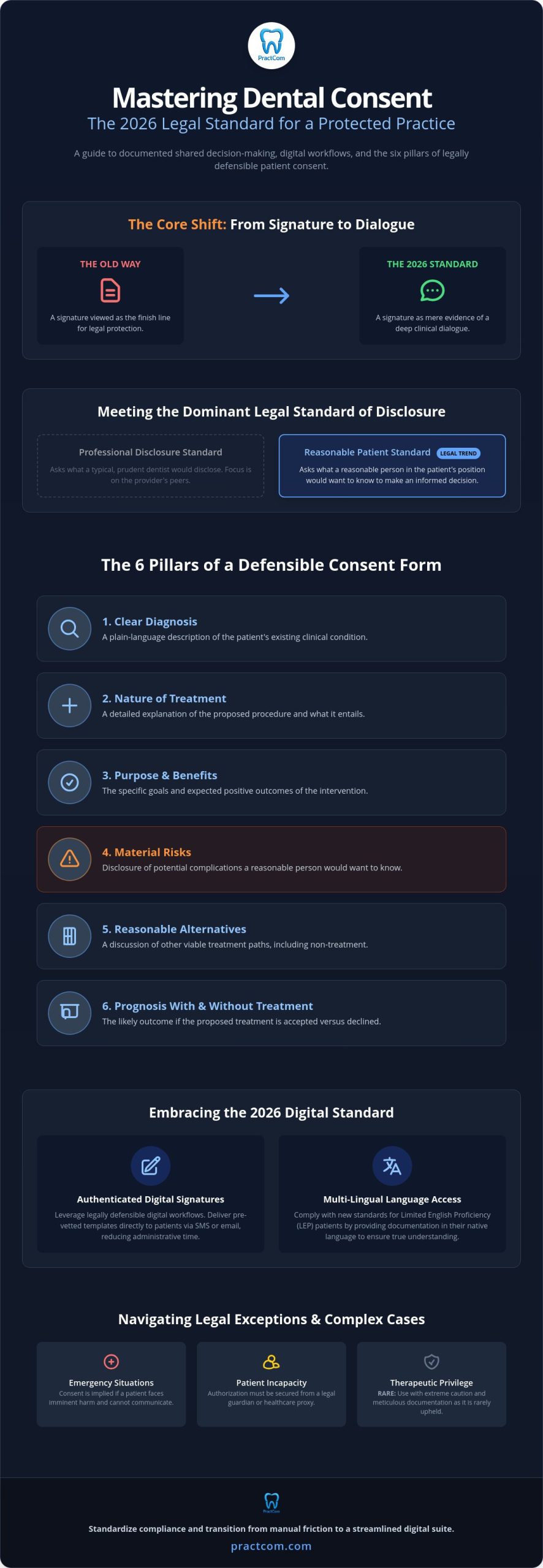
In 2026, a patient’s signature is no longer the finish line for legal protection; it’s merely the evidence of a much deeper clinical dialogue. You likely feel the constant pressure of evolving regulations, such as the February 2026 HIPAA updates regarding substance use disorder records or the new ADA sedation mandates. It’s exhausting to manage the administrative weight of paper forms while trying to ensure every patient truly understands their treatment risks. Mastering the current legal requirements for dental consent forms is the only way to move from the anxiety of potential malpractice claims to the confidence of a standardized, compliant system.
We’ll show you how to protect your practice and ensure patient autonomy by integrating essential legal elements into your daily workflow. This guide previews the shift toward documented shared decision-making, the latest language access requirements for non-English speaking patients, and the transition to legally defensible digital workflows. You’ll learn how to reduce chairside administrative time while building deeper trust with every patient who walks through your door.
Key Takeaways
- Understand the shift toward the “Reasonable Patient Standard” to ensure your disclosure process meets modern ethical and legal expectations.
- Identify the six non-negotiable legal requirements for dental consent forms, including clear diagnoses and treatment alternatives, to build a defensible clinical record.
- Learn how to leverage authenticated digital signatures and multi-lingual documentation to comply with 2026 standards for Limited English Proficiency (LEP) patients.
- Standardize your approach to complex consent scenarios, such as treating minors or non-legal guardians, to eliminate operational disorganization and legal exposure.
- Discover how to transition from manual administrative friction to a streamlined digital suite that delivers pre-vetted templates directly to patients via SMS or email.
Understanding the Legal Doctrine of Informed Consent in Dentistry
Informed consent isn’t a hurdle to clear; it’s a foundational pillar of patient autonomy and a core ethical duty. When you discuss a procedure with a patient, you aren’t just checking a box. You’re fulfilling a professional obligation rooted in the ADA Code of Ethics, which prioritizes the patient’s right to self-determination. The Legal Doctrine of Informed Consent establishes that every competent adult has the right to decide what happens to their own body. In your practice, this means providing enough information so a patient can make an intelligent choice about their care.
It’s a common misconception that a signature on a piece of paper constitutes consent. In reality, that signature is merely evidence that a conversation took place. If a legal dispute arises, the court won’t just look at the ink on the page; they’ll examine the quality of the dialogue. Meeting the legal requirements for dental consent forms in 2026 requires you to document that a shared decision-making process actually occurred. This shift moves the focus from administrative completion to clinical transparency, protecting your reputation and your peace of mind.
The Two Primary Legal Standards of Disclosure
Courts generally apply one of two standards when determining if a dentist provided enough information. The “Professional Disclosure Standard” asks what a typical, prudent dentist would disclose in similar circumstances. However, the 2026 legal trend heavily favors the “Reasonable Patient Standard.” This objective standard asks what a reasonable person in the patient’s position would want to know to make an informed decision. Some jurisdictions even look at a subjective standard, which considers the specific, unique needs of the individual sitting in your chair. Moving toward a patient-centric disclosure model reduces your liability and strengthens the bond of trust.
When Consent is Not Required: Legal Exceptions
While informed consent is nearly universal, specific legal exceptions exist to protect both the patient and the practitioner. Understanding these ensures you don’t hesitate during critical moments.
- Emergency Situations: If a patient faces imminent harm or a life-threatening condition and cannot communicate, you may proceed with necessary treatment to preserve life or health.
- Patient Incapacity: When a patient is legally unable to provide consent due to age or mental status, you must secure authorization from a legal guardian or healthcare proxy.
- Therapeutic Privilege: This is a rare and narrow exception where a clinician withholds information because disclosure would pose a serious psychological threat to the patient. Use this with extreme caution and meticulous documentation, as it’s rarely upheld in modern dental litigation.
Navigating these legal requirements for dental consent forms ensures your practice remains a safe, compliant environment for every procedure, regardless of the complexity.
6 Essential Legal Elements for Every Dental Consent Form
While some industry resources argue against a “cookbook” approach to documentation, leaving your practice’s safety to guesswork is a significant legal risk. To be defensible, your documentation must meet specific Essential Legal Elements for Every Dental Consent Form. These components ensure that the patient isn’t just signing a paper; they’re acknowledging a comprehensive understanding of their clinical situation. Meeting the legal requirements for dental consent forms requires you to standardize the information you provide for every procedure, from routine fillings to complex oral surgery.
Every legally sound consent form must include these six core elements:
- Clear Diagnosis: A plain-language description of the patient’s existing clinical condition.
- Nature of Treatment: A detailed explanation of the proposed procedure and what it entails.
- Purpose of Treatment: The specific goals and expected benefits of the intervention.
- Material Risks: Disclosure of potential complications that a reasonable person would want to know.
- Reasonable Alternatives: A discussion of other viable treatment paths, even if they aren’t your primary recommendation.
- Consequences of Non-Treatment: A clear warning of the clinical risks if the patient chooses to decline care.
Defining “Material Risks” for High-Stakes Procedures
Legal standards distinguish between common side effects, like minor swelling, and life-altering “material” risks. For high-stakes procedures such as endodontics or implants, you must be explicit. Disclosures such as permanent nerve damage, sinus perforation, or the total loss of a tooth are non-negotiable. If you fail to mention a risk that later occurs, a patient can claim they never would’ve agreed to the procedure had they known. Standardizing these disclosures across your practice removes the burden of memory from your clinical staff.
The Consequences of Non-Treatment
A patient has the legal right to refuse care, but they must do so with a full understanding of the fallout. Documenting “Informed Refusal” is just as critical as documenting consent. You need to record that you explained the specific clinical outcomes of declining a recommendation, such as the spread of infection or bone loss. If you’re struggling to manage the administrative weight of these detailed requirements, you can explore a standardized digital approach to ensure every form and refusal is captured accurately. This systematic oversight is a pre-emptive strike against the “failure to inform” claims that often fuel malpractice litigation. Following these legal requirements for dental consent forms turns your documentation into a guardian of your professional reputation.
Digital Signatures and Language Access: The 2026 Standard
Digital signatures are no longer a luxury; they are a compliance necessity. Under the ESIGN Act and the Uniform Electronic Transactions Act (UETA), which 48 states have adopted as of 2026, electronic signatures carry the same legal weight as ink. However, a simple image of a signature is insufficient. To meet the legal requirements for dental consent forms, your digital system must provide a robust audit trail. This trail proves the identity of the signer, the exact timestamp of the signature, and the specific device used, creating a defensible record that paper simply cannot match.
The federal rule issued on March 20, 2026, now adopts the HL7 Digital Signatures Guide for health care claims attachments. This standard ensures document integrity and identity verification across the industry. When choosing a platform, you must look for tamper-evident seals that lock the document the moment it is signed. For a deeper look at how different systems handle these security protocols and protect your clinical data, you can review this PractCom vs Modento security analysis.
Legality of Digital Signatures in Dentistry
Modern compliance requires psychological security through systematic control. A legally valid digital signature must be authenticated and stored with a full audit trail to satisfy HIPAA and state-level UETA requirements. This technology eliminates the risk of lost or illegible paper forms while ensuring that the version of the document the patient signed is the exact version stored in your records. It moves your practice from a state of operational disorganization to one of high-utility oversight.
Informed Consent for Non-English Speaking Patients
Language access is the second, often overlooked, pillar of 2026 compliance. Section 1557 of the Affordable Care Act (ACA) and Title VI of the Civil Rights Act mandate that practices provide “meaningful access” to patients with Limited English Proficiency (LEP). If a patient cannot read the form they are signing, the consent is legally ineffective. Many practices rely on machine translation, but Google Translate is a liability, not a clinical solution. It lacks the technical precision to explain complex surgical risks, leaving you exposed to litigation.
Standardizing your library across 15+ languages ensures you meet the legal requirements for dental consent forms while providing true patient understanding. This systematic approach follows Best Practices for Clinical Documentation by removing the inconsistencies of live interpretation. By delivering translated digital forms via SMS or email before the appointment, you ensure the patient has time to process the information in their primary language. This reduces chairside administrative friction and builds a foundation of trust that protects your practice from claims of national origin discrimination.
Mitigating Risk: Best Practices for Clinical Documentation
Paper-based systems are a liability in a modern clinical environment. When you rely on physical folders, you risk lost documents, illegible handwriting, and incomplete records that won’t hold up in court. Transitioning to a standardized digital workflow isn’t just about efficiency; it’s a strategic move to ensure every interaction meets the legal requirements for dental consent forms. By automating the collection and storage of these documents, you remove the limitations of human memory and create a chronological, tamper-evident record of patient agreement.
Documentation must also account for HIPAA data retention rules. While federal law generally requires keeping these records for six years from the date of creation or last effect, many state laws demand longer periods, especially for pediatric patients. A digital system ensures these files remain accessible and secure without taking up physical real estate in your office. This level of systematic control provides the psychological security you need to focus on clinical care rather than administrative anxiety.
While you optimize the physical real estate of your practice, you may also be looking to enhance your personal portfolio; Portland Real Estate Consulting, Inc. provides the specialized expertise needed to navigate the market for luxury homes in exclusive golf communities.
Consent for Minors and Vulnerable Adults
Treating minors introduces a layer of complexity that requires absolute precision. You must verify legal guardianship before any treatment begins, as a stepparent or temporary caregiver may not have the legal authority to sign. Some states recognize the “Mature Minor” doctrine, allowing older children to consent to certain treatments, but these laws vary significantly across jurisdictions. Using standardized forms for different types of guardians ensures you never miss a critical authorization. If you’re ready to eliminate the guesswork, you can standardize your guardianship workflows today to ensure every minor’s record is legally bulletproof.
Documenting the Consent Conversation
The signed form is the “floor” of your legal protection, but the conversation is the “ceiling.” To truly meet the legal requirements for dental consent forms, your patient record must include contemporaneous notes. These are notes made at the time of the discussion, detailing the specific questions the patient asked and the answers you provided. If a patient expresses concern about a particular risk, like nerve damage, your notes should reflect that you addressed it in detail.
Using digital dental informed consent forms helps guide this dialogue. It ensures you follow a consistent script and that no material risk is omitted. When your digital forms are integrated into the patient record, they serve as a guardian of your reputation. This approach transforms the consent process from a high-pressure administrative task into a high-utility clinical asset that improves patient trust and understanding.
Standardizing Compliance with PractCom’s Digital Suite
Adhering to the legal requirements for dental consent forms shouldn’t feel like a constant battle against administrative chaos. While earlier sections established the ethical and legal necessity of informed consent, the challenge lies in execution. PractCom’s digital suite transforms these complex obligations into a high-utility, automated workflow. By providing access to a library of 80+ pre-vetted digital consent templates, the platform ensures your clinical team never has to guess which risks or alternatives to disclose for a specific procedure. This systematic control moves your practice away from the limitations of human memory and toward a future of total regulatory reassurance, much like how medical device and pharmaceutical firms learn more about validation through specialized consulting.
True patient understanding requires more than just a clear conversation; it requires documentation in a language the patient actually speaks. As we’ve discussed, 2026 compliance mandates meaningful access for Limited English Proficiency (LEP) patients. PractCom facilitates this by offering email and text delivery for all documents in 15 languages. This capability doesn’t just check a box for federal nondiscrimination laws. It creates a complete clinical loop by integrating these consent forms with automated post-treatment instructions, ensuring your patients are informed from the moment they book their appointment until they’ve fully recovered at home.
Reducing Administrative Friction
Manual paperwork is the primary source of operational resistance in a busy office. Automated delivery via SMS or email allows patients to review and sign documents from the comfort of their own homes before they ever reach your chair. This prevents the “forgotten signature” crisis that often happens during a high-pressure clinical day. Your front desk stays empowered through a practice performance dashboard that tracks document completion in real-time, identifying gaps before they become legal liabilities. PractCom ensures every patient receives the correct legal disclosures every time by mapping standardized, procedure-specific templates to your daily schedule.
Securing Your Practice’s Reputation
The transition from a manual, risky documentation process to an automated, protected system is an investment in your practice’s long-term security. Relying on paper or fragmented digital tools leaves you vulnerable to audit failures and “failure to inform” lawsuits. A dedicated patient portal provides your clients with 24/7 access to their signed documents and post-op instructions, which significantly improves patient trust and reduces repetitive phone calls to your staff. This modern, tech-savvy approach positions you as a forward-thinking professional who values both accuracy and patient autonomy. You can start your free trial with PractCom today to modernize your consent process and satisfy the legal requirements for dental consent forms with absolute confidence.
Secure Your Practice’s Legacy through Standardized Documentation
The 2026 regulatory landscape demands more than just a patient’s signature; it requires a verifiable, multi-lingual, and tamper-evident record of the entire informed consent process. You’ve seen how meeting the legal requirements for dental consent forms involves balancing technical precision with clinical warmth. By transitioning from manual paperwork to a systematic digital workflow, you eliminate the operational resistance that leads to administrative errors and legal exposure. This shift ensures every disclosure is accurate and every patient feels truly informed before treatment begins.
PractCom provides the psychological security of knowing your documentation is bulletproof. With access to 80+ post-treatment and consent templates, 15-language support for all documents, and HIPAA-compliant digital signatures, you can focus on delivering exceptional care instead of managing administrative chaos. It’s time to replace the anxiety of a potential “failure to inform” claim with the confidence of a standardized system that protects your reputation.
Upgrade to Digital Informed Consent with PractCom and take control of your practice’s legal standing today. You’re not just protecting your business; you’re building a foundation of transparency and trust that will serve your patients for years to come.
Frequently Asked Questions
Does a signed consent form protect me from all malpractice claims?
A signed form does not provide absolute immunity from malpractice claims. It serves as documented evidence that a disclosure conversation occurred, but it won’t protect you if the clinical care fell below the standard of care or if the patient can prove the “reasonable patient standard” wasn’t met. True protection comes from the combination of a thorough clinical dialogue and a defensible, contemporaneous record.
How long must a dental practice keep signed consent forms on file?
HIPAA requires practices to retain signed consent forms for at least six years from the date of creation or the date it was last in effect. However, you should check your specific state laws, as many jurisdictions require longer retention periods for pediatric records, often until the patient reaches the age of majority plus several years. Digital storage ensures these legal requirements for dental consent forms are met without physical clutter.
Can a dental assistant or hygienist obtain informed consent?
While staff can facilitate the paperwork, the ultimate legal responsibility for ensuring the patient is informed rests with the dentist. The April 2026 ADA guidelines specifically mandate that the dentist must personally obtain written consent for moderate or deep sedation. Using a standardized system helps your team support the process, but your personal clinical input remains a non-negotiable legal requirement.
What is the difference between general consent and informed consent?
General consent covers routine, low-risk procedures like exams or cleanings, while informed consent is required for specific treatments with material risks. General consent is often obtained during intake to cover basic contact, but informed consent requires a detailed discussion of a specific diagnosis, proposed treatment, and alternatives. This distinction is vital for maintaining a compliant and protective documentation trail in a modern practice.
Do I need a new consent form if the treatment plan changes mid-procedure?
You must obtain new consent if the treatment plan changes significantly during a procedure. If a routine extraction becomes a complex surgical one, the original consent no longer covers the material risks of the new situation. Documenting this secondary conversation is an essential part of meeting the legal requirements for dental consent forms when unexpected clinical shifts occur at the chairside.
Are digital signatures on an iPad as legal as pen-and-paper signatures?
Digital signatures on an iPad are legally equivalent to pen-and-paper signatures under the ESIGN Act and UETA. As of 2026, these signatures are valid across all 50 states, provided they include a secure audit trail and tamper-evident sealing. This technology offers superior security by proving exactly when and where the document was signed, which is a level of verification that paper forms cannot provide.
What happens if a patient refuses to sign a consent form but wants treatment?
You cannot legally proceed with treatment if a patient refuses to sign the necessary consent forms. Treatment without consent can be legally classified as battery, even if the clinical outcome is successful. In these cases, you should document an “Informed Refusal” in the patient record, noting that you explained the risks of declining care and that the patient understood those consequences.
Is it legally required to provide consent forms in the patient’s native language?
Providing consent forms in a patient’s primary language is a legal requirement under federal and state nondiscrimination laws, including Section 1557 of the ACA. As of May 2026, many jurisdictions require vital documents to be translated into several languages to ensure “meaningful access” for patients with limited English proficiency. Relying on machine translation is a liability; you need professionally vetted, multi-lingual templates to ensure true understanding.

Article by
Cary Ganz DDS
Dr. Cary H. Ganz is a dentist, prosthodontist, entrepreneur, lecturer, and author with more than 50 years of experience in clinical dentistry and dental technology. Throughout his career, he has combined hands-on patient care with a deep understanding of how technology can improve dental practice operations, communication, documentation, and patient outcomes.
In addition to his clinical background, Dr. Ganz has held significant leadership roles in the dental technology industry, including Past Owner and Vice President of Clinical Affairs at DEXIS Digital Radiography and Past Vice President of Clinical Affairs at Denticon Practice Management Software. His business experience includes product development, clinical strategy, dental software innovation, practice management solutions, and educating dental professionals on the effective use of technology in modern dentistry.
Today, Dr. Ganz continues to focus on creating practical technology solutions for dental practices, including PractCom, a comprehensive dental practice communication platform designed to improve patient communication, documentation, compliance support, referrals, and overall practice efficiency. His work reflects a career-long commitment to helping dentists deliver better care while making their practices more organized, efficient, and protected.
No responses yet