
Could your current consent process withstand a 2026 legal audit, or is it a liability waiting to happen? For many clinicians, obtaining informed consent for root canal therapy feels like a high-stakes race against the clock where technical jargon often leaves patients confused and practitioners exposed. You likely feel the weight of regulatory pressure, especially with the 2026 updates to ADA Sedation Guidelines and new HIPAA disclosures regarding Substance Use Disorder. We understand that your time is best spent on clinical excellence, not repeating the same manual explanations while worrying about potential litigation.
This guide provides the blueprint to transform your documentation from a burdensome task into a protective, digital-first asset. You’ll learn how to implement a legally robust system that reduces chairside time and bridges the communication gap for non-English speaking patients using modern, multi-language tools. We will examine the latest requirements from California’s SB 351 to evolving transparency standards, ensuring your practice remains a secure and authoritative leader in modern endodontics.
Key Takeaways
- Distinguish between a mere signature and a compliant communication process to align your practice with the latest AAE standards and ethical requirements.
- Identify the “Big Six” essential components of informed consent for root canal therapy to protect your reputation against common clinical risks like instrument separation and perforation.
- Eliminate communication barriers by translating complex technical jargon into patient-friendly digital dialogues available in 15 different languages for improved compliance.
- Transition from disorganized paper filing to a secure digital workflow that leverages the ESIGN Act for maximum legal robustness and reduced administrative overhead.
- Standardize your administrative output using a comprehensive library of over 80 customizable templates designed specifically for modern endodontic clinical techniques.
What is Informed Consent for Root Canal Therapy?
Informed consent is the cornerstone of modern clinical practice. It is a process of communication between a patient and an endodontist that results in the patient’s authorization to undergo treatment. Obtaining informed consent for root canal therapy isn’t just about handing over a clipboard; it’s an interactive dialogue where you explain the diagnosis, the procedure, and the potential outcomes. The American Association of Endodontists (AAE) distinguishes the “consent form” as the physical record of this deeper “informed consent process.” Informed consent is fundamentally an ethical obligation to ensure patient autonomy rather than just a liability shield. Root Canal Therapy (RCT) requires more detailed disclosure than routine restorative work because it involves irreversible changes to the internal tooth structure and carries unique risks like instrument separation or canal calcification.
The Legal Necessity of Disclosure in Endodontics
In 2026, the legal standard for disclosure often revolves around the “reasonable patient” model. This means you must disclose any information that a reasonable person in the patient’s position would find significant when making a decision. While federal guidelines provide a baseline, your state dental association remains the primary source for specific legal requirements. For instance, clinicians in California must now navigate SB 351, which mandates explicit language regarding risks and alternatives. Additionally, professional liability carriers often vet your consent language to ensure it meets current judicial expectations. A standardized system helps you meet these high bars without increasing your administrative burden.
Beyond the Signature: The Ethical Component
True consent requires that the patient has the mental capacity to understand both the diagnosis and the prognosis. It’s your responsibility to ensure they aren’t just nodding along. You must provide a non-pressured environment where they feel comfortable asking questions. This is where many manual processes fail. When explanations are rushed chairside, patients often feel coerced. Using standardized digital documentation prevents “information drift” between your front office, your assistants, and yourself. It ensures every patient receives the same high-quality, legally vetted information every time. By modernizing this workflow, you move from operational disorganization to systematic control, fostering deeper trust with those in your care.
Effective informed consent for root canal therapy bridges the gap between clinical necessity and patient understanding. It transforms a potentially scary procedure into a collaborative health decision. When you prioritize this process, you protect your reputation and your practice’s legal standing simultaneously.
Essential Components of a Root Canal Consent Form
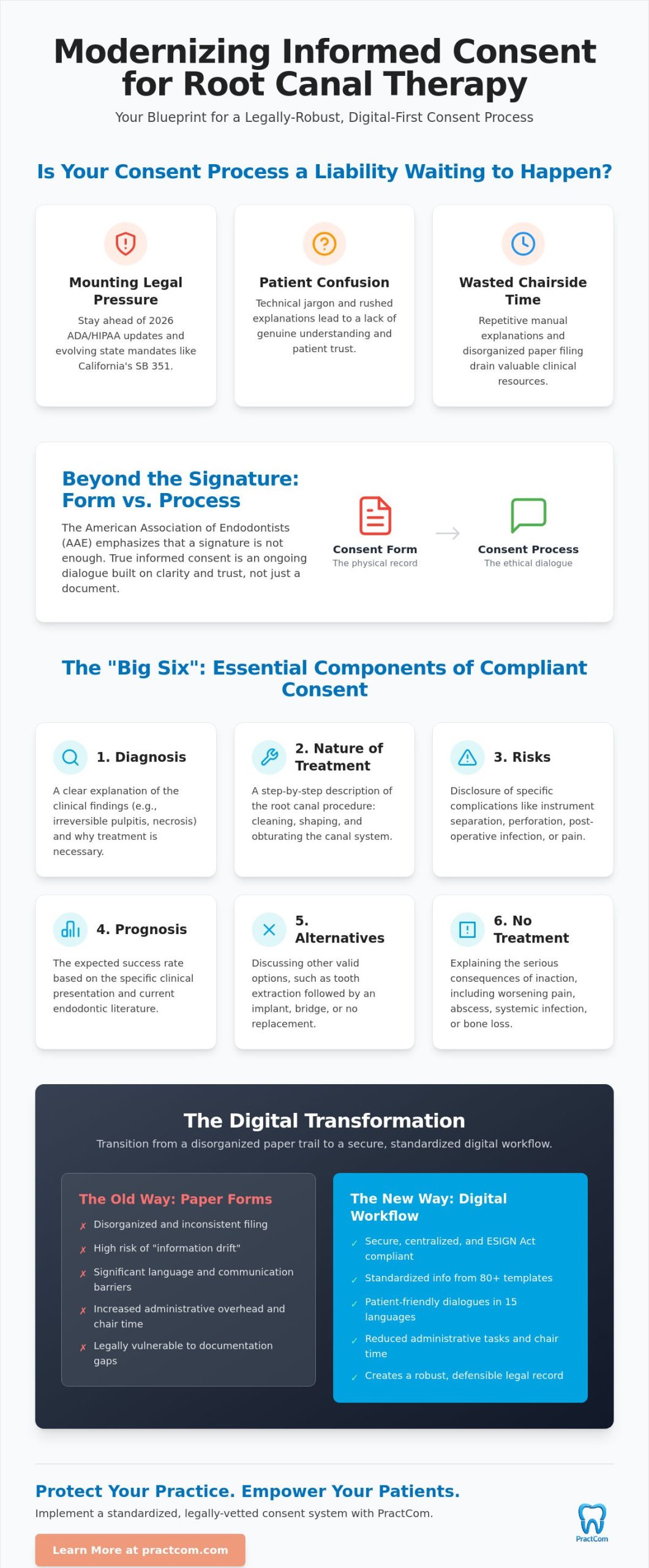
Standardizing your documentation is the only way to ensure every patient receives a complete disclosure without draining your chairside time. The American Association of Endodontists defines the essential components of informed consent through six core pillars. These elements form a protective shield for your practice while providing the psychological security patients need before an invasive procedure. Your informed consent for root canal therapy must explicitly cover:
- Diagnosis: A clear explanation of the clinical findings and the necessity of treatment.
- Nature of Treatment: The step by step process of cleaning, shaping, and obturating the canal system.
- Risks: Specific complications that may occur during or after the procedure.
- Prognosis: The expected success rate based on the specific clinical presentation.
- Alternatives: Options such as tooth extraction followed by an implant or bridge.
- Risks of No Treatment: The consequences of choosing to do nothing, such as systemic infection or bone loss.
It’s vital to remember that “no treatment” must always be presented as a valid, albeit risky, alternative to the proposed endodontic care. When discussing alternatives like extraction, you should explain the subsequent need for prosthetic replacements to maintain arch integrity. This comprehensive approach prevents patients from claiming they weren’t aware of the long term financial or clinical implications of their choices.
Defining Clinical Risks and Complications
Effective communication requires describing “instrument separation” without causing unnecessary panic. Instead of using alarming language, explain it as a procedural limitation where a small piece of a sterilized instrument may remain in the canal, which might require a different sealing approach. You must also address the common risk of post operative pain and the potential for flare ups that could require antibiotics. Additionally, your forms need to mention the possibility of permanent or temporary numbness, known as paresthesia, particularly when working near the mandibular nerve or the maxillary sinus. Using digital informed consent forms allows you to automate these complex explanations, ensuring no detail is overlooked during a busy clinical day.
Prognosis and the ‘No Guarantee’ Clause
Endodontists must never guarantee success or a specific outcome, as biological responses vary between individuals. Your documentation should clearly state that success depends on several factors, including the tooth’s location, the presence of existing fractures, and whether the tooth has undergone previous treatments. It’s equally important to document the requirement for a permanent restoration, such as a crown, following the procedure. To help patients understand the signs that make this restoration necessary, you can share resources such as this one from U-First Dental Care; simply click here to read more. Without a timely crown, the risk of tooth fracture increases significantly, which can lead to the ultimate failure of the endodontic work regardless of your clinical skill.
Overcoming Communication Barriers in Endodontic Consent
Clinical jargon often creates an invisible wall between you and your patient. Terms like “obturation” or “apexification” are second nature to an endodontist, but they mean very little to a layperson. If a patient doesn’t truly understand the steps of the procedure, they cannot provide valid informed consent for root canal therapy. This communication gap is more than a minor misunderstanding; it’s a failure of health literacy that directly impacts patient compliance and post-operative success. When patients aren’t fully engaged in the dialogue, they’re more likely to experience anxiety or skip critical follow-up visits.
Understanding the various Types of consent in dentistry is the first step toward a compliant practice, but the actual dialogue requires a shift toward simplified language. You must translate complex biological processes into benefit-driven explanations. This ensures the patient feels like an active participant in their care rather than a passive recipient of a confusing technical service. By prioritizing clear communication, you move your practice away from the resistance of manual tasks toward the confidence of a standardized system.
Multi-Language Support as a Regulatory Necessity
Managing Limited English Proficiency (LEP) is a common operational stressor in diverse communities. Relying on a patient’s family member to act as a translator is often insufficient and legally risky. Family members may inadvertently omit critical risk disclosures or lack the clinical vocabulary to explain endodontic complications accurately. PractCom’s 15-language support provides a standardized remedy for this issue. By delivering digital forms and instructions in the patient’s native tongue, you ensure regulatory reassurance and a higher level of psychological security. This clear communication significantly reduces post-treatment anxiety and the volume of emergency calls regarding normal healing processes.
Using Visuals to Explain Root Canal Complexity
Visual aids transform abstract clinical concepts into tangible realities. Integrating tooth loss charts and anatomical diagrams into your workflow helps patients appreciate the structural complexity of their teeth. Using smile design tools and “before and after” visualizations allows patients to see the long-term value of saving their natural tooth structure. It contrasts the preservation of their smile with the potential bone loss and shifting associated with extraction. Standardizing this visual message across all providers in a multi-doctor practice eliminates “information drift” and ensures that every patient receives a high-utility explanation. This approach moves your practice from operational disorganization to a state of systematic, visual-first control.
Modernizing the Workflow: Digital Consent vs. Paper Forms
The administrative burden of paper documentation is a significant operational stressor for modern endodontic practices. Manual scanning, physical filing, and the constant risk of lost documentation create a state of operational disorganization that can compromise your legal standing. Transitioning to a digital system for informed consent for root canal therapy moves your practice toward systematic control and regulatory reassurance. Under the ESIGN Act of 2000, digital signatures carry the same legal weight as handwritten ones, provided they meet specific requirements for authentication and intent. While paper systems lack a verifiable tracking mechanism, digital consent provides a comprehensive audit trail that logs exactly when a document was sent, viewed, and signed.
Optimizing your dental practice workflow starts by sending these forms before the patient even enters your office. This proactive approach eliminates the rush of chairside paperwork and allows you to focus entirely on clinical care. It transforms the administrative process from a point of friction into a seamless part of the patient experience.
The Benefits of Pre-Appointment Digital Consent
Sending forms in advance offers patients the psychological security of reviewing risks in a non-pressured environment at home. This proactive step significantly reduces the likelihood of future “pressure” claims where patients argue they didn’t have time to understand the procedure. Once signed, these documents automatically sync with the patient portal. This ensures your clinical team has immediate access to the treatment plan and specific authorizations without digging through physical charts or waiting for scans to upload. It’s a no-nonsense solution that values both your time and the patient’s comfort.
Integration with Post-Op and Referral Systems
A truly modern consent process doesn’t exist in a vacuum; it functions as part of a comprehensive ecosystem. A signed consent form should act as a trigger for automated dental post-op instructions, ensuring the patient receives aftercare guidance exactly when they need it. This continuity of care extends to your professional network as well. Ensuring the referring GP receives a digital copy of the signed consent and treatment plan strengthens your professional relationship and provides a unified record of care. Utilizing digital dental informed consent forms reduces the liability gap during specialist-GP handoffs by creating a clear, shared record of what was disclosed. To experience this level of administrative warmth and clinical precision, you can start your 15-day free trial today.
Implementing a Standardized Consent System with PractCom
Leveraging a library of over 80 post-treatment and consent templates provides immediate administrative relief for your practice. It eliminates the need to draft complex legal documents from scratch, allowing you to focus on clinical excellence. You can easily customize these RCT forms to reflect your specific clinical techniques, such as unique irrigation protocols or advanced obturation methods. This level of customization ensures that your informed consent for root canal therapy is a precise reflection of your specific standard of care rather than a generic template. It’s a proactive strike against administrative failure that builds immediate trust with your patients.
Moving toward a paperless dental office shouldn’t mean sacrificing clinical thoroughness. Digital systems actually enhance your ability to verify patient understanding. Automated follow-ups act as a critical safety net after the patient leaves the chair. If a patient has questions about their healing process, the system can trigger specific educational resources, which reduces the time your staff spends on the phone. This creates a comprehensive ecosystem where no part of the professional communication process is left to chance. You gain the confidence of a standardized system while providing the administrative warmth your patients expect.
Streamlining Clinical Communication for DSOs
For larger organizations, maintaining brand and legal consistency across multiple locations is a significant operational stressor. Using a centralized practice performance dashboard allows you to track consent completion rates in real-time across all your clinics. You can identify which locations might be lagging in documentation and provide targeted training. Customizing PractCom for DSOs ensures you meet regional legal variations, such as specific state mandates in California or New York, without managing dozens of different paper versions. It’s a no-nonsense solution for maintaining high compliance standards at scale.
Next Steps: Transitioning Your Practice
Transitioning to a digital workflow is a straightforward process that yields immediate benefits. Start by auditing your current RCT consent form for 2026 compliance. Ensure your language reflects the latest ADA sedation guidelines and HIPAA updates mentioned earlier in this guide. Training your staff on the digital consent workflow is the next critical step to ensure high adoption. When your team understands how to leverage the patient portal and automated follow-ups, they can explain the benefits to patients with confidence. This shift moves your practice from the resistance of manual tasks to the security of a modern, tech-savvy system. Ready to eliminate the paper trail? Start your free trial with PractCom today and reclaim your clinical time.
Future-Proofing Your Endodontic Documentation
Establishing a robust process for informed consent for root canal therapy is no longer just a legal checkbox. It’s a strategic move that enhances patient trust and clinical efficiency simultaneously. By transitioning to a digital-first workflow, you eliminate the operational disorganization of paper files and replace it with a system that provides psychological security for both you and your patients. You’ve seen how clear communication, multi-language support, and standardized templates protect your reputation while reducing chairside stress. This standardized approach ensures that no critical risk is ever overlooked, even during your busiest clinical days.
Modernizing your practice documentation doesn’t have to be a burden. With access to over 80 clinical templates, 15-language support, and HIPAA-compliant digital signatures, you can ensure every disclosure is thorough and legally sound. It’s time to move from the resistance of manual tasks to the confidence of a standardized ecosystem that acts as a guardian for your practice. Secure your practice with digital consent—Start your PractCom free trial today. Take the first step toward a more organized, protective, and efficient future for your endodontic practice.
Frequently Asked Questions
Is a digital signature on a root canal consent form legally binding?
Yes, digital signatures are legally binding under the Electronic Signatures in Global and National Commerce (ESIGN) Act and the Uniform Electronic Transactions Act (UETA). These laws grant electronic signatures the same legal weight as traditional ink signatures. A digital audit trail provides superior evidence of consent compared to paper forms because it records the specific time, date, and IP address of the signer.
What happens if a patient refuses to sign the informed consent for RCT?
You must not perform the procedure if a patient refuses to sign the informed consent for root canal therapy. In this scenario, you should document an “informed refusal” in the patient’s record. This documentation must include the clinical recommendation, the specific risks the patient is accepting by refusing care, and their acknowledgment that they understand these consequences.
Do I need a separate consent form for an endodontic retreat?
Yes, endodontic retreatment requires a specific consent form because the risks and prognosis differ from an initial procedure. Retreatment involves navigating previous filling materials and often carries a higher risk of tooth fracture or perforation. Your documentation must reflect these unique clinical challenges to ensure the patient understands why the success rate may be different from their first treatment.
How long should our practice retain signed informed consent documents?
Retention requirements vary by state, but most experts recommend keeping signed consent documents for at least seven to ten years. Some states require records to be kept until the patient reaches the age of majority plus the statute of limitations period. Digital storage solutions make this long-term retention manageable without the physical space requirements of paper filing systems.
Can informed consent be obtained by a dental assistant or treatment coordinator?
While staff members can facilitate the paperwork, the dentist is legally and ethically responsible for the informed consent dialogue. You must personally discuss the diagnosis, risks, and alternatives with the patient to ensure they have a clear understanding. Delegating the entire process to a non-clinician is a significant liability risk that can be challenged in court.
What are the most common reasons for informed consent litigation in endodontics?
Litigation typically arises from a “failure to inform” regarding specific complications like instrument separation or root perforation. Patients often claim they wouldn’t have agreed to the procedure if they had known a specific risk was possible. Another common issue is the failure to discuss extraction as a viable alternative, leading to claims of coerced treatment.
How do I handle informed consent for a minor requiring a root canal?
A parent or legal guardian must sign the consent form for any patient under the age of 18. In states like California, specific codes such as BPC Section 1682 require additional advisories for minors, especially if any form of sedation is used. You should also involve the minor in the discussion at an age-appropriate level to build trust and cooperation during the clinical visit.
Should the informed consent form include the cost of the procedure?
Including the estimated cost and the requirement for a follow-up crown is essential for true informed consent. Financial transparency prevents “sticker shock” and ensures the patient understands the total commitment required to save the tooth. Documenting that the root canal cost does not include the final restoration protects your practice from claims that the treatment plan was incomplete or misleading.

Article by
Cary Ganz DDS
Dr. Cary H. Ganz is a dentist, prosthodontist, entrepreneur, lecturer, and author with more than 50 years of experience in clinical dentistry and dental technology. Throughout his career, he has combined hands-on patient care with a deep understanding of how technology can improve dental practice operations, communication, documentation, and patient outcomes.
In addition to his clinical background, Dr. Ganz has held significant leadership roles in the dental technology industry, including Past Owner and Vice President of Clinical Affairs at DEXIS Digital Radiography and Past Vice President of Clinical Affairs at Denticon Practice Management Software. His business experience includes product development, clinical strategy, dental software innovation, practice management solutions, and educating dental professionals on the effective use of technology in modern dentistry.
Today, Dr. Ganz continues to focus on creating practical technology solutions for dental practices, including PractCom, a comprehensive dental practice communication platform designed to improve patient communication, documentation, compliance support, referrals, and overall practice efficiency. His work reflects a career-long commitment to helping dentists deliver better care while making their practices more organized, efficient, and protected.
No responses yet