
A signature on a tooth extraction consent form is only one part of informed consent. The form can record the patient’s decision, but it shouldn’t replace a clear conversation about the planned procedure, its purpose, relevant risks and benefits, and alternatives.
A practical form helps the team document that conversation consistently, even when procedure details and patient questions vary. This guide explains what to include, how to record the patient’s questions and decision, and how to use a repeatable process without treating paperwork as a substitute for discussion.
You’ll find guidance on identifying the patient and clinician, describing the proposed extraction in plain language, documenting risks, benefits, and alternatives, and recording signatures and dates. You’ll also learn how a consistent workflow can make consent documents easier to deliver and retain. PractCom’s digital informed consent forms can be sent by email or text, or provided in print, in 15 languages. They give your practice a structured way to manage documentation while keeping clinical judgment at the center.
Key Takeaways
- Use a tooth extraction consent form to support the discussion, not replace the clinician’s explanation or the patient’s choice.
- Build the form around the proposed procedure, its purpose, relevant patient information, and topics discussed with the patient.
- Record meaningful questions, answers, decisions, and any points needing follow-up so the patient record reflects the conversation.
- Use a repeatable workflow to prepare the document, support the clinician-led discussion, and complete the record consistently.
- Compare paper and digital options for delivery, completion, access, and recordkeeping without changing the responsibilities involved in consent.
What a Tooth Extraction Consent Form Is, and What It Cannot Do
A tooth extraction consent form is a written record that supports a clinician’s discussion with a patient about a proposed extraction and the patient’s decision. It helps organize and document the exchange, but it can’t replace the conversation or guarantee that the patient understood every point.
That distinction matters in a busy practice. A signed document shows that a form was completed; on its own, it doesn’t establish what the clinician explained, which questions the patient asked, or how the patient reached a decision. Use the form as one part of a patient-specific consent process, not as a shortcut or a promise of legal compliance or liability protection.
How informed consent and a signed form relate
Informed consent develops through discussion: the clinician explains the proposed care, the patient has an opportunity to ask questions, and the patient makes a decision. The form records relevant parts of that process. The ethical principle of informed consent centers on giving people information they can use to make a decision, rather than relying on a signature alone.
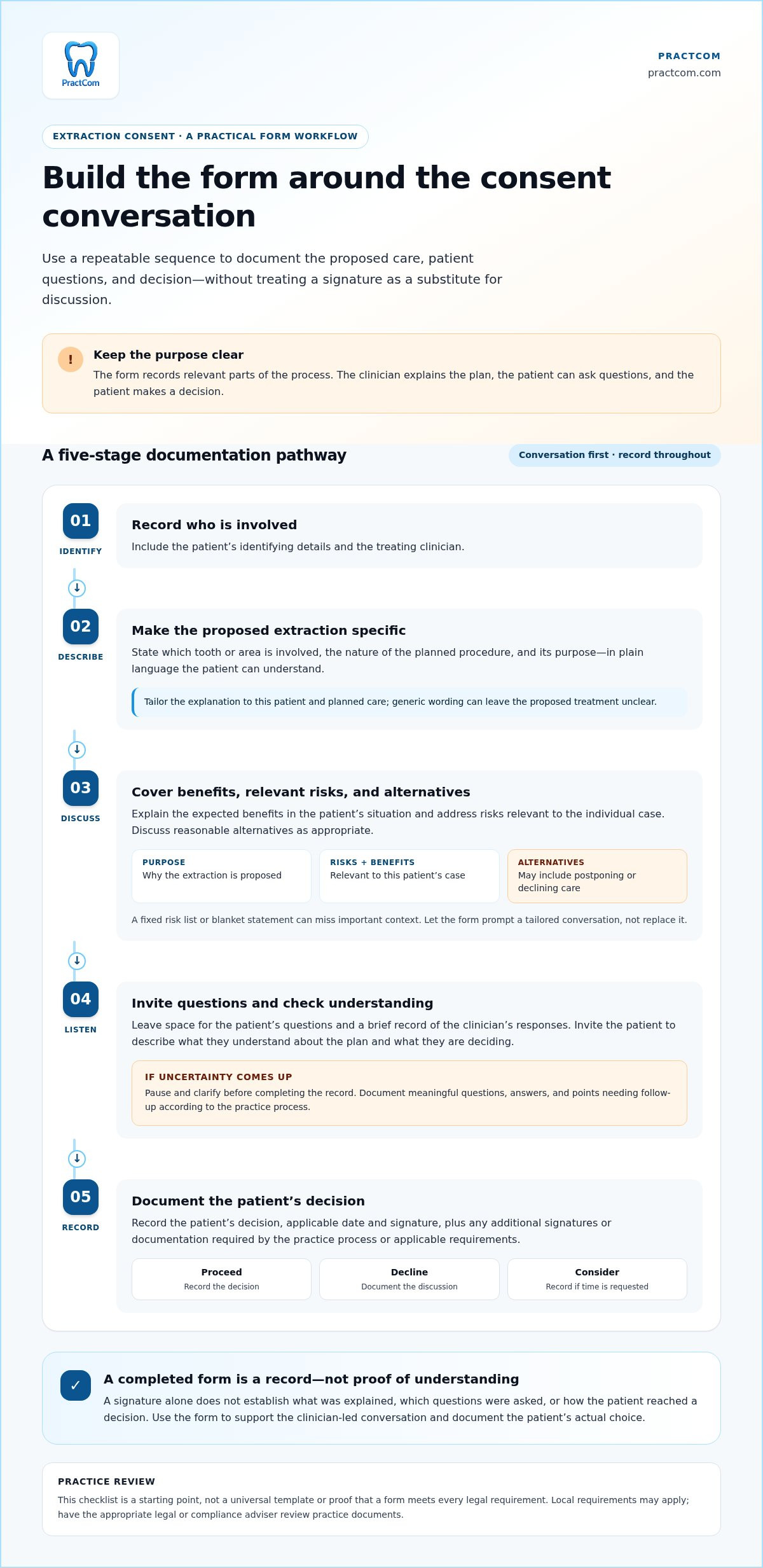
Check understanding in plain language. Invite the patient to describe what they understand about the planned treatment and what they’re deciding. If their response reveals uncertainty, pause and clarify before completing the record. Document meaningful questions and points discussed according to your practice process, but don’t assume a form captures every detail of the conversation.
Why extraction consent needs procedure-specific context
The discussion should reflect the proposed extraction and the patient’s relevant circumstances. A general template can provide structure, but it shouldn’t replace the treating clinician’s explanation of how the plan applies to this patient. Keep the wording understandable, and leave room to address individual questions rather than treating standard language as a complete script.
A clear written record can also help patients revisit information after the appointment. Digital consent documents may support delivery and access by email, text, or print, while clinical explanation and decision-making remain with the clinician and patient. For broader context on digital documentation workflows, see PractCom’s digital dental informed consent guide.
This section offers general form guidance, not individualized clinical advice or legal review. Consent practices and documentation expectations can vary by location and situation, so use appropriate clinical judgment and review applicable requirements when developing practice documents.
What to Include in a Tooth Extraction Consent Form
A useful checklist keeps the consent discussion organized, but it isn’t a universal template or proof that a form meets every legal requirement. Use it to support the treating clinician’s explanation, tailor the discussion to the patient and planned care, and create a clear record of the decision. The American Dental Association guidelines can help inform a practice’s approach to dental consent; local requirements may also apply.
Procedure details, risks, benefits, and alternatives
Describe the proposed extraction in plain language, including which tooth or area is involved and the nature of the planned procedure, as explained by the clinician. State its purpose and discuss the expected benefits in this patient’s situation. Avoid generic wording that could leave the patient unsure which care is being proposed.
Include space to address risks relevant to the individual case, along with reasonable alternatives. Depending on the clinical circumstances, the discussion may include postponing care or declining it, and what the clinician explains about those options. A fixed risk list or blanket statement can miss important context, so the form should prompt a tailored conversation rather than replace one.
Patient understanding and documentation fields
Make the document easy to complete consistently. Check whether it records:
- The patient’s identifying details and the treating clinician
- The proposed extraction and its purpose, in language the patient can understand
- Patient-specific discussion of relevant risks, expected benefits, and alternatives
- Space for the patient’s questions and a brief record of the clinician’s responses
- The patient’s decision, with applicable date and signature fields
- Any additional signatures or documentation called for by the practice’s process or applicable requirements
Before the patient signs, invite questions and address anything that remains unclear. A completed form is a record, not a substitute for checking understanding or documenting the patient’s actual decision. If the patient declines or wants time to consider, record the discussion and decision according to the practice’s process rather than treating a signature as the only meaningful outcome.
Use this checklist as a starting point, then have the practice’s appropriate legal or compliance adviser review the form for jurisdiction-specific requirements. A standard template can support consistency, but it can’t establish that every version is suitable for every location or patient.
For a more consistent document workflow, explore digital informed consent forms alongside your clinical review process.
Does a Signed Tooth Extraction Consent Form Mean the Patient Is Fully Informed?
No. A signature records that a patient signed or agreed to a document at a particular point in time. It doesn’t independently show what the clinician explained, whether the patient understood the information, or whether their questions were answered. A tooth extraction consent form is most useful as part of a broader clinical process, with a meaningful discussion and a clear record of the patient’s decision.
What a signed form can and cannot establish
A completed form can help the practice record which procedure was discussed, when the document was signed, and what decision the patient made. But it isn’t a transcript of the conversation. A checked box may indicate that risks were listed, for example, but not which risks the clinician explained in relation to the patient’s circumstances or what the patient asked about them.
Keep the record aligned with the actual discussion. If the clinician clarifies a concern or discusses an individual factor, document the relevant point according to practice policy. Avoid treating the signature as proof of every detail or as a guarantee of compliance. Requirements can vary by jurisdiction, so have the practice’s appropriate legal or compliance adviser review local expectations.
How to respond when a patient has questions or needs clarification
Pause before proceeding. Questions are a cue to clarify, not an obstacle to completing the form. The treating clinician should answer clinical questions in plain language and give the patient a chance to consider the information. If a patient asks how the proposed extraction relates to their situation, explain the plan in terms they can follow rather than repeating technical wording from a template.
If a patient has language or communication needs, arrange appropriate qualified language support where needed. A translated document can help make written information more accessible, but it doesn’t replace the clinician’s explanation or confirm comprehension by itself. Invite the patient to describe their understanding in their own words, then clarify any gaps without pressuring them to sign.
For a consistent record, capture meaningful questions, the clinician’s responses, any additional explanation, and the patient’s decision using the practice’s established process. If the patient is uncertain, wants more time, or chooses not to proceed, document that accurately rather than treating an unsigned form as a completed consent discussion. The goal is a record that reflects what happened, not merely a completed field.
How to Use an Extraction Consent Form in a Repeatable Practice Workflow
A repeatable process helps the team prepare documents consistently without turning consent into a paperwork handoff. Set clear roles: administrative staff can prepare or deliver the form, while the treating clinician leads the clinical explanation, answers treatment questions, and confirms the patient’s decision.
A practical sequence before, during, and after the discussion
Use a simple sequence that makes ownership clear at each step:
- Before: Prepare the relevant extraction document and check that the patient details and planned procedure information are accurate. Consider the patient’s communication needs and whether print or digital delivery fits the workflow.
- During: The treating clinician explains the proposed care, answers questions, and gives the patient time to decide before authorization. If a question remains unanswered, pause rather than treating a signature as a completed discussion.
- After: Check that the decision, applicable dates, signatures, and relevant discussion notes are complete. Retain the document with the patient record according to practice policy.
If the plan changes, return to the discussion. The clinician should explain what has changed and address any new questions before the patient authorizes the revised plan. If required information or a signature is missing, follow up and complete the record according to practice policy; don’t assume an incomplete form reflects consent.
A concise informed consent form checklist can help teams standardize document review and completion. The checklist supports a consistent process, while the clinician remains responsible for applying clinical judgment to each patient.
Keeping consent documents clear and accessible
Use readable language, logical sections, and signature fields that are easy to identify. Avoid dense blocks of text or labels that leave patients guessing where to respond. Choose print or digital delivery based on the patient’s needs and the practice’s workflow, then retain the completed record consistently.
For questions about digital document workflows, review your practice’s consent process and recordkeeping policies. A digital tooth extraction consent form can support organized delivery and documentation, but the format doesn’t change the clinician’s role in explaining the procedure or responding to concerns.
To organize consent documents alongside your practice’s communication workflow, explore PractCom’s digital consent tools.
How Digital Consent Forms Support a Clearer Extraction Documentation Process
Choosing paper or digital consent is an operational decision, not a change to the consent process itself. The treating clinician still needs to explain the proposed extraction, answer questions, and discuss the patient’s decision. The format affects how the document reaches the patient, how it’s completed, and how the practice manages the resulting record.
Paper and digital forms: workflow differences
| Workflow point | Paper form | Digital form |
|---|---|---|
| Delivery | Given to the patient in person or provided as a printed document. | Can be sent electronically, such as by email or text, depending on the practice’s workflow. |
| Completion | Completed on paper and returned to the practice. | Completed through the digital process used by the practice. |
| Access | The patient and team refer to the physical copy. | The patient can receive the document electronically; staff access depends on the practice’s setup. |
| Recordkeeping | Filed and retained according to practice policy. | Managed and retained according to the practice’s digital recordkeeping and privacy policies. |
Neither option is automatically clearer or more appropriate for every patient. A printed document may suit someone who prefers paper, while electronic delivery may fit a practice that organizes patient documents digitally. In either workflow, confirm that the form is complete and stored according to your policies. Apply the same privacy and retention standards your practice uses for patient records.
Technology doesn’t replace the clinician-patient conversation. Sending a document in advance or collecting it digitally doesn’t, by itself, show that the patient understood the discussion or had their questions answered.
Where PractCom fits in dental consent documentation
PractCom provides digital informed consent forms as part of its patient communication and documentation platform for dental practices. Documents can be delivered by email, text, or print in 15 languages, giving practices options for organizing delivery around patient and office workflows. The format supports document handling; the treating clinician remains responsible for the clinical explanation and discussion.
PractCom is not full practice management software. It supports dental communication and documentation workflows, while clinical decisions and consent conversations remain with the practice and patient. A tooth extraction consent form should still reflect the planned care and the discussion that took place, whether it’s printed or digital.
If you’re considering a more organized way to manage patient documents, explore the patient communication platform.
Make Consent Clear, Consistent, and Patient-Centered
A tooth extraction consent form works best when it supports a thoughtful discussion, not when it stands in for one. Keep the document focused on the proposed care and the patient’s circumstances, make room for questions and decisions, and use a repeatable process to complete and retain the record.
Digital documents can help organize delivery without changing the clinician’s responsibility to explain the procedure and respond to the patient. PractCom offers digital informed consent forms, with documents delivered by email, text, or print in 15 languages, alongside a library of more than 80 post-treatment templates.
Ready to bring more structure to patient communication and documentation? Explore PractCom’s digital consent tools. A clear workflow helps your team keep documents organized while supporting informed conversations.
Frequently Asked Questions
What should a tooth extraction consent form include?
A tooth extraction consent form should support a discussion of the planned procedure, its purpose, relevant risks and expected benefits, alternatives, and the patient’s questions and decision. The treating clinician should tailor the explanation to the individual case rather than rely on generic wording. Include appropriate date and signature fields to document the process. A checklist can help organize the form, but it can’t guarantee that a document is legally sufficient in every jurisdiction.
Is a signed tooth extraction consent form enough?
No. A signature records agreement to a document, but it doesn’t by itself show what the clinician discussed or what the patient understood. Pair the form with a clinician-led explanation, time for questions, and documentation consistent with practice policy. Consent requirements can depend on the jurisdiction and circumstances, so practices should review applicable rules with a qualified legal or compliance adviser rather than treating a signed form as a universal standard.
Can a patient change their mind after signing an extraction consent form?
A patient can raise concerns or communicate a changed decision after signing, and the clinical team should address this before proceeding. The treating clinician can clarify the situation, discuss relevant options, and answer questions. Update the record to reflect the new discussion and the patient’s decision according to practice policy. A signed form shouldn’t be treated as a reason to disregard a patient’s current concerns or choice.
What risks should be listed on a tooth extraction consent form?
Relevant risks depend on the planned extraction and the patient’s circumstances, so there isn’t one fixed list that fits every case. The treating clinician should explain applicable risks in understandable language, alongside expected benefits and alternatives. A form can provide structure and a place to document the discussion, but a generic list shouldn’t replace clinical judgment or an explanation tailored to the patient.
When should a tooth extraction consent form be reviewed with the patient?
Review the form early enough for the patient to understand the information, ask questions, and make a decision before consenting to the procedure. The appropriate timing depends on the clinical situation and the practice’s process. If the treatment plan changes or new concerns come up, the treating clinician should revisit the discussion and document the updated information and decision according to practice policy.
Can a dental practice use a digital tooth extraction consent form?
Yes. Digital forms can support document delivery and completion, while the treating clinician remains responsible for explaining the proposed care and answering questions. Choose a process that fits your practice’s documentation and privacy policies, and review applicable requirements. PractCom’s digital informed consent forms and other documents can be delivered by email, text, or print in 15 languages. A digital format supports workflow, but doesn’t make a form universally sufficient.

Article by
Cary Ganz DDS
Dr. Cary H. Ganz is a dentist, prosthodontist, entrepreneur, lecturer, and author with more than 50 years of experience in clinical dentistry and dental technology. Throughout his career, he has combined hands-on patient care with a deep understanding of how technology can improve dental practice operations, communication, documentation, and patient outcomes.
In addition to his clinical background, Dr. Ganz has held significant leadership roles in the dental technology industry, including Past Owner and Vice President of Clinical Affairs at DEXIS Digital Radiography and Past Vice President of Clinical Affairs at Denticon Practice Management Software. His business experience includes product development, clinical strategy, dental software innovation, practice management solutions, and educating dental professionals on the effective use of technology in modern dentistry.
Today, Dr. Ganz continues to focus on creating practical technology solutions for dental practices, including PractCom, a comprehensive dental practice communication platform designed to improve patient communication, documentation, compliance support, referrals, and overall practice efficiency. His work reflects a career-long commitment to helping dentists deliver better care while making their practices more organized, efficient, and protected.
No responses yet