
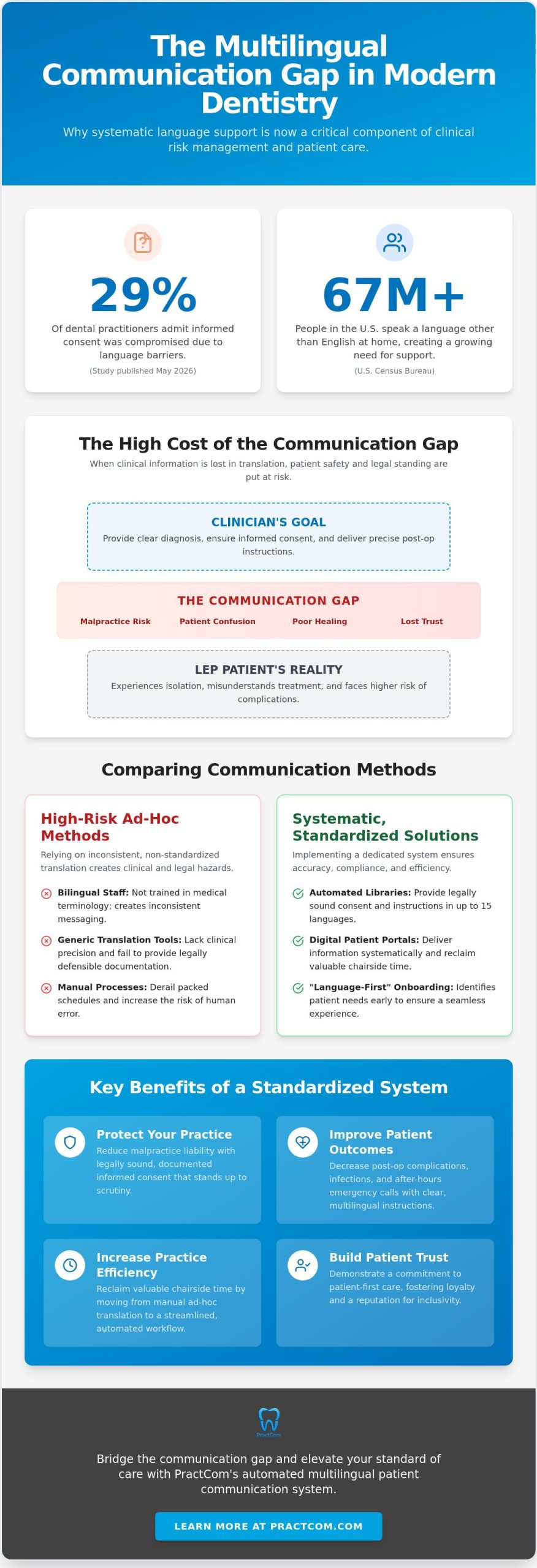
A study published in May 2026 revealed that 29% of dental practitioners admitted informed consent was compromised due to language barriers. This data makes effective multilingual patient communication in dentistry a clinical necessity rather than an administrative luxury. You’ve likely experienced the frustration of a packed schedule being derailed by ad-hoc translation. It’s a high-pressure scenario where the limitations of human memory can lead to patient confusion and a genuine fear of medical malpractice.
You deserve a system that functions as a guardian of your reputation and legal standing. This guide will show you how to implement a standardized communication system that improves patient outcomes, ensures legal compliance, and streamlines your practice workflow. By moving from manual tasks to systematic oversight, you can eliminate the operational resistance that slows your team down.
We’ll provide a roadmap for utilizing standardized documentation in multiple languages to reduce liability and improve patient healing. You’ll discover how to provide the psychological security your patients need while maintaining the technical precision your practice demands.
Key Takeaways
- Understand why systematic language support has evolved from a courtesy into a fundamental requirement for clinical risk management.
- Learn how to protect your practice from malpractice claims by securing legally sound informed consent in 15 different languages.
- Discover how standardized multilingual patient communication in dentistry reduces after-hours emergency calls and improves post-operative healing.
- Identify why relying on bilingual staff or generic translation tools creates clinical hazards that compromise patient safety and accuracy.
- Implement a high-efficiency workflow using digital patient portals and automated libraries to reclaim valuable chairside time.
The Growing Necessity of Multilingual Patient Communication in Dentistry
Multilingual patient communication in dentistry is the systematic delivery of clinical information in a patient’s primary language. It represents a fundamental move away from the “ad-hoc” translation methods that once defined the industry. In a modern practice, relying on a bilingual staff member who happens to be nearby is no longer a viable strategy. You need a standardized system that ensures every patient receives the same level of care and clarity, regardless of their native tongue. This approach transforms communication from a logistical hurdle into a professional clinical standard that protects both the patient and the practitioner.
The demographic landscape of 2026 in the US has made this transition mandatory. According to data from the U.S. Census Bureau, over 67 million people in the United States speak a language other than English at home. Suburban and urban clinics are seeing a significant rise in patients with Limited English Proficiency (LEP). When these patients enter your practice, a “Communication Gap” often occurs during clinical hand-offs. This gap erodes patient trust and creates a sense of isolation. If a patient doesn’t fully understand their diagnosis, they’re less likely to commit to a comprehensive treatment plan, leading to higher rates of untreated conditions.
Addressing the Limited English Proficiency (LEP) Challenge
Clinical risks are the most immediate concern when treating LEP patients. If a patient cannot read their instructions, they’re at a higher risk for infection or improper medication usage. This creates intense psychological stress for both the clinician and the patient. You’re left wondering if the patient truly grasped the principles of informed consent before you started the procedure. This stress intersects with the concept of health literacy. Health literacy is a patient’s ability to find and understand health information. When a language barrier is present, even a patient with high general literacy can struggle to navigate complex dental terminology. Providing native-language documents bridges this gap and ensures safety.
The Shift Toward Inclusive Clinical Standards
Leading DSOs and private practices are now adopting “Language-First” onboarding for all new patients. They identify preferred languages during the initial intake to ensure that every touchpoint, from consent forms to follow-up texts, is accessible. This proactive strategy is a cornerstone of building a “Patient-First” brand identity. It demonstrates that you value the patient’s comfort and legal rights from the moment they walk through the door. Adopting these inclusive standards isn’t just about compliance; it’s about creating a welcoming environment that encourages long-term loyalty. To understand how this fits into your broader practice goals, explore The Dental Patient Experience: A 2026 Guide. Establishing multilingual patient communication in dentistry as a baseline ensures your practice stays competitive and ethically sound.
Risk Management: Multilingual Informed Consent and Post-Op Instructions
Obtaining a signature is not the same as obtaining consent. For dental practitioners, the legal implications of treating a patient who doesn’t fully understand the procedure are severe. If a patient’s primary language is not English, a signed English document may fail to protect you in a “failure to inform” malpractice suit. Standardizing your multilingual patient communication in dentistry ensures that every risk, benefit, and alternative is communicated with technical precision. This documentation serves as your primary defense, proving that the patient had the capacity and information required to make an autonomous decision.
Clinical clarity extends far beyond the chairside encounter. When patients leave with translated post-op instructions, the volume of emergency after-hours calls and unnecessary office visits drops. Patients who understand their hygiene protocols are less likely to experience complications like dry socket or secondary infections. Clear communication bridges the gap between a successful surgery and a successful recovery. If you’re looking to modernize your documentation, you can explore our automated library of clinical forms to see how easy it is to implement.
The Legal Pillar: Translated Informed Consent
A signed English form might be ruled invalid if the patient can prove they didn’t comprehend the content. This vulnerability makes digital, easy-to-read consent forms in the patient’s native tongue a clinical necessity. Providing these documents electronically allows patients to review them at their own pace, reducing the pressure of the waiting room. For a deeper look at compliance, read our Digital Dental Informed Consent Forms: The 2026 Guide. Using standardized templates ensures that no clinical detail is lost in translation, maintaining the same high standard of care for every demographic.
Clinical Outcomes: Post-Treatment Compliance
Successful healing is directly linked to how well a patient follows their medication and hygiene protocols. Recent research on dental language barriers suggests that even minor misunderstandings can lead to medication errors. Providing native-language instructions breaks the “anxiety loop” for patients recovering at home. They don’t have to rely on family members for translation or guess their dosage. This clarity speeds up healing times and improves overall procedure outcomes. It’s a pragmatic approach that values the patient’s time and your practice’s efficiency. By implementing these systems, you shift from operational disorganization to systematic control.
Comparing Solutions: Human Translators vs. Automated Instruction Libraries
Many practices attempt to solve the language barrier through a “bilingual staff” model. While this feels personal, it’s often financially unsustainable and clinically inconsistent. Hiring a native speaker for every language in your community is impossible. Relying on one or two staff members creates a bottleneck and risks inconsistent terminology. You’re also at the mercy of their availability. If your only Spanish-speaking assistant is at lunch, your clinical flow stops. To maintain productivity during these gaps, many clinics utilize automated assistants like Aglaé By ClicFone to handle patient calls and inquiries 24/7. This prevents a high-pressure environment where documentation is often rushed or skipped entirely.
Don’t be tempted by free tools like Google Translate. These algorithms often misinterpret specialized dental terms or, worse, provide incorrect dosages. A misinterpreted instruction regarding post-extraction care can lead directly to patient harm. This is where multilingual patient communication in dentistry moves from a convenience to a safety requirement. Following American Dental Association guidelines is essential for compliance with Section 1557. This federal law mandates effective communication, which “ad-hoc” methods rarely provide.
The alternative is a standardized instruction library. This model offers pre-vetted, professional translations available on demand. It provides the same clinical precision for every patient, regardless of the language spoken. A standardized library is the most cost-effective way to manage multilingual patient communication in dentistry across a diverse patient base. It allows you to provide documentation in 15+ languages without the high cost of on-call human translators.
The Pitfalls of Ad-Hoc Translation
Using family members as translators is a common but risky practice. Family members often lack the clinical vocabulary to convey medical nuances accurately. They might omit “scary” details or simplify complex hygiene protocols to avoid upsetting the patient. In a high-pressure clinical environment, verbal-only instructions are frequently forgotten the moment the patient leaves the office. This leads to “clinical drift,” where different staff members explain the same procedure in slightly different ways, causing patient confusion and increasing your liability.
Standardization as a Business Strategy
Moving to an automated library is a savvy business move that offers immediate ROI. It provides “regulatory reassurance” by ensuring every document meets a high professional standard. You gain massive efficiency by sending a pre-translated text or email in seconds. Instead of wasting chairside time on ad-hoc explanations, your team can focus on clinical care. This systematic approach reduces operational resistance and protects your reputation. To see how these models stack up against traditional methods, check out the PractCom Comparison.
Implementing a Multilingual Workflow in a Busy Dental Practice
Transitioning to a systematic approach for multilingual patient communication in dentistry requires a structured plan. It’s about moving from operational disorganization to a state of controlled efficiency. The first step is to audit your patient demographics. Don’t guess which languages are most prevalent. Use local census data or your own intake reports to identify the top 3-5 non-English languages in your area. This focus allows you to master the most impactful translations first without overwhelming your staff.
Once you’ve identified your target languages, transition from paper forms to a digital patient portal with multi-language support. Paper is a bottleneck. It’s slow, easily lost, and nearly impossible to translate on the fly. A digital portal provides a centralized hub for all clinical documentation, ensuring that every patient has access to their records in a language they understand. This shift reduces the manual workload on your team and ensures that multilingual patient communication in dentistry remains a consistent part of your clinical standard.
Staff training is the engine that drives this new workflow. Train your front-desk and clinical teams on how to trigger automated SMS and email instructions. This should be a one-click process that occurs immediately after a procedure. When the system is easy to use, compliance becomes the path of least resistance. You can see how our automated workflow triggers work to simplify this transition for your team.
Multi-Channel Delivery: SMS, Email, and Print
Effective communication requires meeting patients where they are. Digital instructions sent via SMS or email are highly effective because they’re always accessible on a smartphone. This reduces the “anxiety loop” for patients who are recovering at home. However, you must also address the needs of older demographics who may prefer hard copies. Use physical document printing to provide professionally translated handouts; for practices looking to automate the mailing of these materials, Postal Methods offers a reliable solution. Throughout this process, maintaining HIPAA compliance is non-negotiable. Ensure your digital delivery methods use secure, encrypted channels to protect patient privacy and your practice’s reputation.
Automating the Follow-Up Process
Automation doesn’t end when the patient leaves the chair. Automated follow-ups in the patient’s native language can identify minor complications before they escalate into emergencies. By asking targeted questions about pain levels or swelling in their primary language, you can provide preemptive care. Use a performance dashboard to track patient engagement across different language groups. This data-driven approach helps you refine your strategy and ensures every patient receives high-quality care. For more on streamlining your office, read our Optimizing Dental Practice Workflow: 2026 Guide.
How PractCom Solves the Multilingual Communication Gap
PractCom functions as the stabilizing force your practice needs to manage the complexities of modern patient demographics. It’s an all-in-one patient communication platform designed specifically to bridge the clinical and administrative gaps that traditional systems leave behind. Unlike a full Practice Management Software (PMS), PractCom focuses exclusively on the precision of your documentation and the efficiency of your delivery. This specialization ensures that your team isn’t bogged down by unnecessary features while trying to secure essential clinical clarity.
The platform features an extensive library of over 80 post-treatment templates. These are not generic machine translations; they are professionally vetted instructions available in 15 different languages. This level of standardized multilingual patient communication in dentistry ensures that your instructions for a complex root canal or an implant placement are as clear in Vietnamese or Arabic as they are in English. By providing these resources on demand, you eliminate the need for costly on-call translators and reduce the risk of clinical errors.
Securing digital informed consent is streamlined through a secure patient portal. Patients can review and sign documents in their primary language from the comfort of their own devices, which significantly reduces waiting room friction. To further transcend verbal limitations, PractCom includes a Smile Design tool. This visual communication feature allows you to show patients their potential cosmetic changes through “before and after” simulations. It serves as a universal language that builds trust and increases case acceptance without the need for complex verbal explanations.
The PractCom Advantage: 15 Languages at Your Fingertips
PractCom integrates directly into your daily clinical routine to eliminate operational resistance. The system allows for “one-click” delivery of essential documents via text or email, ensuring that patients receive their instructions the moment they leave the chair. This automated delivery model provides the psychological security that both your staff and your patients need. You can focus on clinical excellence while the system handles the heavy lifting of secure, multilingual transmission. To understand the full scope of these benefits, explore Why PractCom? and see how it functions as a guardian of your practice’s reputation.
Scaling for Growth and DSOs
For larger organizations, maintaining a consistent standard of care across multiple locations is a logistical challenge. PractCom helps DSOs standardize their multilingual patient communication in dentistry by ensuring every clinic uses the same pre-vetted, high-quality templates. The Practice Performance Dashboard offers systematic oversight, allowing administrators to monitor clinical documentation compliance and patient engagement across the entire organization. This data-driven approach is essential for scaling your practice without compromising on legal or ethical standards. Discover more about our enterprise solutions at PractCom for DSOs.
Securing Your Clinical Future Through Systematic Clarity
The shift toward comprehensive multilingual patient communication in dentistry is no longer optional. It’s a fundamental requirement for risk management and patient safety in a diverse landscape. By replacing ad-hoc translations with a standardized system, you protect your reputation while improving clinical outcomes for every demographic you serve. You’ve seen how digital workflows eliminate the anxiety of documentation failures and reduce the burden of after-hours emergency calls. It’s about moving from operational disorganization to a state of complete clinical control.
You can implement these professional standards today without adding administrative overhead. PractCom provides a library of 80+ post-op templates and supports 15+ languages to ensure your message is always clear. With automated SMS delivery and secure digital informed consent, your team can focus on providing exceptional dental care while the system handles the complexities of compliance. Start your free trial of PractCom’s multilingual communication suite today to transform your practice into a modern, inclusive, and legally protected environment. You have the tools to lead your community with confidence.
Frequently Asked Questions
Is it legal to use digital consent forms for non-English speaking patients?
Yes, digital consent forms are legally valid for non-English speaking patients as long as the information is presented in a language they actually understand. Using standardized digital forms ensures you meet federal requirements for nondiscrimination and language access. It provides a clear audit trail that proves the patient received the necessary information to make an informed decision before treatment began.
How many languages should my dental practice support?
You should support the specific languages spoken by the demographics in your immediate community. Most practices find that supporting the top 3 to 5 non-English languages covers the vast majority of their patient base. Auditing your intake reports allows you to focus your resources where they provide the most significant clinical impact without overwhelming your staff.
Can I just use Google Translate for dental post-op instructions?
Using Google Translate for clinical instructions is dangerous and not recommended for professional use. Automated generic translation often fails to account for technical dental terminology and precise medication dosages. Professional vetting is required to ensure multilingual patient communication in dentistry remains safe and clinically accurate for every procedure you perform.
Does multilingual communication software integrate with my existing PMS?
Multilingual communication platforms are typically designed as standalone solutions that complement your existing Practice Management Software. They focus on the delivery and documentation of clinical information rather than scheduling or billing. This specialized approach allows for a “one-click” workflow that doesn’t require a full system overhaul or complex technical integration.
What happens if a patient claims they didn’t understand the translated instructions?
If a patient claims a lack of understanding, your standardized documentation serves as your primary legal defense against “failure to inform” claims. It provides verifiable proof that you delivered instructions in the patient’s primary language. This level of multilingual patient communication in dentistry reduces your liability and demonstrates that you followed professional standards for informed consent.
How much does it cost to implement a multilingual communication system?
Implementation costs are generally structured as manageable monthly subscriptions that offer a high return on investment. This model is far more cost-effective than hiring bilingual staff for every language or paying per-word for ad-hoc human translation. It allows you to scale your practice’s language capabilities without unpredictable administrative expenses or high overhead.
Can I print translated documents for patients who don’t use a smartphone?
Yes, you can provide hard copies through physical document printing features within the platform. While digital delivery via SMS and email is efficient, many patients, particularly older demographics, still value physical handouts. Providing professionally translated paper instructions ensures your practice remains inclusive and accessible to every patient who walks through your door.
How do translated instructions reduce emergency phone calls?
Translated instructions reduce emergency calls by providing patients with clear, native-language protocols for pain management and hygiene. When a patient understands exactly what to expect during recovery, they’re less likely to experience the anxiety that leads to after-hours calls. This clarity improves healing times and keeps your clinical schedule on track by preventing unnecessary office visits.
Article by
Cary Ganz DDS
Dr. Cary H. Ganz is a dentist, prosthodontist, entrepreneur, lecturer, and author with more than 50 years of experience in clinical dentistry and dental technology. Throughout his career, he has combined hands-on patient care with a deep understanding of how technology can improve dental practice operations, communication, documentation, and patient outcomes.
In addition to his clinical background, Dr. Ganz has held significant leadership roles in the dental technology industry, including Past Owner and Vice President of Clinical Affairs at DEXIS Digital Radiography and Past Vice President of Clinical Affairs at Denticon Practice Management Software. His business experience includes product development, clinical strategy, dental software innovation, practice management solutions, and educating dental professionals on the effective use of technology in modern dentistry.
Today, Dr. Ganz continues to focus on creating practical technology solutions for dental practices, including PractCom, a comprehensive dental practice communication platform designed to improve patient communication, documentation, compliance support, referrals, and overall practice efficiency. His work reflects a career-long commitment to helping dentists deliver better care while making their practices more organized, efficient, and protected.
No responses yet