
Measuring ROI of patient communication software means comparing financial gains with investment costs, then considering changes in patient and practice outcomes. A positive financial return is important, but it does not tell the whole story if communication still creates extra work or patients do not complete the intended next steps. Set baseline measures before implementation so you can assess what changes afterward.
Message volume and open rates do not show whether patients followed instructions, kept appointments, or felt supported. Assess financial and clinical outcomes alongside operational efficiency, patient satisfaction, and communication KPIs. Portal adoption and workflow impact can also help distinguish activity from meaningful results, giving your practice a clearer basis for evaluating software.
Key Takeaways
- Assess financial returns alongside clinical changes, such as patient follow-through and outcomes, to understand the value communication tools may create.
- Measure operational impact by tracking staff time and routine call volume, not just the number of messages sent.
- Use portal adoption, patient feedback, and completed actions to distinguish meaningful engagement from basic communication activity.
- Choose a focused set of baseline and outcome metrics that connects software performance to your practice’s priorities.
Measuring clinical outcomes and financial benefits
Set a baseline for each clinical outcome and financial measure before implementation. Compare the same measures afterward, using consistent patient groups and reporting periods. The Agency for Healthcare Research and Quality advises estimating how improved patient outcomes affect hospital revenues and expenses. This connects clinical change to financial impact without treating message volume as proof of value.
Separate engagement from business outcomes
Opens, clicks, and replies show whether patients interacted with a message, not whether they acted on it. Pair each engagement metric with a clinical or operational result. For example, track whether patients who receive aftercare instructions follow them, attend follow-up visits, or avoid preventable complications. This makes outcomes such as fewer missed appointments or better follow-through measurable, rather than assumptions based on communication activity.
Connect clinical changes to financial impact
Hourly rounding illustrates why outcomes should extend beyond message counts. It has been associated with improved perceptions of staff responsiveness, fewer falls and call-light uses, and higher patient satisfaction scores. Track these results alongside staffing and care costs to understand the wider effect of a communication program.
Readmissions offer another outcome to monitor. One reported healthcare-system example reduced readmissions by 20% and generated over $5 million in avoidable acute-care cost savings. These figures describe that example, not a forecast for every organization. For a local evaluation, compare readmissions and related expenses before and after the communication change, while accounting for other care changes.
Keep reimbursement categories distinct
For chronic care management (CCM), assess financial performance using the practice’s own relevant service and collection data, alongside patient engagement and clinical outcomes. Don’t treat remote patient monitoring (RPM) reimbursement as a CCM rate. The provided estimate for combined CPT 99454 and CPT 99457 RPM reimbursement is approximately $97 per month. A reported health system serving 10,000 chronic-disease patients generated $3 million in additional annual RPM reimbursement revenue. Those RPM figures illustrate a separate program; they don’t establish the return from communication software or CCM.
Review each outcome alongside its financial effect, then compare both with implementation costs. This paired view shows whether clinical improvements and operational gains support the investment.
Operational efficiency and call reduction
Patient communication software can affect appointment volume by supporting confirmations and follow-ups that help patients act on scheduling messages. Revenue depends on completed appointments, available capacity, and the practice’s billing model, so measure those outcomes alongside communication activity.
Operational Efficiency and Cost Avoidance
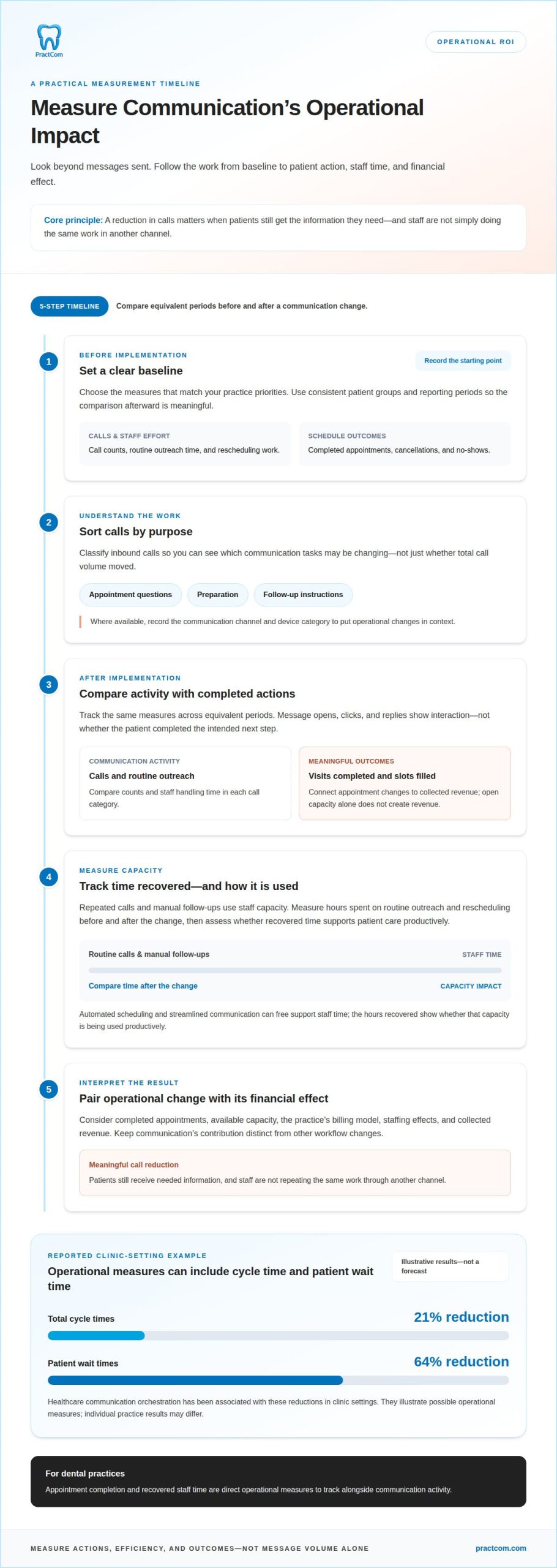
Operational efficiency means completing necessary work with less staff time and fewer avoidable steps. Repeated calls and manual follow-ups consume capacity that could support patient care. Track call volume, time spent on routine outreach, and rescheduling work before and after a communication change. Automated scheduling and streamlined communication can free support staff’s time; measuring the hours recovered shows whether that capacity is being used productively.
Appointment Volume and Revenue
Appointment volume reflects how many scheduled visits patients complete, while revenue reflects the financial result of those visits. Compare completed appointments, cancellations, and no-shows across equivalent periods, then connect those changes to collected revenue. This separates increased message engagement from changes that affect the schedule. Also consider whether newly available slots are filled, since open capacity alone does not create revenue—specialty and aesthetic clinics, for example, often turn to solutions like pitcrewlabs.ai to drive revenue by reactivating dormant patients.
For call reduction, classify inbound calls by purpose, such as appointment questions, preparation, or follow-up instructions. Then compare call counts and staff handling time in each category. A reduction is meaningful when patients still receive the information they need and staff are not doing the same work through another channel. Record the communication channel and device category where available to put operational changes in context.
Healthcare communication orchestration has been associated with a 21% reduction in total cycle times and a 64% reduction in patient wait times in clinic settings. These results illustrate possible operational measures, not a forecast for an individual practice.
For hospitals, operating-room throughput can be assessed through schedule utilization, delays, and completed procedures. Connect those measures to revenue and staffing effects, while keeping communication’s contribution distinct from other workflow changes. For dental practices, appointment completion and recovered staff time provide more direct operational measures. A closer look at automated patient follow-ups can help frame how follow-up communication fits into appointment workflows.
Patient portal and communication KPIs
Compare patient communication platforms by whether their features support measurable outcomes, not by feature count alone. Track portal enrollment, completed actions, staff workflow impact, and patient experience to determine whether returns are driven by useful engagement.
For a hospital or dental practice, compare platforms using the same measures: portal adoption, follow-up completion, message delivery, and staff time. Routine care providers like Blue Ridge Family Dentistry, for instance, benefit when online patient resources and digital messaging clarify insurance and appointment details before visits. A dashboard is useful when it connects technology activity with patient actions and operational results, rather than reporting clicks alone.
In the United States, HIPAA privacy and security requirements and TCPA rules for certain communications can affect platform configuration. Include privacy safeguards, consent processes, and communication preferences in your evaluation before automating messages.
There is no single typical price or pricing model for every platform. Compare each proposal’s billing structure, included features, usage limits, and implementation needs, then relate those terms to the practice’s expected workload and outcomes.
Automated reminders can support fewer missed appointments, but results depend on patient access, message timing, and whether patients can respond or reschedule easily. Set a baseline, then track missed appointments before and after rollout to assess the change in your practice.
Most practices see initial ROI from patient engagement tools within 60-90 days. Treat that as an initial-return benchmark, not a universal payback period; adoption, staff workflow changes, and the value of completed appointments influence the calculation.
Low adoption, inconsistent data, and staff workarounds can weaken returns. Review enrollment, adoption, and workflow impact at 30 days, then use regular performance reviews to identify barriers. Enrollment below 40% of eligible patients is a warning sign, while a 60-75% portal adoption rate is a suggested target.
Pair portal activity with communication outcomes: completed forms, follow-up actions, and appointment attendance. A 90% email open rate alone doesn’t show behavior change. Tracking both action and impact gives leaders a clearer basis for deciding whether a platform is delivering value.
What metrics measure ROI of patient communication software?
Use metrics that connect communication activity to clinical, operational, and financial outcomes. For example, compare completed follow-ups with staff time spent on outreach, then review the financial effect. Traditional healthcare ROI divides financial gains by investment costs. A practical approach to measuring ROI of patient communication software ties each measure to a defined goal, such as reducing missed appointments or improving patient follow-through.
Build a balanced scorecard with four categories. For each measure, record its baseline, data source, and review schedule:
- Engagement: portal enrollment, message delivery, and completed actions.
- Operations: staff time, repeat calls, and correction work.
- Clinical: completion of care instructions and follow-up attendance.
- Financial: collected revenue linked to completed appointments and avoided work.
This structure helps teams distinguish a busy communication channel from a useful one. An email open rate, for instance, does not show whether a patient completed the intended action.
Use the ROI Methodology’s five levels to organize evaluation: reaction, learning, application, impact, and financial ROI. A patient may value a message, understand an instruction, act on it, and contribute to a measurable practice outcome. Tracking those stages helps show where engagement is working and where the process breaks down.
Define data sources before reporting results. Appointment records can show attendance, while staff logs can capture time spent handling routine questions. Patient surveys can add context about satisfaction. If two systems label the same outcome differently, align definitions before comparing results. This helps avoid attributing a change to communication software when the underlying data does not match.
Review the scorecard regularly and share findings with practice leaders and staff. A dashboard can surface changes, while a focused review explains what drove them and what needs adjustment. When measuring ROI of patient communication software, keep the report practical: show the goal, baseline, current result, and business implication for each KPI.
Start mapping your communication KPIs to the outcomes your practice needs to improve.
PractCom: The All-in-One Patient Communication Platform for Dental Practices
PractCom brings patient communication tools for dental practices together, helping organize processes that might otherwise rely on separate manual steps. Turn to it when you want to support patient follow-through and streamline communication workflows.
PractCom’s Post-Treatment Instruction Library helps practices provide patients with aftercare guidance. Digital Informed Consent Forms support the consent process, while the Referral Management System helps organize referral communication. These tools can support ROI reviews using practical measures such as completed instructions, consent workflows, and referral follow-through.
Use your own baseline and priorities to evaluate whether these communication workflows address the operational needs you identified. Contact PractCom to discuss how its platform can fit your dental practice.
Make measurement part of your practice rhythm
Measuring ROI of patient communication software is most valuable when findings shape decisions, not just reports. Assign someone to review the chosen measures and share what they reveal with practice leaders. Use those discussions to refine communication goals, address workflow friction, and keep patient experience in view.
Keep the evaluation focused on decisions your team can act on. If a measure changes, identify the workflow behind it and decide whether to adjust the communication process, staff support, or the metric itself. A clear review rhythm helps prevent useful data from becoming another forgotten dashboard.
As your priorities evolve, revisit whether your communication approach still supports the outcomes that matter to your practice. A thoughtful conversation can help clarify where a platform fits into that plan. Contact PractCom to discuss your needs, and take the next step with a clearer measurement plan.
Frequently Asked Questions
So How Do You Do It?
Start by choosing a practice decision the evaluation should inform, such as whether to expand automated follow-ups. Identify the financial and patient outcomes connected to that decision, then assign an owner for each data source. During review, distinguish software-related changes from staffing, scheduling, or policy changes. This gives your team a more useful explanation of results than a single return figure alone.
How do you calculate ROI for patient communication software?
Divide the financial gains attributed to the software by its total investment costs, then express the result as a ratio or percentage. For example, include documented savings from reduced manual work and attributable revenue from completed appointments. Include applicable costs of implementation and use. Keep assumptions visible, especially how you valued staff time, so decision-makers can understand what the result represents.
How does software reduce staff time and administrative costs?
Communication software can reduce repetitive work by organizing routine patient messages and follow-ups in a consistent workflow. Staff may spend less time preparing the same information repeatedly, searching for prior communications, or responding to preventable questions. To assess the effect, map a task such as sending post-visit instructions from start to finish, then identify which manual steps change and how staff use the time saved.
How can healthcare practices track communication software ROI before and after implementation?
Create a written measurement plan that records metric definitions, data owners, and reporting sources before rollout. After implementation, apply those same definitions to comparable patient groups and workflows. For example, separate appointment types or communication channels if their outcomes differ. Note changes in staffing, scheduling, or patient mix that could influence results, so leaders can interpret the comparison without attributing unrelated changes to the software.
How much can automated patient reminders reduce no-shows?
The recommended target is a 20-40% reduction in missed appointments, but actual results depend on patient access, message timing, and how easily patients can respond or reschedule.

Article by
Cary Ganz DDS
Dr. Cary H. Ganz is a dentist, prosthodontist, entrepreneur, lecturer, and author with more than 50 years of experience in clinical dentistry and dental technology. Throughout his career, he has combined hands-on patient care with a deep understanding of how technology can improve dental practice operations, communication, documentation, and patient outcomes.
In addition to his clinical background, Dr. Ganz has held significant leadership roles in the dental technology industry, including Past Owner and Vice President of Clinical Affairs at DEXIS Digital Radiography and Past Vice President of Clinical Affairs at Denticon Practice Management Software. His business experience includes product development, clinical strategy, dental software innovation, practice management solutions, and educating dental professionals on the effective use of technology in modern dentistry.
Today, Dr. Ganz continues to focus on creating practical technology solutions for dental practices, including PractCom, a comprehensive dental practice communication platform designed to improve patient communication, documentation, compliance support, referrals, and overall practice efficiency. His work reflects a career-long commitment to helping dentists deliver better care while making their practices more organized, efficient, and protected.
No responses yet