
Imagine it’s 8:00 PM on a Tuesday, and your phone buzzes with an emergency call from a patient who simply “forgot” their post-operative instructions. You aren’t just managing a minor inconvenience; you’re witnessing how improving dental patient compliance remains the most significant hurdle to achieving predictable clinical outcomes in 2026. It’s frustrating to watch a technical success be undermined by patient neglect, especially when your chairside handovers feel like a race against time and patient anxiety.
We recognize the operational stress that comes with redundant phone calls and the constant fear of documentation gaps. This guide will show you how to transform patient adherence from a clinical hurdle into a streamlined, automated workflow that protects your practice and improves recovery rates. We’ll explore a systematic approach to instruction delivery and digital consent that provides psychological security for you and clear, accessible guidance for your patients. By moving from manual tasks to a standardized system, you can reduce post-op complications and ensure your legal protection is as robust as your clinical work.
Key Takeaways
- Quantify the hidden financial impact of non-adherence by using a performance dashboard to track the correlation between patient neglect and practice overhead.
- Discover why a digital instruction library is the most effective method for improving dental patient compliance compared to traditional verbal handovers.
- Eliminate language barriers and literacy hurdles by providing clinical instructions in 15 languages using simplified, jargon-free terminology.
- Automate the “Golden 24 Hours” of post-op care through scheduled SMS and email follow-ups to reduce redundant front-desk phone calls.
- Strengthen your legal protection and operational oversight by integrating a documentation-first workflow that complements your current software.
Understanding the True Cost of Dental Patient Non-Compliance
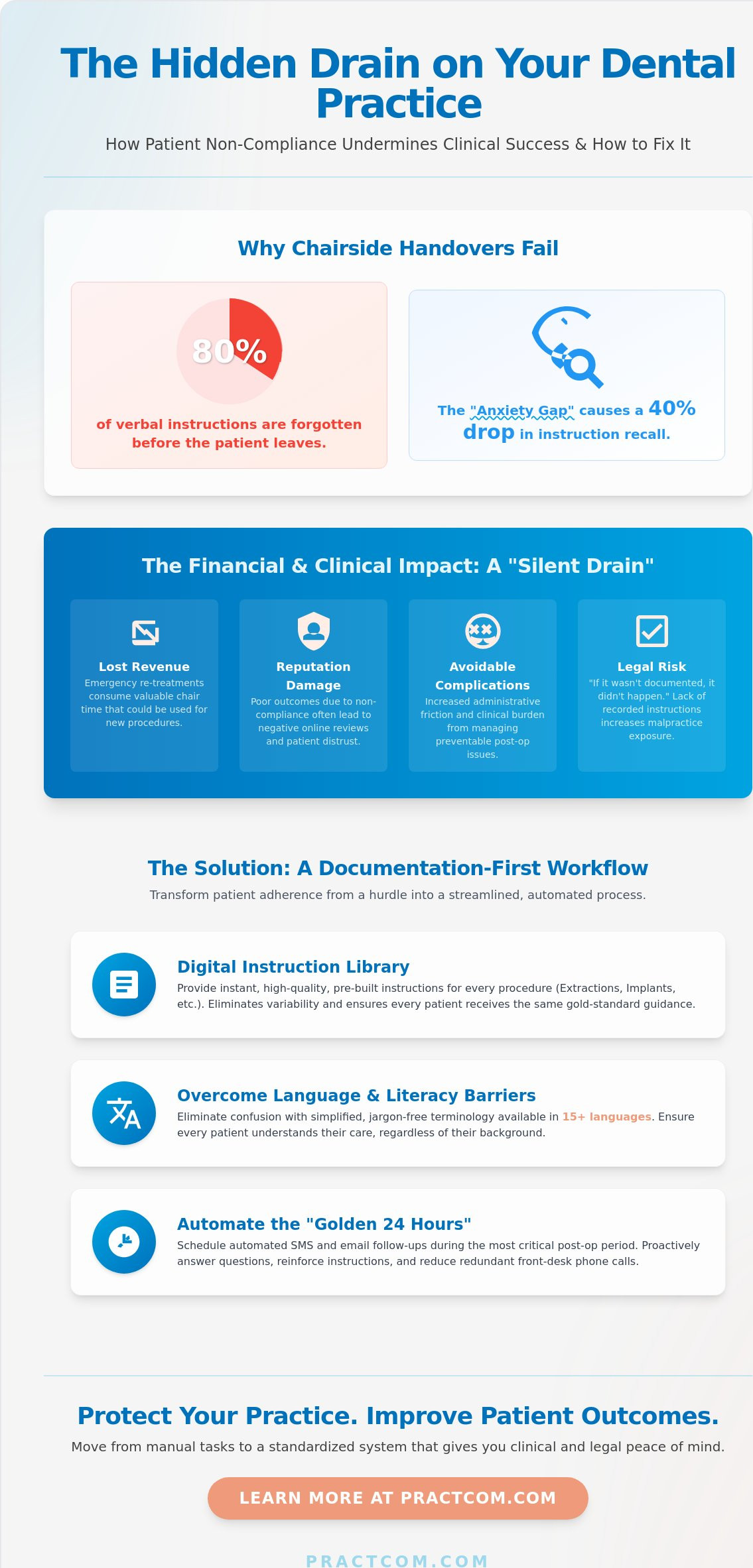
In 2026, patient compliance is no longer a passive expectation; it’s a measurable clinical metric. We define it as the degree to which a patient’s behavior aligns with agreed-upon recommendations from their provider. This concept, often referred to as patient adherence, is the foundation of successful long-term outcomes. When patients fail to follow post-treatment protocols, it creates a “silent drain” on your practice performance dashboard. You see this manifest as lost revenue from emergency re-treatments, increased administrative friction, and the burden of managing avoidable complications that could have been prevented with better oversight.
The Financial and Clinical Impact
Non-compliance isn’t just a clinical hurdle; it’s a financial liability. Every minute spent on a corrective treatment for a failed post-op recovery is chair time that could have been used for a new procedure. Beyond the immediate loss of revenue, poor outcomes often lead to negative online reviews. From a risk management perspective, clear aftercare isn’t just about healing; it’s about creating a documented trail that reduces your malpractice risk. Improving dental patient compliance simultaneously protects your bottom line and your professional standing.
Why Verbal Instructions Fail
Most practitioners rely on chairside handovers, yet research shows patients forget nearly 80% of verbal instructions before they leave the parking lot. This is the result of the “Anxiety Gap.” High-stress procedures trigger a physiological response that blocks memory retention. Patients experience cognitive overload during the checkout process while managing physical discomfort. Data indicates that the “Anxiety Gap” creates a 40% drop in instruction recall, making verbal advice almost entirely ineffective. To bridge this gap, you need a system that moves past the limitations of human memory. See how standardized systems provide stability at Why PractCom.
The Legal Necessity of Documentation
In a high-pressure environment, “if it wasn’t documented, it didn’t happen.” Relying on staff memory is a dangerous gamble. Standardized documentation ensures every patient receives the same high-quality instruction, regardless of staffing changes. This systematic oversight acts as a guardian for your reputation. By providing clear, written, and accessible instructions, you fulfill your professional necessity to provide a complete standard of care. Improving dental patient compliance starts with recognizing that your words are only as effective as the system that records them.
Standardizing the Chairside Handover with Digital Tools
The transition from the clinical chair to the front desk is often where the most critical information is lost. When you rely on ad-hoc verbal advice, you introduce variability that undermines your clinical success. Improving dental patient compliance requires a shift toward a standardized digital ecosystem. By replacing inconsistent verbal handovers with a comprehensive digital instruction library, you ensure that every patient receives precise, actionable guidance that they can reference long after the local anesthetic wears off. This systematic approach doesn’t just help the patient; it provides your staff with a reliable framework that eliminates the stress of “winging it” during a busy checkout process.
Building a Post-Treatment Instruction Library
Templates are the backbone of administrative efficiency. Instead of forcing assistants to type manual notes for every procedure, a pre-built library allows for the instant delivery of high-quality instructions. We recommend categorizing your resources by procedure type, such as Extractions, Endodontics, or Implants, to ensure accuracy. This method reduces the cognitive load on your team and guarantees that no vital step is omitted. For a deeper look at streamlining this process, explore our guide on Automated Dental Post-Op Instructions.
A significant gap in many practices is the disconnect between informed consent and aftercare. In 2026, these should be viewed as two sides of the same coin. Digital informed consent forms should lead directly into post-op education, creating a continuous narrative of care. This integration reinforces the patient’s role in their own recovery. To see how these systems work in tandem, you can view our platform capabilities.
The Power of Visual Reinforcement
Visual aids transform abstract clinical concepts into concrete realities. Using “Before and After” visualizations through smile design tools serves as a constant reminder of the patient’s aesthetic and functional goals. Digital tooth loss charts are equally effective, as they provide a sobering look at the necessity of adherence to prevent further complications. Research into Strategies for Improving Patient Compliance highlights that engagement levels rise when patients can see the “why” behind the “how.” Implementing visual smile design increases treatment acceptance by 30% by making the clinical outcome tangible and desirable.
Finally, the delivery of these digital documents must be secure. HIPAA compliance is a professional necessity when sending instructions via email or text. Using a platform that encrypts these communications provides the regulatory reassurance you need to protect your practice’s reputation. This secure, digital-first approach ensures that patients have 24/7 access to their care plans without compromising their privacy or your legal standing.
Overcoming Language and Literacy Barriers to Compliance
Clear communication is the bridge between a successful surgery and a successful recovery. When a patient leaves your office, their ability to follow your instructions depends entirely on their understanding of the material provided. Language barriers and low health literacy aren’t just social challenges; they’re clinical risks that lead to post-operative complications. By addressing these hurdles head-on, you’re not just providing a service; you’re improving dental patient compliance through inclusive care. This requires moving away from complex clinical jargon and adopting a 5th-grade reading level for all patient-facing materials. This simplification ensures that instructions are accessible to everyone, regardless of their educational background or stress levels at the time of discharge.
Multi-Language Support as a Clinical Necessity
Relying on generic tools like Google Translate is a significant liability for any modern practice. These tools often fail to capture the nuance of medical terminology, which can lead to dangerous misunderstandings in complex surgical aftercare. Providing professional templates in a patient’s native tongue offers the psychological security they need to feel confident in their recovery. Our platform supports 15 different languages, ensuring your instructions are accurate and culturally relevant. This level of precision is especially vital when dealing with Digital Dental Informed Consent Forms, where legal clarity is a non-negotiable professional requirement.
The Hybrid Delivery Model
Effective communication requires meeting patients where they are. While younger demographics prefer the speed of SMS and Email, older patients often value the tactile nature of physical document printing. A “Print + Digital” strategy ensures no one is left behind. This hybrid approach caters to different age demographics and learning styles, which is one of the most effective strategies to improve patient compliance. Accessibility means ensuring that digital instructions are readable on any device, from a smartphone in the pharmacy line to a tablet at home.
By using a centralized patient portal, you provide 24/7 access to care plans. This eliminates the “lost paper” problem and reduces the volume of redundant phone calls to your front desk. When patients can revisit their instructions at their own pace, the likelihood of “Lost in Translation” errors during the critical first 48 hours of recovery drops significantly. This systematic oversight transforms your aftercare from a point of friction into a standardized business requirement that protects both the patient and your practice reputation. It moves your team from the resistance of manual translation tasks to the confidence of a standardized, multi-lingual system.
A How-To Guide for Automated Patient Follow-Ups
Manual follow-up calls are a significant operational drain that often results in inconsistent care. By replacing these ad-hoc efforts with a structured cadence, you ensure that every patient receives the attention they need during the most critical stages of recovery. Improving dental patient compliance depends on your ability to maintain contact without overwhelming your administrative team. Automation allows you to deliver high-utility guidance exactly when the patient is most likely to need it. This shift moves your practice from a reactive stance to a proactive, systematic model that values both clinical accuracy and staff time.
Designing Your Automated Sequence
The “Golden 24 Hours” represents the most vulnerable window for post-operative success. A well-designed sequence addresses this by providing immediate digital delivery of instructions as the patient leaves. This is followed by a 24-hour check-in message to confirm they are managing discomfort and a 7-day progress survey. This cadence ensures that improving dental patient compliance isn’t left to chance. You can automate your follow-up cadence today to witness these operational improvements firsthand.
Referral Compliance: The Missing Link
Even when a patient is compliant within your office, the system often breaks down during a specialist handover. Research shows that 40% of dental referrals are never completed, which represents a massive gap in the continuum of care. This failure often stems from a lack of systematic tracking. By using a referral management system, you can monitor patient movement and ensure the loop is closed between the general dentist and the specialist. This level of oversight is a professional necessity for maintaining high standards of care. For more on this, read our guide on Mastering Dental Referral Management Software.
Tracking engagement is the final piece of the puzzle. Instead of wondering if a patient read their aftercare guide, you receive a signal once the document is accessed. This allows your team to focus their energy only on those who haven’t opened their instructions, maximizing staff efficiency and protecting your practice from claims of negligence. This data-driven approach removes the guesswork from patient adherence and provides a clear record of your commitment to their recovery. By implementing these automated touchpoints, you replace operational resistance with a reliable, standardized system of care.
Implementing a Documentation-First Culture with PractCom
The final step in improving dental patient compliance is moving from theory to practical implementation. A documentation-first culture ensures that every interaction is recorded, every instruction is delivered, and every patient is tracked with technical precision. PractCom functions as a specialized layer of communication that works alongside your existing software, filling the gaps that standard Practice Management Systems (PMS) often leave open. It doesn’t replace your PMS; it enhances it by providing a dedicated environment for patient education and legal documentation. This systematic oversight acts as a guardian for your reputation, ensuring that clinical necessity is always backed by administrative proof.
Integrating Communication into Daily Workflow
For dental assistants and front-desk staff, administrative friction is the primary enemy of consistency. When a system is difficult to use, it often gets ignored during the mid-day rush. PractCom addresses this by offering a high-utility interface where a patient portal can be established in just 5 minutes. This ease of use is essential for maintaining order in a high-pressure environment. By standardizing these touchpoints, you ensure consistency across multi-location practices. For large-scale operations, PractCom for DSOs provides the centralized oversight needed to maintain the same high standards across dozens of chairs, reducing the risk of human error.
The performance dashboard acts as a pre-emptive strike against operational failures. It allows you to identify compliance bottlenecks before they result in clinical complications or poor reviews. By monitoring which instructions are being accessed and which follow-ups are being ignored, you can intervene early. Data shows that this proactive communication can reduce emergency after-hours calls by 60%, simply by providing patients with the psychological security of accessible, clear information. It’s a pragmatic solution for the busy professional who values time and accuracy above all else.
Next Steps for Your Practice
Transitioning to a systematic model requires a clear, logical roadmap. We recommend starting with an audit of your current post-op instruction delivery to find where the communication gaps are most prevalent. Identify your high-risk procedures, such as complex implants or endodontic treatments, where non-compliance leads to the most expensive corrective work. Moving from the resistance of manual tasks to the confidence of a standardized system is the most effective way to protect your reputation and your patients. To begin this transformation, you can start your free trial of PractCom today and experience the reduction of operational resistance firsthand.
Mastering the Future of Clinical Communication
Transitioning from a manual, verbal-heavy approach to a standardized digital ecosystem is no longer just a luxury; it’s a professional necessity for the modern dental practice. By centralizing your instruction delivery, you eliminate the “Anxiety Gap” and ensure that recovery guidance is accessible long after the patient leaves your chair. This systematic shift protects your clinical outcomes, reduces the burden of emergency after-hours calls, and provides the regulatory reassurance you need to practice with confidence.
We’ve explored how identifying compliance bottlenecks through data and removing language barriers can transform your practice’s efficiency. Improving dental patient compliance is ultimately about replacing operational resistance with a reliable, automated workflow that supports both your staff and your patients. With over 80 procedure-specific templates, multi-language support in 15 languages, and an automated SMS and email follow-up system, you have the tools to secure your reputation and legal standing.
Start improving your patient compliance with a PractCom free trial
You don’t have to manage the stress of patient adherence alone. We’re here to help you build a more resilient, documentation-first practice today.
Frequently Asked Questions
What is the most common reason for dental patient non-compliance?
The primary driver of non-compliance is the “Anxiety Gap,” where high-stress procedures block memory retention. Patients often leave the office in a state of cognitive overload, causing them to forget up to 80% of verbal instructions. By improving dental patient compliance through written, digital materials, you bridge this memory gap and provide a reliable reference for their recovery journey.
How can I ensure my post-op instructions are HIPAA compliant?
To ensure HIPAA compliance, you must use a platform that encrypts data both in transit and at rest. As of February 16, 2026, practices must also ensure their Notice of Privacy Practices includes specific protections for substance use disorder records under 42 CFR Part 2. Using a standardized system for instruction delivery ensures that sensitive patient data is protected by industry-standard security protocols rather than unsecured personal devices.
Do digital consent forms actually stand up in court?
Digital informed consent forms are legally binding provided they include a secure audit trail and a verifiable timestamp. Courts value the consistency of a standardized digital system over the variability of manual paperwork. Having a documented record of exactly what the patient was told, and when they signed it, provides a robust layer of legal protection for your practice reputation.
How many languages should my dental practice support?
Your practice should support at least the most common languages spoken in your local demographic, though offering 15 languages is the current industry benchmark for comprehensive care. Providing instructions in a patient’s native tongue reduces “Lost in Translation” errors during complex surgical aftercare. This inclusive approach is a professional necessity for improving dental patient compliance across diverse patient populations.
Can I send post-op instructions via text message?
You can send post-op instructions via text message, provided the communication is handled through a secure, HIPAA-compliant gateway. SMS delivery is highly effective because it meets patients where they are on their mobile devices. This immediate accessibility ensures they have their care plan available at the pharmacy or at home without searching through physical paperwork.
What is the best way to follow up with a patient after a surgical procedure?
The best way to follow up is through an automated cadence that focuses on the “Golden 24 Hours” post-procedure. This includes an immediate digital delivery of instructions, a check-in message the following day, and a progress survey after one week. This systematic approach ensures no patient falls through the cracks while reducing the administrative burden on your front-desk staff.
How does a patient portal improve compliance compared to email?
A patient portal improves compliance by providing a centralized, secure location for all care documents that patients can access 24/7. Unlike email, which can be easily lost, deleted, or filtered into spam, a portal offers a stable environment for recovery resources. It also allows you to track engagement, so you know exactly when a patient has accessed their instructions.
Will automating my follow-ups make my practice feel less personal?
Automation actually enhances the personal feel of your practice by ensuring that every patient receives timely, high-quality attention. It removes the risk of human error or staff forgetfulness during a busy clinical day. By automating routine follow-ups, your team is freed from redundant phone calls, allowing them to focus on providing warm, empathetic care during chairside interactions.

Article by
Cary Ganz DDS
Dr. Cary H. Ganz is a dentist, prosthodontist, entrepreneur, lecturer, and author with more than 50 years of experience in clinical dentistry and dental technology. Throughout his career, he has combined hands-on patient care with a deep understanding of how technology can improve dental practice operations, communication, documentation, and patient outcomes.
In addition to his clinical background, Dr. Ganz has held significant leadership roles in the dental technology industry, including Past Owner and Vice President of Clinical Affairs at DEXIS Digital Radiography and Past Vice President of Clinical Affairs at Denticon Practice Management Software. His business experience includes product development, clinical strategy, dental software innovation, practice management solutions, and educating dental professionals on the effective use of technology in modern dentistry.
Today, Dr. Ganz continues to focus on creating practical technology solutions for dental practices, including PractCom, a comprehensive dental practice communication platform designed to improve patient communication, documentation, compliance support, referrals, and overall practice efficiency. His work reflects a career-long commitment to helping dentists deliver better care while making their practices more organized, efficient, and protected.
No responses yet