
What if the reason your patients ignore post-operative instructions isn’t a lack of willpower, but a failure of the delivery system itself? You’ve likely felt the frustration of seeing a clinical success undermined by poor home care, or the exhaustion of a staff forced to repeat the same basic guidance dozens of times a week. When patients fail to follow through, it’s often because human memory is fragile under the stress of a dental procedure. Improving dental patient compliance requires moving beyond the chairside chat and into a standardized, automated framework.
You already know that clear communication is the bedrock of successful outcomes, yet manual processes frequently leave room for error and neglect. This guide will show you how to transform patient behavior and clinical results by replacing verbal reminders with an automated system supporting 15 languages. We’ll explore a systematic approach for 2026 that utilizes a comprehensive Post-Treatment Instruction Library and digital follow-ups to reduce post-op complications and protect your office from administrative burnout. By the end of this article, you’ll have a blueprint for creating a more predictable, efficient, and legally secure clinical environment.
Key Takeaways
- Understand why patients forget up to 80% of clinical advice immediately and how to use the “Forgetting Curve” to your advantage.
- Discover how a multi-channel delivery system is the key to improving dental patient compliance by reaching patients where they’re most attentive.
- Learn to reduce administrative friction and staff burnout by implementing a standardized Post-Treatment Instruction Library with over 80 pre-built templates.
- Explore how providing digital instructions in 15 languages can safeguard your practice against miscommunication and post-operative complications.
- Identify the specific shift from manual to automated follow-ups that protects your clinical outcomes and your practice’s legal standing.
The High Cost of Dental Patient Non-Compliance in 2026
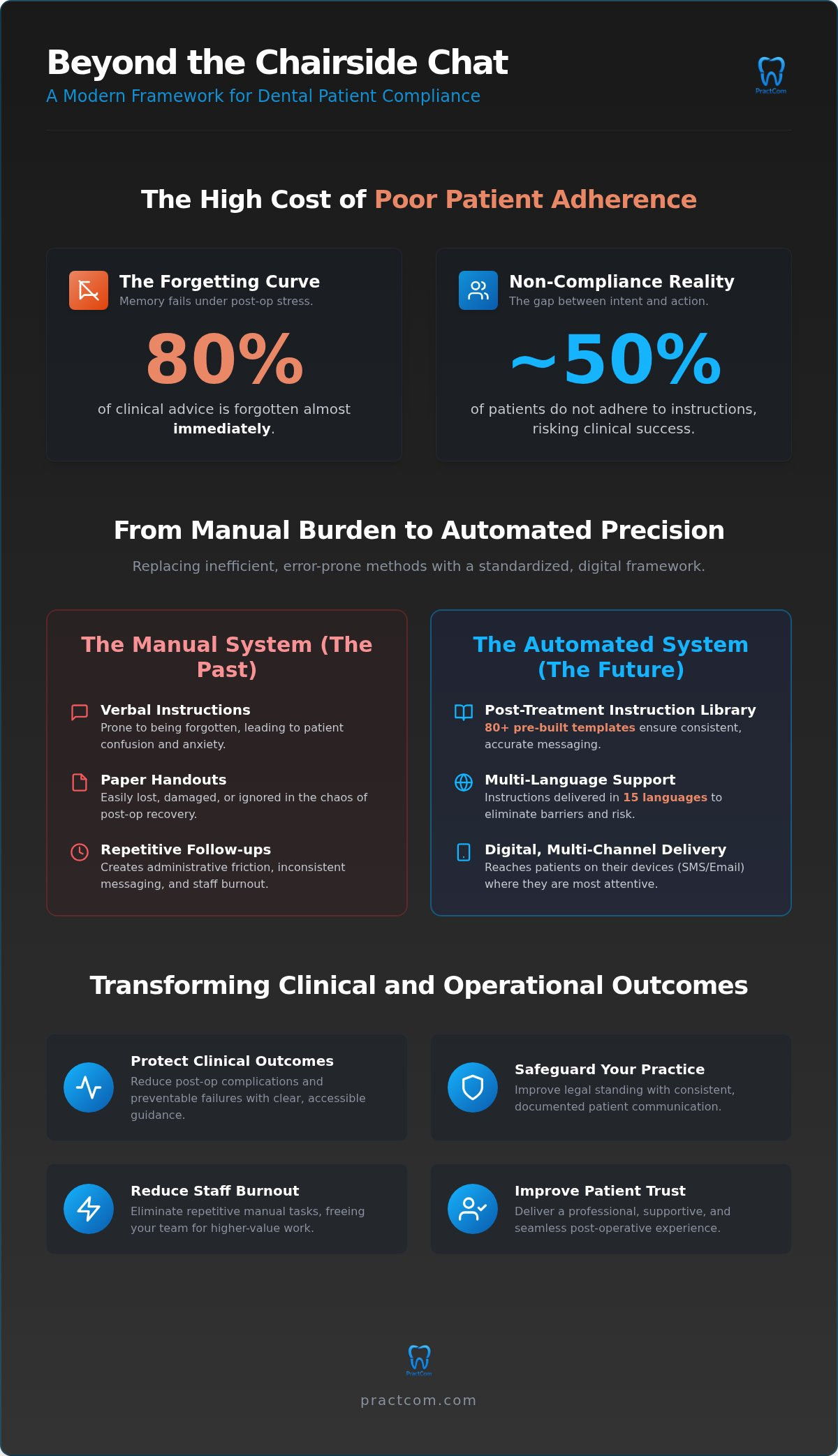
Clinical success is never just the result of a precise procedure; it’s the product of the intersection between patient understanding and actual behavior. While practitioners focus on technical mastery, the industry reality in 2026 remains sobering. Research suggests that non-compliance rates hover near 50%, creating a significant gap between clinical intent and patient reality. This gap isn’t just a clinical hurdle. It’s a direct threat to your practice’s operational stability. When we talk about patient adherence, we are discussing the lifeblood of practice reputation and financial health.
The financial impact of non-compliance manifests in lost chair time due to avoidable retreats, increased liability risks, and a decline in referral rates. If a patient doesn’t follow protocols, they don’t get the results they expected. This leads to a breakdown in the patient-provider trust relationship. Improving dental patient compliance is the only way to ensure that your clinical expertise isn’t undermined by factors outside the operatory. By systematically addressing how information is delivered, you move from a state of operational vulnerability to one of clinical control.
Clinical Risks and Post-Operative Complications
Poor adherence is a leading cause of secondary infections and preventable implant failures. When patients neglect post-operative care, the risk of complications skyrockets, often leading to “false alarm” emergency calls that disrupt your schedule and your team’s focus. Standardizing aftercare isn’t just a convenience; it’s a clinical necessity. In the context of modern documentation, the Standard of Care is defined by the clinician’s ability to demonstrate that clear, actionable instructions were delivered in a way the patient could actually understand. By improving dental patient compliance through better delivery systems, you protect both the patient’s health and your practice’s legal standing.
The Administrative Burden of Manual Follow-ups
Manual instruction delivery is a silent thief of staff productivity. Think about the hours your front-office team loses every week repeating the same instructions via phone or unorganized printouts. This manual approach often leads to inconsistent messaging across different providers, which confuses patients and increases their anxiety. The psychological stress on you and your team is immense when you feel like you’re constantly fighting against patient neglect. Moving toward a system that utilizes a standardized Post-Treatment Instruction Library with over 80 templates ensures that your messaging remains consistent, even when dealing with complex cases or patients who require instructions in one of 15 different languages. You can explore how this transition reduces administrative friction at PractCom’s overview of system benefits.
Psychology of Retention: Why Verbal Instructions Fail
The human brain isn’t built to retain complex medical data under stress. Research into the “Forgetting Curve” shows that patients forget between 40% and 80% of medical information immediately after hearing it. When you add the cognitive fog of sedation or the physiological impact of post-treatment anxiety, that retention rate drops even further. Verbal instructions, while well-intentioned, often vanish before the patient even reaches the parking lot. This psychological reality is a primary hurdle in improving dental patient compliance.
Relying on physical paper slips doesn’t solve the problem either. These documents are frequently lost, stained, or simply ignored in the chaos of post-op recovery. To ensure clinical success, patients need persistent, digital access to their specific protocols. Having instructions available on a smartphone via SMS or email provides a psychological safety net that physical media cannot match. You can explore how digital delivery stabilizes patient care by ensuring information is always within reach, regardless of the patient’s state of mind.
Bridging the Language Gap in Dental Aftercare
Adherence rates plummet when a language barrier exists. If a patient’s primary language isn’t English, the risk of misinterpreting complex aftercare is high. Providing instructions in the patient’s native tongue, with support for 15 languages, is both an ethical necessity and a legal safeguard. It ensures that every patient has the same opportunity for a successful recovery. Clear, multi-language documentation fulfills your regulatory obligations while removing the anxiety of miscommunication for both the staff and the patient.
Visual vs. Auditory Learning in Dentistry
Most people are visual learners who struggle to process long lists of spoken requirements. Tools like smile design software create immediate buy-in by showing the end result, but that momentum must carry into the aftercare phase. Standardized templates from a Post-Treatment Instruction Library ensure that every clinical detail is documented and delivered visually. Linking this to digital informed consent forms creates a continuous educational loop. This systematic approach transforms the patient from a passive recipient into an informed participant who understands the “why” behind their recovery steps.
Manual vs. Automated Systems for Improving Compliance
The traditional “verbal-only” method of delivering aftercare is inherently flawed because it relies on a patient’s cognitive state immediately following a stressful procedure. Automated digital delivery removes this variable by providing a consistent, permanent record of necessary actions. While email is a useful secondary channel, SMS provides superior visibility for immediate post-op instructions. Most patients check their text messages within minutes, ensuring that critical first-step protocols are seen before the local anesthetic wears off. This immediacy is vital for clinical success.
Automated follow-ups serve as a vital safety net for the modern practice. They don’t just remind the patient to follow instructions; they provide time-stamped proof that the clinician fulfilled their duty of care. In an era of increasing regulatory scrutiny, maintaining HIPAA-compliant digital communication is an ethical and professional necessity. Using a secure platform ensures that sensitive clinical data is protected while improving dental patient compliance through persistent, automated engagement. This systematic oversight acts as a pre-emptive strike against common administrative failures and patient neglect.
The Power of a Post-Treatment Instruction Library
Custom-writing instructions for every individual patient is a massive scalability bottleneck that drains your team’s energy and introduces human error. A standardized Post-Treatment Instruction Library solves this by offering over 80 pre-vetted templates for specific procedures like extractions, root canals (RCT), and implants. This approach reduces clinical variance across multiple providers in a practice. When every doctor uses the same high-quality guidance, the patient experience remains uniform and predictable. This consistency is a cornerstone of operational order in high-pressure clinical environments, ensuring that no detail is omitted during the handoff from the operatory to the home.
Digital Informed Consent as a Compliance Foundation
Compliance doesn’t start after the procedure; it begins the moment the patient signs their consent forms. The consent process sets the psychological stage for everything that follows. When a patient engages with clear, structured Digital Dental Informed Consent Forms, they are more likely to respect the subsequent aftercare requirements. Digital documentation provides a clear, time-stamped audit trail that significantly reduces liability and protects the practice’s reputation. This foundation of transparency and documentation is essential for improving dental patient compliance throughout the entire treatment lifecycle, moving the patient from a state of passive observation to active clinical participation.
Actionable Strategies to Boost Patient Adherence Today
Moving from a reactive to a proactive communication framework is the most effective way to begin improving dental patient compliance. You can’t rely on the patient’s memory or a single piece of paper to carry the weight of a complex clinical outcome. To stabilize your practice, you must implement a system that removes the burden of manual follow-up from your staff while ensuring the patient feels supported throughout their recovery. This transition requires a structured, multi-stage approach.
Step 1: Standardize your clinical instruction library. Use a centralized Post-Treatment Instruction Library with pre-vetted templates for every procedure. This ensures that every provider in your practice delivers the same high-quality guidance, which reduces clinical variance and prevents staff from having to draft new content from scratch.
Step 2: Implement multi-channel delivery. Send instructions via SMS and email, and provide a printed copy for those who prefer physical media. Supporting 15 languages is essential for inclusivity and provides a layer of legal protection in a diverse clinical environment.
Step 3: Automate follow-up touchpoints. Set your system to trigger reminders at 24-hour and 7-day intervals. This persistent engagement acts as a safety net for the patient during the most critical phases of healing.
Step 4: Use analytics to track engagement. Monitor which patients have actually opened and accessed their digital instructions. This data allows your team to identify high-risk patients who haven’t reviewed their protocols before complications arise.
Step 5: Integrate referral management. Ensure compliance remains high even when patients leave your physical office for specialty care. A broken communication chain during a hand-off is a primary cause of treatment neglect.
Optimizing the Referral Hand-off
Patients often fall off the treatment plan during a specialist hand-off because the documentation chain breaks. If the specialist doesn’t receive the same high-level instructions or clinical context you provided, the patient loses confidence in the process. You can close this gap by using Mastering Dental Referral Management Software to track the status of the referral. This integration ensures that all instructions were delivered and received, maintaining the Standard of Care across practice boundaries.
Leveraging SMS for 10DLC Compliant Communication
Texting is the most effective way to reach patients, but it must be handled with technical precision. In 2026, 10DLC (10-Digit Long Code) registration is an absolute requirement for high-deliverability. Without this registration, your messages might be flagged as spam by carriers. Effective post-op SMS reminders should be concise and direct, linking the patient back to their specific instructions in a secure portal. Managing these inquiries through a centralized system rather than personal staff phones saves time and keeps your documentation legally secure. To see how these automated systems can stabilize your practice today, get started with a PractCom trial and begin standardizing your patient communications.
PractCom: The Professional Engine for Patient Compliance
PractCom functions as the professional engine designed to solve the delivery failures that often undermine clinical success. Instead of leaving patient care to chance, our all-in-one patient communication platform provides a structured, high-utility ecosystem that bridges the gap between the operatory and the home. At the heart of this system is a Post-Treatment Instruction Library containing over 80 pre-vetted templates. This library removes the burden of content creation from your staff, ensuring that clinical instructions for procedures like extractions, root canals, or implants are always technically precise and ready for immediate delivery. This is the foundation for improving dental patient compliance across your entire practice.
By supporting 15 languages across SMS, email, and print, PractCom ensures that every patient receives guidance they can actually understand and follow. This multi-language capability doesn’t just improve the patient experience; it serves as a guardian of your practice’s reputation and legal standing. When you provide instructions in a patient’s primary language, you significantly reduce the risk of post-operative complications caused by simple misunderstandings. This level of systematic control is why top-performing DSOs and individual practices rely on PractCom to scale their operations while maintaining a high Standard of Care. It moves the practice from the resistance of manual tasks to the confidence of a standardized system.
Standardizing Aftercare Across Your Organization
For larger organizations, maintaining consistency across multiple locations is a significant operational challenge. PractCom provides a Practice Performance Dashboard that offers immediate visibility into patient engagement levels. You can see exactly which patients have accessed their instructions and which might need a proactive check-in before a minor issue becomes an emergency. Our automated patient follow-ups act as a pre-emptive strike against administrative burnout, freeing your front-office team from the repetitive task of manual calls. This systematic oversight is explored further in our guide on PractCom for DSOs, which details how to maintain clinical excellence at scale.
Getting Started with a Frictionless Workflow
Transitioning from a paper-based or manual system is often met with resistance, but PractCom is built for ease of use in high-pressure clinical settings. The setup process is direct, allowing you to replace disorganized folders with a digital library in minutes. Beyond the immediate clinical benefits, providing standardized, digital instructions leads to better online reviews and increased patient loyalty. When patients feel supported and informed throughout their recovery, they’re more likely to trust your practice for future treatments. You can experience this shift from operational disorganization to systematic control by taking the first step today. Start your free trial with PractCom today and discover how a standardized approach transforms your practice’s efficiency and clinical outcomes.
Standardizing Your Path to Clinical Excellence
Standardizing your patient communication isn’t just a matter of office convenience; it’s a professional necessity for any practice looking to scale in 2026. By moving away from fragile verbal instructions and toward a robust, automated framework, you eliminate the cognitive gaps that often lead to treatment failure. Improving dental patient compliance requires a system that supports your expertise with persistent, multi-language follow-ups and a Post-Treatment Instruction Library of over 80 professional templates. This approach ensures that every patient, regardless of their primary language or post-op anxiety, has the clear guidance they need for a successful recovery. Implementing these automated follow-ups and referral tracking systems acts as a pre-emptive strike against administrative burnout and post-operative complications.
Streamline your practice and boost compliance; Start your PractCom free trial today.
You have the technical skill to provide world-class care. Let a standardized system handle the communication so you can focus on the clinical results your patients deserve.
Frequently Asked Questions
How can I improve dental patient compliance without increasing staff workload?
You can improve dental patient compliance without adding to your team’s burden by implementing automated digital delivery. By using a standardized Post-Treatment Instruction Library, your staff no longer needs to spend time drafting or repeating manual instructions. The system handles the delivery via SMS or email, ensuring the patient receives consistent info every time. This automation removes administrative friction and allows your team to focus on higher-value clinical tasks.
What are the most common reasons dental patients fail to follow post-op instructions?
Cognitive overload and post-treatment anxiety are the primary culprits. Patients often forget up to 80% of what they hear in the chair due to stress or the lingering effects of sedation. Physical paper instructions are easily lost or ignored in the chaos of recovery. When info isn’t readily available or is provided in a language they don’t fully grasp, adherence drops significantly. Standardizing digital delivery ensures instructions are persistent and accessible.
Does providing instructions in multiple languages actually improve clinical outcomes?
Clear understanding is the foundation of adherence. When patients receive instructions in their primary language, they’re less likely to make critical errors in medication timing or wound care. PractCom supports 15 languages, which bridges the communication gap and reduces the risk of secondary infections. This inclusivity fulfills your ethical duties as a provider and leads to more predictable healing across diverse patient populations who might otherwise struggle with English-only documentation.
How does automated follow-up software reduce emergency phone calls?
Automated follow-ups act as a proactive safety net for your practice. By sending reminders at 24-hour and 7-day intervals, you address common concerns before they escalate into perceived emergencies. Patients feel supported and are less likely to call for “false alarms” when they have clear, digital guidance on what to expect during recovery. This systematic approach stabilizes the office schedule and protects your staff from the stress of after-hours interruptions.
Is SMS or email better for delivering dental post-treatment instructions?
SMS is generally superior for immediate visibility, as most patients check texts within minutes. This is critical for post-op steps that must happen right away, such as gauze replacement or ice pack application. However, email is excellent for providing a more detailed, permanent record that patients can reference later on a larger screen. A multi-channel approach using both ensures the highest likelihood of the patient seeing and retaining the information during their recovery.
What should be included in a standard post-extraction instruction template?
A high-quality template must cover bite pressure on gauze, clot protection, and specific dietary restrictions. It should also include guidance on pain management and signs of potential complications like dry socket. Using a Post-Treatment Instruction Library ensures these details are never omitted by mistake. Clear, step-by-step instructions help in improving dental patient compliance by removing ambiguity and providing a structured, easy-to-follow path for the patient’s home care routine.
Can digital informed consent forms help with patient adherence?
Digital consent is the first step in the patient educational process. These forms allow patients to review risks and responsibilities at their own pace, which sets the psychological stage for the aftercare that follows. When the consent process is structured and professional, patients are more likely to view the follow-up instructions as an essential part of the treatment rather than an optional suggestion. This creates a stronger foundation for clinical success from the very beginning.
How do I ensure my patient texting is HIPAA compliant?
Compliance requires using a secure, encrypted platform that offers 10DLC registration and maintains a clear audit trail. Standard personal texting apps don’t meet the regulatory requirements for protecting PHI. Platforms like PractCom are designed specifically for clinical environments, ensuring that every message is legally secure and fully documented. This protects your practice’s reputation and legal standing while providing the modern, tech-savvy communication that patients expect in a professional setting.

Article by
Cary Ganz DDS
Dr. Cary H. Ganz is a dentist, prosthodontist, entrepreneur, lecturer, and author with more than 50 years of experience in clinical dentistry and dental technology. Throughout his career, he has combined hands-on patient care with a deep understanding of how technology can improve dental practice operations, communication, documentation, and patient outcomes.
In addition to his clinical background, Dr. Ganz has held significant leadership roles in the dental technology industry, including Past Owner and Vice President of Clinical Affairs at DEXIS Digital Radiography and Past Vice President of Clinical Affairs at Denticon Practice Management Software. His business experience includes product development, clinical strategy, dental software innovation, practice management solutions, and educating dental professionals on the effective use of technology in modern dentistry.
Today, Dr. Ganz continues to focus on creating practical technology solutions for dental practices, including PractCom, a comprehensive dental practice communication platform designed to improve patient communication, documentation, compliance support, referrals, and overall practice efficiency. His work reflects a career-long commitment to helping dentists deliver better care while making their practices more organized, efficient, and protected.
No responses yet