
A patient gets home after a dental procedure and can’t tell what to do next, what to avoid, or when to call the practice. The instructions were given, but the key details are hard to find. Learning how to write clear dental post-op instructions means making those details easy to understand and revisit.
The challenge is turning clinical protocols into patient-friendly directions without losing procedure-specific actions, timing, or follow-up guidance. Generic wording can leave patients guessing, while inconsistent instructions can make it harder for your team to deliver the same message every time.
This article offers a practical writing and review process to help you create instructions patients can use at home. You’ll learn how to order actions by timing, replace clinical jargon with plain language, make contact guidance easy to find, and review each document for accuracy and readability. You’ll also see how customizable templates can provide a consistent starting point while leaving room for your practice’s approved protocols.
Key Takeaways
- Organize each instruction around what the patient should do, when to do it, what to avoid, and when to seek help.
- Use short, direct sentences and familiar words so patients can quickly find and understand each action.
- Start with a clinician-approved protocol, then review the draft for procedure fit, clear timing, and easy-to-find guidance.
- Use a repeatable structure, while keeping procedure-specific clinical details under clinician review.
- Templates can support consistent formatting and delivery, but they should remain a starting point for approved, procedure-specific content.
Why Clear Dental Post-Op Instructions Matter After Treatment
Useful dental post-op instructions are specific, readable, and easy to revisit. They tell a patient what to do after a particular procedure, when to do it, and how to get help if a concern arises. A patient may listen carefully in the operatory, then need written guidance later at home to recall the next step or what the care team explained.
Every useful aftercare instruction connects an action with its timing and a clear contact for questions or concerns. This makes it easier to find the needed information without sorting through clinical background. It also gives the dental team a practical standard for checking whether a handout is complete.
What patients need from written aftercare
Written aftercare should reinforce the treating clinician’s verbal explanation, not compete with it or replace it. Put the patient’s next action first, then add only the detail needed to carry it out according to the approved protocol. A concise direction is easier to scan than a paragraph that opens with technical background and buries the action near the end.
For example, identify the relevant action and its timing in plain language, using details approved for that patient’s treatment. If the patient has a concern, make the appropriate practice contact easy to find. This supports recall while keeping clinical decisions with the treating team.
Why one generic handout may not fit every procedure
Different treatments call for different aftercare details. Guidance following an extraction may address healing and management considerations that aren’t the focus of instructions for a filling, root canal treatment, implant surgery, or another procedure. A general Dental extraction post-operative care overview can provide background, but it shouldn’t be treated as a practice-ready protocol. Patient-facing directions need to reflect the clinician’s approved instructions for the specific treatment.
Reusable headings can bring order without making clinical content generic. A practice might use consistent labels such as “What to do,” “When to do it,” “What to avoid,” and “When to contact us.” The directions under those headings should still be selected and reviewed for the procedure and patient. Avoid lifting another practice’s time-sensitive surgical advice and presenting it as universal guidance. Protocols and treatment contexts differ.
Keep the purpose of each document clear
Aftercare instructions are for the patient’s use after treatment. They aren’t a substitute for clinical notes, which record relevant information about care, or informed consent documentation, which relates to the treatment decision and discussion. These documents serve different purposes, so keep each focused and organized within the practice’s established workflow.
For teams, the writing question is not just how to write clear dental post-op instructions. It’s how to make approved guidance understandable and retrievable without changing its clinical meaning. Keeping patient directions distinct from internal documentation helps everyone use the right information at the right moment.
Build Each Dental Post-Op Instruction Around Clear, Specific Guidance
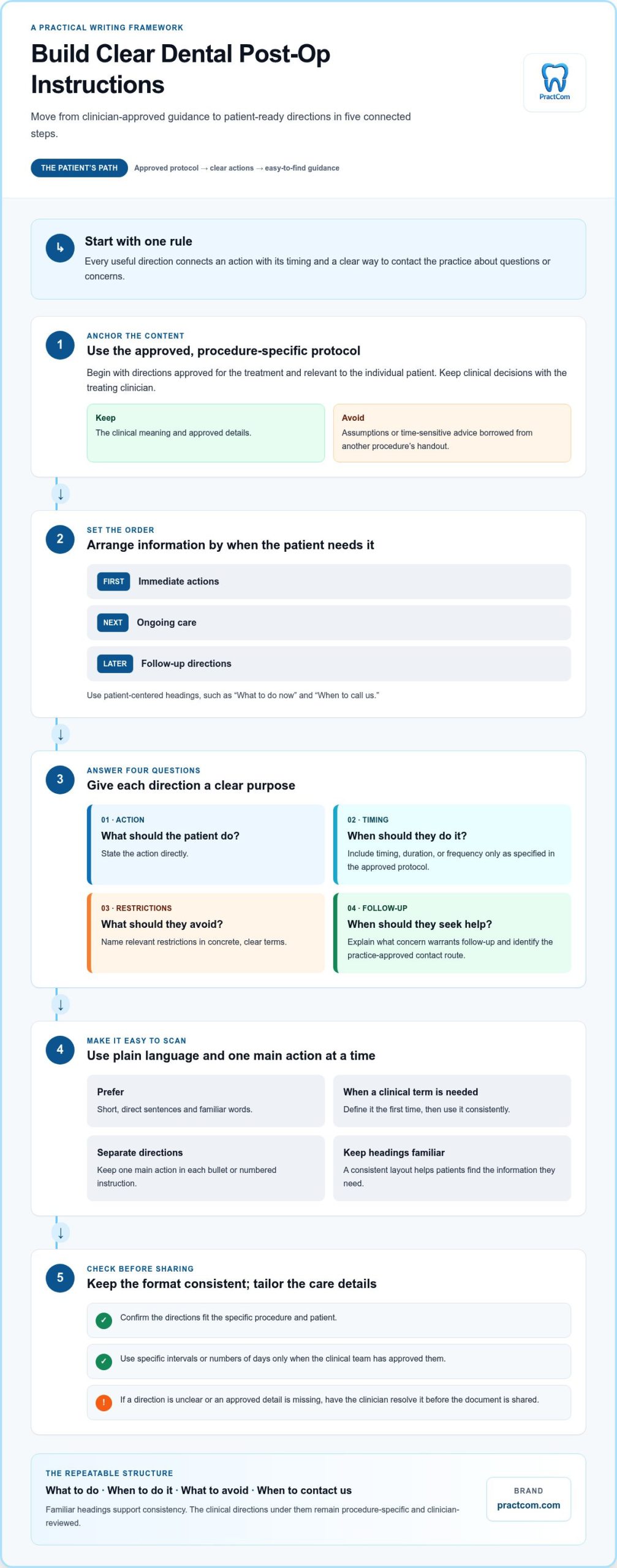
A useful instruction answers four questions: What should the patient do? When should they do it? What should they avoid? When should they seek help? This structure makes guidance easier to scan while leaving clinical decisions where they belong: in the treating clinician’s approved protocol. It gives your team a dependable framework for writing clear directions without relying on vague or one-size-fits-all wording.
Pair every action with its timing so patients know both what to do and when to do it. If a direction includes a clinical term, translate it into everyday language. If the term is necessary, define it the first time it appears, then use it consistently.
Choose a sequence patients can scan
Arrange information in the order a patient is likely to need it: immediate actions first, ongoing care next, and later follow-up directions after that. Use short, patient-centered headings such as “What to do now” or “When to call us,” rather than internal clinical labels. Keep one main action in each bullet or numbered direction. Patients can then locate a specific step without untangling several instructions in one paragraph.
- What to do: State the action in direct language.
- When to do it: Include timing, duration, or frequency only as specified in the approved protocol.
- What to avoid: Name relevant restrictions in clear, concrete terms.
- When to seek help: Explain what concern warrants follow-up and identify the practice-approved contact route.
Keep the sequence steady across documents, but tailor the content. A familiar layout helps patients know where to look; it doesn’t mean every procedure has the same care steps.
Make procedure-specific details precise
Start with directions approved for the procedure and relevant to the individual patient. Don’t fill gaps with assumptions or borrow time-sensitive directions from a handout written for another treatment. If a direction calls for a specific interval or number of days, include it only when the clinical team has approved that detail. Otherwise, have the clinician resolve the wording before the document is shared.
Replace unexplained terminology with plain language. For example, if a protocol uses a technical term, explain what the patient should notice or do rather than expecting them to interpret it. Keep the clinical meaning intact. A language edit should make the instruction easier to understand, not change the care direction.
Give patients one clear route for questions or concerns, using the contact method approved by the practice. Avoid general phrases such as “call if needed” when the document can explain what should prompt contact. A consistent structure helps teams prepare instructions efficiently; customizable post-treatment templates can provide a starting point, with clinical details reviewed before use.
Compare Dense Clinical Language With Patient-Ready Instructions
Patient-ready wording doesn’t mean removing clinical detail that matters. It means making each approved direction easier to understand, act on, and find. A patient shouldn’t have to translate professional terminology or search a long paragraph to identify the next step. Plain-language editing preserves clinical meaning while simplifying expression.
Use the comparison below to spot common barriers. The examples illustrate wording, not treatment advice. Any clinical direction, including what action to take or when to take it, must come from the practice’s approved protocol.
| Review point | Dense wording | Patient-ready approach |
|---|---|---|
| Sentence length | Several instructions joined in one long sentence | Separate each approved direction into a short sentence |
| Action clarity | “Postoperative care should be undertaken as indicated” | State the specific approved action directly |
| Jargon | Unexplained clinical terms | Use familiar words or briefly define necessary terms |
| Sequence | Actions appear in no clear order | Group directions by when the patient needs them |
| Urgent information | Contact guidance is buried in a paragraph | Place clinician-approved warning and contact details under a clear heading |
Replace jargon without changing clinical meaning
Choose familiar words and active verbs where they accurately express the approved instruction. Instead of a passive phrase such as “medication is to be taken as directed,” identify who should act and point to the clinician-approved directions. Don’t simplify by guessing at missing details or changing a clinical term’s meaning.
Some terms may need to remain because they identify a procedure, finding, or part of the care plan. Define those terms briefly at first use, then use the same wording throughout the document. As a practical check, ask a colleague unfamiliar with the draft to mark words they don’t understand and steps they can’t easily locate. Their questions can reveal gaps the writer may no longer notice.
Format instructions for quick scanning
Clear wording can still be hard to use if the page looks crowded. Add descriptive headings, whitespace, and bullets to separate care actions. Give each bullet one main point, and use a consistent sequence so readers can scan the document instead of reading every line to find a particular direction.
Reserve bold text or other emphasis for important actions and clinician-approved warning guidance. If everything is highlighted, nothing stands out. Review the final document on a screen and as a printed handout. Check that headings are easy to distinguish, text isn’t cramped, and contact information remains visible. This turns the wording and layout review into a repeatable task.
How to Draft and Quality-Check Dental Post-Op Instructions
A reliable review process starts with the clinical source, not a blank page. Before drafting, identify the intended procedure and audience, then work from the practice’s clinician-approved protocol. Editors can improve wording and organization, but clinical staff must approve medical directions. An editor shouldn’t create recommendations, fill in missing care details, or alter the meaning of an approved instruction.
Draft from an approved clinical source
Use these steps to move from protocol to patient-ready document while keeping clinical decisions with the care team.
- Confirm the procedure and audience. Identify the treatment the document covers and whether it’s intended for a particular patient or a broader patient group.
- Collect approved directions. Record the actions, timing, cautions, and follow-up guidance the clinical team has approved for that procedure. Flag anything unclear or missing for clinician review rather than guessing.
- Organize the content. Put directions in a useful sequence, such as immediate care, ongoing instructions, and follow-up. Give each step one main action so patients can locate it quickly.
- Edit for patient understanding. Replace unnecessary jargon with familiar wording and use direct sentences. Keep necessary clinical terms, but explain them briefly. Editing should make the protocol easier to follow, not add instructions or change its meaning.
- Mark patient-specific details. Highlight any direction that depends on an individual patient’s care for review by the clinician before the document is distributed.
Review the final document before delivery
Read the document as a patient might: outside the clinical conversation, looking for a clear next step. Check for unexplained terms, missing transitions, and directions that could be read in more than one way. Then use this final checklist:
- Does the document match the intended procedure and current practice protocol?
- Are actions, timing, cautions, and follow-up details complete and clinician-approved?
- Can a patient quickly find the relevant heading and understand each direction?
- Are contact details, document version, and patient-specific instructions accurate?
- Does the document read clearly on screen and in print?
Before each use, verify that the correct version is being provided and that its procedure details remain current. Staff feedback and recurring patient questions can point to phrases that need clarification or sections that patients struggle to find. Route proposed clinical changes to the clinical team for approval, then update the patient-facing wording through the same review process. This creates a repeatable way to write clear instructions without shifting clinical responsibility to the editor.
Practices looking to organize approved aftercare documents into a consistent drafting and delivery workflow can review PractCom’s 15-day free trial – no credit card needed.
Standardize Dental Post-Op Instructions Without Losing Clinical Context
Standardization works best when the document structure is reusable, not when clinical directions become generic. Consistent headings and formatting help staff prepare patient-facing materials in a familiar way. Procedure-specific actions, timing, cautions, and follow-up details still need review against the clinician-approved protocol. This balance can reduce avoidable variation without treating different procedures as if they require identical aftercare.
For practices refining their aftercare workflow, templates can provide a dependable starting point. PractCom’s Post-Treatment Instruction Library includes 80+ templates covering common and complex procedures. Teams can customize documents with practice branding, then edit, download, or print them. Saved favorites can make frequently used documents easier to find, while version history helps teams track document changes. These tools support a workflow; they don’t replace clinical review or approval.
Use templates as a controlled starting point
Start by selecting a template that fits the procedure, then adapt its content to the practice’s approved protocol. Keep a distinction between reusable elements, such as headings and layout, and clinical directions that must be checked for relevance. Before a document is used, the clinician remains responsible for approving its procedure-specific instructions and any patient-specific details.
Version history can help staff see how a document has changed over time, but a record of edits isn’t clinical approval. Make review responsibility clear within your workflow so a wording change doesn’t accidentally become an unreviewed change to care guidance.
Choose a delivery workflow patients can revisit
Once the document is ready, practices can provide it as a print-ready handout or send it by email or text. A digital copy gives patients a way to revisit their instructions after leaving the practice; a printed version offers another format to consult at home. PractCom documents are translated into 15 languages, giving practices additional options for sharing aftercare information with patients.
Tracked delivery logs record what was sent, how it was sent, and when. Teams can refer to these records when reviewing document distribution. The patient portal provides access to patient documents 24/7/365, so patients can return to available information beyond the appointment itself.
With a consistent structure, approved clinical content, and a defined delivery method, aftercare communication can become easier for staff to manage and for patients to revisit. PractCom’s post-treatment instruction tools include templates and delivery options to support this workflow.
Make Your Next Aftercare Update Easier to Maintain
Choose one instruction document your team uses regularly and make it the starting point for a consistent review routine. Confirm who approves clinical wording, who checks readability, and how staff will know when a document has changed. This helps turn writing clear dental post-op instructions from a one-time task into a dependable practice process.
As your team refines its workflow, keep approved guidance organized and straightforward to share with patients. PractCom brings patient communication tools together to support that work. Explore PractCom’s patient communication platform to see how it could fit your aftercare process.
Clear instructions start with careful clinical review and become more useful when patients can find and revisit them. With a consistent process in place, your team can keep improving the experience one document at a time.
Frequently Asked Questions
Should dental post-op instructions be given verbally as well as in writing?
Yes. Explain the relevant aftercare verbally, then provide written instructions the patient can refer to later. A brief check-in, such as asking the patient to describe the next step in their own words, can help the team identify anything that needs clarification before they leave. Keep the spoken explanation and handout aligned, and make sure a caregiver receives the guidance when appropriate to the patient’s situation.
Can post-op instructions replace informed consent?
No. Post-op instructions explain care after treatment; informed consent supports the patient’s decision before treatment by addressing the proposed care and relevant options. A handout given after a procedure can’t stand in for that earlier discussion. Keep the documents distinct in your workflow, and use the consent process and forms appropriate to the procedure and practice. Each document should have a clear purpose and be provided at the right stage of care.
How often should a dental practice review its post-op instructions?
Review instructions whenever the underlying clinical protocol changes, and include them in the practice’s routine document review. A review is also useful after staff notice repeated patient questions, a mismatch between a handout and the verbal explanation, or an outdated contact detail. Assign responsibility for checking content and version status. If a proposed edit changes a care direction, route it to the clinician for approval before using the revised document.
Do dental post-op instructions need to be translated for patients?
Provide instructions in a language the patient can understand whenever language is a barrier to following care guidance. Don’t assume a patient can confidently interpret clinical wording in a second language. Use a reliable translation workflow, preserve the meaning of clinician-approved directions, and have translated material reviewed for clarity. PractCom documents are translated into 15 languages, giving practices options for sharing aftercare guidance with patients in their preferred language.
What should a patient do if written instructions differ from what the dentist said?
Patients should contact the dental practice promptly and explain which written direction conflicts with what they remember being told. They shouldn’t guess which version to follow or change a care step on their own. The team can check the patient’s treatment details and clarify the clinician’s guidance. If the patient has an urgent or worsening concern, they should use the contact instructions provided by their practice to seek timely advice.
Can one post-op instruction template work for every dental procedure?
No single set of clinical directions fits every procedure. A shared template can provide consistent formatting, but its care content needs to match the treatment and the clinician-approved protocol. For example, an instruction document for a restorative procedure may need different directions from one for oral surgery. Treat templates as a framework to adapt and review, not as universal clinical guidance.

Article by
Cary Ganz DDS
Dr. Cary H. Ganz is a dentist, prosthodontist, entrepreneur, lecturer, and author with more than 50 years of experience in clinical dentistry and dental technology. Throughout his career, he has combined hands-on patient care with a deep understanding of how technology can improve dental practice operations, communication, documentation, and patient outcomes.
In addition to his clinical background, Dr. Ganz has held significant leadership roles in the dental technology industry, including Past Owner and Vice President of Clinical Affairs at DEXIS Digital Radiography and Past Vice President of Clinical Affairs at Denticon Practice Management Software. His business experience includes product development, clinical strategy, dental software innovation, practice management solutions, and educating dental professionals on the effective use of technology in modern dentistry.
Today, Dr. Ganz continues to focus on creating practical technology solutions for dental practices, including PractCom, a comprehensive dental practice communication platform designed to improve patient communication, documentation, compliance support, referrals, and overall practice efficiency. His work reflects a career-long commitment to helping dentists deliver better care while making their practices more organized, efficient, and protected.
No responses yet