
Did you know that relying on traditional paper systems leads to missing signatures for nearly two-thirds of patients by the time they reach the treatment chair? That statistic is a wake-up call for any clinician juggling a heavy caseload while trying to maintain strict regulatory standards. You likely feel the weight of overwhelming physical paperwork and the constant, nagging fear that a single incomplete dental consent form template could leave your practice vulnerable to malpractice claims. It’s exhausting to manage a system where patients sign documents they don’t truly understand, especially when language barriers or complex clinical jargon complicate the dialogue.
You deserve a standardized, legally compliant process that acts as a guardian of your reputation rather than a source of administrative stress. This guide will show you how to move beyond static, one-size-fits-all templates toward a digital informed consent ecosystem that builds genuine patient trust and secures your legal standing. We’ll explore the critical 2026 updates to HIPAA and ADA guidelines, including the latest requirements for sedation and multi-language communication. By the end of this article, you’ll have a clear roadmap to reduce your scanning time, eliminate filing errors, and ensure every patient walks away with a clear understanding of their care.
Key Takeaways
- Understand why a signature alone is no longer a legal shield and how a modern dental consent form template serves as a record of a comprehensive educational dialogue.
- Identify the core components of legally sound documentation, including the critical distinction between general and procedure-specific consent requirements.
- Compare the risk management profiles of paper and digital systems to see how cloud-based storage eliminates the dangers of lost or illegible physical records.
- Learn how to implement multi-language support in 15 languages to meet ethical standards and protect your practice when treating diverse patient populations.
- Discover how to close the clinical documentation loop by integrating digital consent with automated post-treatment instructions and patient follow-ups.
Why Static Dental Consent Form Templates Are Obsolete in 2026
A dental consent form template is often misunderstood as a mere administrative hurdle. In reality, it serves as a permanent legal record of the critical educational process between a doctor and their patient. This document validates that a patient has been provided with the necessary information to make an autonomous decision about their health. Grounded in established Informed Consent Principles, the form acts as the final evidence of a shared understanding. However, in 2026, the traditional paper-based approach has become a liability that no modern practice should carry.
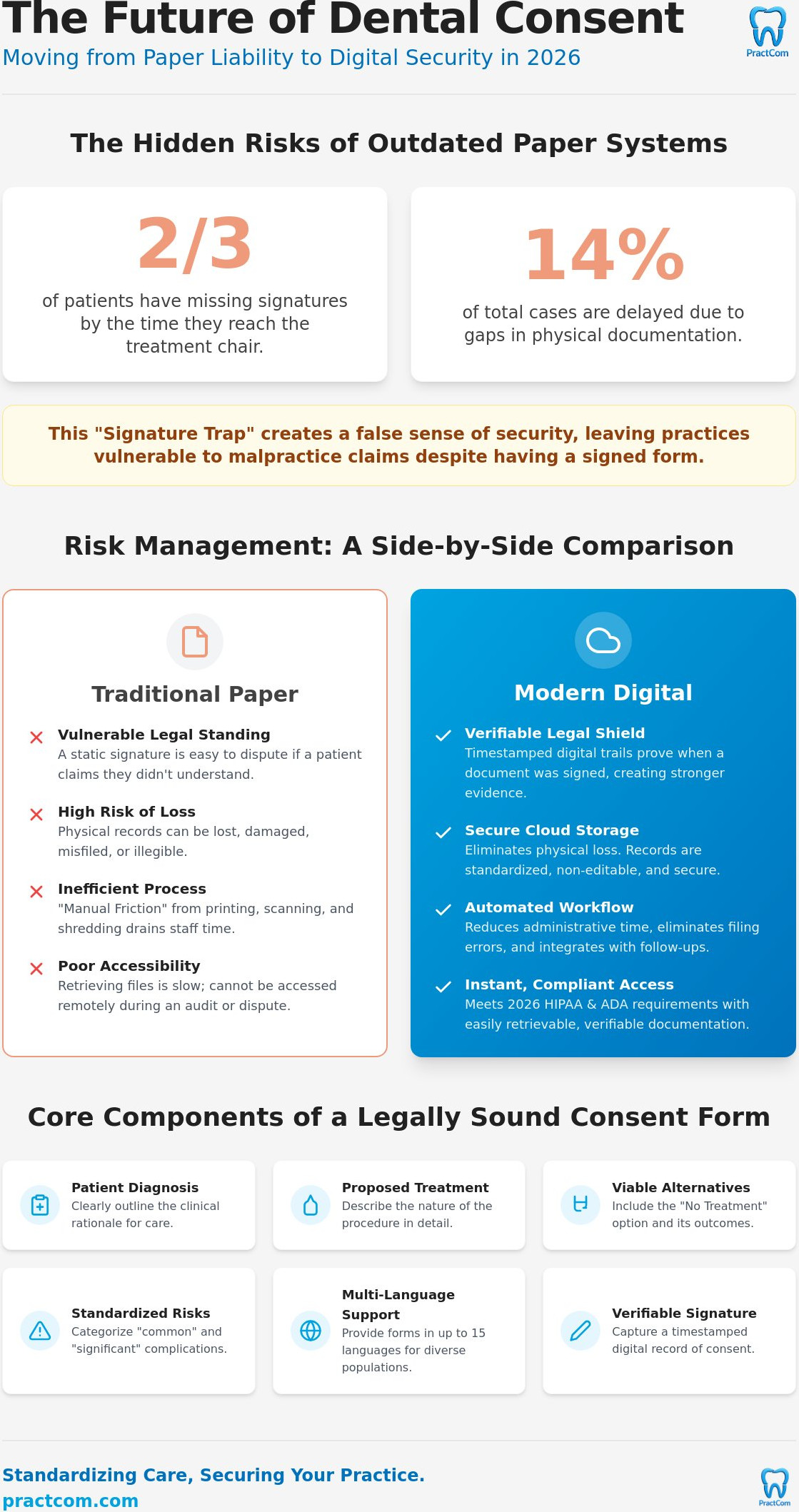
Many practitioners fall into the “Signature Trap.” They assume a squiggle of ink on a page provides absolute protection against malpractice. This is a dangerous misconception. If a patient can prove they didn’t understand the risks, or if the form was signed under duress or in a rush, the legal weight of that paper evaporates. Modern courts and regulatory bodies look for evidence of a comprehensive dialogue, not just a static signature. Without a verifiable trail, your practice remains exposed to unnecessary risk.
The Shift from Paper to Digital Documentation
Physical filing systems are an active liability in high-pressure clinical settings. Research from 5thPort indicates that paper consent forms result in missing signed documents for two-thirds of patients at the time of surgery. These documentation gaps lead to delays for 14% of total cases, disrupting your schedule and frustrating your team. Beyond the risk of loss, the “Manual Friction” of printing, scanning, and shredding drains hours of administrative productivity every week. Transitioning to cloud-based storage provides a stabilizing force for your practice. It ensures every procedure is backed by a standardized, non-editable record that you can retrieve instantly during a regulatory audit or a patient dispute.
The Legal Burden of Proof in Modern Dentistry
The legal landscape changed significantly on February 16, 2026, when HIPAA-covered practices were required to update their Notice of Privacy Practices to include stricter confidentiality standards. This shift emphasizes the need for verifiable, timestamped digital trails. Digital signatures provide much stronger evidence of intent than ink because they capture specific metadata that paper cannot. They prove exactly when the document was accessed and signed. Informed consent is an ongoing clinical process of communication and education, not a single administrative event or document. By moving your dental consent form template into a digital ecosystem, you transition from operational disorganization to systematic control. This shift protects your professional reputation and ensures you meet the intensified 2026 ADA requirements for sedation and complex procedures.
Essential Elements of a Legally Sound Dental Consent Template
A robust dental consent form template must do more than capture a name; it must document the specific clinical rationale for the proposed care. To stand up to legal scrutiny in 2026, your documentation needs to clearly outline the patient’s diagnosis, the nature of the proposed treatment, and any viable alternatives. This level of detail ensures that the patient’s choice is truly informed. It’s not enough to simply list the procedure. You must also include the “No Treatment” alternative, explaining the likely clinical outcomes if the patient chooses to decline care. This creates a logical, persuasive record that protects your practice from claims of negligence or lack of disclosure.
Standardizing risk disclosure is another essential pillar of clinical documentation. Your templates should categorize risks into “common” occurrences, such as post-operative swelling, and “significant” complications, such as permanent nerve damage or sinus involvement. By using a structured format for these disclosures, you ensure that every patient receives the same high standard of information. This systematic control replaces the variability of human memory with a reliable, repeatable process that functions as a guardian of your reputation.
General Consent vs. Informed Consent
Understanding the nuance between different Types of Dental Consent is vital for modern risk management. Implied consent, such as a patient sitting in your chair and opening their mouth, is legally sufficient for a basic exam but fails entirely for invasive procedures. General consent usually covers minor restorative work and the administration of local anesthesia. However, once you move into surgical or irreversible treatments, you require a dedicated, stand-alone informed consent form. Relying on a single “blanket” form for every procedure is a significant administrative failure that leaves your practice vulnerable during an audit.
Must-Have Clauses for High-Risk Procedures
High-risk procedures like extractions, endodontics, and implants demand specialized language that addresses unique complications. For example, an implant consent form must discuss the possibility of failure to osseointegrate, while an endodontic form should mention the risk of instrument separation. By integrating these specific clauses, you provide a pre-emptive strike against post-treatment disputes. For a complete breakdown of these requirements, refer to the Digital Dental Informed Consent Forms guide for procedure-specific checklists.
Moving from manual checklists to a standardized digital system allows you to verify patient comprehension through active acknowledgement prompts rather than a passive “I agree” box. This ensures the patient actually processes the risks before proceeding. If you want to see how a streamlined system can safeguard your practice while improving efficiency, you can explore a digital consent library to find the right fit for your clinical workflow.
Paper vs. Digital Consent: A Risk Management Comparison
The transition from paper to digital represents a move from operational disorganization to systematic control. Physical documents are inherently fragile. They get lost in the shuffle between the front desk and the operatory, or they sit in a scanning backlog for weeks, leaving your practice exposed. When you use a digital dental consent form template, you remove the possibility of human error. Every record is instantly accessible from any terminal via a secure patient portal. This ensures that your clinical team has the information they need exactly when they need it, without the friction of manual filing.
Beyond accessibility, digital systems offer a level of compliance that paper simply cannot match. Modern regulations demand automatic HIPAA-compliant encryption for all sensitive patient data to prevent unauthorized access. While a paper form sitting on a clipboard is a potential privacy breach, a digital form is protected by multi-factor authentication and high-level encryption. This technical precision signals to your patients that you run a modern, high-trust practice. It shows you value their privacy as much as their clinical outcome, which is a powerful way to build long-term patient loyalty.
Reducing Practice Liability Through Automation
One of the most common administrative failures is the “forgot to sign” error. Automated clinical workflows act as a pre-emptive strike against this issue by preventing a procedure from being logged as “ready” until the consent is verified. This ensures every patient receives the same high-level disclosure every time. Following a recognized Informed Consent Guideline becomes effortless when the requirements are baked into your digital workflow. This standardization reduces operational resistance and guarantees that your documentation meets the highest ethical and clinical standards, providing you with the psychological security of knowing you are always audit-ready.
Improving Patient Comprehension and Compliance
Patients are significantly more likely to engage with and understand information when they can review it on their own devices in a low-pressure environment. Digital forms allow you to supplement text with visual aids, such as smile design tools or 3D models, which bridge the gap between complex clinical jargon and patient understanding. To truly close the care cycle, you should link your dental consent form template directly to automated dental post-op instructions. This ensures that the educational process continues long after the patient leaves the chair. It reduces post-treatment disputes and improves overall compliance by providing clear, accessible guidance for the recovery period.
Implementing Multi-Language Consent Forms for Diverse Populations
Providing a dental consent form template in a language the patient doesn’t fully grasp is more than an administrative oversight; it’s a significant clinical and legal liability. True informed consent requires a clear, unambiguous exchange of information. If a patient’s primary language is not English, your ethical duty is to provide documentation they can actually comprehend. Research from the Association of Health Care Journalists indicates that only about 11% of U.S. patient portals are accessible in languages beyond English or Spanish. This leaves a massive portion of the population, including Mandarin, Vietnamese, and Arabic-speaking communities, navigating complex surgical risks with incomplete information.
Relying on amateur interpreters or family members to translate clinical jargon is a recipe for disaster. These informal “workarounds” often lead to clinical errors and inconsistent standards of care. By standardizing your translations across 15 different languages, you eliminate the risk of “misunderstanding” being used as a malpractice defense. This systematic approach ensures that every patient, regardless of their linguistic background, receives the same high-level disclosure. It transforms your consent process from a potential bottleneck into a stabilizing force that protects your practice and builds deep, cross-cultural trust.
Bridging the Clinical Communication Gap
PractCom enables you to deliver essential clinical documents in 15 languages directly via email or text. This immediate accessibility reduces patient anxiety by presenting risks and benefits in familiar linguistic terminology. When a patient reviews a dental consent form template in their native tongue, their confidence in your care increases. While digital delivery is the standard, we also recognize the logistical reality of patients who lack digital access. To ensure no one is left behind, our system supports physical document printing for in-office review, maintaining a consistent standard of documentation across all patient demographics.
HIPAA Compliance in Digital Delivery
Security is a non-negotiable requirement when sending sensitive health information. Our platform ensures the secure transmission of consent forms using 10DLC registered SMS, which meets modern regulatory standards for mobile communication. Patients access their documents through secure portals, providing a protected environment for them to review and sign their forms. This technical precision ensures your practice remains compliant while providing the extreme ease of use your patients expect. You can learn more about our About Us mission to bridge these communication gaps through innovative technology.
If you’re ready to move beyond basic templates and implement a truly inclusive documentation system, you can view our multi-language consent library to see how we support diverse patient needs.
Beyond the Template: Automating the Clinical Documentation Loop
A static dental consent form template is only one half of the clinical equation. To truly protect your practice and your patients, you must close the documentation loop by connecting pre-operative risks with post-operative care. Modern clinical environments require a unified ecosystem where information flows seamlessly from the initial consultation to the final follow-up. By automating this loop, you move away from the fragmented chaos of isolated documents and toward a state of systematic control. This approach ensures that no detail is lost in transition, providing the psychological security that your practice is both compliant and patient-centered.
Practice performance dashboards provide real-time tracking of documentation completion rates, which allows you to identify administrative failures immediately because manual oversight is no longer sufficient in a high-volume office. Instead of wondering if every file is audit-ready, you can verify it with a single glance. This level of transparency identifies bottlenecks before they become legal liabilities, allowing you to maintain a high standard of care across your entire team. Automated follow-ups further strengthen this loop by checking in on patients during their recovery, ensuring they are healing as expected without requiring additional chair time.
Connecting Consent to Aftercare
A unified platform ensures your patients have a clear understanding of both the “risks” and the “remedies.” When you link a dental consent form template to a comprehensive post-treatment instruction library, you provide a complete care cycle. This integration significantly reduces emergency phone calls by giving patients clear, multi-language instructions for their recovery at home. Providing these resources in the patient’s primary language is an ethical necessity that prevents post-treatment disputes. Clear communication also streamlines the referral management process. When a specialist receives a patient alongside a complete digital record of their consent and instructions, it enhances the professional continuity of care and protects your reputation as a thorough clinician.
The PractCom Advantage for Modern Practices
Generic PMS modules often treat documentation as an afterthought, offering limited flexibility and outdated language. PractCom provides a peer-recommended alternative with a library of 80+ templates that offer far greater clinical precision than a single Word document or a basic PDF. This variety allows you to select the exact form for the specific procedure, ensuring your disclosures are always relevant and legally sound. For DSOs and multi-location practices, this scalability is essential for maintaining consistent communication standards across dozens of operatory rooms. It replaces operational disorganization with a reliable, tech-savvy system that grows with your practice.
Ready to secure your practice and eliminate operational resistance? Start your free trial with PractCom today.
Securing Your Practice’s Future with Digital Excellence
We have explored why the traditional, paper-based dental consent form template is an active liability in a modern clinical setting. By transitioning to a digital ecosystem, you replace operational disorganization with the systematic control needed to meet 2026’s rigorous HIPAA and ADA standards. This shift ensures every patient receives clear, procedure-specific disclosures in a language they actually understand, while automated follow-ups close the care loop and reduce post-treatment disputes.
PractCom functions as your guardian of reputation, offering a library of 80+ post-op templates and support for 15 languages delivered instantly via SMS or email. This technical precision provides the psychological security you need to manage a high-pressure practice with total confidence. It’s time to move beyond static documents and embrace a communication platform that protects your legal standing and improves patient trust. Furthermore, for those looking to maximize the value of their clinical assets, you can learn more about Healthcare Biz Brokers, Inc. to see how robust documentation processes enhance the marketability of a healthcare business.
Secure your practice with PractCom’s digital consent suite.
You don’t have to manage these administrative burdens alone. Take the first step toward a more organized, compliant, and patient-centered future today.
If you find that structured templates improve your clinical workflow, you might also enjoy the personal organization resources from Clear Pages Studios, which offers printable trackers and checklists for wellness and daily planning.
Frequently Asked Questions
Is a digital signature on a dental consent form legally binding?
Yes, digital signatures are legally binding provided they meet federal regulations to ensure they are unique and verifiable. The Electronic Signatures in Global and National Commerce Act (E-Sign Act) of 2000 validates these signatures for clinical documentation. Using a digital dental consent form template ensures the signature is captured alongside essential metadata, such as timestamps and IP addresses, which offers a more robust legal defense than traditional ink on paper.
What is the difference between general consent and informed consent in dentistry?
General consent covers routine, non-invasive procedures like cleanings, exams, and the administration of local anesthesia. In contrast, informed consent is a specific educational process required for invasive or high-risk treatments like extractions or implants. While general consent is often implied by a patient sitting in the chair, informed consent must be documented with a clear explanation of risks, benefits, and alternatives to satisfy 2026 clinical standards.
How long should a dental practice keep signed consent forms?
You must retain HIPAA compliance documentation for a minimum of six years from the date of its creation or the date it was last in effect, whichever is later. However, state-level statutes of limitations for malpractice may require longer retention periods. Storing these records in a secure digital ecosystem eliminates the physical space requirements of paper filing while ensuring that documents remain audit-ready and easily accessible for a decade or more.
Can a dental assistant or hygienist obtain informed consent?
While clinical staff can assist in the educational process, the legal responsibility for obtaining informed consent rests solely with the dentist. Assistants or hygienists may present the dental consent form template and answer basic questions, but the doctor must lead the dialogue regarding specific risks and alternatives. Documenting that this conversation occurred between the dentist and the patient is a critical step in protecting your professional reputation.
What should I do if a patient refuses to sign a consent form?
If a patient refuses to sign, you cannot proceed with the treatment. You should clearly document the refusal in the patient’s clinical notes, including the specific reasons provided and the information shared during the discussion. Proceeding without a signed form constitutes a significant legal risk and an ethical failure. This situation highlights the importance of having a standardized process to manage and record these clinical interactions accurately.
Do I need a separate consent form for every dental procedure?
Separate informed consent is mandatory for any procedure involving significant risk, such as surgery, endodontics, or sedation. Using a single “blanket” form for every treatment is an administrative failure that won’t hold up in court. A modern digital library provides specific dental consent form template options for different procedures, ensuring that the risk disclosures are accurate and relevant to the specific care the patient is receiving that day.
How can I provide consent forms to patients who don’t speak English?
You should provide consent documentation in the patient’s primary language to ensure true comprehension. Relying on family members to translate complex clinical jargon is a liability that leads to misunderstandings. Utilizing a platform that supports 15 languages allows you to deliver a professional dental consent form template via text or email, ensuring that diverse populations can review risks and benefits in a familiar linguistic context.
Are digital consent forms HIPAA compliant?
Digital consent forms are HIPAA compliant as long as they are transmitted and stored using end-to-end encryption and multi-factor authentication. Modern systems use 10DLC registered SMS and secure patient portals to protect sensitive health information from unauthorized access. This technical precision provides a higher level of security than paper files, which are often left exposed on clipboards or stored in unlocked cabinets.

Article by
Cary Ganz DDS
Dr. Cary H. Ganz is a dentist, prosthodontist, entrepreneur, lecturer, and author with more than 50 years of experience in clinical dentistry and dental technology. Throughout his career, he has combined hands-on patient care with a deep understanding of how technology can improve dental practice operations, communication, documentation, and patient outcomes.
In addition to his clinical background, Dr. Ganz has held significant leadership roles in the dental technology industry, including Past Owner and Vice President of Clinical Affairs at DEXIS Digital Radiography and Past Vice President of Clinical Affairs at Denticon Practice Management Software. His business experience includes product development, clinical strategy, dental software innovation, practice management solutions, and educating dental professionals on the effective use of technology in modern dentistry.
Today, Dr. Ganz continues to focus on creating practical technology solutions for dental practices, including PractCom, a comprehensive dental practice communication platform designed to improve patient communication, documentation, compliance support, referrals, and overall practice efficiency. His work reflects a career-long commitment to helping dentists deliver better care while making their practices more organized, efficient, and protected.
No responses yet