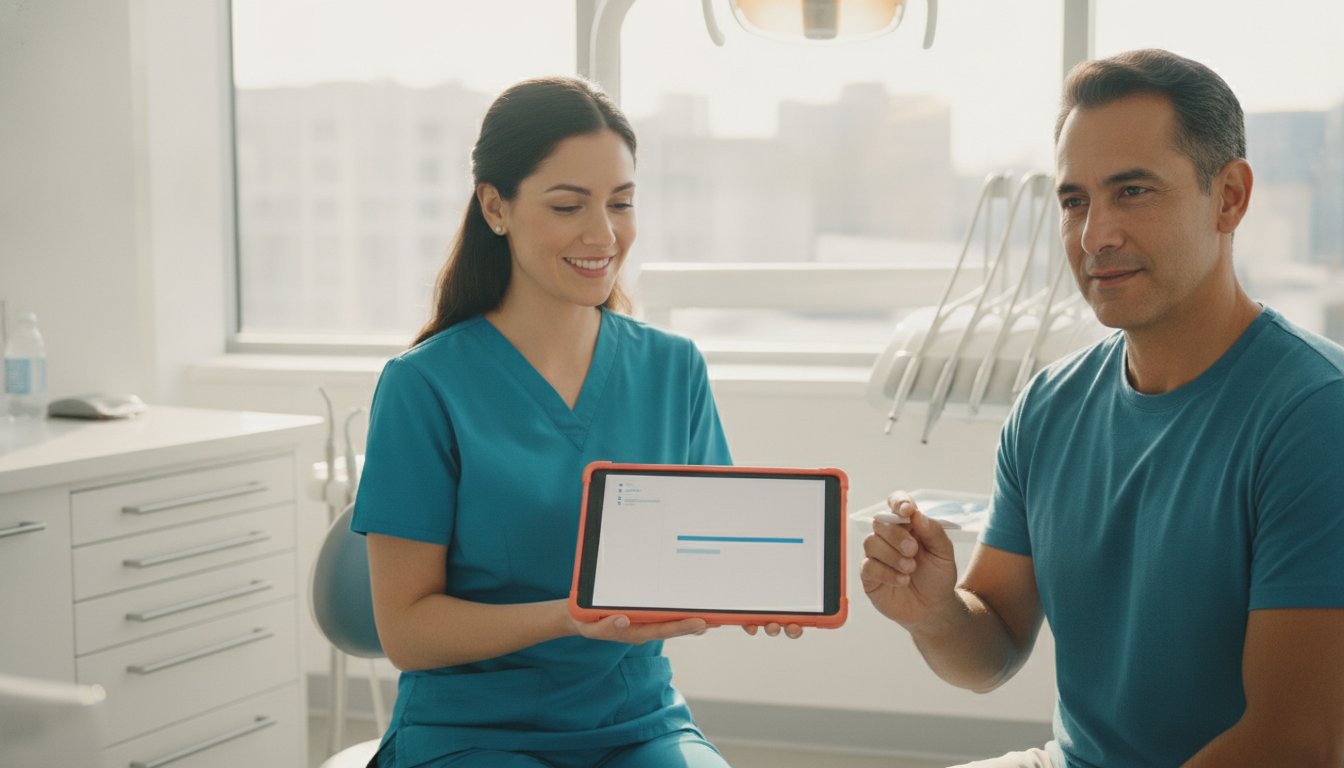
In 2026, providing a dental consent form in Spanish is no longer a secondary administrative task; it’s a fundamental requirement for clinical safety and professional liability protection. You likely feel the silent pressure when a language barrier stands between a complex treatment plan and a patient’s true understanding. Relying on makeshift translations or outdated paper forms doesn’t just create confusion; it exposes your practice to significant legal risks and operational friction that your team shouldn’t have to manage.
We agree that your focus should remain on clinical excellence rather than the stress of documentation gaps. This guide will show you how to implement high-quality Spanish dental consent forms that protect your practice and ensure your Spanish-speaking patients fully understand their treatment. We will preview the modern standards for informed consent, the shift toward digital automation, and the practical steps to integrate these resources into your daily workflow without adding to your administrative burden.
Key Takeaways
- Understand why native-language documentation is a clinical necessity for patient safety and a primary defense against malpractice litigation in 2026.
- Identify the essential legal components required for a professional dental consent form in Spanish, including simplified procedure descriptions and explicit risk disclosures.
- Discover why transitioning from static paper templates to digital workflows eliminates administrative resistance and prevents the use of outdated clinical documentation.
- Learn a structured two-step process to audit your patient demographics and standardize your consent library across multiple languages for total operational control.
- Explore how automating document delivery via SMS and email can transform your communication workflow and ensure total clinical compliance.
The Critical Role of Spanish Dental Consent Forms in 2026
In 2026, the ethical standard for patient care includes a robust commitment to language equity. A dental consent form in Spanish isn’t just a document; it’s the bridge between clinical intent and patient understanding. Without it, your practice operates in a high-risk zone where miscommunication can lead to clinical errors. You need a system that eliminates this vulnerability while respecting the patient’s right to clarity.
Legal protection depends on the validity of Informed consent. If a patient cannot read the terms they’re signing, the consent is legally void. This creates a direct correlation between native-language documentation and reduced malpractice litigation. When patients truly grasp the risks and benefits, they’re less likely to feel blindsided by clinical outcomes. This awareness significantly lowers the probability of legal disputes and administrative headaches.
Beyond risk management, providing a professional dental consent form in Spanish directly impacts your practice growth. Hispanic demographics represent a massive growth opportunity for modern clinics. Patients who feel respected and understood are more likely to approve treatment plans. By removing the friction of a language barrier, you improve case acceptance rates and build long-term loyalty. It’s a pragmatic business move that aligns with clinical excellence.
Bridging the Clinical Communication Gap
Signing a complex medical document in a second language creates a high-stress psychological environment for the patient. This anxiety often leads to ‘nodding along’ without actual comprehension. Inadequate communication is a primary driver for post-treatment complications and unnecessary emergency calls. Moving your practice from basic compliance to genuine connection means ensuring every patient feels secure. It’s about shifting the patient experience from confusion to confidence through standardized, clear documentation.
National Standards for Language Access
Ethical guidelines for 2026 demand meaningful access to health information for all patients. Relying on a family member to translate is a dangerous clinical shortcut that often results in omitted details or medical inaccuracies. Professional, pre-translated forms provide the technical precision required for high-stakes procedures. In the context of 2026 dental standards, meaningful access is defined as the provision of accurate, culturally appropriate medical information that allows a patient to make an autonomous decision without language-based barriers.
Essential Components of a Legally Sound Spanish Consent Form
A legally sound dental consent form in Spanish must do more than just translate words from English. It requires a strategic structure that ensures the patient understands the clinical reality of their treatment. You shouldn’t settle for a literal translation that might miss the nuance of dental procedures. Instead, focus on a document that balances technical accuracy with administrative clarity to protect your practice from future disputes.
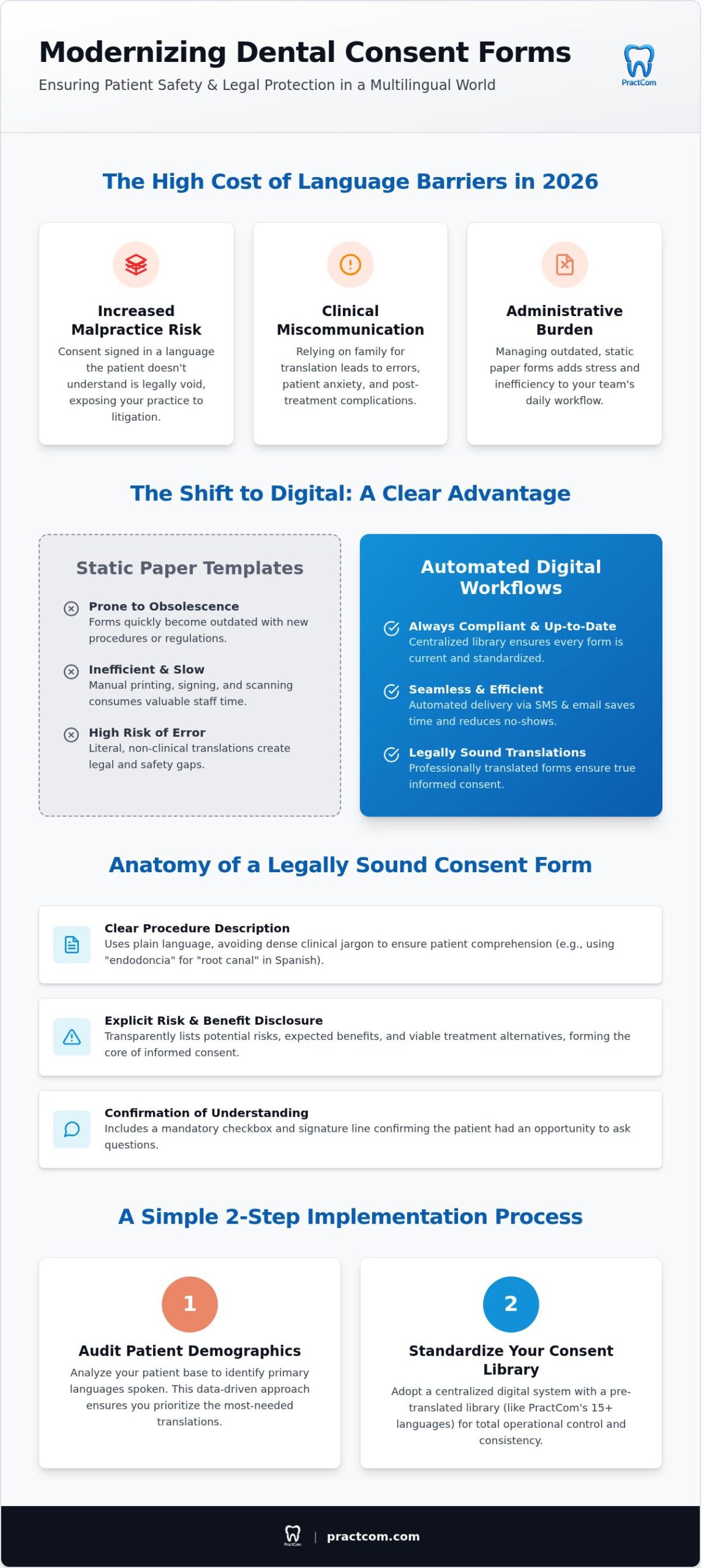
Every professional form needs a clear description of the procedure using simplified Spanish. You must include explicit sections detailing the potential risks, expected benefits, and any viable alternatives. This level of detail is necessary to meet federal language access requirements, which mandate that healthcare providers offer meaningful assistance to patients with limited English proficiency. By including these elements, you demonstrate a commitment to both regulatory compliance and patient respect.
Translating Clinical Jargon for Patient Clarity
Using dense medical terminology often backfires. For example, a literal translation of “root canal” might confuse a patient, whereas using “endodoncia” provides the correct clinical context. Your goal is plain language Spanish. This approach ensures that the Spanish version of your dental consent form in Spanish mirrors the English version exactly in intent and scope. When both documents are legally consistent, your team can operate with greater confidence and less administrative friction.
Legal Safeguards for the Modern Practice
Documentation is your best defense against misunderstandings. Your forms should include a specific section where the patient confirms they had the opportunity to ask questions before signing. In multi-language scenarios, witness signatures can add an extra layer of protection for the clinician. You should also integrate a mandatory confirmation checkbox where the patient acknowledges their understanding in their native tongue. Managing these details manually is exhausting, but you can explore automated solutions that handle these requirements systematically.
Never overlook the “No Guarantee” clause. Managing patient expectations in Spanish is critical for avoiding post-treatment dissatisfaction. Clearly stating that clinical outcomes can vary ensures the patient has realistic goals before the procedure begins. To finish the document, ensure signature and date fields are optimized for either physical or digital verification. This creates a clear, verifiable audit trail that stands up to scrutiny and protects your professional reputation.
Digital vs. Paper: Why Static Spanish Templates Fall Short
Relying on static paper templates is a gamble that modern practices can no longer afford. When you download a generic dental consent form in Spanish from the internet, you often receive a one size fits all PDF that lacks the specific nuance your practice requires. These static files are difficult to track, easy to lose, and nearly impossible to update across an entire team without manual intervention. You need a solution that moves as fast as your clinic does.
Paper based systems create massive operational friction. If you rely on a manual dental consent form in Spanish, you’re essentially betting your clinical compliance on the organization of a physical filing cabinet. This approach is prone to human error and administrative fatigue. Beyond the physical clutter, there is the risk of the “lost in translation” effect. If a patient’s handwriting is illegible or a critical section is skipped on a paper form, the document may not hold up in a legal dispute.
The Efficiency Gap in Manual Documentation
Manual documentation creates a hidden tax on your practice’s productivity. Front desk staff lose valuable time searching for specific translated forms, printing them, and then scanning the signed copies back into a digital record. This repetitive cycle is inefficient and costly. Physical storage also takes up space that could be used for clinical purposes. Most importantly, paper records increase the risk of HIPAA violations. Leaving sensitive documents on a counter or in an unlocked bin is a security failure that a digital system naturally prevents.
Advantages of an Integrated Digital System
Transitioning to a digital workflow offers immediate relief from administrative resistance. Automated delivery allows you to send forms via SMS or email, enabling patients to sign from the comfort of their home. This remote signing capability ensures that the dental consent form in Spanish is completed accurately and thoughtfully before the appointment begins. Version control is another critical benefit; it guarantees that your team never uses an obsolete form that might be legally non-compliant.
Digital systems also provide robust legal protection through IP logging and timestamps. These metadata points offer a verifiable audit trail that physical paper simply cannot match. If a dispute arises, you can prove exactly when the patient accessed the form and when they signed it. This level of systematic control turns your documentation process into a reliable guardian of your professional reputation. It moves your practice from a state of disorganized risk to one of systematic oversight.
Implementing a Multi-Language Workflow for Your Dental Team
Transitioning to a multi-language environment requires a structured roadmap. It’s about replacing administrative guesswork with a standardized system that supports your team and protects your patients. You shouldn’t view a dental consent form in Spanish as an isolated document; rather, it’s a critical component of a larger, automated ecosystem. Implementing this workflow correctly reduces operational resistance and ensures that no patient is left behind due to a language barrier.
- Step 1: Audit your demographics. Analyze your current patient records to identify the primary languages spoken in your community. This data allows you to prioritize which forms to deploy first.
- Step 2: Standardize your library. Instead of using fragmented templates, adopt a unified library of over 80 digital consent forms and instructions available in 15 languages. This ensures clinical consistency across every procedure.
- Step 3: Train your staff. Ensure your front-desk team knows how to send a dental consent form in Spanish via SMS or email. They should be comfortable explaining the digital signing process to patients.
- Step 4: Integrate follow-ups. Connect your consent process to an automated follow-up sequence. This keeps the patient engaged from the initial consultation through the post-operative phase.
Training Your Team for Cultural Competence
Staff training is the engine of a successful multi-language workflow. Your team must be prepared to assist patients who may be less tech-savvy. Empower your front-desk staff to handle questions about Spanish documentation with empathy and technical precision. You should also establish a clear protocol for when a live translator is required for complex clinical discussions. This balanced approach maintains professional standards while providing the administrative warmth that builds patient trust.
Measuring the Impact on Practice Efficiency
You can’t manage what you don’t measure. Use a performance dashboard to track form completion rates and identify bottlenecks in your documentation process. Monitoring the reduction in “no-shows” is also vital; patients are more likely to arrive for their appointments when they fully understand their treatment plan in their native tongue. Automated follow-ups increase patient compliance by delivering timely, native-language reminders that reinforce treatment instructions without requiring manual staff intervention. To see how these tools can transform your clinic, start your free trial today and experience a more streamlined workflow.
Streamlining Communication with PractCom’s 15-Language Library
PractCom positions your practice as a leader in clinical safety by providing a library of over 80 digital consent forms and post-treatment templates in 15 languages. This library removes the burden of manual translation and ensures that every dental consent form in Spanish you issue is professionally vetted. You gain the confidence that comes with standardized documentation, knowing that your clinical intent is accurately conveyed to every patient. It’s a stabilizing force for teams that need to maintain high standards under pressure.
Automated delivery via SMS or email allows your team to send these forms in seconds. This speed doesn’t just improve office efficiency; it provides the patient with enough time to review the document carefully before their appointment. Standardized documentation acts as a guardian of your practice’s professional reputation by reducing the risk of malpractice claims related to informed consent failures. By using a system designed for high-pressure clinical environments, you replace administrative chaos with systematic control.
Beyond Consent: The Full Communication Suite
Effective communication doesn’t end when the patient signs the form. Pairing your dental consent form in Spanish with automated post-op instructions ensures that aftercare is just as clear as the initial agreement. For cosmetic procedures, the Smile Design tool allows you to visualize potential outcomes for your Spanish-speaking patients, bridging the gap between clinical jargon and aesthetic desire. These tools work together to create a comprehensive ecosystem where patient understanding is the priority.
PractCom functions as a protective ally for your clinic. It anticipates common administrative failures, such as forgotten signatures or misplaced paper files, and offers a preemptive strike against those issues. This level of oversight is an ethical necessity in a modern practice, ensuring that every patient receives the same high standard of care regardless of the language they speak. It moves your operation from the resistance of manual tasks to the confidence of a standardized system.
Get Started with a Frictionless Workflow
Implementing a modern communication platform is a professional requirement for clinics aiming to scale in 2026. While the digital workflow is the primary focus, PractCom also supports physical document printing for situations where a digital signature isn’t feasible. This flexibility ensures that your team can adapt to the logistical realities of the profession without sacrificing compliance. You shouldn’t have to choose between speed and accuracy.
Protecting your reputation and improving patient satisfaction shouldn’t be a complex burden. You can eliminate the anxiety of documentation gaps by integrating a system that handles the heavy lifting of translation and delivery. Start your journey toward a more efficient, multi-language practice today.
Securing Your Practice with Modern Language Solutions
Informed consent is the cornerstone of clinical safety and professional integrity. Implementing a high-quality dental consent form in Spanish ensures your patients feel respected while providing your practice with a robust legal shield. You don’t have to navigate the complexities of translation and compliance alone. By moving away from static paper forms and adopting a digital, automated ecosystem, you eliminate the administrative friction that leads to human error and documentation gaps.
Your practice requires a reliable professional ally to manage these operational stresses. PractCom provides support for 15 languages and a library of over 80 dental instruction templates to ensure clinical consistency across every procedure. Our platform also features built-in referral management to keep your entire communication workflow seamless and secure. It’s time to replace disorganized manual tasks with the confidence of a standardized, protective system that grows with your clinic.
Streamline your practice with digital Spanish consent forms today. You have the tools to build lasting patient trust and maintain total clinical compliance.
Frequently Asked Questions
Are digital dental consent forms in Spanish legally binding in the US?
Digital dental consent forms in Spanish are legally binding across the United States when they comply with the ESIGN Act and the Uniform Electronic Transactions Act (UETA). These laws establish that electronic signatures carry the same legal weight as traditional ink signatures. To maintain validity, your system must provide a verifiable audit trail. This includes recording the signer’s intent, the date of signature, and the IP address used during the transaction.
How do I ensure my Spanish dental consent form is HIPAA compliant?
HIPAA compliance for a dental consent form in Spanish requires the use of a secure, encrypted platform that protects Protected Health Information (PHI). You must ensure that your digital provider signs a Business Associate Agreement (BAA) to establish legal accountability. The system should also feature restricted access controls and detailed logging. These measures prevent unauthorized viewing of sensitive patient data while maintaining a clean record for regulatory audits.
What are the most common procedures that require a Spanish consent form?
Any invasive procedure that carries significant risk requires a dental consent form in Spanish to ensure valid informed consent. Common examples include surgical extractions, endodontic treatments, dental implant placement, and bone grafting procedures. You should also utilize native-language forms for complex cosmetic changes or sedation dentistry. Providing clear documentation for these high-stakes treatments reduces the likelihood of post-operative disputes and clinical misunderstandings.
Can I use Google Translate for my dental consent forms?
You shouldn’t use Google Translate or other automated tools for clinical documentation. These services often produce literal translations that miss critical dental nuances, which can lead to dangerous clinical errors. An inaccurate translation can legally void the informed consent process. It’s better to use a professionally vetted library of over 80 templates that have been translated by experts who understand specific dental terminology.
What should I do if a Spanish-speaking patient cannot read the form?
If a patient is unable to read the Spanish form due to literacy issues, you must provide a qualified interpreter to read the document aloud. Your staff should document that the form was read to the patient and that they were given the opportunity to ask questions. This verbal process ensures the patient truly understands the risks and benefits. It’s a critical step in maintaining the ethical standard of meaningful access to health information.
How does PractCom handle updates to its multi-language form library?
PractCom manages all updates to its multi-language library automatically to ensure your forms remain clinically and legally current. When regulations change or new clinical standards emerge, the platform pushes these updates to your system without requiring manual intervention. This version control eliminates the risk of using obsolete paper templates. You can trust that your team always has access to the most accurate documentation for your patients.
Is it necessary to have both English and Spanish on the same form?
It isn’t strictly necessary to have both languages on the same document, but it can be helpful for staff verification. However, providing a dedicated dental consent form in Spanish is often more effective for patient comprehension. It reduces visual clutter and allows the patient to focus on the information in their primary language. Most modern practices prefer sending a native-language form that mirrors the English version for legal consistency.
How can I send a Spanish consent form to a patient via text message?
You can send a Spanish consent form via text message by using an automated patient communication platform. The system generates a secure, unique link that the patient can open on their smartphone to review and sign the document. This method is significantly faster than waiting for a patient to arrive at the office. It also allows them to sign the form in a low-stress environment before their scheduled procedure begins.

Article by
Cary Ganz DDS
Dr. Cary H. Ganz is a dentist, prosthodontist, entrepreneur, lecturer, and author with more than 50 years of experience in clinical dentistry and dental technology. Throughout his career, he has combined hands-on patient care with a deep understanding of how technology can improve dental practice operations, communication, documentation, and patient outcomes.
In addition to his clinical background, Dr. Ganz has held significant leadership roles in the dental technology industry, including Past Owner and Vice President of Clinical Affairs at DEXIS Digital Radiography and Past Vice President of Clinical Affairs at Denticon Practice Management Software. His business experience includes product development, clinical strategy, dental software innovation, practice management solutions, and educating dental professionals on the effective use of technology in modern dentistry.
Today, Dr. Ganz continues to focus on creating practical technology solutions for dental practices, including PractCom, a comprehensive dental practice communication platform designed to improve patient communication, documentation, compliance support, referrals, and overall practice efficiency. His work reflects a career-long commitment to helping dentists deliver better care while making their practices more organized, efficient, and protected.
No responses yet