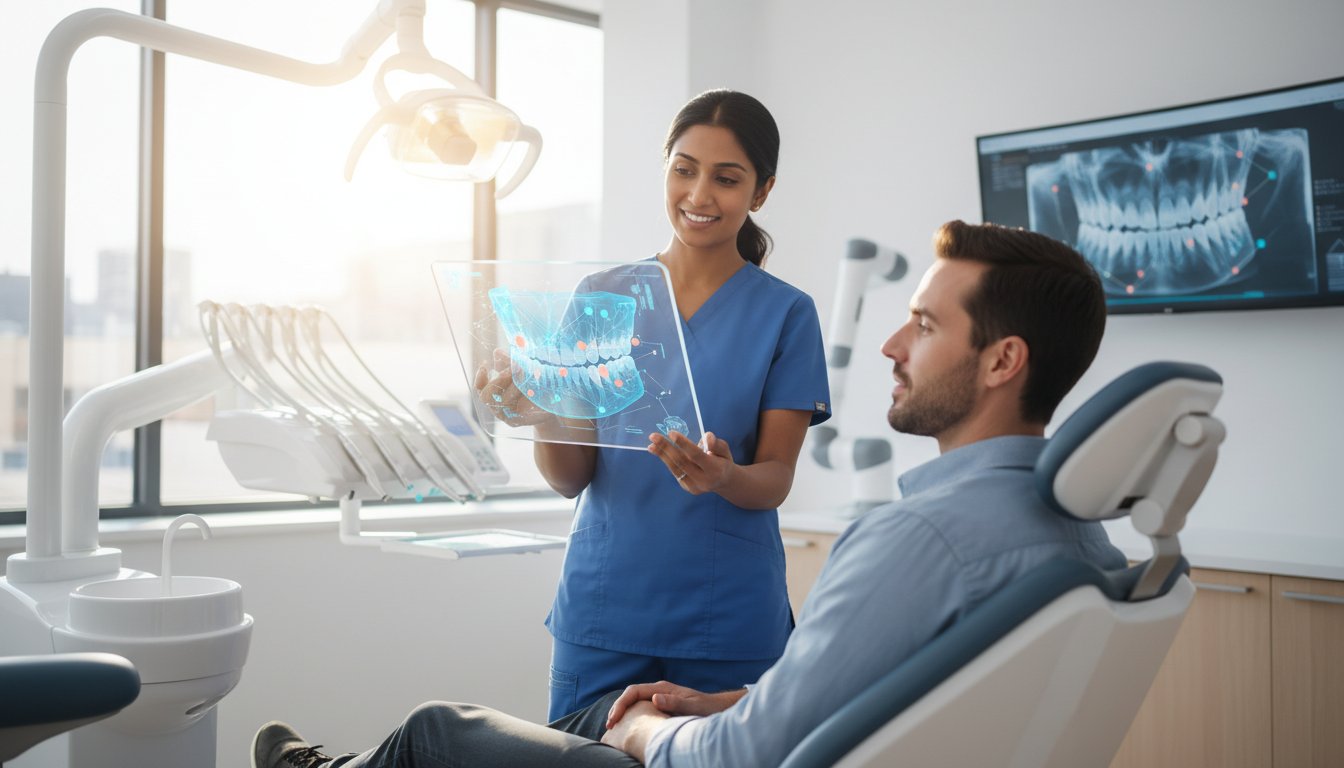
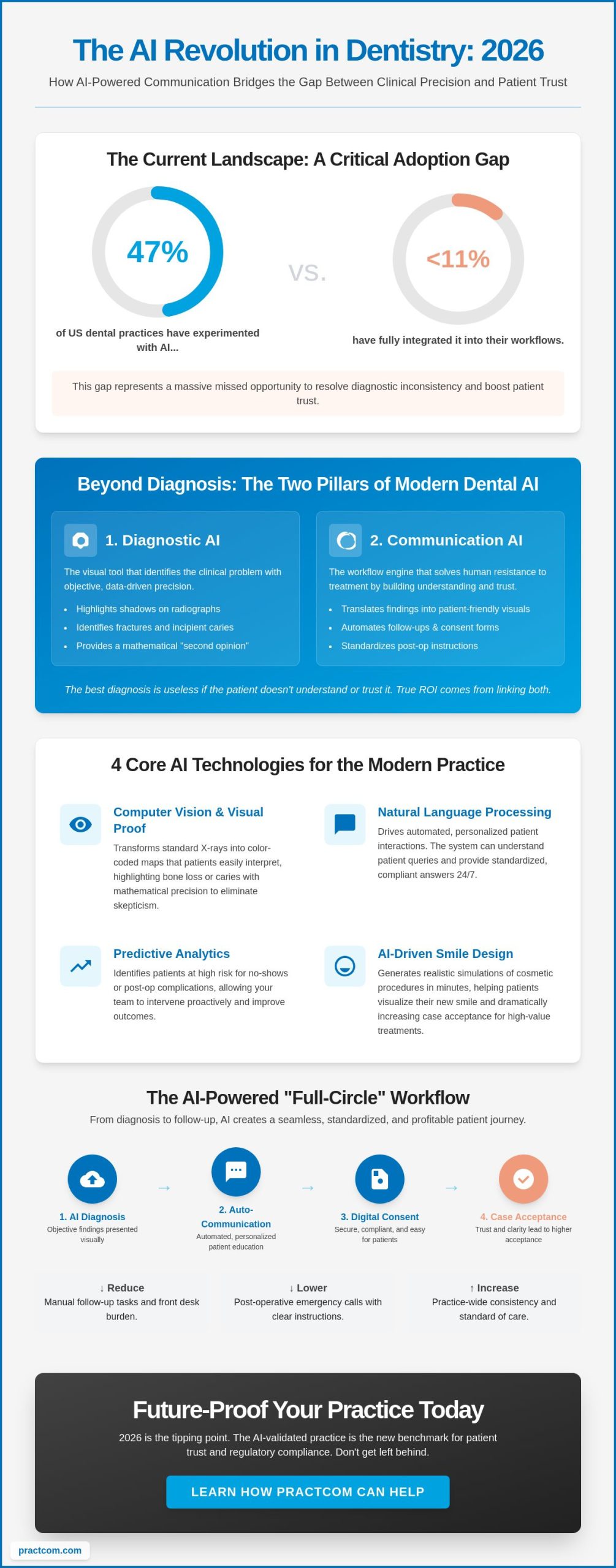
According to a 2025 American Dental Association survey, over 47% of US dental practices have experimented with AI, yet fewer than 11% have fully integrated it into their clinical or operational workflows. This gap represents a missed opportunity to solve the diagnostic inconsistency and patient skepticism that often stalls practice growth. Implementing ai in dental patient communication isn’t just about modernizing your tech stack; it’s about building an ethical bridge between clinical precision and patient trust. You’ve likely felt the frustration of a patient questioning a high-cost treatment plan because your associate’s assessment didn’t perfectly align with yours.
We understand that the manual burden of follow-up tasks often leaves your front desk overwhelmed and your post-op protocols inconsistent. This guide will show you how to integrate AI diagnostic precision with automated communication to skyrocket case acceptance and patient trust in 2026. You’ll learn how to standardize documentation across your practice, reduce post-op emergency calls with automated instruction libraries, and use digital informed consent to protect your reputation. We’ll explore the shift toward systems that save hours of clinical time while keeping your practice fully compliant with the latest 2026 regulations.
Key Takeaways
- Learn why 2026 marks the shift from AI as an optional novelty to a baseline requirement for clinical transparency and patient trust.
- Discover how implementing ai in dental patient communication transforms complex clinical data into visual, patient-friendly maps that eliminate treatment skepticism.
- Bridge the “last mile” of care by automatically linking AI-detected findings to standardized post-treatment instructions and digital consent forms.
- Calculate the true ROI of automation by measuring significant reductions in manual follow-up tasks and post-operative emergency calls.
- Establish a standardized “full-circle” workflow that ensures consistent documentation and a uniform standard of care across every operatory.
The Landscape of AI in Dental Patient Communication for 2026
In 2026, ai in dental patient communication is defined by the sophisticated integration of machine learning and Natural Language Processing (NLP) to create highly personalized patient interactions. This technology is no longer an optional luxury for high-end boutique practices; it’s a foundational requirement for clinical transparency. While artificial intelligence in healthcare has historically focused on backend diagnostics, the modern dental practice uses it to humanize the clinical experience. It serves as a stabilizing force in high-pressure environments by providing an objective, data-driven “second opinion” that both the clinician and the patient can rely on. It bridges the gap between technical precision and administrative warmth.
It’s essential to distinguish between diagnostic AI and communication AI. Diagnostic AI is the visual tool that identifies a suspicious shadow on a radiograph or a fracture in a molar. Communication AI is the workflow engine that takes that clinical finding and translates it into a digital consent form, a text message, or an automated follow-up. One identifies the problem; the other solves the human resistance to treatment. By 2026, the industry has realized that the best diagnosis in the world is useless if the patient doesn’t understand it or trust the person delivering it.
From Diagnostic Tools to Communication Ecosystems
Identifying a pathology is only 50% of the battle. The remaining 50% depends entirely on the patient’s willingness to accept the treatment plan. AI bridges this gap by turning complex gray-scale data into a narrative the patient can actually understand. This transition reduces the administrative resistance that often plagues the front desk. Instead of your staff spending hours drafting manual updates or chasing patients for signatures, the system handles the documentation automatically. This ensures that every clinical finding is met with a standardized, professional response that protects your practice’s legal standing while saving precious time.
Why 2026 is the Tipping Point for AI Adoption
Patients are more tech-savvy than ever. They don’t just want to be told they have a cavity; they want to see the objective evidence presented in a clear, digital format. Regulatory standards in 2026 have also evolved, placing a higher premium on clear, consistent documentation that proves informed consent was obtained. AI provides the regulatory reassurance you need by creating a permanent, unalterable trail of communication. This shift moves your practice from a model of “manual memory” to one of “systematic oversight.”
The AI-validated practice is the new benchmark for trust. By removing the “he-said, she-said” dynamic between associates and patients, you create a culture of clinical certainty. Understanding why practices choose PractCom for this essential communication layer is the first step toward future-proofing your reputation and ensuring every patient leaves with a clear understanding of their care.
Core AI Technologies Shaping the Modern Patient Experience
The transition toward ai in dental patient communication is driven by four primary technological pillars: Computer Vision, Natural Language Processing (NLP), Predictive Analytics, and AI-driven Smile Design. Each of these tools serves a specific purpose in reducing operational friction and increasing clinical clarity. In a high-pressure practice, these aren’t just features. They’re essential business requirements that ensure your patients feel seen, heard, and clinically secure. By automating the data-heavy aspects of the patient journey, you allow your team to focus on the human elements of care that technology cannot replicate.
Computer Vision and Visual Proof
Computer Vision is perhaps the most visible advancement in 2026. It transforms standard gray-scale X-rays into color-coded maps that patients can easily interpret. This technology overlays objective data on top of clinical images, highlighting bone loss or incipient caries with mathematical precision. Research from Harvard Medical School suggests that AI tools for patient motivation are highly effective because they provide a visual “second opinion” that validates the dentist’s recommendation.
This creates a significant psychological shift. The conversation moves from “The dentist says I need this crown” to “The data shows I need this crown.” When patients see color-coded proof of their oral health status, skepticism vanishes. This is particularly vital when explaining complex dental technology trends to laypeople who may be overwhelmed by clinical jargon. Visual proof leads directly to higher case acceptance rates because it removes the ambiguity from the diagnostic process.
Predictive Follow-ups and Patient Sentiment
Natural Language Processing (NLP) allows your practice to maintain administrative warmth while automating repetitive inquiries. Modern NLP systems monitor patient sentiment during text or email interactions. If a patient’s response indicates confusion or anxiety after a procedure, the system can flag the interaction for immediate human intervention. This prevents minor concerns from escalating into emergency phone calls or negative reviews.
Automated follow-ups are now intelligent enough to adjust based on procedure complexity. A routine cleaning might trigger a simple “How are you feeling?” text, while a multi-unit bridge prep triggers a sequence of detailed post-operative instructions. This intelligent routing reduces the burden on front-desk staff by filtering out routine questions that the system can answer with 99% accuracy. You can explore how automation stabilizes your workflow by reviewing our comprehensive communication platform.
Finally, AI-driven Smile Design serves as a powerful motivator for cosmetic interest. By showing patients a realistic “before and after” of their own smile during a routine exam, you move them from the middle of the funnel to active treatment interest. It turns a hypothetical outcome into a tangible goal, making the investment feel immediate and personal.
Bridging the Gap: Translating AI Diagnostics into Patient Compliance
The most sophisticated diagnostic tools in the world are meaningless if the patient walks out of your operatory confused. While diagnostic AI identifies pathologies with incredible accuracy, the “Last Mile” of the patient journey is where most practices lose momentum. If you don’t bridge the gap between a high-tech diagnosis and a clear path to recovery, you risk treatment rejection or poor post-operative compliance. True ai in dental patient communication requires a seamless handoff from the digital finding to the patient’s smartphone. This is where automation transforms a clinical observation into a completed treatment and a satisfied patient.
Linking AI-detected findings directly to automated dental post-op instructions ensures that patients receive the exact information they need the moment they leave your chair. This isn’t just about convenience; it’s about psychological security. When a patient sees a color-coded map of their bone loss and immediately receives a digital informed consent form, the professional standard of your practice is solidified. You move from a reactive model to a proactive documentation system that protects your reputation and your legal standing. Standardizing this journey ensures that every patient receives the same high-level care, regardless of which associate is in the operatory.
The Psychology of AI-Verified Treatment Acceptance
Patients often feel a natural skepticism when a dentist recommends a high-cost procedure. They sometimes perceive the clinician as a salesperson rather than a healthcare provider. Objective data changes this dynamic. By improving patient understanding with AI, you remove the subjective element of the diagnosis. You aren’t just giving an opinion. You’re presenting a verified clinical reality. This transparency builds a level of trust that manual explanations simply cannot match. It establishes a consistent, high-quality communication loop that fosters long-term loyalty and higher case acceptance rates.
Standardizing Aftercare for AI-Detected Procedures
Consistency is the primary defense against liability. When your practice uses a system that automatically triggers a standardized, multi-language post-op text based on AI findings, you eliminate the risk of human error. Using PractCom’s Post-Treatment Instruction Library provides the necessary structure to support these AI findings. Some industry professionals report that proactive, automated education can significantly reduce emergency calls for issues like dry socket or post-operative pain. By providing clear, accessible instructions in the patient’s preferred language, you ensure they feel supported long after they’ve left the office. This standardized approach ensures that ai in dental patient communication serves as both a clinical and an administrative safety net.
Operationalizing AI: ROI and Workflow Integration for Practices
Operationalizing ai in dental patient communication is where clinical theory meets business reality. For many practice owners, the initial appeal of AI is diagnostic accuracy, yet the true return on investment (ROI) often lies in the reduction of administrative friction. Research indicates that AI-powered charting and communication can save dentists between 2 to 3 hours per day on clinical documentation. This isn’t just a minor convenience; it’s a structural shift that allows your team to focus on high-value patient interactions rather than manual data entry. To see these results, your AI must “talk” to your communication suite, ensuring that every finding is instantly documented and shared with the patient. Understanding how dental patient communication technology is evolving from basic reminders into comprehensive clinical documentation suites is essential for practices looking to stay ahead of these operational demands.
Clinical consistency is another major driver for adoption, particularly within Dental Support Organizations (DSOs). When you have multiple associates across different locations, diagnostic standards can vary. AI serves as a stabilizing support system that mitigates “diagnostic fatigue,” especially during the final hours of a high-pressure clinical day. It ensures that a cavity detected at 8:00 AM is treated with the same precision as one found at 4:30 PM. This uniformity protects your practice’s reputation and ensures every patient receives a standardized level of care regardless of which clinician they see. Practices evaluating their communication stack often compare dedicated platforms against all-in-one solutions; understanding how Weave for dental fits into a unified communication hub can help you make a more informed decision about which tools best support your AI-driven workflow.
Measuring the Impact on Case Acceptance
Tracking the delta in acceptance rates is the most direct way to measure AI’s impact. By using visual overlays and color-coded proof, you remove the subjective nature of treatment planning. You can monitor these clinical trends through the Practice Performance Dashboard, which provides a clear view of how automation affects your bottom line. Additionally, automated follow-ups play a critical role in recapturing “lost” patients who didn’t book chair-side. These systems send personalized reminders and education, ensuring that treatment recommendations don’t simply disappear once the patient leaves the office.
Mitigating Liability with AI-Driven Documentation
Documentation is your primary defense against regulatory scrutiny. In 2026, the legal importance of matching AI findings with signed digital informed consent forms cannot be overstated. Standardizing your risk disclosure through digital documentation serves as a pre-emptive strike against administrative failures and potential malpractice claims. When the system automatically pairs a diagnostic finding with the appropriate consent form and post-treatment instructions, you create an unalterable trail of professional care. This level of systematic oversight provides the psychological security every practice owner needs to operate with confidence.
If you’re ready to move from operational disorganization to systematic control, you can start your free trial of PractCom today and experience a fully integrated communication ecosystem.
Future-Proofing Your Practice with PractCom and AI
Future-proofing your practice in 2026 requires more than just high-tech diagnostic sensors. It demands a “Full-Circle” workflow where clinical findings move instantly into a secure communication loop. This ecosystem begins with an AI Diagnosis, transitions into Digital Informed Consent, and culminates in Standardized Aftercare. While diagnostic tools identify the clinical need, PractCom serves as the essential communication layer that ensures those findings lead to completed treatment. Without this layer, the data remains trapped in your imaging software, failing to reach the patient in a way that drives action or compliance. Implementing ai in dental patient communication means closing the loop between what you see and what the patient understands.
To begin this transition, you should perform an audit of your current “Diagnostic-to-Post-Op” friction points. Identify where treatment plans stall or where post-operative confusion leads to avoidable phone calls. Often, the breakdown occurs because the clinical data isn’t translated into a format the patient can review at home. By centralizing your communication, you move from a disjointed manual process to a systematic oversight model that protects your time and your reputation. PractCom provides the stabilizing force needed to manage these high-pressure administrative tasks with technical precision.
Creating a Seamless Diagnosis-to-Consent Workflow
Integrating AI findings into Digital Informed Consent Forms allows for immediate patient signatures while the clinical need is still fresh in their mind. You can use SMS and Email to deliver these AI-justified treatment plans for home review, allowing patients to consult with family members using objective visual proof. Security remains a top priority; ensuring HIPAA compliance is non-negotiable. As of 2026, any tool handling Protected Health Information must have a signed Business Associate Agreement in place. PractCom manages this regulatory burden, providing the encrypted infrastructure necessary to share AI-generated diagnostic images without risking unauthorized disclosure.
The Role of Multi-Language Support
In a national US market, multi-language support is a baseline requirement for clinical safety. AI diagnostics must be followed by instructions the patient can actually read and follow. Bridging the gap between technical AI data and general patient understanding requires delivering documents in the patient’s preferred tongue. PractCom provides Email and Text for all documents in 15 languages, ensuring that technical precision isn’t lost in translation. This level of inclusivity reduces operational resistance and ensures that your practice remains accessible to a diverse patient base. If you’re ready to eliminate administrative failures, you can optimize your clinical workflow with PractCom today.
Securing Your Practice’s Future with Systematic Control
The transition to an AI-validated practice is no longer a futuristic concept; it’s a baseline requirement for clinical trust in 2026. By integrating ai in dental patient communication, you replace operational disorganization with a standardized ecosystem that protects your reputation and your time. You’ve seen how visual proof drives case acceptance and how automated workflows recapture lost treatment opportunities. Now is the time to bridge the final gap between high-tech diagnostics and frictionless patient aftercare. This systematic approach ensures that your clinical expertise is always matched by administrative excellence.
Our platform supports this shift with more than 80 standardized post-treatment templates and multi-language support in 15 languages. These tools work together to provide digital informed consent and seamless referral management, creating a protective shield around your practice’s legal standing. You don’t have to manage the stress of manual follow-ups alone. Streamline your clinical communication-Start here with PractCom. Take the first step toward a more organized, protective, and profitable practice today. Your team and your patients deserve the confidence that only a standardized system can provide.
Frequently Asked Questions
How does AI actually improve patient communication in a dental office?
AI improves communication by translating complex clinical data into visual, color-coded maps that patients can easily understand. It uses Natural Language Processing to automate routine inquiries while maintaining administrative warmth. This ensures that ai in dental patient communication provides a consistent, high-quality experience that reduces the manual burden on your front desk staff.
Is AI in dental diagnostics HIPAA compliant for patient sharing?
AI tools are HIPAA compliant only when a signed Business Associate Agreement (BAA) is in place between the practice and the software provider. As of 2026, standard SMS messaging is not inherently compliant. You must use encrypted platforms with strict access controls to share Protected Health Information (PHI) and diagnostic images safely with your patients.
What is the role of the DentalX AI company in 2026?
Companies in the diagnostic AI space provide the clinical “second opinion” that identifies pathologies like bone loss or caries with mathematical precision. In the 2026 landscape, these firms act as the diagnostic engine that feeds data into your communication layer. This allows practices to present objective evidence that validates treatment recommendations and builds immediate patient trust.
Can AI help increase my practice’s treatment case acceptance rate?
AI significantly increases case acceptance by providing visual proof that removes the “salesperson” stigma from the diagnostic process. When patients see color-coded evidence of their clinical needs, they are more likely to prioritize care. Additionally, AI-powered scheduling and communication tools can reduce no-show rates by 20% to 40% according to industry data published in May 2026.
Do I need a full Practice Management Software (PMS) to use AI communication tools?
You don’t need to replace your entire PMS to implement advanced communication tools. PractCom is an all-in-one patient communication platform that functions as the essential layer between your diagnostic AI and the patient. It handles the “last mile” of care, including digital informed consent and automated follow-ups, without requiring a full software overhaul.
How do patients typically react to AI-analyzed dental images?
Patient acceptance of AI is generally high for both administrative and clinical tasks because it provides transparency. Patients respond positively when they are aware they are interacting with an AI tool, provided they have a clear path to human contact. Visual simulations and color-coded overlays make the treatment plan feel more tangible and less intimidating.
Does AI replace the need for dental staff to explain procedures?
AI doesn’t replace your staff; it transforms their role by freeing them from repetitive manual tasks. By automating the delivery of post-treatment instructions and clinical justifications, your team can focus on high-value patient interactions. This shift allows clinicians to spend more time on complex decision-making and empathetic patient care rather than routine documentation.
What are the costs associated with implementing AI communication in 2026?
The investment for implementing ai in dental patient communication varies based on the size of the practice and the complexity of the integrated systems. First-year costs for a solo practice typically depend on whether you are opting for standalone services or bundled “AI workforce” packages. These packages often cover clinical scribing, insurance verification, and patient retention as a coordinated ecosystem.

Article by
Cary Ganz DDS
Dr. Cary H. Ganz is a dentist, prosthodontist, entrepreneur, lecturer, and author with more than 50 years of experience in clinical dentistry and dental technology. Throughout his career, he has combined hands-on patient care with a deep understanding of how technology can improve dental practice operations, communication, documentation, and patient outcomes.
In addition to his clinical background, Dr. Ganz has held significant leadership roles in the dental technology industry, including Past Owner and Vice President of Clinical Affairs at DEXIS Digital Radiography and Past Vice President of Clinical Affairs at Denticon Practice Management Software. His business experience includes product development, clinical strategy, dental software innovation, practice management solutions, and educating dental professionals on the effective use of technology in modern dentistry.
Today, Dr. Ganz continues to focus on creating practical technology solutions for dental practices, including PractCom, a comprehensive dental practice communication platform designed to improve patient communication, documentation, compliance support, referrals, and overall practice efficiency. His work reflects a career-long commitment to helping dentists deliver better care while making their practices more organized, efficient, and protected.
No responses yet